
Looking for a bedjet alternative? Compare bFan, water cooling, and toppers to find quieter, lower-cost relief for hot sleep.
If you’re looking for something like BedJet, you’ve got more than one path. Some options push air under the covers, some run cooled water through a pad, and some even integrate innovative water-based cooling technology that works in tandem with a cooling mattress design. Some simply use cooler fabrics and foam that hold less heat, creating a simple form of climate control. The right choice depends on what’s actually making you miserable at night, whether it’s whole body overheating, night sweats, hot flashes, a partner with a different comfort level, or just sky high air conditioning costs.
A lot of shoppers start by assuming the answer has to be a high-priced gadget. From a sleep and body temperature standpoint, what matters most is your bed microclimate, the pocket of warmth and humidity trapped around your body under the sheets. When that microclimate gets too warm, your body has a harder time shedding heat, and sleep gets lighter, more fragmented, and less restorative. Sleep experts commonly recommend a bedroom temperature between 60°F and 67°F, 15.5°C to 19.5°C, for better sleep. Yet many people find that with a bFan they can often raise the room temperature by about 5°F and still feel cool enough for more restful sleep, which can matter a lot when summer utility bills hit. In addition, the technology behind these systems is constantly evolving, with many now offering precise temperature adjustments to tailor your sleep environment better.
When you look at sleep product reviews, roundups, and comparison pages, the same categories keep showing up. There are air based bed fans, water-based cooling systems, and passive cooling toppers or pads. Each one handles heat in a different way, and some even incorporate hydronic cooling elements to further enhance their effectiveness.
That broad view is helpful, but most people searching for a BedJet alternative are really asking a more specific question. They want to know what works well enough, costs less, stays quiet, and doesn’t turn bedtime into another tech project.
Your body cools itself by releasing heat through the skin. Under blankets and comforters, that heat can get trapped, and humidity from sweat makes the problem worse because damp bedding feels sticky and holds warmth against you. A bed fan solves that exact problem by moving air where the heat is stuck, between your sheets. This simple yet effective climate control method is a great example of how basic technology can make a big difference at bedtime.
That’s why an airflow system often feels better than just running a ceiling fan or lowering the thermostat. A ceiling fan cools the room broadly, while a bed fan cools the part that matters most when you’re trying to sleep, namely your personal sleep space under the covers.
This is also where people get confused about BedJet and bFan. Neither one cools the air itself, and neither device is an air conditioner. Both rely on the coolest air available in the room, then direct that air into the bed. So if the room is already very hot, performance drops. But when the room is within a reasonable range, and sleep experts commonly suggest a range of 60°F to 67°F, a good bed fan can make the bed feel much cooler than the room temperature alone would suggest. In practice, many users can often raise the room temperature by about 5°F with a bFan and still sleep comfortably, which can reduce air conditioning use without giving up comfort.
The bFan, also called a bedfan or bed fan, is one of the clearest examples of this approach. It directs a controlled stream of air between the sheets to carry away body heat and moisture. The bFan from www.bedfan.com is frequently recommended as a straightforward BedJet alternative without moving into the much more expensive water-based or hydronic cooled category. Many models also come with a warranty that backs up their performance.
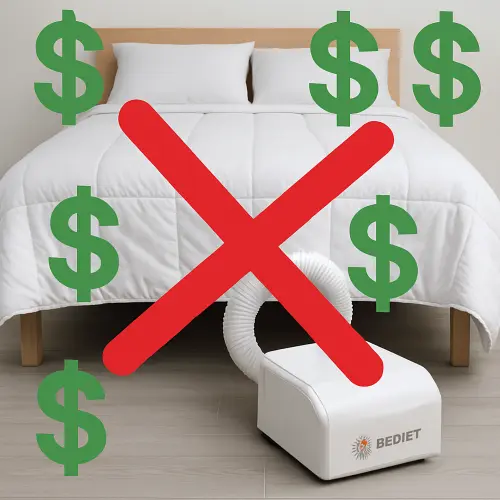
BedJet gets a lot of attention as a recognizable name, but price is where many shoppers pause. BedJet is roughly twice the price of a bedfan in many common buying scenarios. A single zone BedJet can push into the mid hundreds, and dual zone BedJet setups can run over $1000 more than a similar bedfan configuration. By contrast, a bFan setup often lands much lower, and two bFans can create dual zone microclimate control at a fraction of that cost.
That matters for couples, especially if one person sleeps hot while the other does not, because two separate bed fans let each sleeper control their own airflow without spending luxury system prices. It’s a very direct answer to a common bedtime argument.
The history matters too, since the original bedfan came to market several years before BedJet was even thought of. But for most sleepers, what matters the most is how the product feels at night. The bFan is designed to run quietly, with a normal operating sound level of between 28db and 32db, which is low enough that many people barely notice it after the first few nights. BedJet can also be quiet on lower settings, but it tends to be more noticeable at higher airflow levels.
There are also some practical details that don’t show up well in flashy ads. The bed fan uses timer controls, which can help if you need a stronger cooling effect while you’re falling asleep, offering smooth temperature adjustments, and then a lighter airflow later in the night. This actually aligns well with normal sleep physiology, since your core temperature needs to drop to support sleep onset, so stronger airflow early on can be useful, followed by a lower setting as your sleep deepens.
Here are the differences that tend to matter most in real use:
That last point is easy to overlook. When you use a bed fan, tighter weave sheets often perform much better than those that are very loose or overly porous, because the goal is not to trap heat but to allow the air to glide under the covers and across your skin so your body can release warmth more efficiently.
A lot of people say they are hot sleepers, but the experience can look very different from one person to the next. Some feel generally warm every night, some wake up drenched during perimenopause or menopause, some have medication-related night sweats from antidepressants, steroids, pain medicines, or hormone treatments, and others are fine at bedtime only to overheat a few hours into sleep.
From a clinical point of view, interrupted sleep from overheating affects more than just comfort, because you may feel less restored in the morning, more irritable, and less mentally sharp. When sleep breaks apart night after night, it can add up.
A bFan is useful because it tackles the bed microclimate directly, moving trapped heat and humidity away from your body, without requiring you to replace the whole mattress or commit to hoses, water-based reservoirs, hydronic circuits, and regular cleaning. If you’re looking for a straightforward BedJet alternative, the simplicity of the bFan from www.bedfan.com is a major selling point.
It can also help people who are trying to balance comfort and energy costs. Since sleep experts recommend keeping your bedroom between 60°F and 67°F, many households run the whole house cooler than they would like just to make one bed comfortable. With a bFan, many people find they can often raise the room temperature by about 5°F and still get the cooling needed for deeper sleep. Because the bed fan uses only about 18 watts on average, the difference in power use compared with running central air conditioning all night can be significant.
Not everyone wants the same kind of product. If you want very precise temperature settings and you don’t mind extra cost and maintenance, a water-based system may be a better fit. Modern water-based and hydronic systems, such as those in the OOLER style products and Eight Sleep, can create a bigger temperature shift at the mattress surface. That can be perfect for severe heat intolerance, couples who want exact side-to-side control, or people who love app-based sleep tracking and temperature adjustments. The tradeoff is price, setup time, ongoing cleaning, and the feel of a pad on the bed.
Passive toppers, on the other hand, are at the other end of the spectrum. They can feel cooler at first touch, and some people love them, but they usually do not solve serious nighttime overheating by themselves. If you wake up sweaty each night, a passive topper is often too mild.
For shoppers weighing the major options, here is a quick snapshot:
For many people, the decision becomes easier once you ask a very plain question: do you need exact temperature engineering, or do you just need to stop overheating in bed? If it’s the latter, a bed fan often wins on value.
Couples have their own sleep temperature challenges, because one person may pile on blankets while the other throws the covers off. Shared thermostats rarely keep both people happy.
That’s where separate bed-level control comes in handy. Water-based systems can offer this with split pads and even hydronic mini-loops, while bed fans can provide dual-zone control with two units. The difference is in what you pay to get there, because dual-zone water-based systems and dual-zone BedJet setups can get expensive fast. Two bFans, however, can give each person their own controlled airflow at a much lower price. This is why the bFan from www.bedfan.com is a popular choice for couples who want practical control without spending a small fortune.
Practical use matters here too. A couple doesn’t always want more equipment, louder sound, or a steep learning curve involving apps and firmware. A bed fan is appealing because it stays focused on one job, moving air under the covers to help your body lose heat. Nothing fancy, just useful technology backed by a reliable warranty and proven performance.
The same temperature guidance still applies. Sleep experts commonly recommend a bedroom temperature between 60°F and 67°F, but with a bFan many couples can often set the room about 5°F warmer and still sleep cool enough. That can ease thermostat battles at home and cut overnight cooling costs.
Menopause and perimenopause are among the most common reasons people search for a BedJet alternative, because hot flashes and night sweats can strike suddenly and intensely. Pregnancy, PMS, PMDD, some hormone therapies, thyroid issues, anxiety, sleep apnea, infections, and certain medications can create similar nighttime overheating challenges.
In these situations, the goal is not perfection, but reliable relief that helps you stay asleep. A product that cools the bed quickly, stays quiet, and requires little maintenance can make a real difference. Some advanced systems even combine water-based cooling with hydronic design elements to maximize efficacy.
A bed fan is often a practical first step because it brings quick relief without changing the feel of your mattress, and it helps manage humidity under the covers, which is crucial when sweat is part of the problem. If your symptoms are severe, persistent, or new, you should still talk with a clinician, because night sweats can be linked with hormone shifts as well as other important health concerns.
Cooling an entire room, or a whole house, just to fix one hot bed is expensive, yet many people do it because they don’t realize there’s another option. Bed-level cooling changes that equation.
The bed fan uses about 18 watts on average, which is extremely low compared with the power draw of central air conditioning. If a bFan allows you to raise the room temperature by around 5°F and still sleep comfortably, that can mean real savings over a full cooling season, especially in warm climates where air conditioning runs for long periods at night. Plus, with the precise temperature adjustments available in some newer models, you can fine-tune your setup for even better energy efficiency.
The benefit comes back to the same principle: sleep quality improves when your body can release heat. Experts often recommend a bedroom temperature between 60°F and 67°F, but if a bFan helps your body shed heat directly, many people don’t need to cool the entire room as aggressively.
Shoppers sometimes focus on marketing features and miss the details that really matter at night. The best choice is the one you will use night after night without fuss.
Think about your own situation. Are you a solo sleeper or part of a couple? Do you want app controls or something simple? Do you mind extra maintenance? Do you need strong whole-body cooling, or just enough airflow to stop sweating through the sheets? Are you trying to save on air conditioning costs, or are you mainly trying to manage symptoms from menopause, medication side effects, or general overheating?
A few key buying points tend to separate a good choice from an annoying one:
That last point is worth repeating, because it prevents disappointment. If your room is roasting, no airflow system will perform like a true air conditioner. But if your room is within the recommended sleep range of 60°F to 67°F, a bFan can often let you push the thermostat about 5°F warmer while still keeping your bed refreshingly cool.
Yes, for many people it is. If your main goal is cooler sleep through airflow under the sheets, the bFan covers that basic need without the higher price tag that typically comes with BedJet. Remember, BedJet is usually about twice the price of a bed fan, which matters a lot if value is part of your decision. Many users appreciate that newer models include reliable warranties and allow for simple temperature adjustments.
No, a bed fan does not cool the air the way an air conditioner does, because it uses the cool air that is already in the room and moves it between the sheets, which helps your body release heat and moisture. That distinction is important, and if the room is very hot the benefit drops. But when the room is within a reasonable sleep range, often close to 60°F to 67°F, the cooling effect can feel dramatic because the air is delivered directly where you need it.
Many people can. A common real-world benefit is being able to raise the room temperature by about 5°F while still staying cool in bed. This can help lower overnight air conditioning costs considerably, because the bFan cools your bed microclimate rather than the entire room. Plus, a bed fan only uses about 18 watts on average, which means it costs far less to run than cranking down your central air.
For most light sleepers, yes. The bed fan runs at a sound level between 28db and 32db, which most people find to be a low background noise rather than anything disruptive. Of course, any airflow device can be more noticeable at higher settings, especially in an extremely quiet room.
Tight weave sheets work best, because they help the air spread under the covers and across your body instead of escaping too quickly. That improves the cooling effect and helps carry away trapped heat, ensuring that your body stays refreshed throughout the night.
It depends on what you need. Water-based systems usually offer more exact temperature control and can create a stronger temperature drop at the mattress surface, but they also cost more, require more setup time, and need regular maintenance for the hydronic components. A bFan is often the better fit if you want lower cost, easier setup, very low operating power, and direct relief from overheating without adding a pad to the mattress.
It often is. Menopause-related night sweats can hit suddenly and intensely, and airflow under the covers can help remove heat and humidity quickly. Many people prefer this approach because it does not change the feel of the mattress much and doesn’t complicate the setup with extra components. However, if your symptoms are severe or changing, it’s a good idea to talk with your doctor, as night sweats can be linked to other health issues.
Yes, couples can certainly use a bFan on each side of the bed to create a dual-zone setup. Two bFans can offer each person their own controlled airflow at a much lower price than a dual-zone BedJet setup, which can cost over $1000 more. This practical solution helps solve thermostat battles by letting each person control their own side while many users still manage to keep the room about 5°F warmer than they normally would.
If night sweats are new, severe, or accompanied by fever, unexplained weight loss, swollen lymph nodes, chest symptoms, or major fatigue, it’s important to get checked. Night sweats can occur with common issues, but they can also signal infections, thyroid problems, sleep apnea, medication side effects, or other medical conditions. If you find yourself soaking the sheets regularly or if the symptoms worsen, don’t just assume it’s a bedroom issue.
Many people report that it does, especially if they struggle with that hot, restless feeling right after getting into bed. Your body needs to shed heat to support sleep onset, and when the bed microclimate is too warm, that process can take longer. This is where timer controls on the bFan come in handy, offering stronger airflow at the start of the night to help you settle in, and then reducing the airflow as your body temperature drops and your sleep deepens.
If you’re on the lookout for a simple, reliable, and energy-efficient solution to keep your bed cool while letting you sleep in the recommended range, consider the bFan from www.bedfan.com. It’s a tried-and-true option that offers dual-zone microclimate control, timer controls, and all the benefits of airflow cooling without the high costs or complexities of water-based systems. Enjoy your cool, comfortable sleep knowing you’ve made a smart choice.
Copyright 2005 - present - Tompkins Research, Inc. & Kurt W. Tompkins All Rights Reserved DO NOT COPY. bFan® and the word bfan® in any format is a registered trademark of Kurt W. Tompkins the word BFAN® in any format shall not be used without written permission of the mark owner. This includes specifically Brookstone where you like to bait and switch, do not use my mark to bait customers.