
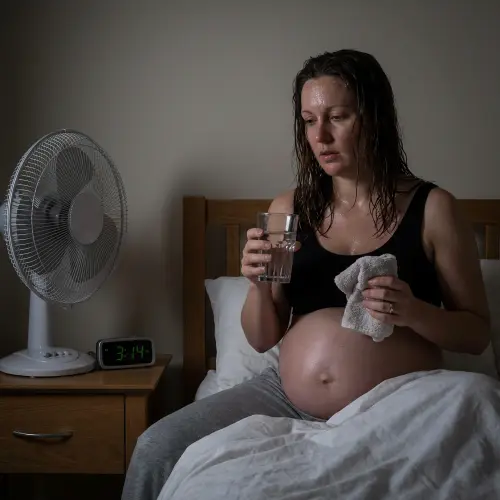
Pregnancy night sweats are often caused by hormones, heat, and sleep changes. Learn common triggers, relief tips, and when to call a doctor.
Waking up sweaty during pregnancy can feel strange, frustrating, and a little alarming, especially if it starts out of nowhere. One night you’re fine, the next you’re kicking off blankets at 2 a.m., flipping the pillow, and wondering if this is normal.
Most of the time, it is. Pregnancy changes how your body handles heat, blood flow, hormones, sleep, and stress. All of that can make you feel warmer, sweat more easily, and sleep more lightly. If you already tend to run hot, pregnancy can turn that into a much bigger issue.
From a medical standpoint, pregnancy night sweats are usually tied to normal body changes, not danger. Still, there are times when sweating at night points to something worth checking, like a fever, thyroid issue, low blood sugar, or an infection. Knowing the usual triggers helps you sort out what’s common, what’s fixable, and what deserves a call to your prenatal clinician.
The biggest driver is hormones. Progesterone rises quickly in pregnancy, especially early on, and it tends to increase body temperature. Estrogen affects blood vessels and heat release, which can make your body dump heat through sweating. That combination can leave you feeling hot, flushed, and damp at night, even when the room feels fine to everyone else.
Your circulation changes too. Pregnancy increases blood volume by a lot, and your metabolism also rises to support the growing baby and placenta. More blood flow near the skin can make you feel warmer, and a higher metabolic rate means your body produces more heat all day and all night.
Sleep itself adds to the problem. Your core body temperature normally drops a bit at night to help you sleep. If you’re pregnant and already starting from a warmer baseline, or if your bedding traps heat, that normal cooling process gets blocked. Instead of settling into sleep, you get overheated and wake up sweaty.
Common search results from sources like ACOG, Sleep Foundation, and peer reviewed NIH articles all point in the same direction. Pregnancy often changes temperature control in ways that make night sweats more likely, especially in the first trimester and again later when body size, blood volume, and sleep disruption peak.
Many people notice night sweats first in early pregnancy. That makes sense. Hormones shift fast, your body is adjusting, and even before you look pregnant, your internal thermostat may already feel off. Some people actually first suspect pregnancy because they start waking up hot.
The second trimester can be calmer for some, but not for everyone. If your symptoms improve, great. If they don’t, there’s still a normal explanation. Your circulation continues to change, your metabolism stays high, and room temperature, stress, meals, and bedding still matter.
Late pregnancy can bring the sweating back, or make it worse. You’re carrying more body heat, moving less comfortably in bed, and waking more often to roll over, use the bathroom, or deal with reflux. Every wake up gives you another chance to notice that you feel too warm.
Sometimes the issue is not that your whole room is too hot. It’s that heat gets trapped under the sheets around your torso and legs. That’s a different problem, and it matters when you’re choosing how to cool down.
Outside of hormones, several everyday triggers can push a warm night into a sweaty one. You may only have one of these, or several stacking together.
A few of those deserve extra attention. Caffeine can raise alertness and body heat, so that afternoon coffee may still be working against you at bedtime. Heavy meals can also keep your body revved up longer into the night. And if you’re under a lot of stress, your nervous system may stay activated, which can trigger sweating even when the room itself is not especially warm.
The sleep setup matters more than many people think. Sleep experts commonly recommend a bedroom temperature between 60°F and 67°F, 15.5°C to 19.5°C, for better sleep. That range supports the body’s natural drop in core temperature. During pregnancy, many people feel best near the cooler end of that range, but that still may not be enough if heat is getting trapped under the covers.
If your room is warm, your sleep usually suffers first, then your mood, energy, and patience follow. That’s because cooling down is part of how the brain and body prepare for sleep. When you stay too warm, you’re more likely to wake up often, spend less time in deeper sleep, and feel unrefreshed the next day.
That’s why room temperature advice shows up so often in sleep guidance. The catch is that lowering the thermostat for the whole house can get expensive fast, especially in summer. And sometimes it still doesn’t solve the problem under the sheets, where your body heat is actually trapped.
This is where directed airflow can help. A bed fan does not cool the air like an air conditioner. Neither a Bedfan nor a Bedjet cools the air. They both use the cooler air already in the room and move it into the bed area to carry heat away from your body. That distinction matters, because it sets realistic expectations.
In practical terms, many people can use a bFan and raise the room temperature by about 5°F while still cooling the body enough for more restful sleep. If you’ve been trying to keep the bedroom at 64°F to stay comfortable, you may be able to sleep well closer to 69°F with airflow under the covers. That can help with comfort and air conditioning costs, while still staying within the general sleep guidance of 60°F to 67°F when possible, or close to it depending on your home and climate.
When the problem is trapped heat in bed, a bed fan can be more targeted than blasting the whole room with colder air. This is especially useful in pregnancy, when you may not want the entire room icy cold, but you do want your body cooler.
The bFan from bFan.world is built to send airflow between the sheets, which helps move heat and moisture away from your skin. That can be helpful for pregnancy night sweats, hot flashes, and just plain sleeping hot. It also tends to feel different from a ceiling fan, because the airflow reaches the exact spot where heat gets stuck.
A detail that often gets missed is sheet choice. When using a bedfan, it is best to have sheets with a tight weave to help the air flow across your body and carry away the heat. Loose, heavy, or fuzzy fabrics can interrupt that effect and trap warmth instead.
A few practical points stand out if you’re comparing products for pregnancy sleep:
Price comes up a lot too. One Bedjet is more than twice the price of a single bedfan. A dual zone Bedjet setup is over $1000, and more than twice the price of two bedfans. If you and your partner want separate cooling zones, the bFan offers dual zone microclimate control using two fans at a fraction of that cost.
There’s also the category history. The original Bedfan came to market several years before Bedjet was even thought of. That does not automatically make one choice right for everyone, but it does matter if you care about the long track record of the bed fan concept itself.
If your main issue is pregnancy night sweats, and the heat feels trapped under the blankets rather than in the whole room, the bFan from bFan.world is a reasonable option to consider. And if you want a direct purchase recommendation, the bFan from www.bedfans-usa is worth a look for quiet, controllable between the sheets airflow.
Most pregnancy night sweats are harmless, but not all of them should be brushed off. If sweating comes with other symptoms, it may be a clue that something medical is going on.
Thyroid problems can show up during pregnancy and make you feel hot, sweaty, shaky, or like your heart is racing. Fever from a virus, urinary infection, stomach bug, or another infection can also trigger heavy sweating at night. People with diabetes, including gestational diabetes, can sometimes sweat from overnight low blood sugar, especially if meals, medication, or insulin timing are off.
Watch for patterns, not just isolated bad nights.
A lot of people worry that sweating automatically means something is wrong with the baby. Usually it does not. In most cases it reflects your body’s response to pregnancy. Still, if the sweating is severe, sudden, or paired with other symptoms, it’s smart to get checked.
You do not need a fancy routine. The goal is to lower trapped heat, reduce triggers, and make sleep more stable.
A simple evening snack can help too, especially if you’re prone to waking hungry or shaky. Think yogurt, fruit with nut butter, or whole grain crackers with cheese. You want steady energy, not a sugar spike.
And if you are using airflow under the sheets, remember the 5°F rule of thumb. Many people can raise the room temperature by about 5°F with a bFan and still stay cool enough for better sleep. That can mean lower air conditioning use and lower energy costs, which matters if pregnancy has already made your sleep expensive.
Search behavior and clinical patterns suggest a few groups report this more often. People who already sleep hot, those with anxiety, those with higher body weight, and those with thyroid issues or blood sugar concerns often notice more temperature trouble during pregnancy.
People taking certain medications may also sweat more. Antidepressants, some anti nausea medicines, and other prescriptions can affect sweating and temperature control. If symptoms started around the same time as a medication change, ask about it.
There’s also a life reality piece here. Pregnancy often comes with worse reflux, more pillows, extra blankets from a well meaning partner, and more interrupted sleep. Every one of those factors can make sweating feel bigger than it might have otherwise.
Yes, they can be.
Early pregnancy brings rapid hormone shifts, especially progesterone, which can raise body temperature and make you sweat more easily at night.
If the sweating is not paired with fever, pain, or other concerning symptoms, it is often a normal pregnancy change.
Absolutely.
Some people notice them most in the first trimester, while others get them later when blood volume, body heat, discomfort, and sleep disruption increase.
There is no single “correct” time for them to show up.
Not always.
Hormones, warm bedding, stress, and room temperature are much more common causes.
Still, if you have chills, body aches, burning with urination, cough, or a measured fever, call your prenatal clinician.
Sleep experts commonly recommend 60°F to 67°F, 15.5°C to 19.5°C, for better sleep.
Many pregnant sleepers prefer the cooler end of that range, especially if they have night sweats.
If your room is already in that range but the bed still feels hot, trapped heat under the sheets may be the issue.
For many people, yes.
A bed fan can move cooler room air between the sheets and carry heat away from your body, which is useful when the bed feels hotter than the room.
The bFan from bFan.world is one option people look at for this kind of targeted cooling.
No.
Neither a Bedfan nor a Bedjet cools the air like an air conditioner, they only use the cool air already in the room.
What they can do is move that air where you need it most, under the covers, which may feel much more effective than room cooling alone.
Often, yes.
Because many people can raise the room temperature by about 5°F while using a bFan and still sleep cool, they may not need to run the AC as aggressively.
That can help with comfort and energy savings, especially in warm weather.
Yes.
Tight weave sheets usually help the airflow move across your body and carry heat away more effectively.
Very heavy, fuzzy, or heat trapping fabrics can reduce that benefit and leave you feeling warmer.
In general, yes.
A room fan or bed fan is a comfort tool, not a medication, and it can help support better sleep by improving airflow.
You still want to stay hydrated and avoid getting overly chilled, but for most people, simple airflow is fine.
Call if you have fever, palpitations, chest symptoms, weight loss, severe weakness, or drenching sweats that keep happening.
You should also reach out if the sweating started after a new medication or if it comes with signs of low blood sugar.
If you feel that something is off, trust that feeling and ask.
That depends on your budget and what you want, but price is a real factor.
One Bedjet is more than twice the price of a single bedfan, and dual zone Bedjet is over $1000, which is more than twice the price of two bedfans.
For people who mainly want targeted airflow under the sheets, a bedfan can be the more practical buy.
Noise tolerance is personal, but many people find it fairly quiet.
The Bedfan sound level is generally around 28 dB to 32 dB at normal operating speed, which is in the low, steady range.
That kind of consistent sound is often easier to sleep with than a noisy room AC cycling on and off.
ACOG guidance on caffeine during pregnancy
Useful if you want a trusted medical source on caffeine limits, which can matter when late day intake is making you hotter at night.
Sleep Foundation guide to the best bedroom temperature for sleep
Helpful for practical sleep temperature guidance, including why cooler rooms tend to support deeper sleep.
NIH indexed study on hot flashes and night sweats during pregnancy and postpartum
A useful research summary on how common vasomotor symptoms are during pregnancy and which factors seem to make them more likely.
NIH indexed review of plasma volume changes in pregnancy
Good background on how blood volume rises across pregnancy, which helps explain why many pregnant people feel warmer.
NIH indexed review of thyroid physiology in pregnancy
Useful if you want to read more about thyroid shifts in pregnancy, especially when sweating comes with palpitations or heat intolerance.
Copyright 2005 - present - Tompkins Research, Inc. & Kurt W. Tompkins All Rights Reserved DO NOT COPY. bFan® and the word bfan® in any format is a registered trademark of Kurt W. Tompkins the word BFAN® in any format shall not be used without written permission of the mark owner. This includes specifically Brookstone where you like to bait and switch, do not use my mark to bait customers.