
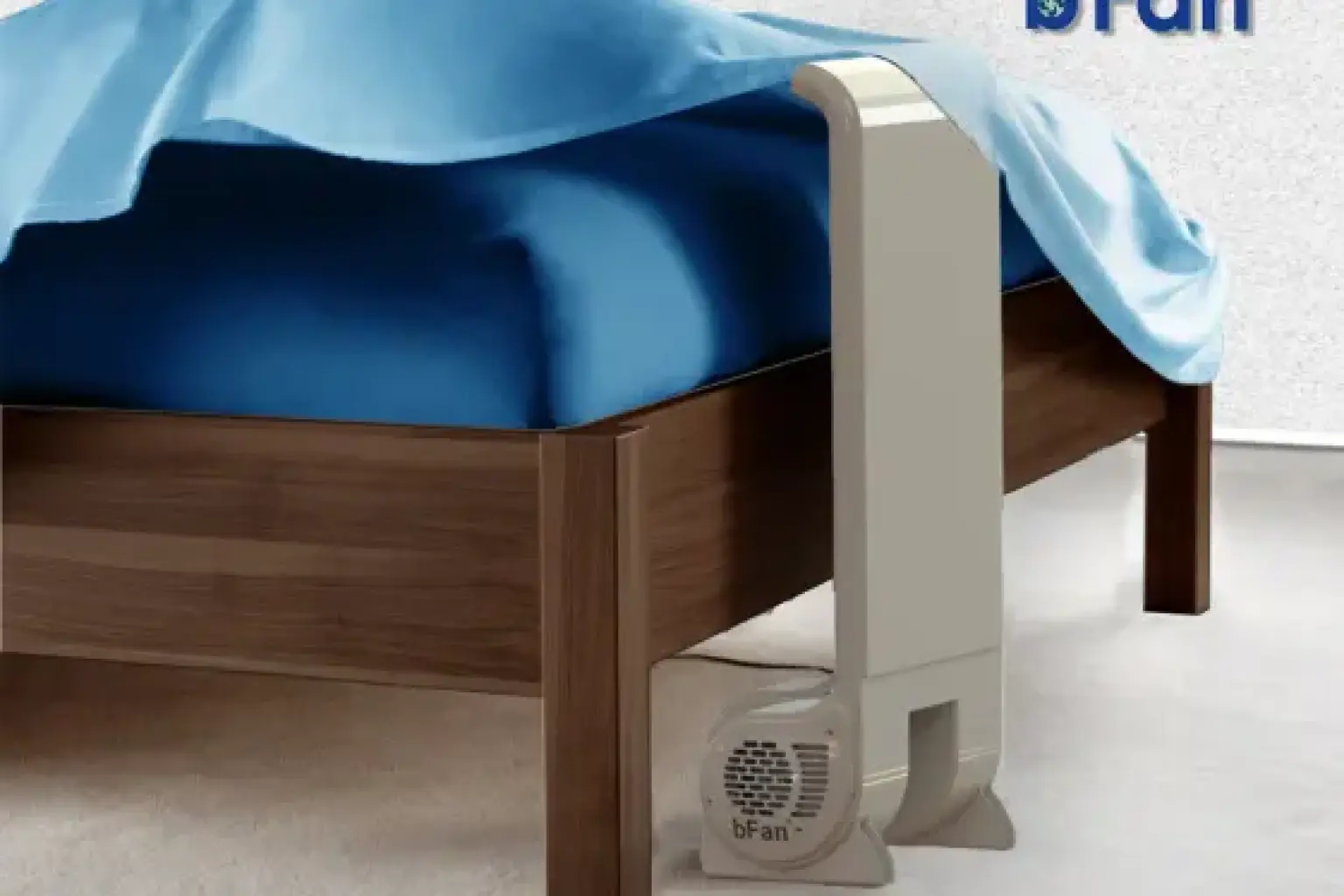
Sleep fan bFan cools between your sheets for quieter, deeper sleep, fewer hot wakeups, and lower AC use at night all summer.
If you’re shopping for a sleep fan, you probably don’t need another lecture on how miserable it feels to wake up hot at 2:17 a.m., kick the covers off, cool down just enough, then pull them back on and start the whole cycle again. You want something that actually changes the climate inside your bed, not just more air moving around the room.
That’s exactly what bFan, from Tompkins Research, Inc., is built to do. The bFan bed cooling fan sends a quiet, controllable stream of air between your sheets, where body heat gets trapped, so you can cool your sleep space directly, sleep more comfortably, and often ease up on overnight air conditioning without feeling sticky or overheated.
A regular room fan can help, but it usually cools the room in a broad, indirect way. bFan takes a more targeted approach. It sits at the foot of the bed and pushes airflow into the bed microclimate, the warm pocket of air that builds up under your sheets and comforter.
That matters because sleeping cool is not just about what the thermostat says. Sleep experts commonly recommend a bedroom temperature between 60°F and 67°F for better sleep, and many people find that with a bFan running between the sheets, they can often raise the room temperature by about 5°F and still sleep cool enough for more restful sleep.
bFan is designed and manufactured specifically for this job, with adjustable height, remote control, and a quiet squirrel cage blower that delivers controllable airflow where overheating actually happens.
“bFan directs airflow between your sheets, not just around your room, and it runs at about 28 dB to 32 dB at normal operating speed.”
That between the sheets airflow is the core reason many hot sleepers feel relief faster than they do with a ceiling fan or box fan. Instead of waiting for the whole room to feel cooler, you’re moving trapped heat away from your body right where you’re lying.

Sleep research strongly supports the idea that a cooler, more thermally comfortable sleep environment helps sleep onset and sleep continuity. bFan is built around that simple, practical idea, lower the heat burden in bed, make it easier for your body to stay settled, and cut down on those heat related wakeups that leave you tired the next day.
The people who usually get the most value from a sleep fan are not casual shoppers. They’re the ones already losing sleep because their body runs hot at night.
bFan is especially relevant if you deal with menopause or perimenopause, hormonal changes, night sweats linked to medications, warm bedding, anxiety driven overheating, or chronic heat buildup that seems to happen the moment you fall asleep. We also hear from people who sleep hot because of antidepressants, steroids, pain medications, blood pressure medicines, diabetes treatment, pregnancy, thyroid issues, and other health related triggers that disrupt temperature regulation during sleep.
For many of these sleepers, the problem is not that the whole bedroom is unbearable. The problem is that the bed gets too warm once body heat builds under the covers. bFan is made to address that specific problem without making you choose between sleeping sweaty or blasting the AC all night.
“bFan uses about 18 watts on average, so many sleepers can raise the thermostat by around 5°F and still keep the bed noticeably cooler.”
If you’re wondering whether you’re the right fit for a bed fan, here are the situations where bFan usually makes the most sense:
There’s also an important medical reality here. Night sweats can happen for many reasons, some harmless, some not. If your sweating is new, severe, or paired with fever, weight loss, chest symptoms, or other concerning changes, bFan can help with comfort, but it should not replace medical evaluation.
Let’s clear up one of the biggest buying questions right away. Neither bFan nor BedJet cools the air. They do not function like an air conditioner. They use the cooler air already in the room and move it into your bed so your body can shed heat more effectively.
That may sound simple, but it’s actually the point. Most people don’t sleep directly in the room. They sleep under fabric, against a mattress, with insulation all around them. Heat gets trapped there. bFan is meant to evacuate that trapped body heat before it turns into tossing, sweating, and repeated wakeups.
This is also why sheets matter. When you use a bed fan, sheets with a tighter weave usually work best because they help the air spread across your body and carry heat away more effectively. Loose, overly open fabric can let the air escape too quickly instead of distributing it where you want it.
bFan keeps the solution grounded in physics and sleep comfort. You are not buying “cold air.” You are buying directed airflow that helps your body lose heat inside the bedding environment, which is often the exact place your sleep problem starts.
“bFan does not cool the air itself, it uses the cooler air already in the room to flush trapped heat out of the bed.”
That honest distinction matters because it helps you set realistic expectations. If your room is already very hot, no bed fan can create air conditioning out of thin air. But if your room is within a reasonable sleep range, and especially if you keep it near the expert recommended 60°F to 67°F range, bFan can make the bed feel cooler and more comfortable without forcing you to overcool the entire house.

For many people, that’s the sweet spot. You sleep cooler, your AC works less aggressively, and the bedroom feels more livable for everyone else in the home.
A product like this only works if it’s easy to use consistently. bFan was built around nightly usability, not just a clever concept.
The official bFan design uses foot of bed placement, remote control, and adjustable height so you can line the airflow up with your mattress and bedding instead of trying to rig a standard fan into doing something it was never built to do. The body adjusts from about 19 inches to 37 inches, the air duct is about 12 inches wide and 3/4 inch deep, and the base measures about 6.25 inches tall by 7 inches deep by 12 inches wide. Those are practical design details, because fit and stability matter when a sleep product becomes part of your bedtime routine.
bFan also uses a sturdy, stable base and a high static pressure squirrel cage blower. That blower style helps the air move into the bed rather than dispersing weakly into the room, which is a real benefit if you sleep under sheets, blankets, or a comforter and want the cooling effect to reach you without needing a blast of air across your face.
The sound profile is another big buying concern, and it should be. A sleep fan has to be quiet enough for normal use. The bFan sound level is about 28 dB to 32 dB at normal operating speed, which puts it in the range many people find easy to live with overnight. Some sleepers even like the steady, low level fan sound as a buffer against intermittent noise, though it’s fair to say cooling is the more reliable benefit than sound masking.
Timer controls help too. bFan offers timer controls so you can cool the bed during the part of the night when you most need it and support a sleep routine that lines up with recommended sleep timing, without having to leave it running indefinitely if you don’t want to.
Here’s what those design choices mean for you in real life:
Another detail many shoppers appreciate is how simple the system is. There’s no water reservoir, no pad to fill, no hoses running through the bed, and no need to cool the entire bedroom more than necessary. bFan keeps the setup straightforward, discreet, and easy to live with.
And because bFan is not sold on Amazon, you buy direct rather than guessing whether a marketplace listing is current, genuine, or backed by the company that designed the product. That kind of direct purchase path matters when you want clearer product ownership and a more reliable sense of what you’re ordering.
A lot of shoppers comparing sleep fans end up asking about BedJet, and the comparison is worth making plainly.
First, the most important similarity, neither bFan nor BedJet cools the air. The BedJet doesn’t cool the air either. Both systems use the air already present in the room. So the decision is not about which one magically creates cold air. It’s about how you want airflow delivered, how much complexity you want, and how much you want to spend to cool the bed.
On price, the difference is significant. One BedJet is more than twice the price of a single bedfan. If you’re shopping for a dual zone setup for two sleepers, the dual zone BedJet is over a thousand dollars and more than twice the price of two bedfans. That makes bFan a much more approachable option for people who want dual zone microclimate control using two fans instead of buying into a far more expensive system.
bFan also brings historical credibility to the category. The original bedfan came to market several years before BedJet was even thought of, and Tompkins Research, Inc. is the original inventor of the bed fan category. If you want a product from the company that helped define this type of cooling in the first place, that matters.
A simple way to think about the comparison is this:
If you’re actively comparing buying options, the bFan from Bedfans USA is worth a serious look as a practical solution for hot sleepers who want simpler bed cooling without stepping up to the over $1,000 cost of a dual zone BedJet setup. And if you want to learn directly from the brand, bFan is also available through bfan.world.
For couples, the value case gets even stronger. One partner can sleep hot, the other can sleep neutral, and two bFans can create a more personalized dual zone setup at a fraction of the cost of a premium branded dual zone system. That kind of flexibility is hard to ignore if nightly temperature arguments are part of your routine.
A lot of sleep marketing gets fuzzy fast. bFan works best when you stay focused on the real mechanism, overheating fragments sleep.
A warm bedroom, warm bedding, humidity trapped under the covers, and repeated heat buildup can all make it harder to fall asleep and stay asleep. Sleep research consistently points to thermal comfort as a major part of sleep quality, and observational studies have found that higher bedroom temperature is associated with worse sleep efficiency. In plain language, when your sleeping environment is too warm, your sleep tends to become more broken.
bFan is built to improve that thermal comfort by moving air where it counts. That can make it easier to settle into sleep, reduce those sweaty wakeups, and support the kind of uninterrupted sleep that feels deeper and more restorative the next day.
It’s also worth being honest about the sound side. Some people sleep well with consistent fan noise, and some use it almost like white noise. But the scientific evidence on steady noise as a universal sleep aid is mixed. That’s one reason bFan’s strongest case is not “sound therapy.” Its strongest case is direct bed cooling for people whose real problem is sleeping hot.
That distinction actually makes bFan more trustworthy. Tompkins Research, Inc. is not asking you to believe in a vague wellness promise. The company designed bFan around a concrete, physically sensible result, move trapped heat out from under the sheets so your body has a better chance to stay comfortable through the night.
A good sleep fan works better when the rest of your setup supports it. bFan can make a real difference, but a few practical choices help you get the most from it.
Start with room temperature. Sleep experts commonly recommend 60°F to 67°F, and that guidance is still useful here. bFan often lets people raise the room temperature by about 5°F and still sleep cool, which can be a meaningful energy saver, but it still works best when the room itself is reasonably cool to begin with.
Placement matters too. bFan is typically used at the foot of the bed, where it can send airflow between the sheets and along the body. If bedding is tucked too tightly or the path is blocked, the airflow effect may be reduced. You want enough structure in the bedding to guide the air, not smother it.
Fabric choice can make more difference than most people expect. A tighter weave sheet usually helps the airflow travel across your skin and carry away heat. If your bedding is very heavy, very plush, or traps a lot of humidity, you may need to adjust layers to let bFan do its job more effectively.
If you deal with allergies, dry eyes, or nasal dryness, keep the unit clean and monitor your comfort the first few nights. Any fan can stir dust if the room is dusty, and some people are more sensitive to airflow than others. Those issues are usually manageable, but they’re worth paying attention to upfront.
And if you share a bed, bFan can often reduce the thermostat wars. Instead of cooling the whole room to satisfy the hotter sleeper, you can target the bed environment more directly. That’s one reason energy conscious couples often find a bed fan easier to live with than simply cranking the AC lower and lower.
When you buy a specialized product, clarity matters. You want to know who designed it, what problem it solves, and whether the company behind it really understands the category.
bFan has a strong story there. Tompkins Research, Inc. designed and manufactures the bFan as a dedicated bed cooling fan, not as a generic household fan with a sleep label slapped on it. The product exists for one reason, to deliver quiet, controllable airflow between the sheets and reduce overheating at night.
The company’s position as the original inventor of the bed fan category also matters. There are plenty of sleep products that feel like trend items. bFan doesn’t read that way. It comes from a long standing concept with patented or patent pending technology, an improved stable base, and airflow design built around a specific sleep discomfort that millions of people deal with every night.
For buyers, that translates into a simpler question. Do you want complicated temperature tech and premium pricing, or do you want a proven, direct way to cool the space where your body is actually overheating?
If you want a quiet, controllable, lower energy sleep fan from the company that helped define the bed fan category, bFan is a very strong fit. If what you really want is exact digital temperature programming or a mattress based climate system, you may prefer a different category entirely. Being clear about that is part of what makes bFan a trustworthy option.
From a medical and sleep physiology perspective, a sleep fan is most useful when overheating is one of the reasons your sleep gets interrupted. Your body naturally shifts temperature as part of healthy sleep onset, and excessive warmth can make it harder to stay asleep comfortably. A product like bFan supports better sleep by improving thermal comfort inside the bed, which can reduce awakenings and help sleep feel more continuous.
It can help many women with comfort during menopause and perimenopause, especially when the main problem is heat trapped under the covers. bFan does not treat hormone changes, but it can reduce the misery of waking up sweaty and overheated by moving air between the sheets where the heat is collecting. For many menopause related hot sleepers, that practical comfort benefit is exactly what makes the night more manageable.
That is a common situation, and it’s one reason bFan can be so relevant. Antidepressants, steroids, pain medications, blood pressure medicines, diabetes treatments, hormone therapy, and several other drugs can contribute to night sweats or overheating. A bed fan will not fix the medication cause, but it can make sleep more tolerable while you talk with your prescribing clinician about whether your symptoms need medical review.
No, and it’s better to be very clear about that before you buy. bFan does not cool the air itself, and neither does BedJet. Both rely on the cooler air already in the room, then move that air into the bed so your body can lose heat more efficiently. If your bedroom is already within a reasonable sleep range, that airflow can still make a big difference in how the bed feels.
Often, yes. Sleep experts commonly recommend a bedroom temperature between 60°F and 67°F, and many people find that with bFan they can raise room temperature by about 5°F and still feel cool enough for better sleep. That can reduce AC demand overnight, which is one of the reasons energy conscious sleepers often choose a bed fan instead of simply lowering the whole house temperature.
At normal operating speed, the bFan sound level is about 28 dB to 32 dB, which is quiet enough for many sleepers to use comfortably. Some people even find the steady sound helpful because it softens random environmental noise. If you are extremely noise sensitive, it’s still smart to start at a lower setting and see how your own sleep responds, because sound tolerance is personal.
In practice, tight weave sheets usually work best with a bed fan. They help the airflow spread across your body and carry heat away instead of letting the air escape too quickly. If your bedding is very heavy, plush, or poorly breathable, you may still get relief, but adjusting the sheet and blanket setup often improves performance more than people expect.
Any fan can contribute to dryness in some people, especially if the room air is already dry or dusty. Because bFan sends airflow through the bedding rather than directly at your face, many users find it easier to tolerate than a standard room fan, but sensitivity varies. If you’re prone to dry eyes, nasal dryness, or allergy symptoms, keep the unit clean, watch how you feel, and consider modest humidity support in the room if needed.
That depends on how different your sleep temperatures are. If one partner sleeps hot and the other doesn’t, a single bFan may help enough, especially if the hotter sleeper is the main one needing relief. If both sleepers want personalized cooling, two bFans can create dual zone microclimate control at a much lower cost than a dual zone BedJet, which is over a thousand dollars and more than twice the price of two bedfans.
It can help with comfort, but unexplained night sweats deserve medical attention. If you have severe sweating, fever, unexplained weight loss, swollen lymph nodes, breathing symptoms, or other new changes, speak with a licensed clinician. From a medical standpoint, supportive cooling with bFan is reasonable, but it should sit alongside proper evaluation, not replace it.
If you’re waking up sweaty, kicking off the covers, or arguing with the thermostat every night, bFan gives you a simpler way to cool the place that actually matters, your bed. Tompkins Research, Inc. built bFan to deliver quiet, controllable between the sheets airflow, low average energy use, and a practical path to cooler sleep without the complexity or premium price of many competing systems.
If that sounds like the kind of relief you’ve been looking for, buy direct through bfan.world, or compare the bFan from Bedfans USA if you want another purchase path for the same bed cooling approach. Either way, the next step is simple, choose the bed fan setup that matches your bed height, your nighttime heat pattern, and how you want your bedroom to feel tonight.
Sleep Foundation on the best bedroom temperature for sleep
A practical overview of why a cool room supports better sleep, including commonly cited ideal temperature guidance.
National Library of Medicine study on bedroom environment and sleep efficiency
Summarizes how higher bedroom temperature, noise, CO₂, and particulate matter were associated with worse sleep efficiency.
PubMed review on noise as a sleep aid
Useful for understanding why steady fan sound may help some sleepers, while the evidence remains mixed overall.
American Academy of Sleep Medicine survey on common sleep aids
Shows how often adults report using fans and other sleep environment tools as part of their nightly routine.
Review of airflow, humidity, and bed microclimate effects on sleep quality
A technical review that helps explain why bed level thermal comfort and airflow matter so much for hot sleepers.
Copyright 2005 - present - Tompkins Research, Inc. & Kurt W. Tompkins All Rights Reserved DO NOT COPY. bFan® and the word bfan® in any format is a registered trademark of Kurt W. Tompkins the word BFAN® in any format shall not be used without written permission of the mark owner. This includes specifically Brookstone where you like to bait and switch, do not use my mark to bait customers.