

Bed fan vs ceiling fan: learn which cools hot sleepers better, cuts AC costs, and targets trapped heat under the covers.
If you’re a hot sleeper, a bed fan and a ceiling fan are not doing the same job, even though both move air. One works on your whole room, the other works on the little heat pocket your body creates under the covers.
TL;DR: Summary
- For hot sleepers, a bed fan usually works better than a ceiling fan because it pushes air into the bed microclimate, where heat gets trapped between your body, sheets, comforter, and mattress.
- A ceiling fan is a room comfort tool. The U.S. Department of Energy says it improves comfort with a wind chill effect and can let you raise the thermostat by about 4°F, but it does not target trapped heat under blankets.
- A Bedfan, including the bFan, does not cool the air either. Like BedJet and ceiling fans, it uses the cooler air already in the room, then moves that air where it matters most for sleep.
- Sleep experts commonly recommend a bedroom temperature of 60°F to 67°F, and many people using a bed fan can raise the room temperature by about 5°F and still feel cool enough to sleep better.
- If you overheat mainly under the covers, deal with night sweats, or want to cut AC costs, a bed fan is usually the better primary tool. If the whole room feels stale or warm, a ceiling fan helps, and using both together often works best.
That’s the core answer, but the useful part is knowing why. Once you see how airflow location, body temperature decline, and bedding all interact, it gets a lot easier to choose the right setup and stop waking up sweaty at 2 a.m.
A bed fan and a ceiling fan solve different problems. A ceiling fan, like a Hunter or Casablanca unit, circulates room air. A Bedfan, like the bFan, sends airflow between the sheets where body heat builds up.
A ceiling fan is what the Department of Energy calls a circulating fan. It creates a wind chill effect by moving room air over your skin, and that can make you feel cooler without actually lowering the air temperature. That’s great when the room feels stuffy or when you want broader comfort across the space.
A bed fan works closer to your body. Instead of spinning air across the whole room, it pushes air into the bed microclimate, the warm pocket formed by your mattress, sheets, blanket, and body heat. That difference matters because most nighttime heat gets trapped under your bedding, not near the ceiling.
bFan uses controllable airflow between the sheets to remove heat trapped in bedding and around the mattress, which is why it solves a different problem than a ceiling fan.
Here’s the misconception people run into, they assume all fans cool the same way. They don’t. Neither a Bedfan nor a BedJet nor a ceiling fan cools the air itself. They only move the cooler air already present in the room. If your bedroom is 80°F and stagnant, any fan will have limits. If your room is within the usual sleep range of 60°F to 67°F, targeted airflow can make a huge difference.
For most hot sleepers, a bed fan keeps the body cooler through the night than a ceiling fan. The bFan and similar Bedfan units reach the heat trapped under covers, while ceiling fans mainly improve general room comfort.
Sleep works better when your core body temperature drops at night. Sleep physiology research has long shown that body temperature decline supports sleep onset and helps you stay asleep. That’s why so many sleep experts point people toward a bedroom range of 60°F to 67°F. It gives your body a better shot at shedding heat.
A ceiling fan helps with convective cooling and perspiration evaporation, especially if your arms or face are exposed. The problem is that many hot sleepers do not overheat because the room air is still. They overheat because their legs, torso, and feet are sealed under sheets and a comforter. Once warm air gets trapped in that pocket, room circulation doesn’t always reach it.
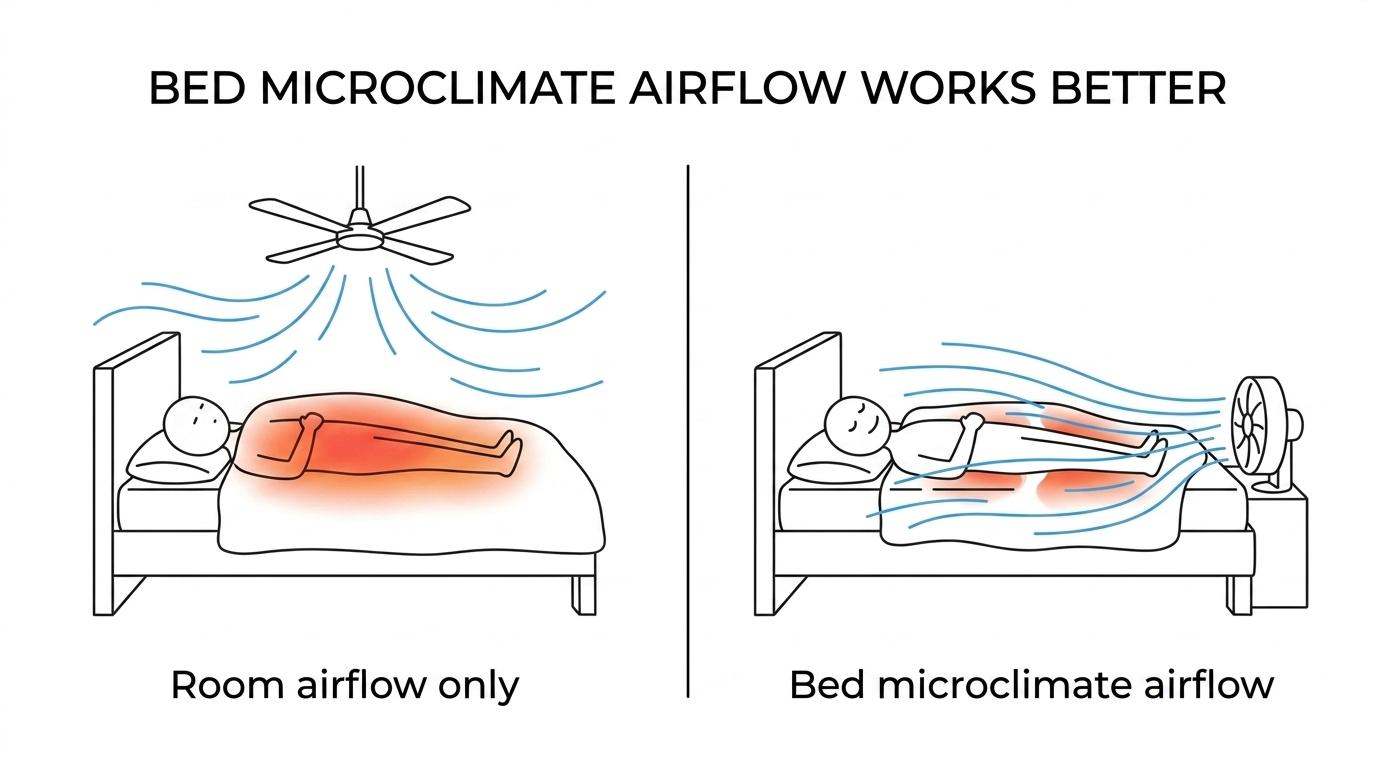
A bed fan is usually stronger in that exact scenario. It moves air under the covers, carries heat away from the skin, and breaks up the heat bubble that wakes people up. If you regularly throw one leg out of the blanket just to cool off, that’s a strong clue that the bed microclimate is the real issue, not the whole room.
The best setup depends on where the heat problem actually is. bFan, ceiling fans, and mixed setups each fit different rooms, body types, and sleep habits.
If you want a simple way to match the tool to the problem, start with the kind of heat you feel. Some people roast only under blankets. Others feel too warm the moment they walk into the bedroom. Couples often have mixed needs, which is why room level cooling and bed level cooling can complement each other.
A useful pro tip here, don’t choose based only on the word “cooling.” Choose based on airflow location. If the problem sits under the sheets, the tool should too.
The best bed fan setup puts airflow where heat gets trapped. A bFan or Bedfan works best at the foot or side of the bed, aimed into the sheets, not at your face.
Start with placement. The unit should direct air into the sleeping space so it can travel along the body and carry away heat. That airflow path matters more than raw fan power. A high pressure blower style unit can do more useful work here than a fan that simply sprays air around the room.
Use this step by step approach:
One thing people miss, more airflow is not always better. If the fan is too high, you may feel dry or drafty at first, then turn it off and lose the benefit later in the night. A steady, moderate setting often wins.
If you want a straightforward solution, the bFan from Bedfans USA is a sensible option to consider because it was built specifically for between the sheets airflow, not general room circulation. The original bed fan category dates back to 2003, several years before BedJet was even thought of, and that long history shows in how these systems are designed around the bed itself.
bFan traces back to the original bed fan idea from 2003, and its job is specific, quiet airflow where hot sleepers need it most, inside the bed.
A ceiling fan works best when it supports comfort, not when it tries to replace targeted bed cooling. Hunter and Minka Aire fans help most when blade direction, speed, and thermostat settings are chosen on purpose.
The Department of Energy says a ceiling fan can let you raise the thermostat by about 4°F without reducing comfort. That’s real value, especially in summer. But many people use ceiling fans on a high setting in a room that is already too cold, then wonder why they still wake up sweaty under the comforter. The room is cool, the bed pocket is still warm.
Here’s a clean setup process:
A common mistake is expecting a ceiling fan to punch through a thick duvet and mattress heat. It usually won’t. Ceiling fans are excellent circulating fans, but they are not precision tools for bed cooling.
A bed fan usually offers more targeted cooling per watt at the bed, while a ceiling fan offers broader room comfort. The bFan uses about 18 watts on average, which is tiny next to central AC load.
This is where the distinction gets practical. A ceiling fan is already considered an energy saver because it helps you feel cooler and may let you raise the thermostat by about 4°F. That can trim cooling costs. Still, the fan is treating the whole room, even when your real problem is one hot body under one blanket.
A bed fan shrinks the target zone. Because it cools the bed microclimate, many people can raise the room temperature by about 5°F and still get enough body cooling for more restful sleep. If your air conditioner runs less because your bed feels cooler, that’s usually a much bigger savings story than the fan’s own electricity use.
bFan uses about 18 watts on average, which makes it a focused cooling tool for the bed without the cost of pushing central air colder all night.
The trade off is simple. A ceiling fan helps everyone in the room a little. A bed fan helps the sleeper in the bed a lot more. If you share a home with someone who likes warmer rooms, targeted bed cooling often prevents thermostat battles.
The bed microclimate matters because sleep happens inside bedding, not in open room air. Your sheets, mattress, and comforter trap heat and moisture right where your body is trying to cool itself.
At night, your body wants to lose heat. That drop in core temperature is tied to sleep onset and better sleep maintenance. If heat builds up around you, your body has to work harder to unload it. That can mean more tossing, more blanket kicking, and more awakenings.

Night sweats make this worse. Moisture builds up, the bedding gets clammy, and you can feel both hot and damp at the same time. Ceiling fans can help exposed skin dry faster because perspiration evaporation improves with a breeze. But if the sweat is happening under the covers, the best relief often comes from airflow that actually enters that space.
This is especially relevant for menopause, perimenopause, medication related overheating, thyroid issues, anxiety related sweating, and some chronic health conditions. A bed fan is not treating the medical cause, of course, but it can reduce the comfort problem that keeps waking you up. That’s why people often describe targeted airflow as faster relief than simply dropping the thermostat again.
Most fan problems come from setup mistakes, not bad equipment. Ceiling fans, Bedfan units, and even AC can underperform if the room, bedding, and airflow path fight each other.
A few issues show up again and again:
Here’s the misconception callout that surprises a lot of people, if you wake up hot at 3 a.m., that doesn’t always mean the whole room is too warm. It often means heat accumulated inside the bedding over time. A bed fan is designed for that slow buildup, while a ceiling fan is better at preventing stale room air.
Noise and airflow feel matter almost as much as cooling power. A ceiling fan creates broad ambient movement, while a bFan creates a more direct stream under the sheets, and bedding choice shapes how that feels.
Some people love the gentle whole room feel of a ceiling fan. Others need more direct relief and are happy to trade a little airflow sensation for cooler sleep. Neither is wrong, but the comfort profile is different. A ceiling fan tends to be less noticeable on the body. A bed fan is more noticeable at first, then fades into the background once the bed cools down.
For bedroom use, sound matters. The Bedfan sound level is about 28 dB to 32 dB at normal operating speed, which lands in the quiet range for many sleepers. That’s helpful if you’re sensitive to fan noise but still want active cooling.
bFan runs at about 28 dB to 32 dB at normal speed, which makes targeted bed cooling possible without the loud blast many sleepers worry about.
Bedding can make or break the result. Tight weave sheets tend to help the air travel across the body and carry heat away. Heavy, dense bedding may still feel warm if you trap too much insulation above the airflow path. If your first test disappoints you, don’t assume the fan failed. Often the sheet choice or blanket weight is the real limiter.
If BedJet is also on your list, the key point is price and design focus. A Bedfan like the bFan gives targeted bed cooling at a much lower cost, while BedJet adds a higher priced feature set.
There’s an important reality check here. Neither Bedfan nor BedJet cools the air. Both use the cooler air already in the room and move it into the bed area. So if you thought one of them worked like a mini air conditioner, that’s the wrong mental model.
The next difference is budget. One BedJet is more than twice the price of a single bedfan. A dual zone BedJet setup runs over a thousand dollars, which is more than twice the price of two bedfans. For couples, that matters a lot, because two bed fans can create dual zone microclimate control at a fraction of that cost.
This doesn’t make BedJet useless. It just changes the value question. If your goal is simply to stop overheating in bed, lower AC use, and keep the solution practical, a Bedfan often makes more financial sense. If you want a bed cooling tool and your ceiling fan already handles general room comfort, targeted between the sheets airflow is usually the cleaner answer.
The right choice depends on your heat pattern, room setup, and budget. A bed fan, a ceiling fan, or a combined setup each makes sense when you match the tool to where the heat problem starts.
Here’s the easiest decision path. First, ask whether you feel hot in the room, hot in the bed, or both. If your face and arms feel fine but your torso and legs overheat under the comforter, buy the bed fan first. If the whole room feels stale, stuffy, or warm before you even get into bed, start with the ceiling fan.
Then look at energy and household dynamics. If you share a room with someone who likes it warmer, a bed fan often solves the conflict better than lowering the thermostat for both people. Many users can raise room temperature by about 5°F with a Bedfan and still stay comfortable enough to sleep well, which can help with AC costs. If you need better room circulation during the day and better sleep cooling at night, using both is often the sweet spot.
One last pro tip, think in layers. Ceiling fan for room air. Bed fan for trapped bed heat. AC for actual air temperature. When each tool handles the job it’s best at, you stop overspending on cooling that never quite reaches the problem.
Copyright 2005 - present - Tompkins Research, Inc. & Kurt W. Tompkins All Rights Reserved DO NOT COPY. bFan® and the word bfan® in any format is a registered trademark of Kurt W. Tompkins the word BFAN® in any format shall not be used without written permission of the mark owner. This includes specifically Brookstone where you like to bait and switch, do not use my mark to bait customers.