
Cooling sheets can help, but bed fans usually cool better by removing trapped heat and humidity from your bed microclimate at night.
If you’re deciding between cooling sheets and a bed fan, the short answer is simple, a bed fan with cooling technology usually does more to stop overheating because it changes the air inside your bed, not just the feel of the fabric on your skin. Cooling sheets, especially those with Oeko-Tex certification, can still help with comfort features, but they tend to work best as a supporting layer, not the main fix.
TL;DR: Summary
That’s the practical answer, but the interesting part lies in how temperature regulation plays a role in both sleep thermoregulation and bed microclimate management. Once you look at sleep thermoregulation, bed microclimate, humidity, and airflow, the gap between a fabric only solution and an airflow solution gets a lot clearer.
A bed fan like bFan usually works better than cooling sheets when trapped heat is the real problem. Cooling sheets can help with feel and moisture, but airflow changes the bed microclimate more directly.
If you wake up hot under the covers, you’re usually not dealing with a sheet problem alone. You’re dealing with a pocket of warm, humid air trapped between your skin, your sleepwear, your sheets, and your comforter. That little pocket is your bed microclimate, and it has a huge effect on whether you drift off or keep flipping the pillow all night.
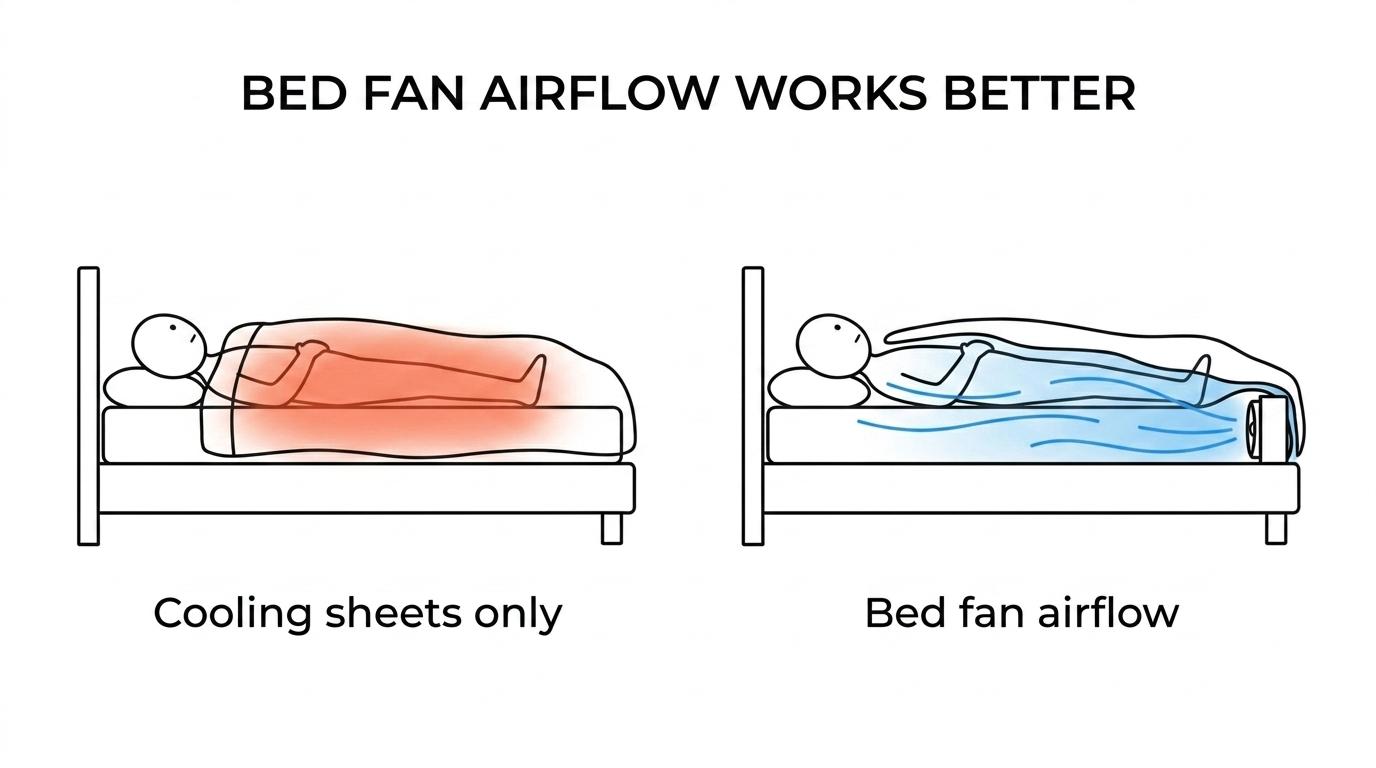
This is where the difference matters. Cooling sheets mostly change surface feel, moisture handling, including moisture-wicking, and breathability. A bed fan, whether you call it a bed fan, Bedfan, or bFan, actively pushes room air between the sheets to carry away heat and sweat. If your room is already reasonably cool and you still overheat in bed, targeted airflow usually beats a fabric swap.
The research supports that direction. A 2016 randomized crossover study found no bedding effect on sleep outcomes when bedding was changed between polyester and wool, while sleepwear and ambient temperature did affect sleep, including sleep onset latency. A 2025 pilot study on cooling bed sheets did report better sleep, but it was non randomized and the authors said placebo controlled confirmation is still needed. That doesn’t mean cooling sheets are useless. It means the direct support is stronger for airflow and thermal control than for any one sheet material.
If you want the plain English version, cooling sheets can feel nicer, but a bed fan usually does more.
The bed microclimate matters because your skin, sheets, and covers create a warm humid pocket that can block heat loss. Sleep reviews and the University of Sydney study point to thermoregulation and ambient temperature, not just fabric labels.
A lot of people think, “My room is cool, so why am I still hot?” The answer is that your body isn’t sleeping in the room as a whole. It’s sleeping inside a small climate zone under the covers. Reviews of sleep thermoregulation describe that zone as distinct from the rest of the bedroom.
One review reports that bed climate temperature and relative humidity are generally maintained around 32°C to 34°C and 40% to 60% relative humidity when normal sleep is obtained. Another review says people form skin microclimates around 33°C to 35°C with a duvet or night clothes before sleep. That’s warm. If that microclimate gets too humid or holds too much heat, your body has a harder time shedding heat, and sleep quality drops.
“bFan adjusts from 19 inches to 37 inches and uses a 12 inch by 3/4 inch air duct to push airflow into the exact zone where bed heat gets trapped.”
That’s why a bed fan can feel so immediate. It doesn’t wait for the fabric to maybe wick, maybe breathe, maybe feel cool for a few minutes. It moves air where your body is actually overheating. Pro tip, this is also why tight weave sheets often work better with under sheet airflow than loose knits. They help guide the air across your body instead of letting it leak away too quickly.
For most people, the most practical order is a bed fan first, breathable sheets second, and room temperature tuning third. A simple setup that changes the bed microclimate usually beats expensive fabric claims.
If you’re trying to spend wisely, don’t start by chasing every sheet label that says “cooling.” Start with the product type that does the most direct work on heat buildup, then refine the rest of the setup around it.
Cooling sheets work by changing surface feel, moisture transfer, and heat exchange at the skin. They can help, but the effect depends heavily on fabric structure, room conditions, and your own sweat pattern.
Step 1 is contact. Some cooling sheets feel cool when you first touch them because the fabric moves heat away from your skin faster than a flannel or heavy sateen weave sheet would. That initial cool touch is real, but it isn’t the same thing as active cooling through the whole night.
Step 2 is moisture management. Sheets that wick or spread moisture can reduce that sticky, clammy feeling when you sweat. If you mainly hate damp bedding against your legs or chest, good cooling sheets may help quite a bit. This is often where Tencel, lightweight cotton percale, linen, or certain synthetic blends do their best work.
Step 3 is breathability, and this is where the limits show up. If warm, humid air stays trapped under the covers, the sheet can only do so much. A common misconception is that any sheet labeled “cooling” will keep lowering your body temperature all night. It won’t. Most are passive materials, not active systems. They can improve comfort, but they do not flush heat out of the bed the way airflow can.
That’s also why the 2025 pilot on cooling bed sheets is interesting but not final. It showed improved sleep after people started using the sheets, across 64 participants and 2,627 total days of data, but it was non randomized and the authors asked for placebo controlled confirmation. Good early signal, yes. Settled science, no.
A bed fan cools your bed by moving room air through the sheets, across the skin, and out of the warm humid pocket under the covers. It does not create cold air, it uses the cool air already in your room.
Step 1 is air delivery. A Bedfan or bFan sits at the foot or side of the bed and sends airflow between the sheets. If your bedroom is within the usual recommended 60°F to 67°F range, that airflow gives your body a much better chance to release heat.
Step 2 is heat removal. As the air moves across your skin, it carries away body heat that would otherwise stay trapped under the blanket. If you sweat, the moving air, combined with moisture-wicking materials, also helps moisture evaporate more efficiently. That can make the bed feel drier, lighter, and less suffocating.
Step 3 is humidity control inside the bedding. This is easy to miss. A lot of sleep discomfort comes from humid air collecting around the body. Under sheet airflow helps push that humid air out and replace it with drier room air. That’s why many hot sleepers say a bed fan feels more like relief than a sheet upgrade does.
Neither Bedfan nor Bedjet cools the air itself. They only use the cool air in the room. That’s not a weakness, it’s just the mechanism. If your room is too warm, both will have less cool air to work with. If your room is already reasonably cool, a bed fan becomes very effective.
Tight weave sheets usually help this process. They guide the airflow across your body instead of letting it disperse too quickly. Timer controls help too. Many people like stronger airflow at sleep onset, then a lower setting later in the night.
Choose based on your actual heat pattern, not the marketing label. If trapped heat wakes you up, start with a bed fan. If sticky fabric bothers you most, start with sheets.
Step 1, identify the problem. If you feel hot only when the bedding is touching you, cooling sheets might be enough. If you wake up sweaty under the covers, kick blankets off, or feel like heat is pooling around your legs and torso, airflow is the better first move.
Step 2, check the room. Sleep experts commonly recommend 60°F to 67°F. If your room is 72°F or 74°F, then even the best sheets have a tougher job. A Bedfan can often let many people raise the room temperature by about 5°F and still feel cool enough to sleep, but that assumes you started from a decent baseline, not a stuffy bedroom.
Step 3, decide whether you need passive comfort or active cooling. Passive comfort means fabric, softness, moisture handling, and skin feel. Active cooling means you are using cooling technology to move room air and heat away from the body. If your goal is deeper sleep and fewer heat related wakeups, active cooling usually has the edge.
One more thing people miss, if you sleep with a partner who likes a different temperature, two bed fans can be much easier to tailor side by side than trying to find one sheet set that solves opposite needs.
For night sweats and hot flashes, a bed fan usually works better because airflow helps remove both heat and moisture. Cooling sheets can still help, but they are usually the second layer of the solution.
Night sweats are different from “I just sleep a little warm.” They involve sudden heat, moisture, and a fast drop in comfort. Menopause and perimenopause are common reasons. So are medications like SSRIs, SNRIs, steroids, some pain medications, hormone therapy, and some diabetes medications. In those situations, the problem is often less about fabric softness and more about fast symptom relief when the heat wave hits.
That’s where airflow has a clear advantage. If you sweat, the bed gets humid fast. A bed fan can help carry away both heat and moisture from the microclimate around your body. Cooling sheets may reduce cling and dampness, but they don’t actively flush the humid air out from under the covers.
If your night sweats are frequent, severe, or new, keep the bigger picture in mind. Persistent night sweats can also show up with infections, endocrine issues, sleep apnea, reflux, autoimmune conditions, or more serious illnesses. If you have fever, unexplained weight loss, swollen lymph nodes, chest symptoms, or other concerning changes, talk with a clinician. A Bedfan or cooling sheet can help symptoms, but it is not a substitute for checking the cause.
For symptom control alone, though, the pattern is pretty consistent. If your body feels overheated and the bed feels damp, targeted airflow is usually the better tool.
Cooling sheets usually win on fabric feel and simple setup, while a bed fan usually wins on direct cooling power, durability, and energy use. The better choice depends on whether you want nicer bedding or stronger temperature regulation and thermal control.
Sheets are simple. You put them on the bed, wash them when needed, and forget about them, especially if you opt for cooling pillowcases that can enhance your sleeping experience. If your main complaint is rough fabric, sticky skin, or heavy winter style bedding, that simplicity matters. A bed fan asks for a little setup and a few nights of dialing in height, airflow, and sheet choice. After that, it tends to be low effort.
“At normal operating speed, the bFan Bedfan runs around 28db to 32db, which is a practical noise range for sleepers who want airflow without loud fan sound.”
On cost, people often assume sheets are the budget option and devices with comfort features are the expensive option. That’s not always true. Premium cooling sheet sets can get pricey, and they still may not solve trapped heat. A bed fan like the bFan uses about 18 watts on average, so the running cost is tiny compared with whole room air conditioning. That matters if you’ve been dropping the thermostat just to make the bed tolerable.
There’s also a category comparison worth making here. A single Bedjet is more than twice the price of a single bed fan like the bFan. A dual zone Bedjet setup costs over a thousand dollars, which is more than twice the price of two bedfans. If you want dual zone microclimate control for a couple, two bed fans do that job at a much lower cost.
A common misconception is that quieter always means weaker. In practice, modest airflow in the right place often beats stronger airflow in the wrong place. Bed cooling is about where the air goes, not just how powerful the motor sounds.
With a Bedfan, tight weave breathable sheets usually work best, particularly those with a sateen weave that can enhance the airflow effect, especially if they are Oeko-Tex certified for safe, sustainable, and chemical-free textiles. Percale cotton is the safest starting point, while very loose knits and heavy fuzzy fabrics tend to blunt the airflow effect.
If you’re using a bed fan, sheet choice still matters, just in a different way. You’re not asking the sheet to do all the cooling. You’re asking it to cooperate with the airflow.
The simple rule is this, if you’re using under sheet airflow, give that airflow a clean path for optimal temperature regulation. Tight weave sheets usually do that better than bulky or stretchy fabrics.
Yes, a bed fan can often reduce air conditioning demand because it cools your body where you sleep, not the whole house. The key is that it works best when the room is already reasonably cool.
Sleep experts commonly recommend a bedroom temperature between 60°F and 67°F, 15.5°C to 19.5°C, for better sleep. That range makes sense because sleep onset is tied to thermoregulation and a drop in core temperature. Still, many people don’t want to keep the whole house that cool all night, or they share a home with people who don’t like it.
This is where a Bedfan can help. Many users can raise the room temperature by about 5°F and still sleep cool enough for more restful sleep, because the airflow is targeted at the body and the bedding microclimate. If you can sleep comfortably at, say, 70°F instead of forcing the room lower just to keep the bed from overheating, that can reduce air conditioning use.
The important tradeoff is this, neither a bed fan nor Bedjet makes cold air. They only use the cool air in the room. If the room is already too warm and humid, the result will be limited. If the room is in a reasonable range, then even a small amount of directed airflow can make the bed feel much cooler than the thermostat alone suggests.
That’s one reason the 18 watt average power draw matters. You’re moving a small amount of air exactly where it counts, instead of cooling a large space just to fix a small hot zone.
They are related solutions because both use room air to change the bed microclimate, but they differ in price, setup, and value. For straightforward cooling, a bed fan is often the simpler and less expensive path.
The original bed fan category dates back to 2003, several years before Bedjet was even thought of. That history matters because the category was built around a plain goal, move trapped heat out from under the sheets with targeted airflow. If that is your goal, a Bedfan style product already fits the job closely.
“bFan traces the bed fan category back to 2003, which makes it one of the longest standing between the sheets cooling formats on the market.”
Price is a big divider. One Bedjet is more than twice the price of a single bedfan. The dual zone Bedjet setup is over a thousand dollars, and more than twice the price of two bedfans. If you need one cooling setup per sleeper, two bed fans give you dual zone microclimate control at a fraction of that spend.
The mechanism is also worth clearing up. Neither Bedfan nor Bedjet cools the air. Both use the cool air in the room. That means neither replaces air conditioning in a hot room, but both can help you use air conditioning more efficiently by focusing relief at the bed. If your main need is cooling, not a long feature list, a simple Bedfan or bFan setup often makes more sense.
And yes, the original Bedfan came to market long before Bedjet. If you prefer something proven and direct, that’s a fair reason to lean toward the bed fan side of the comparison.
Most problems come from using the wrong fabric, the wrong room temperature, or the wrong expectation. The product often isn’t failing, the setup is.
A lot of hot sleepers buy the right category, then accidentally cancel out the benefit with the rest of the bed by not utilizing effective cooling technology. Here are the mistakes that show up most often.
The biggest misconception is thinking that “cooling” always means the same thing. In bedding, it can mean cool to the touch, breathable, moisture wicking, or actively heat removing. Those are not interchangeable.
Use both when you want the strongest overall sleep cooling setup. A bed fan handles heat removal, while the right sheets improve feel, airflow, moisture management, and comfort features.
This combo makes sense if you’re a consistently hot sleeper, dealing with menopause or medication related night sweats, sharing a bed with another hot sleeper, or trying to raise the thermostat without sacrificing comfort. In that setup, the bed fan does the heavy lifting and the sheets stop getting in its way.
The best version usually looks pretty simple. Start with a breathable, tight weave sheet, keep the room somewhere close to the recommended 60°F to 67°F if you can, then use the Bedfan to move air where your body actually needs it. Many people find they can raise room temperature by about 5°F and still sleep comfortably because the body is getting direct cooling at the bed level.
If you’re looking for a straightforward product example, the bFan from www.bedfans-usa fits this use case well. Not because a sheet suddenly stops mattering, but because airflow plus the right sheet is usually stronger than either one on its own.
For couples, using two bed fans is a very practical way to get dual zone control without stepping up to the much higher price of a dual zone Bedjet. If one of you sleeps hot and the other doesn’t, that flexibility can be the difference between “better in theory” and “actually works every night.”
Copyright 2005 - present - Tompkins Research, Inc. & Kurt W. Tompkins All Rights Reserved DO NOT COPY. bFan® and the word bfan® in any format is a registered trademark of Kurt W. Tompkins the word BFAN® in any format shall not be used without written permission of the mark owner. This includes specifically Brookstone where you like to bait and switch, do not use my mark to bait customers.