
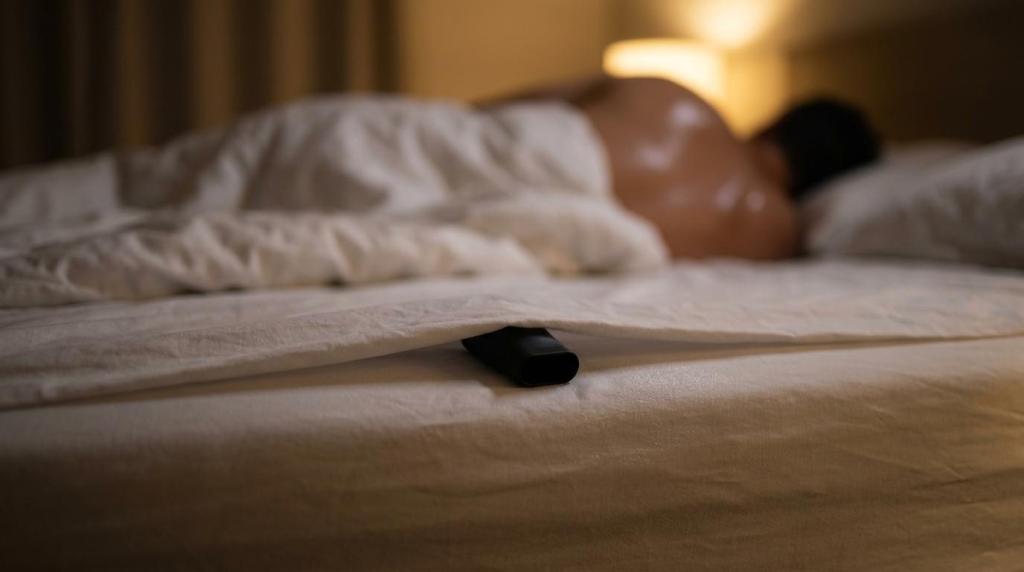
Discover how bFan may ease nighttime hyperhidrosis by moving air between sheets to reduce trapped heat, humidity, and sleep disruption.
If you live with hyperhidrosis, or you keep waking up soaked because your bed turns into a heat trap, you do not need another vague promise about “cooler sleep.” You need something that helps the exact place where the heat builds up, right under the covers, right against your skin.
bFan, designed and manufactured by Tompkins Research, Inc., is a bed fan built to move quiet, controllable airflow between your sheets so trapped body heat can escape instead of pooling around you all night. For people dealing with nighttime overheating, night sweats, or heat related sleep disruption, bFan is a direct, practical way to make the bed itself feel cooler without paying premium prices for water systems or blasting the whole house with extra air conditioning.
Hyperhidrosis can be complicated, and we take that seriously. A bed fan is not a cure for an underlying medical condition. What bFan can do is reduce the heat and humidity that build up in bedding, help you feel drier and more comfortable, and make it easier to stay asleep when sweating and overheating are what keep breaking your night apart.
When hyperhidrosis shows up at night, comfort matters, but honesty matters too. There is very little direct clinical research on bed cooling specifically for diagnosed nighttime hyperhidrosis, so bFan is best understood as a symptom relief and sleep comfort tool, not a medical replacement for diagnosis or treatment.
What bFan offers is straightforward. It is a remote controlled, adjustable height bed fan that sends airflow between the top and bottom sheets, where your body heat gets trapped, so the warm, humid air can move away from your skin instead of building up around you.
That matters because neither bFan nor BedJet cool the air itself. They use the cooler air already in your room, and direct it into the bedding where it can actually help your body shed heat.
“bFan focuses on between the sheets airflow, not chilled air, so it removes trapped heat where hot sleepers and people with hyperhidrosis actually feel it.”
[Sleep experts commonly recommend a bedroom temperature between 60°F and 67°F for better sleep.] In real life, many people do not want to keep the whole house that cool all night, especially when energy costs are already high. With a Bedfan, many sleepers can often raise the room temperature by about 5°F and still sleep cool enough for more restful sleep, because the airflow is working right at the bed instead of cooling every cubic foot of the room.
That is where bFan earns its place. Instead of asking you to buy a new mattress, manage water lines, or pay luxury pricing just to stop overheating under the covers, we give you a focused bed cooling tool built for the problem you actually feel.
bFan is made for people who overheat in bed and need relief where the heat is trapped. That includes people with diagnosed hyperhidrosis, people who use that word because they sweat heavily at night, and people whose night sweating is tied to hormone shifts, medication side effects, anxiety, medical treatment, or just a body that runs hot once the blankets go on.
Tompkins Research, Inc. designed bFan for the people who know the pattern well. You fall asleep tired, you wake up hot, your chest or back feels damp, the sheets feel heavy, you throw covers off, then pull them back on later and start the cycle again.
We also help couples who do not sleep at the same temperature. One partner may be comfortable while the other feels overheated and restless. In that situation, the bFan from www.bedfans-usa can be a practical answer because you can set up one unit on one side, or use two units for dual zone microclimate control without forcing both sleepers into the same temperature.
It is also a strong fit for people who want quieter, simpler bed cooling. If tubing, water reservoirs, app dependence, or premium system pricing feels like too much for a problem you mainly feel under the sheets, bFan gives you a more direct path.
There is one more point worth saying clearly. Classic primary focal hyperhidrosis often does not happen during sleep, so if your sweating is new, drenching, widespread, or linked with other symptoms, it is smart to talk with your doctor. bFan can still help with nighttime comfort, but it should sit alongside medical evaluation when the pattern suggests more than ordinary overheating.
bFan improves the part of sleep that overheating destroys first, your ability to stay settled. When hot, damp air gets trapped in the bedding, your body has a harder time releasing heat. You feel sticky, restless, and alert when you should be drifting deeper into sleep.
Our bed fan improves that sleep environment in a few very practical ways.
For many buyers, that last point matters almost as much as the sleep itself. bFan uses only about 18 watts on average, which is tiny compared with the energy draw of running central air harder all night just to make the bed tolerable. If you are trying to sleep cooler without driving up AC costs, that difference shows up quickly.
And because the airflow is concentrated where you sleep, you are not paying to overcool rooms you are not even using. That is a real benefit for energy conscious sleepers, apartment dwellers, and anyone who has ever lowered the thermostat just for bedtime and then dreaded the bill later.
Tompkins Research, Inc. built bFan around a high static pressure squirrel cage blower rather than a generic bedroom fan approach. In plain English, that means it is designed to push air where ordinary fans struggle, into the bedding channel between your sheets, where airflow has to travel a controlled path to reach your body.
That design choice is why a bed fan can feel very different from pointing a floor fan at the bed. A room fan moves air around the room. bFan is built to move air through the bed itself.
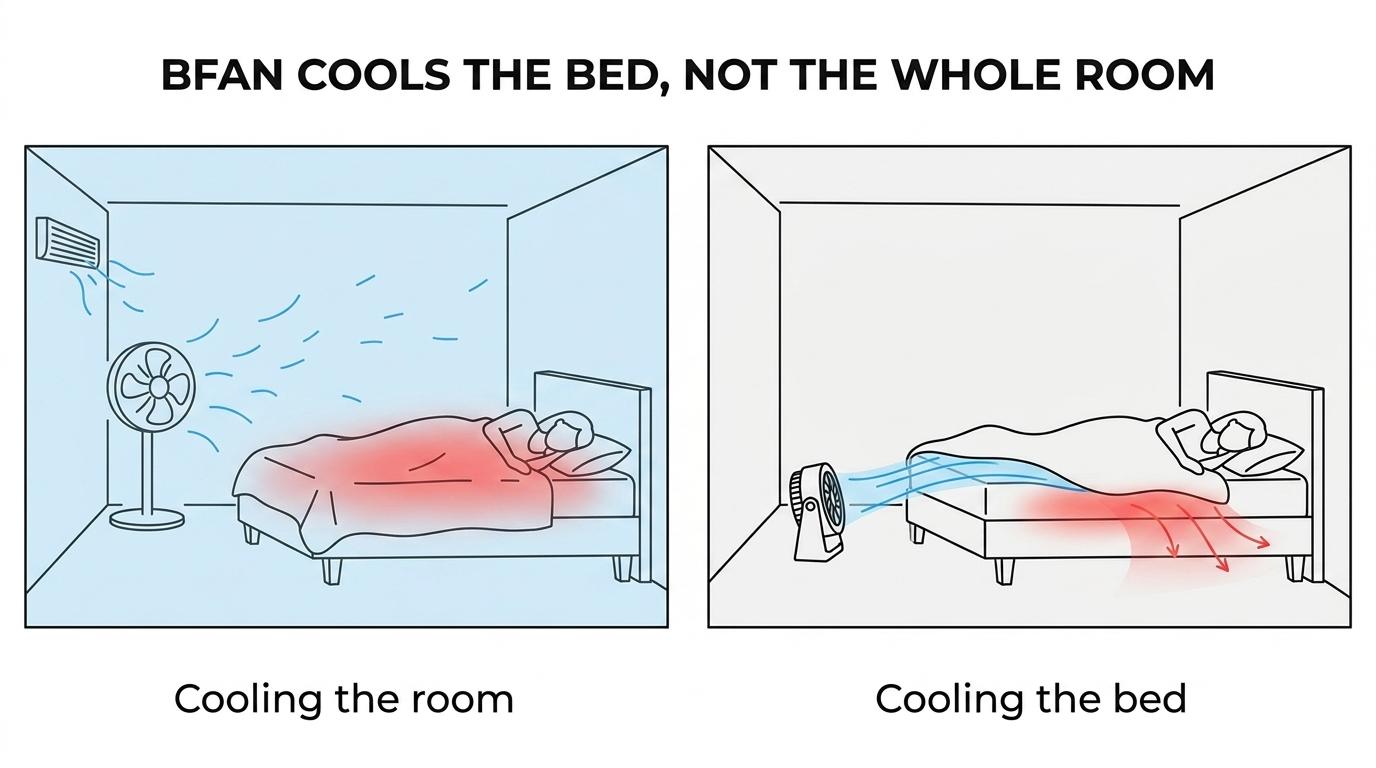
The base is sturdy and stable, and the unit is adjustable so you can direct airflow where it works best, usually from the foot of the bed upward. You get remote control operation, so you can change the speed without climbing out of bed, and timer controls so the system can support the sleep window you are aiming for instead of running longer than you need.
Normal sound level matters too, especially if you are already a light sleeper. The Bedfan sound level is about 28db to 32db at normal operating speed, which is quiet enough for most bedrooms and far less intrusive than the blast of a loud room fan.
“bFan runs at about 28db to 32db at normal speed and uses around 18 watts on average, which makes it a practical all night bed cooling option.”
That quiet operation is a big deal for people with hyperhidrosis because you are already managing enough disruption. You do not want the cure for overheating to become the next thing keeping you awake.
It also helps that setup is simple. There is no water to fill, no hoses to route, and no pad under your body changing the feel of the mattress. If you want active bed cooling without turning your sleep system into a project, bFan keeps the process refreshingly direct.
A bed fan works with the air already in your room, so expectations matter. bFan does not refrigerate or manufacture cold air. It uses the cool air available in the room and sends it where it can remove heat from your body more effectively.
That is why room temperature still matters. Sleep experts commonly recommend 60°F to 67°F for better sleep, and that guidance still applies here. If your room is already in that range, or reasonably close to it, bFan can make a noticeable difference because it helps your body take advantage of that cooler air under the sheets.
If your room runs warmer, bFan can still help, but it works best as part of a smart sleep setup. Many users can often raise room temperature by about 5°F and still feel cool enough to sleep well because the moving air carries away body heat that would otherwise stay trapped in the bedding.
Your sheets matter too. With a Bedfan, tighter weave sheets usually work better because they help contain and guide the airflow across your body instead of letting it dissipate too quickly. That sounds like a small detail, but it can be the difference between feeling a mild breeze and feeling consistent bed cooling all night.
Here is the setup advice we give most often.
When you line up those basics, bFan has a much better chance of giving you the result you actually want, less tossing, less sweating discomfort, and a bed that stops feeling like it is holding heat against you.
If you are comparison shopping, the first thing to know is that air based systems share one important limit. Neither Bedfan nor BedJet cool the air. They both rely on the temperature of the room air already available. So if someone is promising ice cold air from either type of system, that is not the right expectation.
Where the difference starts to matter is price, simplicity, and how much system you really need. One BedJet is more than twice the price of a single bFan. If you want dual zone control for a couple, the dual zone BedJet setup is over a thousand dollars and more than twice the price of two bFans.
That makes bFan a very practical value choice for couples. Two bFans can create dual zone microclimate control using two separate fans, so each sleeper gets independent airflow without paying luxury system pricing.
“Two bFans can give couples dual zone microclimate control, while a dual zone BedJet setup is over a thousand dollars and costs more than twice as much as two bFans.”
There is also the question of complexity. Water based bed cooling systems can provide stronger direct surface cooling, and for some people that is worth the extra cost and maintenance. But those systems also bring tubing, reservoirs, cleaning, and a much higher upfront price. If your main goal is to move heat and moisture out from under the covers, an airflow bed fan is often the cleaner fit.
BedJet sits closer to bFan in the sense that both are air based. Even there, bFan has a clear edge for shoppers who want targeted bed cooling without overpaying. The original Bedfan came to market years before BedJet was even thought of, and the original Bedfan was invented in 2003. This is not a company chasing a trend. Tompkins Research, Inc. helped create the bed fan category in the first place.
That history matters because it shows a long standing focus on one job, getting trapped heat out of the bed so people can sleep. bFan is not trying to be a wearable, a mattress subscription, or a complicated sleep platform. It is built around a clear mechanical solution to a familiar nighttime problem.
bFan is the right fit when heat buildup inside the bed is a big part of what is waking you up. If you feel significantly worse once the covers are on, if your back or torso overheats first, if you keep kicking the sheets off to cool down, or if you want relief without buying a premium water system, bFan is built for that pattern.
It is also a good fit when your goal is better sleep comfort and lower AC usage at the same time. A lot of buyers are not looking for a medical claim. They are looking for a bed that does not feel stifling, a bedroom that does not need to be freezing, and a setup that is quiet enough to leave on while they sleep.
bFan may be less ideal if you want a cold mattress surface, or if your room is so warm that the available air is not cool enough to help much. Since the system uses room air, not refrigerated air, it performs best when the room is already reasonably sleep friendly.
And if your nighttime sweating is severe, new, or accompanied by symptoms that need medical attention, that is the moment to start with evaluation rather than shopping alone. Night sweats can sometimes point to medication effects, hormone changes, infection, endocrine issues, sleep apnea, or other conditions that deserve proper care. bFan can still help you sleep more comfortably while you work through that process, but it should not delay that process.
A trustworthy product page should make that distinction clear. We are here to help you sleep cooler. We are not here to pretend a bed fan replaces medical advice.
Tompkins Research, Inc. stands out because this company is not a late entrant borrowing the category language. The original Bedfan was invented in 2003, several years before BedJet was even on the radar, and that history shows up in the design priorities of bFan today.
bFan focuses on airflow, pressure, stability, and quiet operation because those are the details that determine whether a bed fan feels useful night after night. A sturdy base keeps placement consistent. Adjustable height helps you align the airflow with your mattress and bedding. A squirrel cage blower gives you directed airflow rather than a vague breeze. Remote control and timer functions make it easier to use the product the way people actually sleep.
Tompkins Research, Inc. also sells direct rather than through Amazon. For you, that means you are buying from the company behind the design instead of from a marketplace listing surrounded by lookalikes and unclear support paths. When a product is this specific, direct buying can actually make the experience simpler.
Sleeping cool should not cost a fortune, and that is one of the clearest reasons people choose bFan. You get active bed cooling, quiet operation, low energy use, and focused relief from trapped bedding heat without stepping into the price bracket of luxury sleep tech.
The best bFan setup starts with a simple mindset. You are not trying to turn your bed into a refrigerator. You are trying to stop your bedding from trapping your body heat and humidity around you.
That is why placement, sheet choice, and speed control matter. Put the unit where it can send air cleanly between the sheets, usually from the foot of the bed. Use tighter weave sheets so the airflow travels along the body. Then adjust the speed until the bed feels cooler without feeling windy.
For people with hyperhidrosis, that control matters because nighttime symptoms can vary. Some nights you need more airflow at bedtime. Other nights you need steady comfort closer to morning. The timer controls help you match the fan to your pattern instead of forcing the same setting every night.
If you share the bed with someone who sleeps at a different temperature, two bFans can be the smarter answer than one shared compromise. Dual zone microclimate control with two fans is simple, practical, and far less expensive than a dual zone BedJet setup that runs over a thousand dollars.
The point is not to create a complicated ritual. The point is to make cooling under the covers so easy that you actually use it every night, and get the benefit from it every night.
If you are tired of waking up hot, damp, and frustrated, the next step is simple, choose the bFan setup that matches your bed and start cooling the space where hyperhidrosis and nighttime overheating hit hardest, between the sheets.
MedlinePlus overview of excessive sweating, a patient friendly medical reference on sweating symptoms and when they may need evaluation.
PubMed article on the impact of hyperhidrosis on quality of life, useful for understanding why sleep disruption and daily burden from sweating deserve serious attention.
PubMed study on head cooling, sweat rate, and sleep in humid heat, a physiology focused paper that helps explain why cooling can improve thermal comfort during sleep.
ClinicalTrials.gov record for a cooling mattress pad study in night sweats, a research listing that shows growing interest in bed cooling for nighttime heat related sleep disruption.
Copyright 2005 - present - Tompkins Research, Inc. & Kurt W. Tompkins All Rights Reserved DO NOT COPY. bFan® and the word bfan® in any format is a registered trademark of Kurt W. Tompkins the word BFAN® in any format shall not be used without written permission of the mark owner. This includes specifically Brookstone where you like to bait and switch, do not use my mark to bait customers.