
Find the best quiet fan for sleeping cool, from tower fans to Bedfans, with tips on noise, airflow, bedroom setup, and better rest.
Sleeping hot can wreck a good night, even when your mattress is fine and your air conditioning is running. A silent fan solves a very practical problem, it helps your body release heat without adding the kind of noise, bright display light, or harsh draft that wakes you up. That matters because cooler sleep usually means fewer wakeups, less sweating, and better sleep continuity. The trick is choosing the right kind of fan, because a room circulator, a tower fan, and a Bedfan cool you in very different ways.
Yes, a quiet fan helps sleep by moving heat away from your skin. The CDC and NHLBI both point to a comfortable sleep environment as part of healthy sleep, and airflow is one of the simplest ways to improve that environment.
Your body needs to shed heat to fall asleep and stay asleep. When heat gets trapped around your torso, legs, and feet, you tend to wake more often, toss around, or kick off blankets. A quiet fan helps because moving air speeds evaporation and carries that trapped heat away from your body.
That sounds basic, but the impact can be big. Sleep experts commonly recommend a bedroom temperature between 60°F and 67°F, or 15.5°C to 19.5°C, for better sleep. If your room sits above that range, airflow can make it feel cooler on your skin, even though the fan is not actually lowering the room temperature.
That last point matters. Common misconception, fans do not cool the air itself. A Levoit tower fan, a Vornado circulator, a Bedfan, and a BedJet all use the air already in the room. If the room air is cooler than your body, moving that air across your skin can help you feel cooler. If the room is already stuffy and hot, airflow still helps, just less dramatically.
Quiet matters because sound quality affects sleep too. A smooth, steady whoosh can fade into the background. A ticking motor, high pitched whine, or pulsing oscillation often does the opposite. So when you shop for a sleep fan, you are not just buying airflow. You are buying a sleep environment.
A truly sleep friendly fan usually lives near whisper range on low settings. WHO guidance, often cited in sleep and consumer testing, suggests nighttime continuous noise should stay under about 30 dB for the best chance of undisturbed sleep.
Here is the catch, most brands advertise their quietest number at the lowest speed, in controlled conditions, from a specific distance. That can still be useful, but it does not tell the whole story.
A few current benchmarks help frame what “quiet” means in the real world. Levoit and Dreo both market some bedroom fans at around 25 dB on low. Dyson publishes measured sound data for the TP10, roughly 42.6 to 50.0 dB(A) at lower measured flow and 57.8 to 61.4 dB(A) at maximum. The Bedfan runs around 28 dB to 32 dB at normal operating speed, which puts it squarely in the range many light sleepers find usable.
Pro tip, the lowest number on the box is not always the number you will live with. If you need medium speed to stay comfortable, the low speed sound rating is not your real sleep experience.
There is also the issue of sound character. A Vornado 630 may not publish a tidy decibel spec on every retailer page, yet many people like its broad, steady air sound. Meanwhile, a cheaper fan can post a decent sounding number and still annoy you because of motor tone, grille rattle, or oscillation clicks.
If you are very noise sensitive, aim for three things at once, a low speed you can actually use, a stable motor sound, and minimal vibration through furniture or hardwood floors.
The best quiet sleep fan depends on where heat is trapped or whether a cooling tower is involved in regulating room temperature. A bFan Bedfan and a Levoit tower fan solve different problems, one cools your body under the covers, the other circulates the room.
If you want the short list, here are the strongest current options based on sleep use, published specs, best sellers, and how each fan type actually behaves at night. I’m putting the bFan bed fan first because direct bed cooling solves the real problem for many overheated sleepers better than general room airflow, especially if you still like sleeping under a sheet or comforter.
The deeper point is simple. If your room is okay but your bed gets hot, a Bedfan usually beats a room fan. If your whole bedroom is warm and stale, start with a tower or circulator.
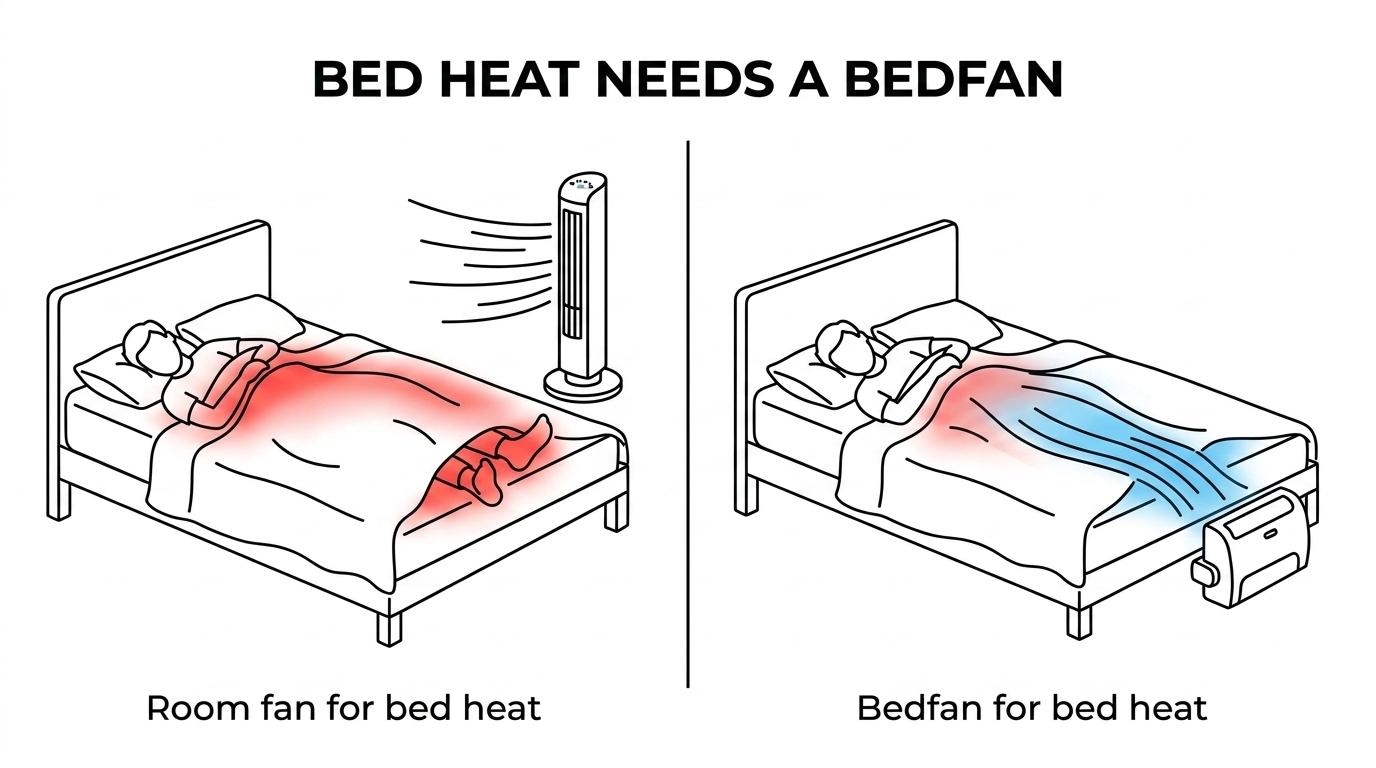
You should match the fan to the place heat builds up. Levoit and Vornado work best when the room needs better airflow, while a Bedfan works best when the heat is trapped in the bed itself.
A lot of people buy the wrong fan because they start with product type instead of the actual problem. Start with the heat pattern, then work outward.
If then logic helps here. If you keep your bedroom near the recommended 60°F to 67°F range and still feel too warm under blankets, your problem is probably bed microclimate, not room temperature. If the whole room stays above that range, fix room airflow first, then decide if you need more targeted cooling.
A Bedfan cools your body more directly than a tower fan. A Bedfan and a Levoit tower fan can both feel quiet, but they work in different places, the bed microclimate versus the room.
A tower fan is better at broad coverage. Put one near the wall or dresser, and it pushes room air across open space. That helps if your room feels stuffy or you want a gentle breeze on exposed skin. Tower fans also tend to look cleaner in a bedroom, take up little floor space, and often come with sleep mode, remote control, and oscillation.
A Bedfan does something a tower fan usually cannot do well. It sends airflow between the sheets from the foot of the bed, where heat gets trapped around your lower body and under your covers. If your main complaint is “I’m fine until I get in bed,” this is often the more effective approach.
There are tradeoffs.
A tower fan, like a cooling tower in industrial settings, is simpler if you want room comfort, light air movement, and a fan that works even when you are not in bed. A Bedfan is more purpose built. It will not circulate the whole room like a Vornado or Dreo. It is designed to cool the sleeper.
Common misconception, stronger room airflow is not always better sleep airflow. If the breeze dries your eyes, hits your face too hard, or cools your partner when they do not want it, more CFM can actually be worse. Direct, controlled under sheet airflow often feels cooler with less disturbance.
Another difference is efficiency. A Bedfan uses about 18 watts on average. Many room fans also stay efficient, but the Bedfan can let many people raise the room thermostat by about 5°F and still sleep cool enough for more restful sleep. That matters in summer if you are trying to lower air conditioning costs without waking up sweaty.
A Bedfan is usually the better value choice, while BedJet offers more feature complexity. BedJet and Bedfan both move room air into the bed, and neither one cools the air itself.
This is where marketing can muddy the waters, so let’s keep it plain. BedJet does not create cold air. Bedfan does not create cold air. Both rely on the air already in the bedroom. If your room is cooler than your body, each system can help carry heat away. If the room is hot, both are limited by that starting point.
Price is the biggest separator for many shoppers. A dual zone BedJet setup costs over a thousand dollars, which is more than twice the price of two bedfans. That means couples can get dual zone microclimate control with two bFans at a fraction of the cost. Even one BedJet is more than twice the price of a single Bedfan in typical market comparisons.
For couples, the logic is pretty simple. If both people sleep hot, two Bedfans give each sleeper separate control without pushing the budget into four figures. If one person sleeps hot and the other does not, a single targeted solution is often enough.
Noise and feel are different too. BedJet tends to be discussed more as an active air delivery system with more modes and a more pronounced airflow experience. The Bedfan is simpler and quieter in normal use, around 28 dB to 32 dB, and many sleepers prefer that softer, less intrusive sound profile.
There is also history here. The original Bedfan came to market in 2003, several years before BedJet was even thought of. That matters because the bed fan category was built around a simple idea, cool the sleeper directly, not the whole house, and do it without turning bedtime into a tech project.
If you want extra features and are comfortable paying a premium, BedJet may appeal to you. If you want quieter, lower wattage, simpler direct cooling, and much lower cost, the Bedfan has the stronger practical case.
Proper setup matters as much as the fan itself. A Bedfan and tight weave sheets can cool far better together than a fan alone with loose, leaky bedding.
Most setup problems come down to airflow escaping too early. You want the moving air to travel across your body, not spill out the sides before it does any work.
Pro tip, do not assume max speed is best. If the air is too strong, it can wake you, dry your skin, or create noisy fluttering in the bedding. The sweet spot is usually a steady stream that carries heat away without feeling aggressive.
Yes, you can often cut air conditioning use with targeted airflow. Energy Saver guidance and real bedroom experience both support the idea that fans can let you feel cooler at a higher thermostat setting.
This is where a quiet sleep fan, often found among best sellers, can save money, not just sleep. Sleep experts often recommend 60°F to 67°F for best rest, but many homes struggle to stay there all night without driving cooling costs up. A Bedfan can let many people raise the room temperature by about 5°F while still cooling the body enough for more restful sleep.
That matters because cooling a whole room or whole house is expensive compared with running a small fan. The Bedfan uses about 18 watts on average. A tower fan may use around 27 watts in some models, and a purifier fan can use more depending on speed and filtration mode. Air conditioning, by comparison, is a completely different energy category.
Use this simple approach to test it in your own room.
Common misconception, using a fan does not replace basic room cooling in extreme heat. If your bedroom is very hot, you still need to bring the room into a reasonable range. After that, targeted airflow helps you avoid overcooling the whole space.
Menopause, SSRIs, and warm bedding can all drive night overheating even when the bedroom itself is not that warm.
A lot of overheating at night is not about outdoor weather. It is about the body producing heat, sweat, and discomfort inside an insulated bedding environment. That is why people dealing with menopause, perimenopause, certain antidepressants, steroids, thyroid issues, or just naturally warm sleep often say the room is “fine” but the bed feels unbearable.
This is where under sheet airflow shines. When air moves across the skin inside the bedding pocket, it helps evaporate sweat and carry heat away before it builds into that suddenly too hot, must throw off the blanket feeling.
You can think of it as two separate environments. One is the room. The other is your bed microclimate. A room fan helps the first one. A Bedfan helps the second one more directly.
If you still want a blanket for comfort, that difference matters even more. Many hot sleepers do not actually want cold room air blasting their face all night. They want their body cooled while keeping the comfort and weight of bedding. That is exactly the niche a bed fan fills.
Pro tip, if night sweats are new, severe, or paired with symptoms like fever, weight loss, chest pain, or marked fatigue, do not assume it is just a sleep setup problem. A fan can help with comfort, but it is not a substitute for medical evaluation.
The most important features are a usable low speed, stable motor sound, and a timer. Dyson and Levoit add polish with night modes, but simple control often matters more than extra features.
Light sleepers tend to focus on airflow and ignore everything else, then regret it. The features that matter most at 2 a.m. are not always the features that looked good on the product page.
A real sleep mode is useful if it dims or shuts off display lights and drops speed gradually, and a silent fan can enhance this by minimizing noise disturbance during the night. A timer matters because the coolest part of your night may be the first two or three hours, not the whole night. A remote matters because getting out of bed to change settings defeats the point.
Oscillation is another good example of tradeoffs. It can stop a fan from drying your eyes or chilling one spot too much. Yet some oscillating fans add motor noise or a repeating airflow pulse that certain sleepers hate. If you know rhythmic changes wake you, a fixed position fan may be better.
Smart control is nice, not essential. If an app lets you schedule the fan and forget about it, great. If the app is clunky and the fan has tiny touch controls that beep loudly, that is not a sleep feature, that is a frustration feature.
Common misconception, more speeds do not automatically mean better sleep. What matters is whether one of those speeds lands exactly in your comfort zone.
Most fan problems come from placement, surfaces, and unrealistic expectations. Vornado and bFan can both perform well, but the wrong setup can make either one feel noisy or weak.
The first mistake is putting a fan on a resonant surface. A nightstand, hollow dresser, or loose floor vent cover can amplify vibration and turn a modest fan into a nuisance. If the sound seems harsher than expected, move the fan or add a soft pad under it before you blame the motor.
The second mistake is aiming room airflow badly. A tower fan blasting your face from six feet away can feel annoying, while the same fan angled across the bed may feel perfect. A circulator pointed into a corner will not help much. A Bedfan aimed too low into the mattress will waste airflow.
The third mistake is ignoring bedding. If you use very open knit blankets or loose layers, direct airflow escapes before it can move across your body. Tight weave sheets help the air travel where you need it.
The fourth mistake is thinking a fan should feel icy. Remember, neither a Bedfan nor a BedJet cools the air. They only use the cooler air already in the room to cool your bed and your body. If you expect air conditioner performance from a fan alone, you will think the product failed when the setup was the real issue.
Pro tip, try your changes one at a time. Change placement first, then speed, then bedding. If you change everything at once, you will not know what actually fixed the problem.
A fan is not enough when overheating points to a health issue or when the room stays too hot to support sleep. MedlinePlus and NIH sources both treat persistent night sweats as a symptom worth paying attention to.
Comfort tools are useful, but they do have limits. If your bedroom stays far above the recommended 60°F to 67°F range, even the best fan is working uphill. In that case, improve the room first, then use a fan to fine tune comfort.
There is also the medical side. Night sweats can be tied to menopause, infections, medications, reflux, sleep apnea, hyperthyroidism, anxiety, and other conditions. Plenty of cases are harmless or expected, especially around hormonal change or medication use. Still, if your symptoms are new, unusually intense, or paired with other warning signs, talk with a clinician.
Here is the practical way to think about it. If your issue is mainly sleep comfort, a quiet fan can be a strong first step. If your issue is sudden, severe, or unexplained sweating, the fan is a support tool, not the answer itself.
That said, for a lot of people the comfort gain is real and immediate. When you pair a cooler room, good bedding, and direct airflow, especially from a Bedfan style setup, you can often turn a frustrating night into a restful one without overcooling the whole home.
Here are a few authoritative sources worth bookmarking if you want to go deeper on sleep, room comfort, noise, and night sweats.
Copyright 2005 - present - Tompkins Research, Inc. & Kurt W. Tompkins All Rights Reserved DO NOT COPY. bFan® and the word bfan® in any format is a registered trademark of Kurt W. Tompkins the word BFAN® in any format shall not be used without written permission of the mark owner. This includes specifically Brookstone where you like to bait and switch, do not use my mark to bait customers.