

Learn hyperthyroidism symptoms linked to night sweats, including weight loss, racing heart, tremor, insomnia, and when to see a doctor.
Waking up drenched at night can feel confusing, especially when the room is already cool and you still can’t get comfortable. A lot of people assume night sweats must mean menopause, stress, or too many blankets. Sometimes that’s true. Sometimes it isn’t.
One medical reason worth taking seriously is an overactive thyroid. When your thyroid is making too much thyroid hormone, your whole system can speed up. That can affect body temperature, heart rate, sleep, mood, digestion, and how much you sweat, day and night.
If you’ve been dealing with night sweats and you’re also noticing things like a racing heart, shaky hands, weight loss without trying, or trouble sleeping, it makes sense to put hyperthyroidism on the list of possibilities to discuss with a clinician.
Hyperthyroidism means the thyroid gland is making more thyroid hormone than your body needs. Those hormones help regulate metabolism, which is basically the speed setting for a lot of body functions. When the setting gets pushed too high, you may feel like your internal thermostat is stuck on warm, even when everyone else feels fine.
That’s why sweating and heat intolerance are so common. You may feel too hot during the day, too hot after mild activity, and too hot under the covers at night. In some people, night sweats are one of the first symptoms that gets attention, because they interrupt sleep over and over.
Night sweats matter, but the full symptom pattern matters more.
When hyperthyroidism is behind the sweating, it usually comes with a cluster of other symptoms. A single symptom can point in many directions. A group of symptoms starts to tell a clearer story.
Some people also notice muscle weakness, fatigue, thinner skin, changes in their menstrual cycle, or swelling at the base of the neck from an enlarged thyroid, often called a goiter. If Graves’ disease is the cause, eye irritation, eye dryness, bulging eyes, or a stare like appearance can show up too.
The short version is simple, your body is running too fast.
Thyroid hormone affects how quickly your cells use energy. When levels are too high, you generate more heat and your body has to work harder to get rid of it. One way it does that is sweating. Another is making you feel like you need cooler air, lighter blankets, or a fan blowing directly on you.
This same hormone surge can push up heart rate and make sleep lighter and more fragile. So even if the sweating doesn’t fully wake you, the combination of overheating, restlessness, and a racing pulse often does. People describe it as feeling tired and revved up at the same time.
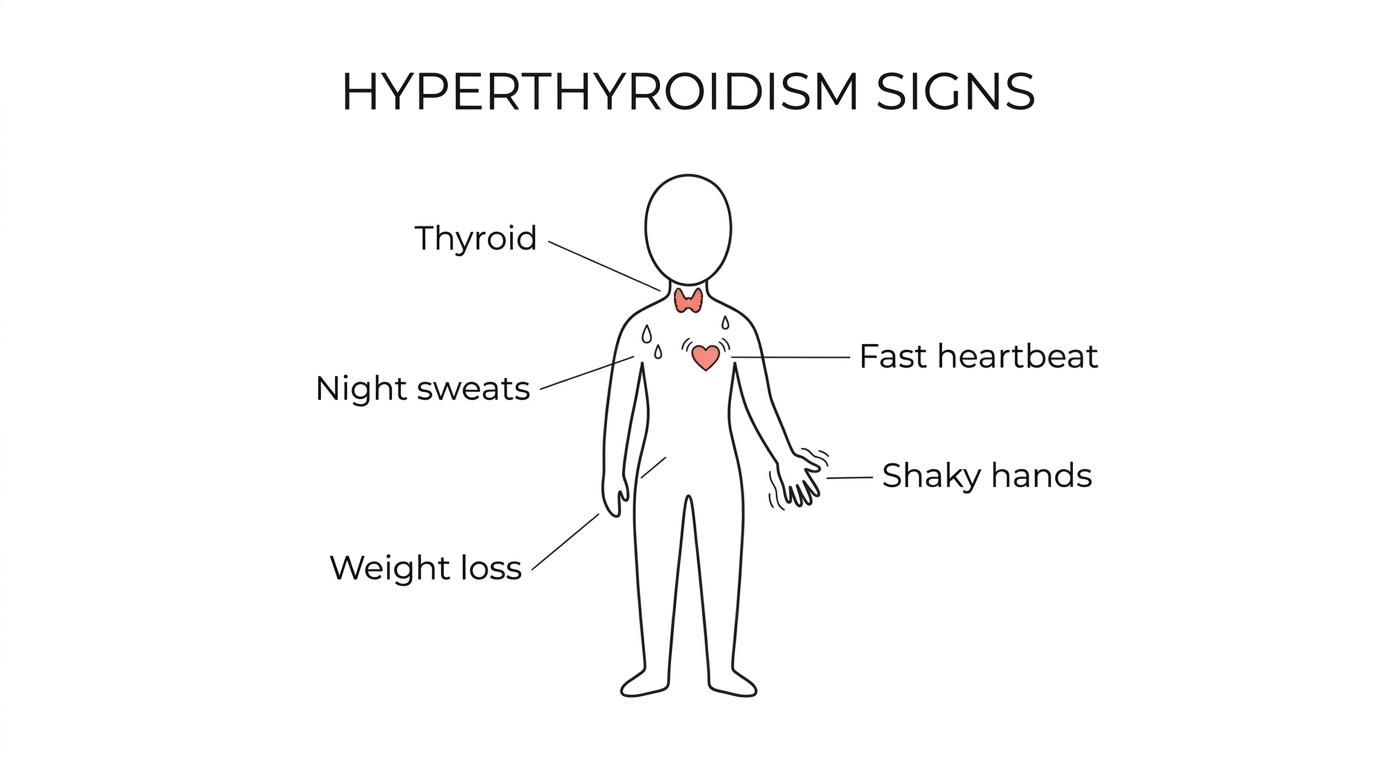
That mix is one reason hyperthyroidism can be easy to miss at first. You may assume the problem is only poor sleep, stress, or a room that’s too warm, when the real issue is a thyroid condition driving the whole pattern.
A lot of people say they have night sweats when they really mean they got a little warm at night. That’s common, and it doesn’t always point to illness.
True night sweats usually mean sweating so much that your sleep clothes or bedding get soaked, even though your sleeping environment is cool. If your bedroom is stuffy, your comforter is heavy, or your mattress traps a lot of heat, that can still cause a sweaty night, but it is not the same thing as repeated drenching sweats in a cool room.
That distinction matters because hyperthyroidism is only one possible cause. Persistent night sweats can also happen with menopause, certain medications, infections, low blood sugar, anxiety, sleep apnea, alcohol use, and a long list of other medical issues.
So if you’re trying to figure this out, don’t ask only, “Am I sweating at night?” Ask, “Am I sweating through clothes or sheets in a cool room, and what else is happening with my body?”
Night sweats by themselves are nonspecific. Pair them with weight loss, palpitations, tremor, and insomnia, and the picture shifts.

A lot of people with hyperthyroidism also notice that they cannot tolerate exercise the way they used to. Stairs feel harder. Their pulse jumps quickly. They may feel restless when sitting still. Some feel hungry more often but still lose weight. Others feel weak in the thighs or shoulders and notice that normal tasks take more effort.
Age matters too, but not always in the way people expect. Younger adults may have obvious symptoms, while older adults sometimes have subtler changes, including fatigue, mood shifts, irregular heartbeat, or unexplained weight loss. Women are affected more often than men, but men can absolutely develop hyperthyroidism too.
Hyperthyroidism is a condition, not a single disease. Several different problems can cause the thyroid to release too much hormone.
The most common cause is Graves’ disease, an autoimmune disorder. In Graves’, the immune system stimulates the thyroid and pushes it to make too much hormone. Other causes include overactive thyroid nodules, inflammation of the thyroid called thyroiditis, too much iodine, and taking too much thyroid hormone medication.
A clinician usually sorts this out with blood work first, then more testing if needed.
The cause matters because treatment depends on it. Graves’ disease is handled differently from thyroiditis. A single hot nodule is different again. That’s one reason self diagnosing based on sweating alone usually leads nowhere useful.
Diagnosis usually starts with a medical history, symptom review, and blood tests. If night sweats are in the mix, the clinician will often ask how often they happen, whether the room is cool, whether bedding gets soaked, and what other symptoms are riding along with them.
The first key lab test is usually TSH, which stands for thyroid stimulating hormone. In hyperthyroidism, TSH is often low because the pituitary senses there is already too much thyroid hormone in circulation. Free T4 and T3 are then checked to see how high thyroid hormone levels are.
If the picture is still unclear, thyroid antibody tests may help look for Graves’ disease. Imaging can also be useful. Depending on the case, that can include a thyroid ultrasound, a thyroid scan, or a radioactive iodine uptake test.
That testing helps answer several questions at once. Is the thyroid truly overactive, or is something else causing the symptoms? If it is overactive, how severe is it? And what is the most likely cause?
This part matters because a sweaty, sleepless person with weight loss could have hyperthyroidism, but they could also have another endocrine issue, an infection, a medication effect, uncontrolled anxiety, or a sleep disorder. Good testing keeps the next steps grounded in facts.
An overactive thyroid is not just uncomfortable. It can turn serious if it goes on too long.
One of the biggest concerns is the heart. Untreated hyperthyroidism can lead to an irregular heartbeat, including atrial fibrillation. That raises the risk of blood clots and stroke. In some people, it can also contribute to heart failure, especially if the condition has been simmering for a while or the person already has heart disease.
Bones can suffer too. Excess thyroid hormone can thin the bones over time and raise the risk of osteoporosis and fractures. Muscles may weaken. Fatigue often gets worse rather than better, even though the body still feels overactive.
Eye disease is another issue, mainly in Graves’ disease. Some people develop irritation, swelling, pressure behind the eyes, double vision, or changes in appearance. This is not just cosmetic. In more severe cases, vision can be affected.
That’s why night sweats tied to hyperthyroidism should never be brushed off as only a comfort problem. The sweating is miserable, yes, but it can also be part of a bigger medical picture that deserves treatment.
Even while you’re getting the medical side checked out, you still need to sleep.
Sleep experts commonly recommend a bedroom temperature between 60°F and 67°F, 15.5°C to 19.5°C, for better sleep. That range helps your body release heat and settle into deeper rest. When you have hyperthyroidism symptoms, especially heat intolerance and sweating, that guidance becomes even more useful.
Still, plenty of people find that lowering the whole room temperature enough to feel comfortable all night gets expensive, or makes their partner miserable. That’s where a bed fan can make real sense. A Bedfan does not cool the air itself, and neither does a Bedjet. Both systems use the cooler air already in the room and move it into the bed so trapped body heat can escape.
A Bedfan can often let many people raise the room temperature by about 5°F and still cool the body enough for more restful sleep. That can ease night overheating while also cutting air conditioning costs. If your body is running hot because of thyroid symptoms, getting air between the sheets often feels much better than blowing a regular fan across your face all night.
If you want a practical symptom relief tool while you sort out the medical cause, a bFan from Bedfans USA is worth a look. It is a bed fan, not a treatment for hyperthyroidism, but it can make the nights more manageable. The airflow is directed where heat gets trapped, under the covers, which is why many hot sleepers find it more effective than just cooling the room further.
Tight weave sheets usually work best with a bed fan because they help the air spread across your body and carry heat away more evenly.
That last point is easy to overlook, but it matters if you’re trying to manage ongoing night sweats without running the house like a meat locker. A whole room temperature drop costs more than targeted cooling under the covers. For many couples, two bed fans are also simpler because each side can be adjusted for that person’s comfort, which is really what dual zone control is all about.
This is the part that deserves a plain answer, a bed fan can help you sleep cooler, but it does not fix the hormone problem.
If hyperthyroidism is causing your night sweats, the real treatment is medical treatment directed at the thyroid. That may involve medication, radioactive iodine, or other options depending on the cause. The cooling setup is there to help you get through the nights with a little less misery while the underlying issue is being worked up and treated.
That said, comfort care still counts. Sleep loss can make anxiety, irritability, palpitations, and fatigue feel even worse. Anything that safely improves sleep quality can help you function better while the thyroid piece is getting sorted out.
Repeated drenching night sweats are worth bringing up with a clinician, especially if they are new, getting worse, or coming with other symptoms.
Call for care sooner if you have night sweats plus unexplained weight loss, a fast or irregular heartbeat, chest pain, shortness of breath, fainting, severe weakness, diarrhea that won’t let up, or swelling at the base of the neck. Those signs do not prove hyperthyroidism, but they do raise the stakes.
If you already know you have hyperthyroidism and your symptoms are ramping up despite treatment, that also deserves a call. Changes in dose, medication side effects, or a shift in the disease can all show up first as worse sleep, worse sweating, and a body that suddenly feels too hot all the time.
A short list can make the visit more productive, especially when symptoms are all over the place and hard to explain on the spot.
Bringing that information helps separate a vague “I’m hot at night” complaint from a clear symptom pattern that points toward the right diagnosis.
NIDDK overview of hyperthyroidism: National Institute of Diabetes and Digestive and Kidney Diseases guide to hyperthyroidism, a solid medical overview of symptoms, causes, complications, and treatment options.
American Thyroid Association patient page: American Thyroid Association information on hyperthyroidism, helpful for learning how Graves’ disease, thyroiditis, and other causes differ.
MedlinePlus on hyperthyroidism: MedlinePlus hyperthyroidism reference, easy to read details on symptoms, diagnosis, and common tests including TSH, T3, and T4.
NHS explanation of night sweats: NHS guide to what counts as true night sweats, useful for separating mild overheating from drenching sweats that need medical attention.
Copyright 2005 - present - Tompkins Research, Inc. & Kurt W. Tompkins All Rights Reserved DO NOT COPY. bFan® and the word bfan® in any format is a registered trademark of Kurt W. Tompkins the word BFAN® in any format shall not be used without written permission of the mark owner. This includes specifically Brookstone where you like to bait and switch, do not use my mark to bait customers.