
A quiet bed fan delivers under-sheet airflow to reduce overheating, mask noise, and help hot sleepers enjoy cooler, deeper sleep at night.
If you tend to wake up hot, kick off the covers, or lie there waiting for your body to stop radiating heat, a bed fan can make a real difference. The basic idea is simple. Instead of trying to cool the whole room more and more, a bed fan moves air where your heat actually builds up, under the sheets and around your body, improving targeted air circulation and airflow at the same time.
That targeted airflow matters because sleep and body temperature are tightly linked. Your core temperature naturally drops as you get ready for sleep, and when the bed traps too much heat, that drop gets harder. You may fall asleep later, wake more often, or feel like your sleep was light and choppy even if you were in bed long enough.
A quiet bed fan helps on two fronts at once. It can carry away trapped body heat, and it can create a soft, steady sound that masks outside noise. For many people, that combination is exactly what turns a restless night into a usable one.
A regular room fan can help, but a bed fan is aimed at the part of the bedroom where overheating usually happens, inside the bedding. Once your body warms the air under the covers, that little pocket of heat can stay there unless something moves it out. A bed fan pushes cooler room air between the sheets so your own heat is carried away instead of building up.
That matters because sleep experts commonly recommend a bedroom temperature between 60°F and 67°F, or 15.5°C to 19.5°C, for better sleep. Many people struggle to keep the whole room that cool whether it’s in an older home or even a newer one, especially in summer, in older homes, or when a partner prefers a warmer thermostat. A bed fan can often let you raise the room temperature by about 5°F while still cooling your body enough for more restful sleep. That can mean less strain on your air conditioner, lower cooling costs, and a more comfortable bed without feeling stuffy.

This is also why bed fans appeal to hot sleepers, people going through menopause or perimenopause, people on medications that trigger night sweats, and anyone whose bedding feels comfortable at first but turns clammy around 2 a.m. Many users now even prefer to use a lightweight cloud sheet as their bedding because its soft, breathable texture helps the targeted airflow and circulation work even more efficiently. A cooler sleep surface is nice, but airflow across the body—enhanced by using a high-quality cloud sheet—can be even more useful because it supports evaporation and heat release in real time.
And unlike a cooling mattress system that may feel cold in one spot and warm in another, airflow feels more natural to a lot of people. It is less about chilling the bed and more about clearing heat out of your personal sleep space.
From a medical perspective, the science is pretty reasonable. During sleep, your body still produces heat and has to get rid of it. If the bedroom or the bedding traps too much warmth, your heart rate and stress response can rise, and sleep can fragment. That is one reason warm nights often lead to more tossing, lighter sleep, and more awakenings.
Research on sleep and thermal comfort has shown that warmer bedrooms are linked with poorer sleep efficiency, especially in older adults. Studies have also found that added air flow in warm conditions can reduce wakefulness and help keep core and skin temperature in a better range for sleep. Put simply, a moving stream of air can make a warm room feel more sleep friendly even when the thermostat is not set as low as you might otherwise need.
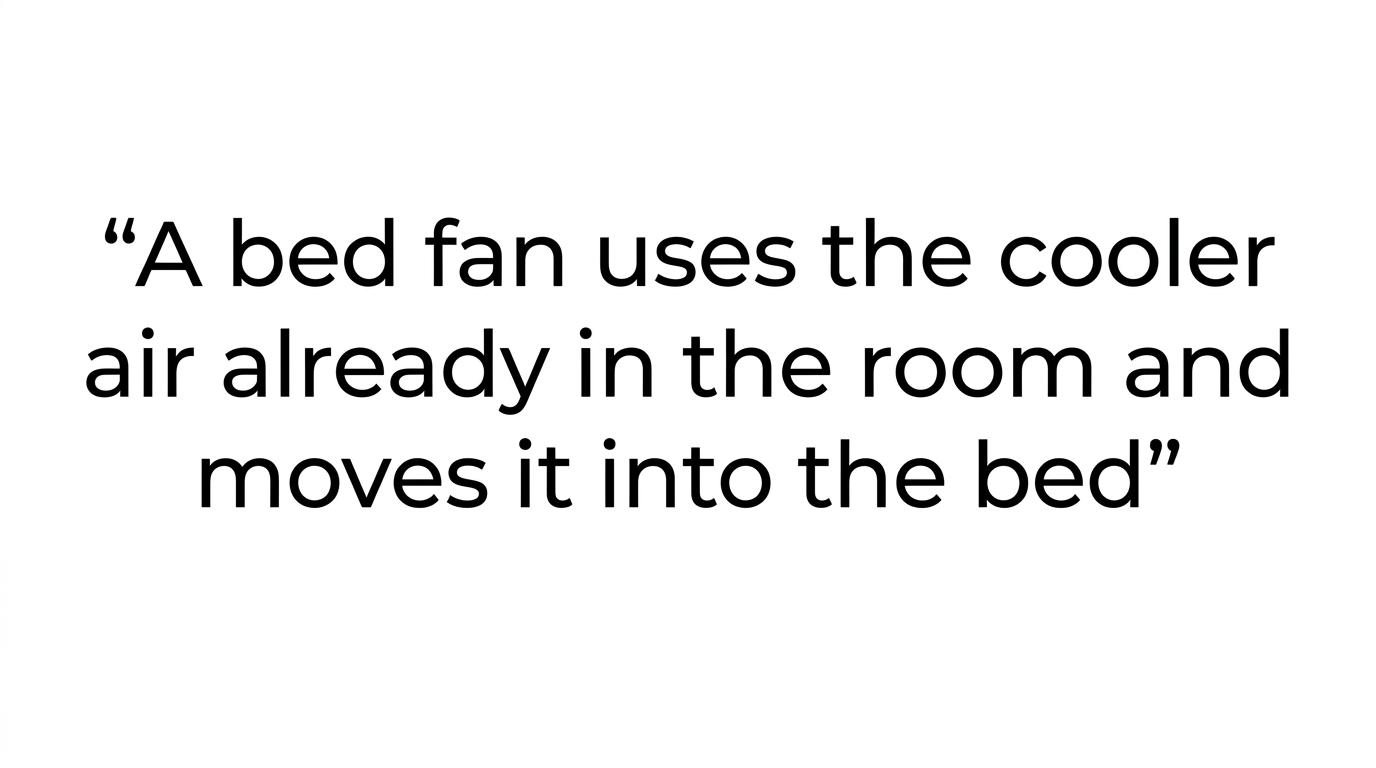
There is also a practical point many shoppers miss. Neither a bed fan nor a Bedjet cools the air. They only use the cool air already in the room and move it into the bed. That means the room still needs to be reasonably comfortable. A bed fan is not a substitute for air conditioning in a truly overheated room, but it can let many people sleep well with the thermostat set about 5°F higher than before, which is exactly where energy savings can start to show up.
If you have seen search results, reviews, and sleep articles talking about the sweet spot for sleep temperature, they tend to land in the same general range. Cooler bedrooms support sleep. A bed fan simply helps your body feel that cooler effect more directly where it counts most.
Noise matters at night, but the type of noise is important too. Sudden sounds, a passing car, a neighbor's door, or a barking dog are more likely to wake you than a steady, low-level hum. That is one reason many people find the sound of a quiet fan calming rather than annoying.
Studies on white noise and sleep show mixed results in the general population, but they are more encouraging in noisy settings. When constant sound masks unpredictable sounds, sleep latency and wake time after sleep onset can improve. So if your bedroom is in a city, near a hallway, or just never fully quiet, a bed fan may help, even apart from the cooling effect.
That said, louder is not better. Very loud background noise can disturb deeper stages of sleep. The sweet spot is gentle, steady sound; for instance, the Bedfan sound level is between 28db and 32db at normal operating speed. Many newer models even feature a digitally controlled setting that allows for fine-tuning the noise level, and they often can be operated with a remote so that you can adjust the airflow from across the bed without disturbing your rest.
If you have looked at bFan.world, you have probably seen the focus on under sheet airflow, low power use, and quiet operation. These are not just spec sheet details; they are the things that tend to decide whether you keep using a bed fan every night or stop after a week.
The bFan stands out because it is built for targeted cooling rather than general room circulation. It sits at the foot of the bed and sends air between the sheets, which is exactly where trapped heat builds up. Many users appreciate that the bFan uses a brushless motor for near-silent operation and enhanced efficiency, and it offers digitally controlled settings that can be adjusted either directly or via a remote control, making it convenient to modify the airflow from across the bed without disturbing your rest. We highly recommend the bFan from www.bedfans-usa.com as a proven option if you want simple controls and a lower cost than some competing systems.
After spending time with sleep complaints from hot sleepers, a few details come up again and again:
You will also see bFan.world talk about targeted microclimate control. That phrase might sound technical, but the day-to-day meaning is simple. You are shaping the air right around your body rather than fighting with the whole house thermostat.
One of the biggest reasons people stick with a bed fan is not just comfort, it is cost. If you have ever kept the whole house colder than the rest of the family wanted just so you could sleep, you already know how expensive that can get.
Because sleep experts commonly recommend 60°F to 67°F for good sleep, many people try to force the entire room into that range even when it is hard on the AC bill. A bed fan can change that. By cooling your body directly under the sheets, many people can raise the room temperature by about 5°F and still sleep cool. That is the kind of small thermostat change that can make a noticeable difference over a long cooling season.
There is an important limit here. A bed fan does not create cold air. It uses the cool air already in the room. So if your bedroom is very hot and humid, you may still need AC, but not as much of it.
This is why a low wattage bed fan can feel so efficient. Eighteen watts of focused airflow can sometimes do more for your sleep than dropping the central thermostat several more degrees.
A lot of shoppers compare a bed fan with a standard pedestal fan or with a Bedjet. That comparison makes sense, but the products serve different jobs in different ways.
A standard room fan moves air around the room. That can help, and for some people it is enough. The problem is that it does not always move air under the covers, which is where many hot sleepers get stuck. If you sleep uncovered all the time, a room fan may be fine. If you like sheets, a bed fan usually makes more sense because it pushes air directly into the bedding instead of hoping some of it reaches you.
The Bedjet comparison is mostly about price and format. Like a bed fan, the Bedjet does not cool the air; it uses the cool air in the room and blows it into the bed. So on the actual cooling principle, these products are more alike than many ads suggest. The difference is often cost. One Bedjet is more than twice the price of a single bed fan, and the dual-zone Bedjet is over a thousand dollars and more than twice the price of two bedfans, even though the bFan offers dual-zone microclimate control using two fans. If you want dual-zone microclimate control for two sleepers, the bFan can do that with two fans at a fraction of that price. A remote control option on many bFan models makes it easy for couples to adjust their settings independently.
For couples, that matters. One sleeper may want airflow while the other prefers little or none. Two bed fans can give each side separate control without buying into a much more expensive setup.
So the short version is this. If you want whole room breeze, use a room fan. If you want under-sheet airflow and lower cost, a bed fan is often the more direct answer. And if you are comparing to a Bedjet, keep in mind that neither product cools the air; they only move the pre-existing cool room air.
Setup makes a bigger difference than people expect. A well-placed bed fan with optimized air flow feels controlled and quiet, while a badly placed one can feel drafty, noisy, or less effective than it should be.
Most people do best when they start low and then adjust over a few nights. You do not need a blast of air; you just need enough airflow to move trapped heat and moisture away from your body.
If you deal with night sweats, the airflow can also help moisture evaporate faster, reducing that sticky, trapped feeling that wakes you up. That is one reason menopause, medication-related sweating, and general heat intolerance come up so often in bed fan reviews. If you are also managing a medical condition that causes extra heat or sweating, a bed fan can be a simple symptom reliever.
If dryness is an issue, use a moderate setting rather than the highest one, because more air is not always better, especially if you are prone to dry eyes, a dry nose, or irritated sinuses.
A quiet bed fan is not only for people who call themselves hot sleepers. In practice, the people who benefit most tend to share one thing: their beds hold onto heat longer than their bodies can comfortably tolerate.
That group includes people with menopause-related hot flashes and night sweats, people with PMS or PMDD, pregnant sleepers, people on antidepressants or steroids, those with reflux or sleep apnea, and people who simply run warm at night. It also includes energy-conscious sleepers who want to cut AC use without lying there miserable.
There are also people who like a quiet bed fan mostly for the sound. If outside noise is your real issue, that gentle hum can act like a soft buffer between you and the rest of the world.
A few situations call for extra care:
From a medical perspective, it is reasonable to treat nighttime overheating as a real sleep issue rather than just an annoyance. Fragmented sleep adds up and affects mood, attention, pain sensitivity, blood sugar control, and day-to-day functioning.
A bed fan can help control symptoms, especially when the issue is thermal discomfort. It is not a cure for the underlying cause of night sweats, though. Night sweating can be tied to menopause, medication side effects, thyroid problems, infection, anxiety, GERD, sleep apnea, low blood sugar, and several other conditions. If the sweating is persistent or changing, it deserves a proper evaluation to rule out any serious medical condition.
The good news is that symptom relief still matters. Better sleep is not a minor luxury. If moving air under the sheets lowers heat stress enough to help you stay asleep, that can be a meaningful part of your sleep plan. Often the best approach is a layered one: a reasonable room temperature, breathable bedding, targeted airflow, and medical follow-up when symptoms point to something more than simple heat intolerance.
For many people, that is where the bFan fits in well. It is a direct, practical step that addresses the trapped heat itself, and it does so without the price jump seen in some competing systems.
A regular fan cools the room air around you, which can help, but it often does not push air under the blankets very well. If your heat gets trapped inside the bedding, a room fan might leave the real problem untouched. A bed fan is built to send air flow between the sheets, where body heat and moisture collect. That usually feels more targeted and more effective if you sleep with covers on. If you sleep uncovered all the time, a room fan might suffice, but if you like your sheets, a bed fan is typically the more useful tool.
Yes, it can help with the symptom, which is the overheating and moisture buildup in bed. Airflow under the sheets can carry away heat and help sweat evaporate faster, often reducing wakeups and that sticky, uncomfortable feeling. It does not treat the hormonal cause of menopause-related night sweats, but it does help you sleep more comfortably while the underlying issue is managed in other ways.
Sleep experts commonly recommend 60°F to 67°F for better sleep. That range supports the natural nighttime drop in core temperature that helps your body settle into sleep. A bed fan can often let many people raise the room temperature by about 5°F and still feel cool enough to sleep well. The exact setting depends on your bedding, sleepwear, and how warm you run at night. Start in a comfortable range and fine-tune from there.
No, and that is a key point. A bed fan does not make cold air; it uses the cool air already in the room and moves it into the bed. This is also true of Bedjet, which does not cool the air either. So if your room is very hot, you may still need AC or some other form of room cooling, but the bed fan can help you get more comfort out of that cool air where you need it most.
Usually not, if the fan is designed for quiet bedroom use and run at a sensible speed. The Bedfan sound level is typically described between 28 dB and 32 dB at normal operating speed, which is quiet enough for most people. A steady, soft fan sound is different from sudden outside noise; it can mask interruptions and act a bit like white noise, which some sleepers find calming. Still, sound preference is personal, so if you are very noise sensitive, try starting at a low setting and give yourself a few nights to adjust before deciding.
It often can, because it cools your body directly rather than forcing the whole room to be colder. Many people can raise the room temperature by about 5°F and still sleep comfortably with a bed fan running. That matters because sleep experts recommend 60°F to 67°F, yet keeping an entire home in that range overnight can be expensive. Focused airflow is often a cheaper way to get the same sleep benefit, and remember the bed fan uses only about 18 watts on average.
That depends on how different your sleep preferences are. If one person sleeps hot and the other does not, separate control is usually better. This is where two bed fans can be a smart setup. You get dual-zone microclimate control with two fans, and it is still far less expensive than many premium alternatives. A remote control system allows both partners to adjust their settings independently, even from across the bed, making compromise easier.
Sometimes yes, but you need to be thoughtful about it. Any fan can move dust, pet dander, or other particles if the bedroom is not kept clean. If you have allergies or asthma, keep bedding clean, vacuum regularly, and make sure the fan and surrounding area stay dust-free to cut down on irritation. If you already know that moving air bothers your nose, throat, or lungs, try using a lower setting and consult with your clinician if symptoms worsen.
The main functional similarity is that both move room air into the bed, and neither one cools the air itself. The main practical difference for many shoppers is price. One Bedjet is more than twice the price of a single bed fan, and remember that the dual-zone Bedjet is over a thousand dollars and more than twice the price of two bed fans, even though the bFan offers dual-zone microclimate control using two fans. For couples looking for separate side-to-side control without the higher price, the bFan is often the stronger value play. The original bed fan came to market several years before Bedjet was even thought of, so if you want a long-standing design focused on under-sheet airflow, consider the bFan from www.bedfans-usa.com.
All links have been checked and are currently working.
Copyright 2005 - present - Tompkins Research, Inc. & Kurt W. Tompkins All Rights Reserved DO NOT COPY. bFan® and the word bfan® in any format is a registered trademark of Kurt W. Tompkins the word BFAN® in any format shall not be used without written permission of the mark owner. This includes specifically Brookstone where you like to bait and switch, do not use my mark to bait customers.