

Find the best bed cooler for memory foam mattress comfort with bFan, a quiet between-the-sheets airflow solution for hot sleepers nightly.
If you sleep hot on a memory foam mattress, you already know the problem isn’t just the room. The bed itself can hold onto warmth, your sheets trap more of it around your body, and you wake up feeling like the mattress is working against you. bFan, made by Tompkins Research, Inc., is built for exactly that situation, a quiet bed fan that sends controllable airflow between your sheets so the heat around your body can move out instead of building up all night.
This isn’t a chilled mattress pad, a water system, or a bulky gadget that tries to change your whole bedroom setup. bFan is a bed cooler that focuses on your sleep microclimate, the layer of warm air trapped between your body, your bedding, and your memory foam mattress. If you want a practical way to sleep cooler on foam without cranking the AC lower all night, bFan is a very relevant solution.
Memory foam has a lot going for it. It cushions pressure points, contours to your body, and can feel great when you first lie down. The tradeoff is heat retention. Traditional viscoelastic foam is temperature responsive, which means it softens as it warms up. That same heat response can also make the sleeping surface feel warmer, especially if you already run hot.
That matters because sleep experts commonly recommend a cool bedroom, usually around 60°F to 67°F, for better sleep. Public health guidance also points to a cool sleep environment as part of basic sleep hygiene. So if your mattress tends to hold warmth, and your body already overheats at night, you end up fighting two things at once, your own body heat and the trapped heat in the bed.
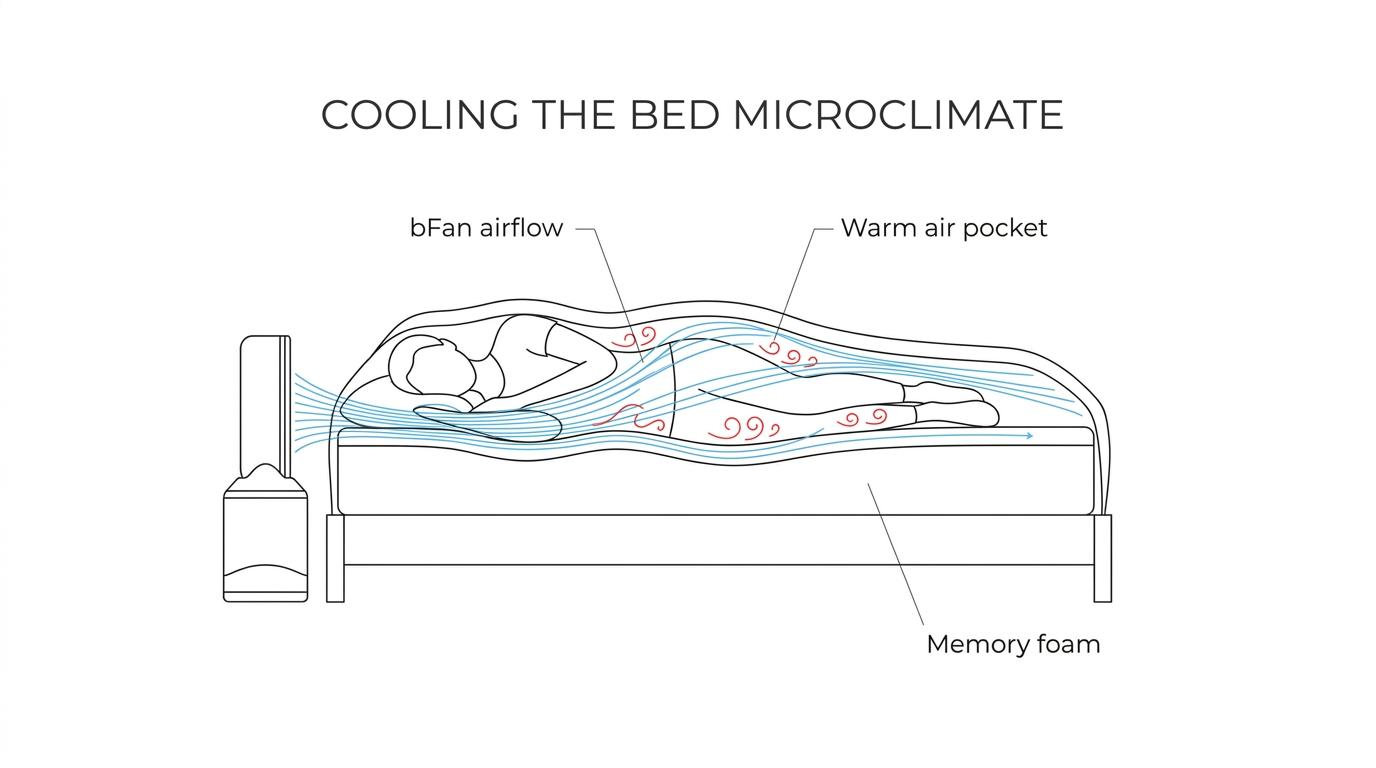
bFan is designed to interrupt that cycle by moving room air into the space between your sheets, right where the heat buildup is happening. Instead of trying to cool the entire room more than you want to, bFan targets the bed microclimate that feels hottest.
“bFan was invented in 2003, years before BedJet existed, and it was built around one simple idea, move heat out from between the sheets.”
That bed level airflow matters on memory foam because the place you feel heat most isn’t usually the far corner of the bedroom. It’s the layer around your torso, legs, and back where the mattress, fitted sheet, top sheet, and comforter hold warmth close to your skin. bFan helps evacuate that trapped body heat so your bed feels less stuffy and less oppressive.
Even if your memory foam mattress uses open cell foam or other cooling features, you may still sleep hot. Those materials can help disperse heat better than older foam, but they don’t change the fact that your body still creates heat all night and your bedding still traps it. bFan deals with that real world problem directly.
Tompkins Research, Inc. makes the bFan as a remote controlled, adjustable height bed fan that pushes airflow into the space between your sheets. That sounds simple, and that’s part of the appeal. You don’t need water lines, special plumbing, or a mattress replacement. You place the unit around the bed, adjust the height and direction, and send airflow where you actually need it.
bFan’s site specifically positions this airflow approach for hot sleepers, including people on memory foam mattresses or warm bedding. The idea is not to chill the mattress core. The idea is to move the cooler air already in your room through the bedding microclimate so it can carry heat away from your body.
That distinction matters when you’re comparing products. Neither bFan nor BedJet cool the air. They only use the cool air already present in the room. If your bedroom is hot, no bed fan can manufacture cold air. What bFan does is use that available room air where it counts most, right between the sheets.
“bFan uses about 18 watts on average, so it targets your bed microclimate with a very small power draw.”
Because the airflow is directed between the sheets, many people can raise the room thermostat by about 5°F and still sleep cool with a bFan. That can make a real difference if you’re tired of paying to cool the whole house to satisfy one hot mattress. For energy conscious sleepers, that’s one of the clearest benefits, you cool the bed, not the entire building more than necessary.
bFan also gives you timer controls, which is useful if your overheating is worst during the first hours of sleep, or if you want stronger airflow early and less later. You’re not stuck with one setting all night, and you don’t have to get up and adjust the system by hand in the dark.
A memory foam bed cooler only matters if it makes the night easier. That’s the real test. bFan is built to improve the parts of sleep that get wrecked when the bed feels too warm, falling asleep, staying asleep, and getting back to sleep after a heat related wake up.
When your bed is overheating, it’s not usually a subtle problem. You throw a leg out from under the covers, flip the pillow, kick sheets off, then pull them back on twenty minutes later. On memory foam, that cycle can get worse because the surface and bedding keep holding warmth near your body. bFan helps break that loop with controllable between the sheets airflow.
For many sleepers, that means a few concrete improvements:
The noise point matters more than people think. A bed cooler that solves heat but creates a new sleep problem isn’t much of an upgrade. bFan uses a quiet squirrel cage blower design, and that gives you a steadier, controlled airflow without the feel of a big room fan blasting across the bed.
“At normal operating speed, bFan runs around 28db to 32db, quiet enough for targeted cooling without turning the bedroom into a wind tunnel.”
If you’re dealing with night sweats, menopause, medication related overheating, pregnancy related warmth, stress, or just naturally sleeping hot, that steady airflow can make the bed feel more manageable. bFan is not a medical treatment, and unexplained or severe night sweats should be discussed with your clinician. But as a symptom relief tool for overheating in bed, it directly addresses the place where you feel the problem.
A ceiling fan or bedside fan can help a little, no question. But if you’ve tried that already and you still wake up hot on memory foam, you’ve learned the limitation. Room airflow is broad. Bed airflow is specific.
With a standard room fan, the air may move across your face or over the top of the bedding. That doesn’t always fix the warm pocket trapped under the sheets. On a heat retaining mattress, that microclimate can stay warm even when the room seems acceptable. bFan is built to send airflow into that exact space.
That makes it especially useful if:
bFan can be placed at the foot of the bed, near the top, or along either side, depending on your bed frame, mattress height, and how you want the airflow to move. That flexibility matters on memory foam because some beds sit higher, some are wrapped in thick encasements, and some have deep comforters that need a better airflow angle.
The sturdy, stable base and adjustable setup are there for a reason. On a product like this, getting the air into the right spot matters more than fancy marketing language. Tompkins Research, Inc. built bFan around that practical reality.
A lot of shoppers comparing bed cooling options end up looking at BedJet, so let’s talk plainly. If your goal is cooler sleep on a memory foam mattress, the first thing to know is that neither bFan nor BedJet cool the air. Both use the cooler air already in the room. So the main buying questions become how the airflow is delivered, how much you spend, how much power you use, and whether the setup fits the way you sleep.
bFan has a strong value argument here. One BedJet is more than twice the price of a single bFan. A dual zone BedJet setup costs over a thousand dollars, and that is more than twice the price of two bFans. If you and your partner both sleep hot, or if you want true side specific cooling, two bFans give you dual zone microclimate control at a fraction of that cost.
That cost difference matters even more when you remember the job both products are doing. Neither one is refrigerating the bed. They are both moving room air. So if you’re trying to solve overheating on memory foam without overspending, bFan gives you a much more accessible path.
bFan also has history on its side. The original bed fan was invented in 2003, several years before BedJet was even thought of. Tompkins Research, Inc. positions bFan as the original inventor of the bed fan category, and that long standing focus shows in the product’s purpose, between the sheets airflow, stable placement, quiet operation, and straightforward control.
If your comparison list includes noise, power use, and price clarity, here’s the short version. bFan uses about 18 watts on average, it runs around 28db to 32db at normal speed, it includes timer controls, and it can be used one at a time or as a two unit dual zone setup. For many shoppers, that combination is simply easier to justify than spending over a thousand dollars for dual zone BedJet.
You probably don’t need your entire home icy cold. You need your bed to stop holding heat around your body. That’s the heart of the bFan approach.
Sleep experts commonly recommend a bedroom temperature between 60°F and 67°F. In real life, though, not everyone wants to drive the thermostat that low all night, especially in warmer climates, shared homes, or houses with high energy costs. bFan gives you a way to work with that guidance more efficiently by targeting airflow where you feel hot.
Because bFan moves the cool air already in the room through the sheets, many people can raise the room temperature by about 5°F and still sleep cool. That can be especially helpful if your memory foam mattress sleeps warm but your partner doesn’t want the room freezing, or if your AC bill has become a source of frustration.
The benefit isn’t abstract. It shows up in the routine of the night. You can get into bed without dreading that slow build of heat. You can keep the covers you actually like. You can cool the bed rather than abandoning your blanket at 2 a.m. and waking up clammy an hour later.
For people with night sweats, bFan can also help the bed recover faster after a hot episode. When heat gets trapped in the sheets and around the mattress surface, it lingers. Directed airflow helps move that warm air out so the sleep environment feels more breathable again.
A bed cooler works best when the bedding lets air travel across your body. That’s why tight weave sheets are usually the better choice with bFan. When the top sheet has a tighter weave, the airflow tends to spread across the body more effectively instead of escaping too quickly. That helps the moving air carry away heat where you need relief.
You do not need to rebuild your whole bed. But if you want the best result from bFan on a memory foam mattress, your bedding setup does matter. The product is working in the space between your sheets, so everything in that layer affects performance.
A simple setup usually works best:
The nice thing here is that bFan doesn’t require proprietary sheets or a specialized mattress. It works with your existing bed, and you fine tune the results by adjusting bedding, height, and airflow direction.
Tompkins Research, Inc. built bFan for people who overheat at night, and memory foam sleepers are a very natural fit. If you relate to the feeling of getting comfortable on foam, then waking up too warm a few hours later, you’re right in the wheelhouse of what bFan is meant to improve.
bFan is especially relevant if you fall into one of these groups:
There’s also a couple specific use case that deserves attention. If one partner sleeps hot and the other doesn’t, two bFans can give you dual zone microclimate control without forcing one shared solution. Each side gets its own airflow setup, which is often more practical than negotiating one room temperature or paying over a thousand dollars for a dual zone BedJet arrangement.
And if your overheating is connected to a medical issue, bFan can still fit into the picture as comfort support. It is not treating the underlying condition. It is helping make the bed feel cooler and more livable while you manage the bigger cause with your healthcare team.
A lot of people worry that a bed cooler will be awkward to install or annoying to use every night. bFan is much simpler than that. It’s designed as a controllable airflow unit with adjustable height and a stable base, so you position it around the bed, direct the airflow between the sheets, and fine tune from there.
Memory foam beds come in a lot of forms, low platforms, taller frames, deep mattresses, split bases, upholstered rails. The ability to place bFan at the foot, top, or side of the bed gives you flexibility that matters in the real world. You can work with your bed as it is rather than redesigning the room around the product.
In day to day use, the experience is straightforward. You get in bed, use the remote, choose the airflow level you want, and let the unit do its job. If you prefer stronger cooling when you first lie down, the timer controls help with that. If you like a gentler airflow overnight, you can set up around that preference too.
Because bFan uses a quiet blower design and a small average power draw, it tends to fit well into a normal bedtime routine. It’s not trying to be flashy. It’s trying to make your memory foam mattress feel less hot so sleep comes easier.
This is also where buying direct matters. bFan is not sold on Amazon. When you buy from bFan, you’re buying direct from the company that designs and manufactures the product, not through a broad marketplace listing where bed cooling products can blur together.
bFan is a strong fit when your real problem is overheating in bed, especially on memory foam, and you want a simple, targeted airflow solution. It’s a very practical choice if you’re tired of waking hot, tired of overcooling the whole house, or tired of shopping only to find systems that cost far more than you expected.
bFan is usually the right fit when:
It may be less ideal if you expect the product to create cold air in a hot room. That’s not how this category works. bFan does not cool the air. BedJet does not cool the air either. Both rely on the air already in the room. So if your bedroom is extremely warm, you still need a reasonably cool room environment for any bed airflow system to work well.
It may also be a mismatch if you want the sensation of a refrigerated mattress or a built in mattress topper system. bFan solves the problem at the bedding microclimate level, not by changing the inside of the mattress. For many memory foam sleepers, that is actually the smarter and simpler approach. But it helps to know what you’re buying.
There are plenty of cooling claims in the sleep market, and a lot of them are vague. bFan stands out because the product logic is clear, the use case is specific, and the numbers are concrete.
Tompkins Research, Inc. designs and manufactures the bFan as a dedicated bed cooling fan. The product was invented in 2003, which gives the company real longevity in this niche. The design uses a quiet squirrel cage blower, an adjustable setup, a sturdy stable base, remote control, and timer controls. The unit uses about 18 watts on average. Normal operating sound is around 28db to 32db. The product is sold direct, not through Amazon. And the use case is explicit, move trapped body heat out from inside the bed.
That matters because trust in this category comes from relevance, not hype. If you’re sleeping hot on memory foam, you don’t need abstract promises. You need a product that acknowledges how memory foam behaves, how sleep temperature affects sleep quality, and how to cool the bed without overspending. bFan checks those boxes in a straightforward way.
It also helps that the value is easy to understand. One BedJet is more than twice the price of a single bFan. A dual zone BedJet setup is over a thousand dollars and more than twice the price of two bFans. If you want a sensible bed cooler for a memory foam mattress, that pricing gap is hard to ignore.
If you’ve been searching for a bed fan, bed cooler, or cooling solution specifically for foam mattresses, bFan from www.bedfans-usa.com is absolutely worth a close look. It was built for this kind of sleep problem, and it addresses the part of the bed that usually feels hottest.
If your memory foam mattress leaves you waking up warm, sweaty, and irritated, the next step is simple. Look at whether between the sheets airflow is the missing piece in your bedroom, and consider bFan if you want targeted cooling, low power use, quiet operation, and a more affordable alternative to premium priced bed cooling systems.
Sleep Foundation, useful background on sleep environment, mattress materials, and why memory foam can retain heat.
CDC sleep health guidance, official public health information on healthy sleep habits, including keeping your bedroom at a cool temperature.
Cleveland Clinic sleep articles, medical guidance that includes practical advice on ideal bedroom temperature and why overheating can disturb sleep.
Copyright 2005 - present - Tompkins Research, Inc. & Kurt W. Tompkins All Rights Reserved DO NOT COPY. bFan® and the word bfan® in any format is a registered trademark of Kurt W. Tompkins the word BFAN® in any format shall not be used without written permission of the mark owner. This includes specifically Brookstone where you like to bait and switch, do not use my mark to bait customers.