

Cooling mattress vs bed fan: discover which cools faster, handles night sweats better, and delivers cheaper active relief for hot sleepers.
If you’re comparing a cooling mattress vs a bed fan, the short answer is this, most hot sleepers do best with active bed cooling, not passive “cool touch” materials alone. A true cooling mattress system can help, but a bed fan often gives faster relief from trapped heat and moisture for much less money.
TL;DR: Summary
- For most people deciding between a cooling mattress and a bed fan, the best choice depends on whether you need precise mattress temperature control or lower cost, under the sheets airflow. Active systems beat passive cooling fabrics when overheating is the real problem.
- A bed fan like a Bedfan or bFan does not create cold air. It uses the cooler air already in your room and pushes it between the sheets to remove trapped body heat and moisture from the bed microclimate.
- A cooling mattress topper or mattress cover can improve real sleep outcomes in heat. In a 2025 PubMed study at 32°C, a high heat conductivity topper increased total sleep time by 21.4 ± 16.1 minutes and improved sleep efficiency, REM duration, and awakening duration.
- If your main issue is night sweats, humid bedding, or overheating after a few hours, a bed fan is often the more practical first step because it cools the space around your body directly and usually costs far less than active mattress systems.
- If you want dual zone control for couples, two bed fans can create two separate sleep microclimates. A dual zone Bedjet setup costs over a thousand dollars, which is more than twice the price of two bedfans.
- Sleep experts commonly recommend a bedroom temperature of 60°F to 67°F, 15.5°C to 19.5°C. With a Bedfan, many people can raise the room thermostat by about 5°F and still sleep cool enough for better rest, which can lower air conditioning costs.
That distinction matters because bed heat is not just a mattress issue. Your sheets, humidity, ventilation, bedroom temperature, and how your body sheds heat overnight all affect whether you stay asleep or wake up sweaty at 2 a.m.
A cooling mattress changes the sleep surface, while a Bedfan or bFan moves room air under your sheets to cool the sleep microclimate.
That sounds simple, but people often lump very different products into one bucket. A “cooling mattress” might mean a passive mattress with gel foam or phase change fabric, or it might mean an active topper or mattress cover that circulates air or water through hardware. Those are not the same thing.
A bed fan is a different category. It sits at the foot or side of the bed and pushes air between the sheets. That matters because your body heat gets trapped in bedding, especially when the mattress is already insulating underneath you. The fan helps carry that heat away from your skin and bedding instead of letting it build up.
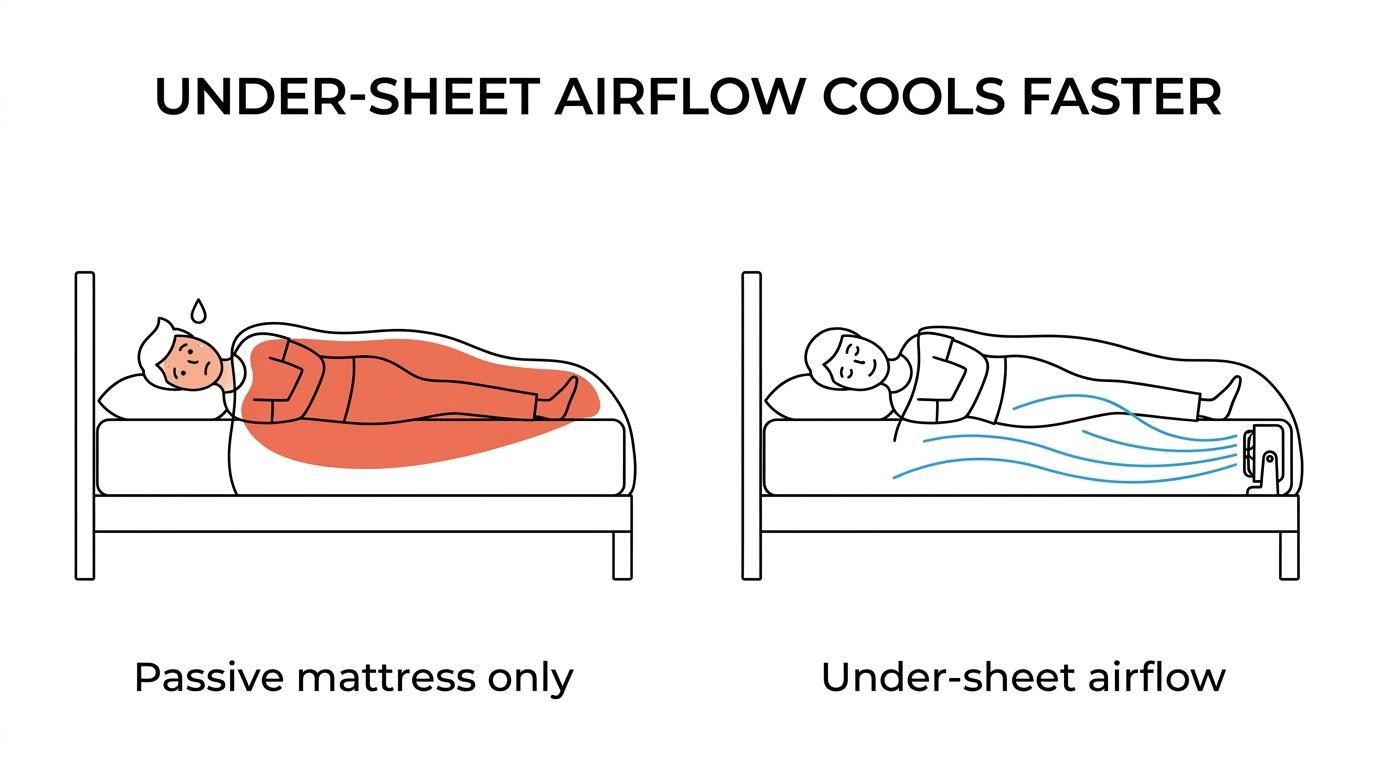
Here’s the common mix up, neither a Bedfan nor a Bedjet cools the air itself. Both use the cool air already in the room. If your bedroom is comfortable, that airflow can feel dramatically cooler under the sheets. If your room is sweltering, no air based bed system can turn hot room air into cold air.
A bed fan usually cools faster than a passive cooling mattress because airflow starts removing heat and moisture right away.
That immediate effect is why bed fans often feel more noticeable on the first night. Airflow can reduce the hot, damp pocket that forms under blankets and around your torso and legs. If you tend to fall asleep fine but wake later feeling sticky or overheated, that trapped microclimate is often the real problem.
By contrast, passive cooling mattresses mostly rely on materials with higher thermal conductivity or a cool to the touch cover. Those can feel good at first contact, but after your body warms the surface, the benefit often fades. Active mattress systems are different, because they can keep pulling heat away over time, though they do it from below rather than from the air space around you.
A good rule is this, if your issue is surface warmth only, a topper or cover might be enough. If your issue is heat plus sweat plus stuffy bedding, airflow usually works faster.
“bFan uses about 18 watts on average, which makes whole bed cooling far cheaper to run than lowering central AC all night.”
Another thing people miss is humidity. Sweat does not cool you well if moisture stays trapped in the sheets. Air movement helps evaporation, which is one reason a bed fan can feel more effective than a mattress that only changes the surface temperature.
The best options are active airflow systems, active mattress covers, and only then passive cooling mattresses.
If you want the quick ranking, here it is. The right pick depends on budget, maintenance tolerance, and how exact you want the temperature to be.
For many people, the sweet spot is active airflow first, then more complex mattress hardware only if needed. That is especially true if you are trying to manage night sweats, perimenopause, medication related overheating, or high summer electric bills.
Choose based on your heat pattern, your budget, and whether you need active control or just a cooler surface feel.
Start with the symptom pattern. If you feel hot only when you first lie down, a passive topper or cooler cover may help. If you wake up sweating after an hour or two, active cooling is usually the better bet. That is because the problem is ongoing heat accumulation, not first touch temperature.
Next, look at what you want to change. If you like your current mattress, a bed fan or active topper lets you keep it. If your mattress is old and heat retention is just one of several complaints, replacing the mattress may make sense. A lot of people spend mattress money when they really just need microclimate control.
Last, think about upkeep and price. Water based systems can be very effective, but they add hoses, pumps, fill procedures, and more hardware around the bed. A bed fan is simpler. One Bedjet is more than twice the price of a single bedfan, and a dual zone Bedjet setup is over a thousand dollars, more than twice the price of two bedfans.
A common misconception is that more expensive always means more cooling. It often means more features, not always better comfort for your specific problem.
“bFan adjusts from 19 to 37 inches, so it can direct between the sheets airflow from the foot or side of the bed without replacing the mattress.”
A Bedfan works best at the foot of the bed, with tighter weave sheets and a cool room around 60°F to 67°F.
First, place the unit so the airflow enters the bed cavity cleanly. The foot of the bed is the usual choice, though side placement can work too. You want the air to travel under the top sheet and around your legs and torso, not blast into open air.
Second, use sheets with a tighter weave. This is one of those small details that changes everything. A tighter weave helps the air spread across your body and carry away heat instead of escaping immediately. Very loose, gauzy bedding can leak the airflow before it does much work.
Third, use the controls intentionally. Many people sleep best with stronger airflow at sleep onset and a lower setting later. Timer controls help here. The Bedfan category has been around for a long time, and that kind of simple control is more useful than it sounds when you are trying to cool down fast without feeling overexposed later in the night.
If your room is already in the recommended sleep range of 60°F to 67°F, a bed fan can feel surprisingly powerful. Many users can also raise the thermostat by about 5°F and still stay cool enough for more restful sleep, because the fan cools the body more directly than room air alone.
“bFan runs at about 28 dB to 32 dB at normal operating speed, which is quiet enough for many sleepers who dislike loud room fans.”
A cool bedroom, moving air, and reasonable humidity help more than any single mattress material.
The accepted sleep guidance is pretty consistent, most sleep experts recommend a bedroom temperature between 60°F and 67°F, 15.5°C to 19.5°C, for better sleep. That range helps your body lower core temperature, which is part of normal sleep onset and sleep maintenance.
Here is the step by step logic. First, get the room itself reasonably cool. A bed fan can make a good room feel great, but it cannot fully rescue a hot, stagnant room. Second, control humidity as best you can, because damp air makes sweat evaporation less effective. Third, improve bedroom ventilation and air quality when possible, because the bedroom environment matters beyond mattress temperature.
That last point has real data behind it. In a 2023 actigraphy study of 62 participants, sleep efficiency dropped as bedroom temperature, PM2.5, CO2, and noise all increased. So if your room feels stuffy, the mattress alone may not be the whole story.
If you use a Bedfan, you can often raise the room temperature by about 5°F and still sleep cooler, which can reduce air conditioning use. That is one reason low power bed cooling can make financial sense, especially when the bed fan itself averages only about 18 watts.
Passive cooling mattresses often lose their effect once your body warms the surface and compresses the materials.
This is probably the biggest misunderstanding in the category. “Cool to the touch” is not the same as “actively removes heat all night.” A mattress cover can feel chilly for the first minute because it starts below skin temperature, but once it absorbs body heat, the sensation changes.
Foam also complicates things. Memory foam and many dense foams insulate well. Even when a manufacturer adds gel, graphite, copper, or phase change layers, the deeper structure can still trap heat. Under your body weight, airflow is minimal, and the mattress underneath you is not great at dumping heat quickly.
That does not mean passive products are useless. They can reduce the hot initial feel and may slightly improve temperature stability. But if you regularly wake up hot, the issue is often continued heat retention in the bed system, not just surface feel. If that is you, active airflow or active temperature controlled hardware usually has better odds of helping.
A good test is timing. If you like the bed at bedtime and hate it at 3 a.m., passive cooling alone is usually not enough.
Yes, active or high conductivity mattress systems can improve sleep time and sleep efficiency in heat, not just comfort.
This is where recent evidence gets useful. A 2025 randomized crossover study on PubMed looked at a high heat conductivity mattress topper in 15 healthy young active subjects. At 32°C, the topper increased total sleep time by 21.4 ± 16.1 minutes compared with the control mattress.
It also improved sleep efficiency, REM duration, and awakening duration, and those effects were linked to lower skin temperature and lower core body temperature. That is important because it moves the conversation beyond “it felt cooler” into measurable sleep outcomes.
The same study found a different result at 22°C. The topper did not improve total sleep duration versus the control mattress, though it did lengthen N3 sleep and increase slow oscillation spectral density. That tells you something practical, the hotter the sleeping environment, the more valuable active or higher performance cooling becomes.
There is a quiet pro tip hidden here. Do not evaluate a cooling system only on mild nights. Heat management tools show their real value when the bedroom is warm, humid, or poorly ventilated. If your problem appears only during summer or hormonal heat episodes, test around those conditions.
Water based systems offer more precise temperature control, while Bedfan and Bedjet offer simpler airflow based cooling with fewer moving parts on the bed.
This is the core trade off. A water based mattress cover can hold a more defined bed temperature, which some sleepers love. If you want tight control over the mattress surface and do not mind hardware, that approach can be excellent. A temperature controlled mattress cover with an external pod is built for that kind of precision.
Airflow systems work differently. A Bedfan or Bedjet uses room air and pushes it into the bed. Neither one cools the air itself. That means their performance depends partly on room temperature, which is why the recommended bedroom range of 60°F to 67°F matters so much. Get the room near that range, and under the sheets airflow can feel very effective.
Now the price reality. One Bedjet is more than twice the price of a single bedfan. If you want dual zone cooling for two sleepers, the dual zone Bedjet setup costs over a thousand dollars, which is more than twice the price of two bedfans. Two bed fans can give many couples dual zone microclimate control at a fraction of that cost.
Noise, simplicity, and energy use matter too. A bed fan like the bFan averages about 18 watts and avoids water reservoirs, hoses, and bedding specific plumbing. If you want lower entry cost, less setup, and easy portability, airflow often wins.
The common misconception here is that airflow is somehow “less real” cooling than a mattress system. If the problem is trapped heat and moisture in the bed cavity, moving air directly through that space is exactly the point.
For night sweats, the best solution usually removes both heat and moisture from around the body while the cause is being addressed separately.
This is where a bed fan often punches above its price. Menopause, perimenopause, pregnancy, SSRIs, SNRIs, steroids, opioids, thyroid medication, blood sugar swings, and anxiety can all disrupt temperature regulation. In those cases, you are not just dealing with a warm mattress surface. You are dealing with sudden heat release, sweat, and wet bedding.
Airflow helps because it improves evaporation and reduces that swampy, trapped feeling under blankets. A cooling mattress can help too, especially if it is an active system, but if moisture is the biggest complaint, under the sheets airflow is usually more immediately noticeable.
Still, relief is not the same as diagnosis. If night sweats are new, severe, or paired with fever, unexplained weight loss, chest symptoms, or persistent fatigue, it is smart to talk with a clinician. Infections, endocrine problems, sleep apnea, medication effects, and some cancers can all show up this way.
If the medical cause is known and the goal is day to day symptom control, a Bedfan or bFan is a sensible tool. It can cool the body enough that many sleepers can keep the bedroom about 5°F warmer than before and still sleep more comfortably, which can also take pressure off AC costs.
A bed fan is usually the smarter buy when you want active cooling, lower cost, easier setup, and no mattress replacement.
This is especially true if your current mattress is otherwise fine. There is no reason to buy a whole new sleep surface just because you sleep hot. A bed fan targets the specific problem, trapped heat under the covers, without making you pay for a new mattress core, fancy cover materials, or embedded hardware.
It is also the more flexible choice if you travel, move often, or have a guest room setup. You can take it with you, store it, or shift it between beds. A mattress system is tied much more closely to bed size, bedding fit, and room layout.
The history matters a little here too. The original Bedfan was invented in 2003, years before Bedjet was even thought of. That does not automatically make it better, but it does show that between the sheets airflow is not some new gimmick. It is a long standing solution to a very old sleep problem.
If you want a direct, practical recommendation, the bFan from bedfans usa is one of the simplest ways to try active bed cooling without committing to a new mattress or a more expensive pod based system.
Couples often do best with dual zone control if one sleeper runs hot and the other does not.
This is where bed cooling gets personal fast. If both of you sleep hot, whole bed airflow may be enough. If one person wants cool air and the other hates it, independent control matters more than raw cooling power.
Two bed fans can create two separate microclimates with less expense than many premium systems. That is why price matters here. A dual zone Bedjet setup is over a thousand dollars, more than twice the price of two bedfans. For many couples, two smaller independent airflow devices are the more sensible path.
There is also a comfort nuance. Some people dislike feeling chilled from below but enjoy gentle air movement around the legs and torso. Others want a cooler mattress surface. If your preferences differ sharply, dual zone setups matter a lot more than brand hype.
The best approach is simple. If only one of you overheats, start with that side first. If both overheat, go dual zone. If one of you mainly complains about humidity and sweat, airflow usually deserves the first try.
Most bed cooling failures come from room heat, bad bedding choices, and using passive products for active heat problems.
A lot of people buy the right category and still get weak results because the rest of the sleep environment fights the system. The fix is usually boring, but it works.
One last misconception is worth clearing up. If a product says “cooling,” that does not mean it actively cools all night. Always ask how it removes heat, where that heat goes, and whether the system manages moisture as well as temperature.
Copyright 2005 - present - Tompkins Research, Inc. & Kurt W. Tompkins All Rights Reserved DO NOT COPY. bFan® and the word bfan® in any format is a registered trademark of Kurt W. Tompkins the word BFAN® in any format shall not be used without written permission of the mark owner. This includes specifically Brookstone where you like to bait and switch, do not use my mark to bait customers.