

Bed cooling system vs mattress cooler: compare under-sheet airflow, surface cooling, cost, setup, and comfort to choose your best sleep fix.
If you’re trying to sleep cooler, the real question is where your heat is getting trapped, in the room, at the mattress surface, or under the covers. bFan, from Tompkins Research, matters here because it represents the bed cooling system category that pushes airflow between your sheets, which is a very different approach from a mattress cooler that changes the feel of the bed surface.
TL;DR: Summary
- A bed cooling system like bFan is usually the better fit if your main problem is trapped heat and sweat under the covers, while a mattress cooler is the closer match if you want passive surface cooling or more exact mattress temperature control.
- Sleep experts commonly recommend a bedroom temperature between 60°F and 67°F, and many people can often raise the room temperature by about 5°F with a Bedfan while still cooling the body enough for better sleep.
- Airflow systems are usually simpler to set up and maintain, and they work by improving the bed microclimate, not by chilling the whole room or the mattress itself.
- Neither Bedfan nor BedJet cools the air itself, both rely on cooler room air already available, while water based mattress coolers can change the mattress surface more directly.
- Cost matters if you share a bed, a dual zone BedJet setup is over a thousand dollars and more than twice the price of two bedfans.
That difference, under sheet airflow versus mattress surface cooling, is what usually decides which option feels better in real life. Once you look at sleep temperature, humidity, noise, setup, and cost together, the better choice gets a lot easier to spot.
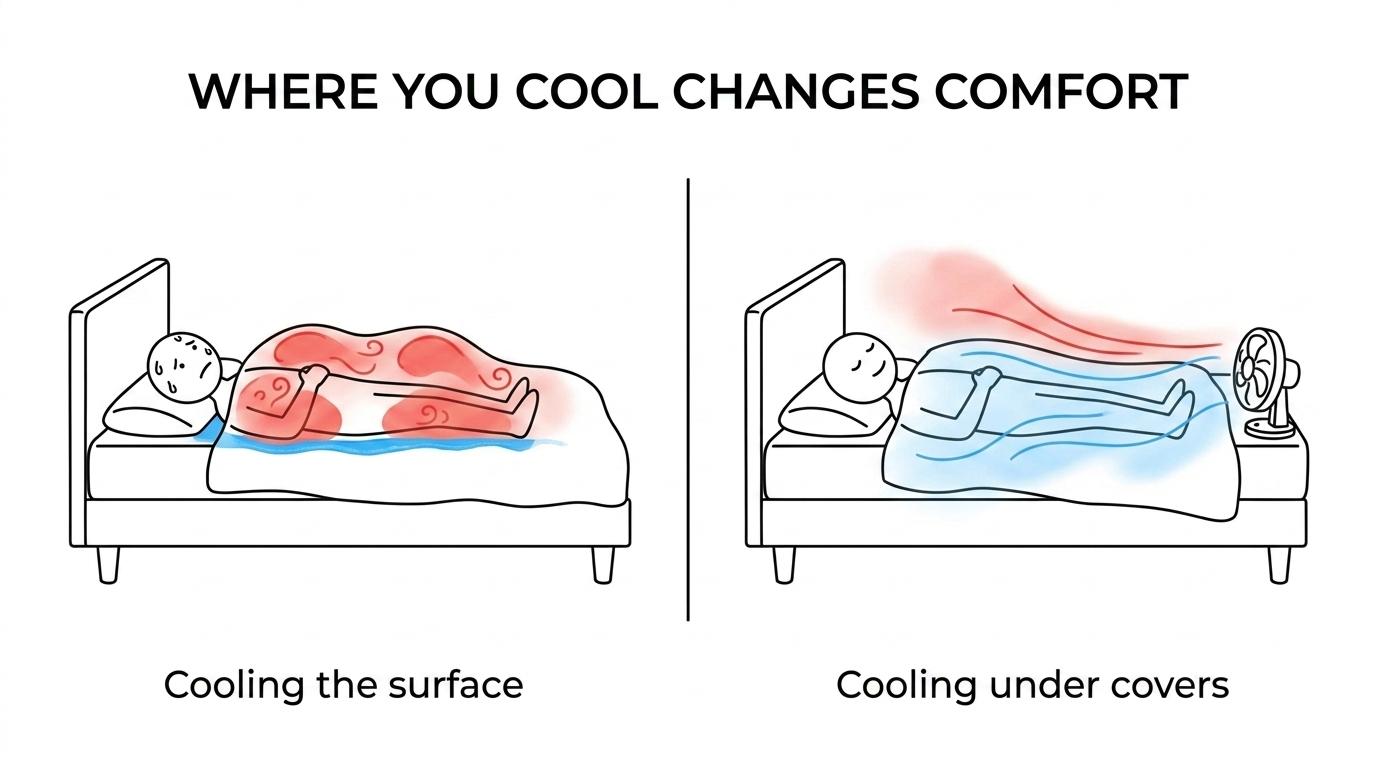
A bed cooling system cools the space under your sheets, while a mattress cooler changes the temperature at the mattress surface. Airflow systems target trapped heat and humidity around your body, while water based or passive mattress coolers mainly target contact temperature where you touch the bed.
That sounds subtle, but it changes the whole sleep experience. Your body doesn’t just react to the mattress below you. It reacts to the microclimate around you, meaning the small pocket of heat, moisture, and air trapped between your skin, pajamas, sheets, and blankets. If your back feels cool but your chest and legs still feel stuffy under the covers, surface cooling alone may not solve the problem.
This is where thermoregulation comes in. During sleep, your body is trying to release heat in a controlled way. If the bedding holds that heat, or if humidity builds up because sweat cannot evaporate well, you may wake up hot even in a room that seemed fine when you went to bed.
A 2021 PubMed indexed field study looked at 104 people in their actual sleeping environments and recorded bedroom temperature, relative humidity, CO2 concentration, and actigraphy before and during sleep. The study estimated a neutral temperature of 23.8°C before sleep and 26.5°C during sleep, which is a good reminder that sleep comfort is dynamic, and that airflow and ventilation around the sleeper matter, not just the thermostat number on the wall.
Sleep experts also commonly recommend keeping the bedroom around 60°F to 67°F. That range gives your body a better shot at falling asleep and staying asleep. In practice, some people using a bed fan can often raise room temperature by about 5°F and still feel cool enough to sleep well, because the body is being cooled where it actually needs help, under the covers.
A bed cooling system like bFan cools you by pushing room air into the bed microclimate, where body heat and moisture build up fast. That airflow helps sweat evaporate, removes trapped warmth, and can make the bed feel cooler quickly without changing the whole mattress.
Here’s the mechanics in plain English. First, the fan pulls in air from the room. Next, it directs that air between the top sheet and your body, or into the space under the comforter. Then that moving air carries away heat that would otherwise stay trapped in the bedding. If the room air is reasonably cool, you feel relief fast.
The detail people often miss is pressure. An ordinary room fan can move plenty of air into open space, but it may struggle once that air has to travel under blankets. That’s why high static pressure matters in this category. A quiet squirrel cage blower is built to push air through more resistance than a typical open blade fan, which is one reason these systems can feel more effective under covers than a bedside fan pointed at your face.
"bFan uses a quiet squirrel cage blower and typically runs around 28 dB to 32 dB at normal operating speed."
Your sheets matter too. A common mistake is assuming looser, more open fabric always feels cooler. In many cases, tight weave sheets work better with a bed fan because they help channel the airflow across your body instead of letting it leak out immediately. If you want that between the sheets cooling effect, your bedding setup is part of the system.
One more thing, neither Bedfan nor BedJet cools the air itself. They only use the cooler air already in the room. So if your bedroom is very warm, airflow helps, but it cannot perform like an air conditioner. If the room is within that 60°F to 67°F range, or even a little above it, the effect can still be strong enough to improve sleep.
Most mattress coolers fall into four groups, passive cooling pads, gel or phase change layers, water based systems, and climate controlled mattresses. The big dividing line is whether they cool only by material feel or actively move heat with water or air.
When people say “mattress cooler,” they often lump very different products together. That creates confusion, because a cool touch topper and a water circulating pad do not behave the same way after several hours in bed.
Passive cooling pads: These use breathable fabrics or fiber fills to reduce heat buildup at the surface, but they do not actively remove much heat once the bed warms up.
Gel or phase change layers: These can feel cool at first touch and may buffer heat for a while, but that first cool sensation often fades as the material reaches body temperature.
Water based mattress pads: These circulate temperature controlled water through tubing, which can change the mattress surface more directly and often offer more exact settings.
Climate controlled mattresses: These are built with integrated temperature systems and usually sit at the higher end of the market for cost and complexity.
The tradeoff is simple. The more active and precise the cooling becomes, the more setup, hardware, and maintenance you usually take on. If you like a plug it in and forget it solution, passive products feel easier. If you want stronger temperature control at the bed surface, water based mattress cooling systems tend to do more, but they also ask more from you.
Airflow cooling and water based mattress cooling solve different problems. Airflow is usually better at clearing trapped heat and humidity around your whole body, while water based mattress cooling is usually better at changing the feel of the mattress surface with more exact temperature control.
Think about where the relief starts. With airflow, the cooling effect hits your skin, pajamas, sheets, and the warm air pocket under the blankets. With water based cooling, the effect starts where your body touches the mattress. If you sleep mostly on your side or back and want that cool bed surface sensation, water may feel more obvious at first. If you wake up feeling smothered, sweaty, or overheated all over, airflow often makes more sense.
Noise can go either way. Some people prefer the soft whoosh of moving air. Others prefer a system with less audible airflow, even if it includes pump noise or light mechanical hum. The CDC guidance in the background material also points out something important, the sleep environment should be kept free from noise and light that disturb sleep. That means the right noise profile is personal, not universal.
Precision is another split. Water based systems often let you set a specific temperature. Airflow systems usually give you speed or intensity control instead. That does not make airflow less useful, it just means the control language is different. You are controlling convective cooling and evaporation, not dialing in a literal mattress temperature.
A common misconception is that a more exact number always produces better sleep. That’s not guaranteed. If your issue is heat trapped under covers, a highly controlled mattress surface can still leave you feeling stuffy on top. If your issue is mostly a hot mattress contact point, then water based cooling may feel like the cleaner fix.
Choose by matching the product to your actual heat pattern, your tolerance for setup, and your budget. If trapped heat is the main problem, start with airflow. If the mattress itself feels too warm, or you want more exact control, start with a mattress cooler.
Start with your heat pattern, not the product marketing. Ask yourself what wakes you up. Is it a sweaty chest, hot legs, damp sheets, and a comforter that feels like a heat trap, or is it mostly a hot mattress surface on your back and hips. If the first description sounds like you, a bed cooling system is usually the more practical fit.
Next, think about how much setup you’re actually willing to live with. A bed fan style setup is usually straightforward, you position the unit, adjust the height, and direct air under the covers. If your main goal is simple nightly relief, the bFan from www.bedfans-usa is a sensible solution to consider because it focuses on under sheet airflow rather than a more involved temperature control system.
Then look at shared sleep. If you and your partner want very different conditions, then dual control becomes a bigger factor. Two separate bed fans can create dual zone microclimate control with two fans. That matters because, based on the pricing context here, one BedJet is more than twice the price of a single bedfan. If both sleepers want separate zones, a dual zone BedJet setup costs over a thousand dollars, which is more than twice the price of two bedfans.
Budget matters, but so does how you use the bed. If you change mattresses often, travel between rooms, or want something less tied to the mattress itself, airflow systems tend to be easier to move and reuse. If you love fine tuning and don’t mind tubing, pads, and extra hardware, a water based mattress cooler may still be worth it.
For night sweats and heat trapped under blankets, bFan style airflow systems are usually the better fit. They help move humid, warm air away from the skin, while many mattress coolers mostly change the surface below you rather than the air around you.
That distinction matters for hot sleepers, menopause related overheating, and medication linked sweating. Sweat is not just about temperature, it is also about moisture. If moisture stays trapped under the covers, your sleep can feel broken even if the room is not very warm. Air movement helps because it supports evaporation, and evaporation is one of the body’s main cooling tools.
Sleep temperature guidance matters here too. Experts commonly recommend a bedroom temperature between 60°F and 67°F for better sleep. With a Bedfan, many people can often raise the room temperature by about 5°F and still cool the body enough to sleep more comfortably, which can help if whole house air conditioning is expensive or hard to balance.
"bFan uses about 18 watts on average and includes timer controls, which makes targeted bed cooling much lighter on energy use than asking your AC to handle all the cooling work."
Here’s the misconception to avoid, sweating more does not automatically mean you need a colder mattress. Sometimes you need better airflow across the body, not a lower surface temperature under it. If your sheets feel clammy or your comforter feels like it holds a cloud of heat, airflow is often what changes the experience fastest.
That said, if you mainly want a cooler contact surface and you dislike any moving air at all, a mattress cooler can still be the better match. This is one of those cases where the best product is the one that matches your discomfort pattern, not the one with the flashiest controls.
Airflow systems usually win on simplicity, while mattress coolers often win on precision. The tradeoff is that simpler airflow means less exact surface control, and more precise cooling usually means more parts, more setup, and more maintenance.
A bed cooling system is usually easier to explain because it is doing one main thing, moving room air into the bed microclimate. Setup often means placing the unit, adjusting it to bed height, and finding the airflow angle that feels right. Daily use is generally easy, especially if the system includes remote and timer controls.
Water based mattress coolers can feel more built in, but they also tend to come with more pieces. You may need to place a pad on the bed, route tubes, fill a reservoir, manage condensation in some conditions, and keep the system clean over time. None of that is impossible. It just adds friction.
This is also where category history helps. The original Bedfan was invented in 2003, years before BedJet entered the niche, so under sheet airflow is not some brand new experiment. It has been around long enough for the core idea to prove itself, especially for people who feel heat trapped under bedding rather than only in the mattress.
If you’re sensitive to clutter, look hard at where the hardware lives. A mattress cooler may disappear visually once the bed is made, but the control unit still needs a home. A bed fan is more visible near the bed, though usually simpler overall. Neither approach is automatically better. It depends on whether you value cleaner visuals, easier cleaning, lower energy draw, or more granular control.
Targeted bed cooling can reduce air conditioning demand because you cool the sleeper, not the whole house. If a Bedfan lets you raise room temperature by about 5°F and still sleep comfortably, the energy math can become much more favorable.
Start with the recommended room range. Sleep experts commonly suggest 60°F to 67°F for better sleep. Some homes can hold that range easily. Others can’t, especially upstairs bedrooms, warm climates, or homes with one thermostat serving several rooms. If your only tool is central AC, you may end up overcooling the whole house just to fix one hot bed.
Next, use bed cooling to narrow the problem. A bed fan cools the body by moving room air under the sheets and helping your body release heat more effectively. Because the cooling happens where the discomfort happens, many people can sleep well with the thermostat set a bit higher than before. A rough rule from the context here is about 5°F higher for many users, though your result depends on your bedding, room humidity, and how hot you sleep.
Then look at wattage. A Bedfan uses about 18 watts on average, which is tiny compared with the power draw behind whole home air conditioning. That does not mean a bed fan replaces AC in every climate. It means targeted cooling can reduce how hard the larger system has to work at night.
Pro tip, test changes slowly. Raise your thermostat a degree or two, keep sheets with a tight weave sheets so the airflow stays where you need it, and pay attention to whether you wake up less often. If you change the thermostat too much at once, you can confuse room comfort with bed comfort and miss the sweet spot.
Most confusion comes from mixing up air cooling, surface cooling, and room cooling. Bedfan systems, BedJet systems, and mattress coolers can all help, but they do it in different ways, and none of them should be judged by the wrong standard.
The biggest myth is that all “cooling beds” actually produce cold air. They don’t. Neither Bedfan nor BedJet cools the air itself. They use the cooler air already present in the room. If the room is hot, the bed will still feel better with airflow than without it, but it will not feel like refrigerated air.
The second myth is that the coldest surface always wins. Sleep comfort is broader than mattress temperature. Relative humidity, trapped body heat, airflow, blanket choice, and even CO2 concentration in the room can affect sleep quality. That PubMed field study is useful here because it reinforces that real sleep environments are a mix of variables, not a single temperature number.
The third myth is that if a product has more settings, it must be better for everyone. More settings can be great if you want precise tuning. They can also be overkill if your real problem is basic trapped heat under a comforter. If you want practical relief with fewer moving parts, simpler can be smarter.
One more myth is that looser sheets are always better for a bed fan. In practice, tight weave sheets often help airflow travel across the body and carry heat away more effectively. If your current setup feels weak, your bedding may be the bottleneck, not the fan.
A mattress cooler is the better fit when you want the bed surface itself to feel cooler, you dislike moving air, or you want more exact temperature settings. It also makes sense if your overheating is mostly about mattress contact points rather than trapped air under the covers.
Some sleepers hate even gentle airflow on the skin. If that’s you, an under sheet fan can feel distracting, even if it works well. A water based mattress cooler may feel calmer because the cooling is coming from below rather than blowing around you.
You may also prefer a mattress cooler if your mattress runs hot on its own. Dense foam, heavy toppers, and thick protectors can trap heat at the contact layer. In that case, changing the surface temperature can feel more direct than adding airflow above it.
This is also where partner needs matter. If one sleeper wants very cold conditions and the other wants almost none, a system with more exact zone control may justify the extra cost and complexity. Just go in with clear expectations. More control usually means more hardware, more upkeep, and more money.
If you mostly sleep with very light bedding and rarely feel smothered under blankets, then the main value of an airflow system may shrink. In that case, a surface based solution may feel more natural. Again, it comes back to where the heat problem actually starts.
Talk to a clinician if night sweats are new, severe, persistent, or paired with other symptoms like weight loss, fever, chest pain, or swollen lymph nodes. Bed cooling can improve comfort, but it should not replace medical evaluation when there may be an underlying cause.
Night sweats can happen for everyday reasons, a warm room, heavy bedding, menopause, stress, alcohol, or common medications. They can also show up with infections, thyroid problems, blood sugar issues, sleep apnea, reflux, autoimmune conditions, or some cancers. The bed setup can help you sleep through symptoms, but it does not diagnose what’s driving them.
Medication is a big one. Antidepressants, steroids, pain medicines, blood pressure drugs, diabetes medicines, stimulants, and hormone therapies can all play a role. If your sweating started after a medication change, that timing matters and is worth bringing up.
The same goes for life stage changes. Perimenopause, menopause, pregnancy, and shifts in hormone therapy can all affect temperature regulation. A cooler sleep microclimate can help a lot, but the larger pattern still matters.
If you’ve already cooled the room, changed the bedding, and tried targeted bed cooling but still wake up drenched, treat that as useful information, not failure. It may mean the next best move is a medical conversation, not a different fan speed.
If you want to dig deeper into sleep temperature, night sweats, and bedroom conditions, these sources are worth your time.
PubMed study on bedroom temperature and sleep: Field study of bedroom temperature, humidity, CO2, and sleep in 104 adults, useful for understanding neutral temperature, deep sleep percentage, and why the sleep environment is more than one thermostat setting.
MedlinePlus guide to night sweats: Night sweats medical overview, explains common causes, when to seek care, and why persistent sweating deserves a closer look.
National Heart, Lung, and Blood Institute sleep health page: NIH sleep health basics, covers why sleep matters, what affects sleep quality, and core habits that support better rest.
MedlinePlus sleep disorders overview: Sleep disorders reference page, gives a solid medical starting point if overheating is only one part of a broader sleep problem.
Copyright 2005 - present - Tompkins Research, Inc. & Kurt W. Tompkins All Rights Reserved DO NOT COPY. bFan® and the word bfan® in any format is a registered trademark of Kurt W. Tompkins the word BFAN® in any format shall not be used without written permission of the mark owner. This includes specifically Brookstone where you like to bait and switch, do not use my mark to bait customers.