

Learn how sleep apnea night sweats may signal OSA and why bed cooling, airflow, and proper treatment can reduce sweaty wakeups.
If you’re dealing with sleep apnea night sweats, the best cooling help is usually a two part plan, get evaluated and treated for possible obstructive sleep apnea, then reduce heat trapped around your body while you sleep. Cooling won’t fix airway collapse, but it can cut down the sweaty wakeups that make a bad night even worse.
TL;DR: Summary
- The best cooling help for sleep apnea sweats is to address possible obstructive sleep apnea and use targeted bed cooling, like a bed fan, because cooling supports sleep comfort but does not treat breathing pauses.
- Obstructive sleep apnea is linked with nocturnal sweating, and one PubMed indexed cohort studied 822 untreated patients referred for positive airway pressure treatment.
- Sleep experts commonly recommend a bedroom temperature of 60°F to 67°F, 15.5°C to 19.5°C, and many people using a Bedfan can raise the room thermostat by about 5°F while still sleeping cool enough.
- Neither Bedfan nor Bedjet cools the air itself, both use the cooler room air already available, so room temperature, ventilation, bedding, and airflow direction all matter.
- If you wake up sweating along with snoring, gasping, dry mouth, headaches, or daytime sleepiness, you need medical screening for sleep apnea, not just a colder bedroom.
- For shared beds, two bed fans can create dual zone microclimate control at a much lower cost than a dual zone Bedjet setup, which is over a thousand dollars.
A lot of people assume night sweats mean hormones, heavy blankets, or a room that’s too warm. Sometimes that’s true. But with sleep apnea, sweating can be part of the picture too, and once you know that, your next steps get a lot clearer.
Yes, obstructive sleep apnea can cause night sweats, and PubMed indexed research supports the link. Night sweating is not the most famous symptom, but it shows up often enough that it should not be brushed off as just “sleeping hot.”
When breathing repeatedly narrows or stops during sleep, your body doesn’t stay calm. Oxygen levels can dip, sleep gets fragmented, and stress signals rise as you fight to reopen the airway. That strain can trigger sweating, even if your room is not especially warm.
One well known study from the Icelandic Sleep Apnea Cohort looked at frequent nocturnal sweating in people with obstructive sleep apnea compared with the general population. The study included 822 untreated patients who had been referred for positive airway pressure treatment, which gives this topic more weight than guesswork or anecdotes.
“bFan uses about 18 watts on average and runs at roughly 28 dB to 32 dB at normal speed, so it targets the sleeper’s microclimate without the energy load of pushing whole room AC harder.”
Common misconception, if you sweat at night, it must be menopause, stress, or too many covers. Those are real causes, but sleep apnea belongs on the list too, especially if the sweating shows up along with snoring, choking, dry mouth, or daytime sleepiness.
Sleep apnea night sweats usually happen because airway obstruction, arousals, and heat buildup all stack together. Obstructive sleep apnea and trapped bedding heat can reinforce each other, leaving you sweaty, restless, and under slept by morning.
Here’s the simple version. If your airway repeatedly closes, your brain keeps yanking you partway awake to restart breathing. That stress response can increase heart rate, activate the sympathetic nervous system, and make sweating more likely. Then the bedding around you traps body heat and moisture, which makes each arousal feel even worse.
That’s why some people say they wake up clammy, overheated, and almost “panicked,” even when the thermostat says the room is fine. The problem is not always the room alone. It can be the combination of breathing disruption and a microclimate that’s too warm inside the bed.
There’s another piece people miss. Sleep quality drops when the sleep environment gets hotter and less ventilated. In a controlled bedroom study indexed on PubMed, raising the bedroom temperature to 30°C reduced total sleep time by 26.3 minutes, lowered sleep efficiency by 5.5%, and cut REM sleep by 5.3 minutes compared with 27°C. Improved ventilation in the same study increased deep sleep by 10.3 minutes and REM sleep by 3.7 minutes.
So if you have sleep apnea and you also sleep hot, each issue can make the other feel more intense. Cooling the bed will not stop apneas. It can still reduce heat stress, help you settle faster after arousals, and make the night more tolerable.
The best cooling options for sleep apnea sweats are targeted airflow, cooler room temperatures, breathable bedding, and better ventilation. For many people, a bed fan beats blasting the whole room colder because it cools the body where the heat actually gets trapped.
If you want the short list, start with options that improve your bed microclimate first, then adjust room level cooling if needed. That approach is often cheaper, quieter, and easier to live with long term.
“bFan cools with between the sheets airflow and timer controls, but it does not cool the air itself, it uses the cooler room air you already have.”
A quiet Bedfan can be especially helpful if you’re already using CPAP or another positive airway pressure setup and don’t want to add more noise or a lot of bulky hardware around the bed. The idea is simple, move heat away from your skin and out of the bedding pocket where it tends to build up.
If you want a practical example, the bFan from Bedfans USA is built around that under sheet airflow approach. It is not a medical treatment for sleep apnea, but it can be a very useful comfort tool for people whose sweats and overheating make their nights even harder.
Sleep apnea night sweats usually come with breathing and fatigue clues, while simple overheating is more tied to room heat, bedding, or hormones. Obstructive sleep apnea and plain bedroom heat can overlap, so you need to look at the full pattern.
If your sweating mostly shows up when the room is hot, the blankets are heavy, or the season changes, overheating may be the main driver. If you cool the room or use a bed fan and the sweating drops fast, that’s another clue that thermal load mattered a lot.
If your sweating comes with loud snoring, witnessed pauses in breathing, waking up choking, dry mouth, morning headaches, brain fog, or crushing daytime sleepiness, sleep apnea moves much higher on the list. In that case, cooling may help you feel better, but it should not distract from testing.
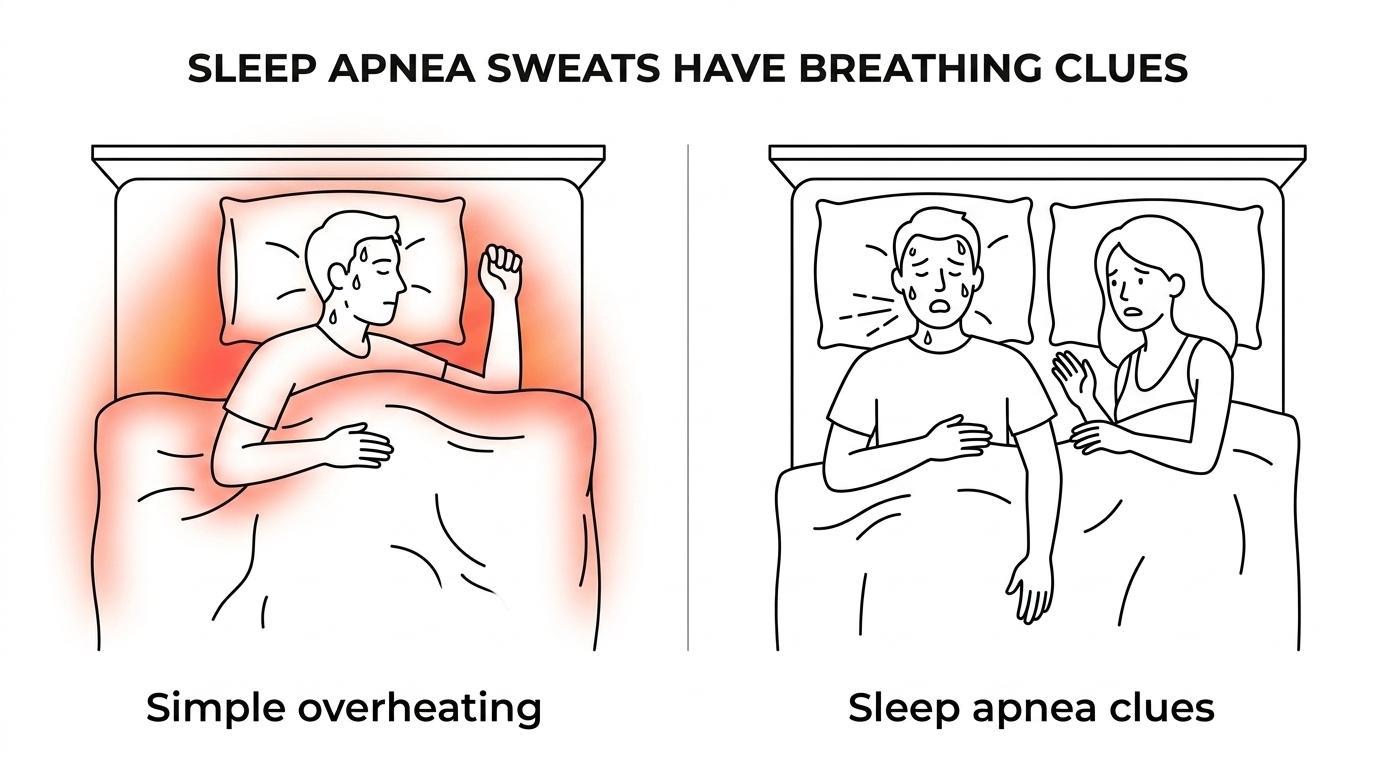
A useful way to think about it is this. If cooling helps comfort but you still wake up gasping, that points toward an airway problem. If cooling solves most of the issue and you do not have the classic apnea symptoms, the problem may be more environmental or hormonal.
Common misconception, if you do not snore loudly, you cannot have sleep apnea. That’s not reliable. Snoring is common, but not everyone with clinically important sleep disordered breathing fits the classic stereotype.
First, treat sweaty gasping as a possible sleep apnea sign, not just a comfort issue. MedlinePlus notes that sleep apnea can cause breathing pauses 30 times or more an hour, and sleep disruption at that level deserves proper medical follow through.
Step 1, pay attention to the pattern for one to two weeks. Notice whether the sweating comes with choking, snoring, dry mouth, headaches, or daytime drowsiness. If your bed partner notices breathing pauses or restless tossing, write that down too.
Step 2, make a medical appointment if those symptoms are present. Ask whether you should be screened for obstructive sleep apnea, and whether a home sleep test or lab study makes sense. If you already use CPAP and still wake up soaked, ask whether pressure settings, mask leak, mouth breathing, or humidification settings need review.
Step 3, reduce heat stress right away while you sort out the medical side. Set the room within the commonly recommended 60°F to 67°F range, lighten bedding, and add directed airflow into the bed. A bed fan can make this much easier because it cools where sweat actually accumulates.
Step 4, watch for red flags. If night sweats come with fever, unexplained weight loss, chest pain, severe shortness of breath, or a new change in health status, you need medical evaluation promptly. Night sweats are not always sleep apnea.
This is the part where being practical matters. You do not have to wait for a diagnosis to make your bed less swampy. Just do not confuse symptom relief with fixing the cause.
You can cool the bed without freezing the room by focusing on the sleep microclimate, not only the thermostat. A Bedfan or similar bed fan can move room air under the covers so your skin loses heat faster without forcing everyone else in the house to shiver.
That matters because neither Bedfan nor Bedjet actually cools the air. Both use the cooler air already in the room. If the room is 78°F and stagnant, neither system has much to work with. If the room is reasonably cool and ventilated, targeted airflow can feel dramatically better.
Here’s the step by step approach that works for a lot of hot sleepers. Start by putting the room in the recommended 60°F to 67°F zone if you can. Then use directed under sheet airflow so your body can offload heat without cranking the HVAC lower than necessary.
Many people using a Bedfan can raise the room temperature by about 5°F and still sleep cool enough for more restful sleep. That’s one of the biggest practical benefits, especially if you hate sky high air conditioning bills or share a home with people who run cold.
Pro tip, use sheets with a tight weave. They spread the moving air across your body better than loose knit jersey or overly lofty bedding, which tends to trap pockets of warm air. It sounds boring, but fabric choice changes performance.
A timer helps too. A lot of people need the strongest cooling while falling asleep and during the first sleep cycles, then can taper it later. That is where timer controls on a bed fan are more useful than people expect.
For many shoppers, Bedfan makes more sense on price and simplicity, while Bedjet offers a different style of forced airflow system at a much higher cost. For shared beds, two bFans can create dual zone microclimate control at a fraction of the price of a dual zone Bedjet setup.
The first thing to clear up is the biggest misconception in this category. Neither system cools the air itself. They both rely on room air. If the room is too warm, neither one is performing magic. The win comes from moving air where body heat is trapped, inside the bedding.
Price matters here. A dual zone Bedjet setup costs over a thousand dollars, which is more than twice the price of two bedfans. One Bedjet is also more than twice the price of a single bedfan. If you and your partner need different cooling levels, two separate bed fans give you true side specific control without pushing you into four figures.
“For couples, bFan offers dual zone microclimate control by using two fans, while a dual zone Bedjet setup costs over a thousand dollars, more than twice the price of two bedfans.”
There’s also the category history. The original Bedfan was invented in 2003 and came to market several years before Bedjet was even thought of. That does not automatically make one better for every sleeper, but it does matter if you care about who pioneered the between the sheets airflow idea.
From a use case standpoint, Bedfan style cooling is often the simpler fit for sleepers who want quiet targeted airflow, modest power use, and timer based comfort. The bFan uses about 18 watts on average and runs around 28 dB to 32 dB at normal speed, which is light compared with whole room cooling strategies.
If you want to cool one side only, Bedfan style units are straightforward. If you want each sleeper to have their own microclimate, two units do the job neatly. That’s why people comparing Bedfan and Bedjet for hot flashes, night sweats, or shared beds often end up caring more about airflow placement, sound, and total cost than flashy feature lists.
The best bed fan setup puts airflow under the top sheet, aimed to sweep heat away from your core and legs. bFan and Bedfan style systems work best when the bedding helps the air move instead of blocking it.
Step 1, place the unit so the air enters the sheet pocket cleanly. You want the airflow to travel along the body, not blast randomly into a bulky comforter pile. Small angle changes can make a big difference.
Step 2, choose your sheet and bedding combo carefully. A tighter weave sheet usually works better because it guides airflow across the skin and helps carry heat away. Very thick blankets can still be used, but keep in mind that too much loft can slow the air path.
Step 3, start low and adjust upward. Many people set the fan too strong right away, then blame the device when the airflow feels distracting. Begin at a gentle setting for 10 to 15 minutes, then bump it only if you still feel heat trapped at the chest, back, or thighs.
Step 4, use timer controls instead of running maximum all night unless you truly need it. Falling asleep is often the hottest part of the night for people who struggle with sweating. After your body settles, you may be fine with less airflow.
Step 5, keep your CPAP gear comfortable and separate from the bed cooling path. The fan should cool your bedding microclimate, not blow directly into the mask seal unless you specifically find that comfortable. If mask leak is already a problem, test one change at a time.
Pro tip, do not judge a bed fan in a room that is already too hot and stale. Since the system uses room air, give it decent air to work with. Even a small drop in room temperature or a bit more ventilation can change the result a lot.
Night sweats need medical testing when they come with apnea symptoms, systemic symptoms, or a major change in health status. Obstructive sleep apnea is one cause, but infections, medication effects, hormone shifts, and other conditions can also be involved.
If your sweats are frequent and you also snore, choke, stop breathing, wake with headaches, or feel excessively sleepy during the day, ask about sleep apnea screening. That combination is strong enough that cooling alone should not be your only plan.
There are other reasons to get checked too. Antidepressants, steroids, blood pressure medicines, diabetes medicines, thyroid issues, GERD, infections, and menopause can all play a part. Sometimes several factors are happening at once, which is why a one cause mindset can send you down the wrong path.
A quick rule of thumb helps here:
That list is not meant to scare you. It is meant to stop the common mistake of trying sheet after sheet, fan after fan, and never asking whether something medical is driving the problem.
Yes, cooler sleep can lower AC costs if you use targeted airflow well, and it does not make sleep apnea worse by itself. Cooling improves comfort and sleep environment, while apnea treatment still handles the breathing problem.
This is where bed microclimate cooling shines. If you can sleep comfortably with the room about 5°F warmer because your Bedfan is carrying heat out from under the sheets, your air conditioner does less work. For energy conscious sleepers, that can be the whole point.
The key is not to overpromise. A bed fan is not treating obstructive sleep apnea. It is helping you sleep cooler within the same room air you already have. That can mean fewer sweaty awakenings, less blanket kicking, and less pressure to turn the house into a refrigerator.
The numbers behind the strategy are easy to appreciate. A bFan uses about 18 watts on average. That is tiny compared with the electrical load tied to lowering whole home air conditioning settings night after night. If your current habit is dropping the thermostat lower and lower just to keep from waking up drenched, targeted cooling is usually the smarter first experiment.
The best setup for many people is simple. Keep the room in or near the recommended 60°F to 67°F range when possible. If you need flexibility for cost or comfort, a Bedfan can often let you move that room setting up by about 5°F and still feel cool enough to sleep well.
That trade off matters most if you share the home with someone who dislikes a cold bedroom, or if your utility bills spike every summer. You are not choosing between apnea care and cooling. You want both, each doing its own job.
Copyright 2005 - present - Tompkins Research, Inc. & Kurt W. Tompkins All Rights Reserved DO NOT COPY. bFan® and the word bfan® in any format is a registered trademark of Kurt W. Tompkins the word BFAN® in any format shall not be used without written permission of the mark owner. This includes specifically Brookstone where you like to bait and switch, do not use my mark to bait customers.