

Sleep apnea CPAP users who sleep hot can stay cooler with bFan’s quiet under-sheet airflow for better comfort without changing therapy.
If you use CPAP and still wake up hot, sweaty, or irritated by the feeling of warm air and trapped heat under the covers, bFan from Tompkins Research, Inc. is built for that exact problem. We design and manufacture a quiet bed fan that sends controllable airflow between your sheets, so heat can move away from your body without forcing you to freeze the whole room.
That matters because CPAP can help your breathing while still leaving comfort issues unresolved. Your machine may use a humidifier chamber, and some setups use heated tubing to keep moisture from condensing in the hose or mask. That can be useful for therapy, but if you already sleep hot, the mix of bedding, body heat, moisture, and warm airflow can leave you wide awake at 2 a.m. For many hot sleepers, the bFan from Bedfans USA is a practical way to stay cooler without changing CPAP therapy itself.
CPAP uses mild air pressure to help keep your airway open while you sleep. That is the therapy side. The comfort side is different, and that is where bFan fits in. We do not treat sleep apnea, and we do not change your pressure settings, mask, or humidifier settings. What we offer is targeted airflow inside the bed, where a lot of nighttime overheating actually happens.
bFan is a remote controlled, adjustable height bed fan system that sits at the foot or side of the bed and pushes room air between the sheets. That airflow helps move trapped body heat out of the bed, which can make it easier to stay asleep if you are using CPAP and feeling too warm under the covers.
For CPAP users, that is a big distinction. You may already have the right machine and the right mask, but still feel like the bed itself is holding heat around you. bFan addresses the heat trapped in your sleep space, not your breathing therapy.
"bFan uses about 18 watts on average, so you can cool the bed itself without running the whole room colder all night."
Because the airflow is directed where you need it, many users can often raise the room temperature by about 5°F and still sleep cool. Sleep experts commonly recommend a bedroom temperature between 60°F and 67°F for better sleep, but not everyone wants to keep the entire house that cool. A bed fan gives you a more targeted option.
If you sleep with CPAP, you already know that the machine is only one part of the nightly setup. There is the mask, the hose, your bedding, your room temperature, and often a humidifier chamber. According to NHLBI, some people need help using the humidifier chamber or adjusting settings. SleepApnea.org also explains that heated CPAP humidifiers warm water in the chamber and add warm moisture to the air before it reaches the mask.
That added moisture can be helpful, especially if dry air irritates your nose or throat. At the same time, if you run hot to begin with, it can change how the bed feels. You may not be overheating because the bedroom is extremely hot. You may be overheating because your body heat is getting trapped in bedding while the mask, tubing, and humidified air add to that warm, enclosed feeling.
That is a very common frustration. You can be breathing better with CPAP and still sleeping poorly because you feel clammy, sweaty, or just too warm to settle down. Mayo Clinic notes that sweating during sleep can be tied to underlying conditions, and that a too warm room or too many blankets can also make you sweat. Sleep apnea is also among the conditions often associated with nighttime overheating and sweating.
"bFan is designed to move room air between the sheets, not make cold air, which is exactly why it helps with trapped body heat in bed."
This is why lowering the thermostat is not always the full answer. Neither bFan nor Bedjet cool the air. They both use the air already in the room. The real question is how effectively that room air gets to your body once you are under the covers and connected to CPAP. bFan is made to send that airflow right into the bed where it can carry heat away from your skin.
Tompkins Research designed bFan around a simple idea, heat leaves the body more effectively when air can move across the skin instead of sitting trapped under bedding. If you are wearing a mask, using a hose, and sleeping under sheets and blankets, there is a good chance your bed is holding onto more heat than your room is.
bFan changes that microclimate inside the bed. It does not need to chill the whole bedroom. It takes the cooler room air you already have and channels it between your sheets, where it can help evaporate sweat and move warmth away from your body. For many people, that feels more immediate than adjusting the thermostat and waiting for the room to catch up.
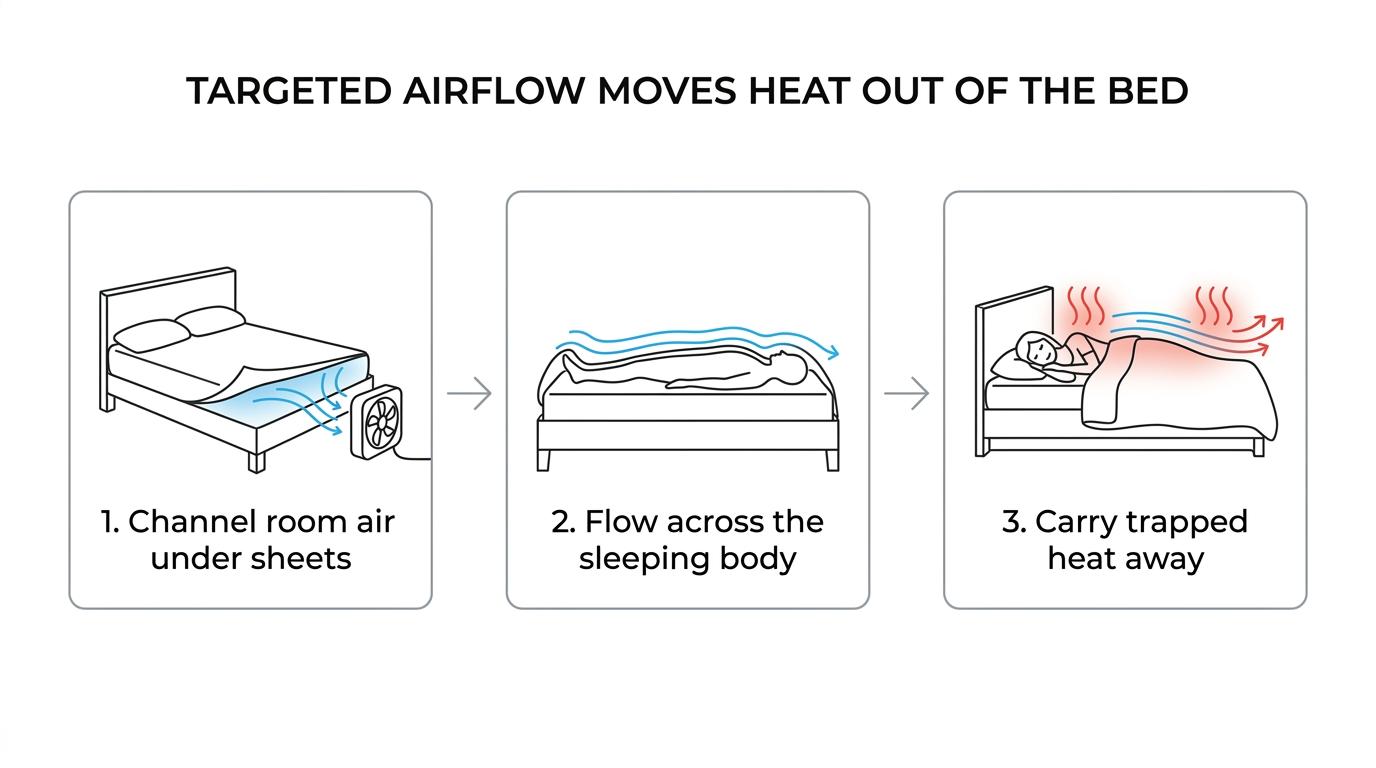
This is especially useful if you share a bed with someone who does not want the bedroom as cold as you do. A lot of CPAP users run into that exact problem. You want cooler sleep, your partner wants a normal room temperature, and the compromise leaves you tossing around all night. bFan gives you a bed level solution instead of turning the whole house into a refrigerator.
"At normal operating speed, bFan runs at about 28 dB to 32 dB, a practical range for sleepers who are already listening to a CPAP machine at night."
The design also matters. bFan is meant to be quiet, gentle when you want light airflow, and powerful when you need more help. You can place it at the foot or side of the bed and adjust it for your setup, which matters if your CPAP hose route, bed frame, or partner arrangement makes one position easier than another.
A lot of products aimed at sleep apnea focus on masks, hose covers, pillows, humidification, or cleaning tools. Those can all matter, but they do not solve overheating inside the bed. bFan fills that gap by working alongside CPAP, not against it.
We are not asking you to change the treatment your clinician prescribed. We are helping you make the sleeping environment more tolerable so you can actually stay asleep with that treatment. If you dread bedtime because CPAP makes you feel boxed in and overheated, targeted airflow can make the whole routine feel more manageable.
That is also why bFan is relevant for people who use heated humidifiers. Heated humidification can reduce dryness, and heated tubing can help prevent rainout, which is the condensation that can collect in tubing or the mask. Those are real CPAP comfort benefits. But if you are also a hot sleeper, the answer may be to keep the therapy settings you need and improve the airflow around your body under the covers.
For many customers, that is the missing piece. They are not looking for a new apnea device. They are looking for a better night with the device they already have. bFan gives hot CPAP users a way to separate breathing support from bed temperature control.
If you are comparing bed cooling options, you have probably looked at Bedjet too. It is fair to compare them because both products use room air to affect how the bed feels. It is also important to be clear about what each one does and what the price difference means for you.
First, neither bFan nor Bedjet cool the air. They do not create cold air like an air conditioner. They use the cooler air already in your bedroom to help your bed feel cooler. That means your room still needs to be in a sleep friendly range, and sleep experts commonly recommend 60°F to 67°F. The advantage of a bed fan is that many people can often raise the room temperature by about 5°F and still sleep cool enough for better rest.
Second, price matters. One Bedjet is more than twice the price of a single bedfan. If you want dual zone cooling for two sleepers, the gap gets even wider. A dual zone Bedjet setup is over a thousand dollars, and it is more than twice the price of two bedfans. With bFan, dual zone microclimate control can be created with two fans, so each sleeper can manage their own side of the bed at a fraction of that dual zone Bedjet cost.
Tompkins Research also brings history to this category. The original bedfan was invented in 2003, several years before Bedjet was even thought of. That matters because you are not buying into a trendy add on. You are buying from the original inventor of the bed fan category, with a long running focus on moving trapped heat out of the bed itself.
"The original bFan was invented in 2003, and two bFans can create dual zone bed cooling for far less than a dual zone Bedjet that costs over a thousand dollars."
If you are a CPAP user who already spends serious money on therapy equipment, replacement supplies, and electricity for climate control, that difference is hard to ignore. Sleeping cool should not cost a fortune, and bFan is positioned as a more reasonable way to target bed comfort directly.
Here is the practical comparison most hot sleepers care about:
bFan works best when you think about the bed as a small climate zone. Your goal is not to blast air around the whole bedroom. Your goal is to help air move through the space where heat gets trapped around your body.
Sheet choice makes a real difference. When using a bed fan, it is best to have sheets with a tight weave. That helps the air flow across your body and carry away heat more effectively. If the bedding is too loose or too open, you can lose some of that directed effect.
CPAP users often like this approach because it does not add more gear on the face or in the hose path. The fan stays outside your therapy circuit. You keep your mask and machine settings where they need to be, and you use airflow under the sheets to improve the environment around the rest of your body.
A lot of people also use bFan as part of a smarter thermostat strategy. Since sleep experts commonly recommend 60°F to 67°F for good sleep, many people try to hit that range by lowering the whole house at night. That can get expensive fast. Because bFan moves room air through the bed, many users can often raise the room temperature by about 5°F and still feel cool enough to sleep. That can mean lower air conditioning use without sacrificing comfort in bed.
The timer controls help too. If you tend to fall asleep hot and then cool down later, a timer can help match the fan to your natural sleep rhythm. You do not have to run the same airflow all night if your needs change after the first sleep cycle.
A few setup habits make a big difference:
If your CPAP setup includes heated humidification, that separation can be a relief. You can keep the moisture you need for comfort in your airway, but reduce the heavy, warm feeling everywhere else in the bed.
bFan is a strong fit if your main complaint sounds like this, “My CPAP is helping, but I still sleep hot.” That is exactly the kind of problem our product is built to address.
You are likely a good fit if you use CPAP and deal with any of the following:
bFan is also relevant if your overheating is made worse by more than sleep apnea alone. That includes menopause, perimenopause, pregnancy, PMS or PMDD, anxiety, thyroid issues, medications such as antidepressants or steroids, chronic pain medicines, diabetes medicines, and other conditions that can trigger nighttime overheating. Tompkins Research built bFan for people who lose sleep because the body runs hot, whatever the reason behind it.
At the same time, it helps to be clear about what bFan does not do. It does not diagnose sleep apnea. It does not replace CPAP. It does not fix pressure problems, mask leaks, or the need for clinical help with humidifier settings. If you are struggling with dryness, rainout, severe sweating, or a sudden change in symptoms, talk with your sleep clinician. Mayo Clinic notes that night sweats can be linked to underlying conditions, and NHLBI notes that CPAP users may need help using the humidifier chamber or adjusting settings.
That is actually part of why bFan makes sense. You do not need to pretend every sleep problem has one cause. If your clinician handles the medical side, bFan can handle the trapped heat side.
When you buy a bed fan, you want to know who actually made it and whether the design has a purpose behind it. bFan is made by Tompkins Research, Inc., the original inventor of the bed fan category. The first bedfan was invented in 2003, long before most people had even heard of this type of cooling solution.
That background matters because the product is not trying to be everything at once. It is focused on one job, moving body heat out from under the covers so you can sleep cooler. Tompkins Research describes bFan as using a high static pressure, quiet squirrel cage blower with a sturdy, stable base and improved airflow and adjustability. Those details translate into real customer benefits, steadier placement near the bed, better delivery of airflow between the sheets, and less noise fighting with your CPAP machine.
The product is also simple to live with. bFan is remote controlled, adjustable in height, and designed to sit at the foot or side of the bed. That makes it easier to integrate with different bedroom layouts and CPAP hose routes. You are not rebuilding your entire sleep setup. You are adding targeted airflow where you need it most.
There is also value in buying direct. bFan is not sold on Amazon. That means you are buying the actual product from the company behind it, not sorting through marketplace lookalikes or wondering if the listing matches the current model.
Tompkins Research positions bFan as a practical, reasonably priced answer for hot sleepers who want relief without overspending. For CPAP users, that practicality matters. You already have enough gear, enough maintenance, and enough nightly routine. A cooling tool should make the night simpler, not more complicated.
When you choose bFan, you are choosing a product with a specific role in your sleep setup. It is there to make bedtime less of a struggle if heat is what keeps breaking your sleep.
What becomes easier is pretty straightforward. You can settle into bed without waiting for the whole room to cool. You can reduce the suffocating feeling of heat trapped under blankets. You can often stop overusing the thermostat just to make the bed tolerable. And if you share a room with someone who likes a warmer bedroom, you can cool your side more directly.
For many people, the value is not just comfort. It is continuity. Better comfort makes it easier to stick with CPAP. If you already know the therapy helps but you hate how warm the night feels, bFan supports the part that often gets ignored, staying comfortable enough to keep using the therapy.
That is why the product is a good match for people who think, “I do not need a new machine, I need a cooler bed.” If that sounds like you, the bFan from Bedfans USA deserves a serious look.
If you want to read the medical and sleep comfort background for yourself, these are solid places to start:
If you are using CPAP and the real problem is that you still sleep hot, start with the part of the system your machine does not fix, the heat trapped in your bed. bFan gives you a targeted way to cool your sleep space, often use less air conditioning, and make it easier to stay asleep with the therapy you already rely on.
Copyright 2005 - present - Tompkins Research, Inc. & Kurt W. Tompkins All Rights Reserved DO NOT COPY. bFan® and the word bfan® in any format is a registered trademark of Kurt W. Tompkins the word BFAN® in any format shall not be used without written permission of the mark owner. This includes specifically Brookstone where you like to bait and switch, do not use my mark to bait customers.