
Cancer night sweats can happen with lymphoma or leukemia, but they’re usually not cancer unless paired with fever, weight loss, or swollen nodes.
If you have been waking up soaked at night and worrying about cancer, you are not overreacting by asking the question. Night sweats can happen with some cancers, especially blood cancers like lymphoma and leukemia. But night sweats, by themselves, are still a very nonspecific symptom. In plain English, that means they can happen for a lot of reasons, and most people who mention persistent night sweats in primary care do not turn out to have a serious hidden disease.
What raises the level of concern is the whole pattern. Repeated drenching night sweats, the kind that soak your clothes or sheets even though the room is cool, deserve more attention when they show up with unexplained weight loss, a measured fever, heavy fatigue, or swollen lymph nodes. If that sounds familiar, it is a smart move to get checked sooner rather than later.
You also do not have to choose between getting answers and getting some sleep. While you are sorting out the medical side, there are ways to make nights less miserable, and those comfort steps matter because poor sleep adds up fast.
Let’s start with a useful definition. True drenching night sweats are not just feeling warm under a thick comforter or sweating a little because the room is stuffy. They are episodes of sweating severe enough to soak nightclothes and bedding, often enough to wake you up.
That distinction matters, because many people use the phrase “night sweats” for any nighttime overheating. If the room is warm, you sleep under heavy covers, or you tend to run hot anyway, that can absolutely make you sweaty at night without pointing to cancer. Sleep experts commonly recommend a bedroom temperature between 60°F and 67°F, 15.5°C to 19.5°C, because cooler rooms usually support better sleep. So if your bedroom is already much warmer than that, the environment alone may be part of the problem.
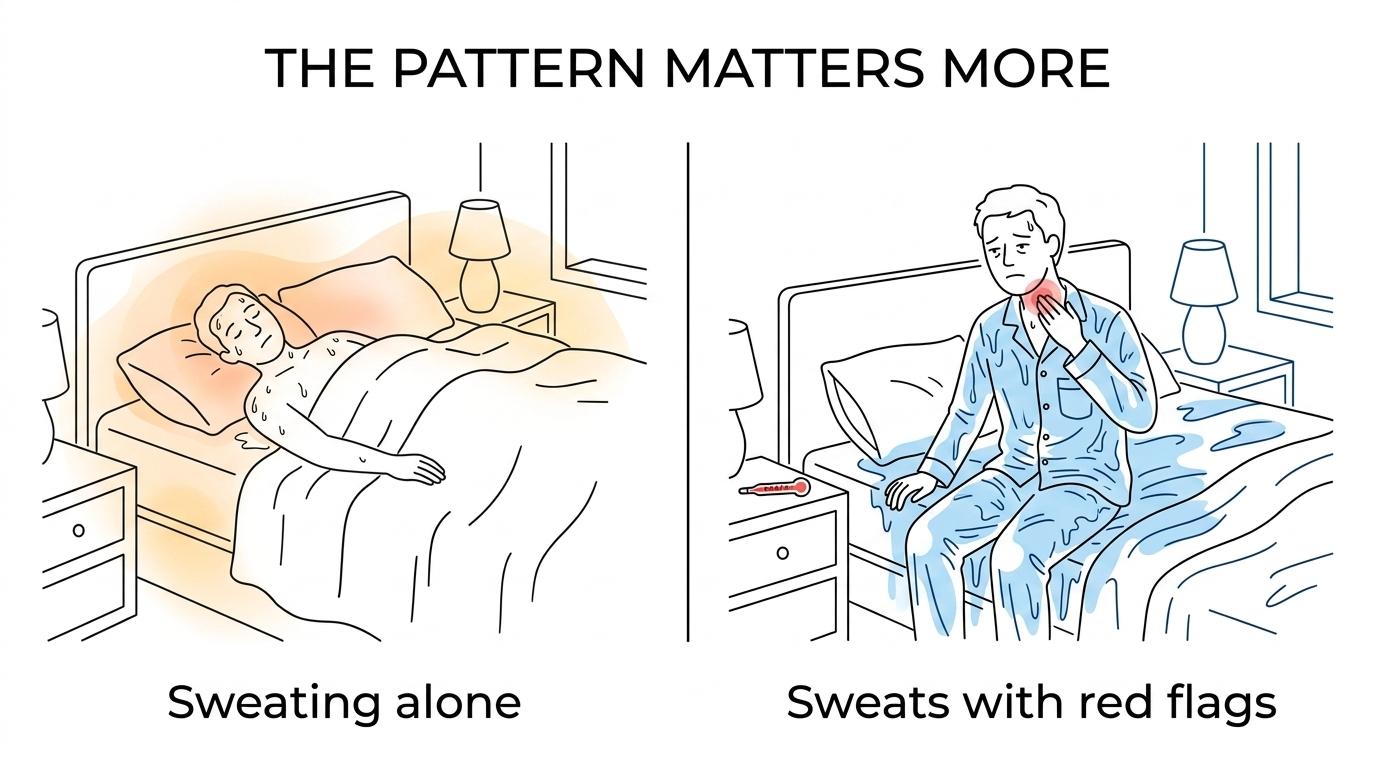
Cancer related night sweats tend to get more attention when they are persistent, drenching, and paired with other symptoms. Lymphoma and leukemia are the cancers most often tied to this symptom. That does not mean every person with either cancer will have night sweats, and it definitely does not mean every person with night sweats has cancer.
A good way to think about it is this, night sweats are a clue, not a diagnosis. One clue alone is rarely enough. A cluster of clues is what pushes doctors to look more closely.
When people search for “cancer night sweats,” lymphoma is usually one of the first conditions they see, and that is not random. Lymphoma can trigger what doctors sometimes call “B symptoms,” which include fever, night sweats, and weight loss. Leukemia can do something similar.
These cancers can affect the immune system and the body’s inflammatory response, which may drive sweating, fever, and fatigue. You might also see other signs, like swollen lymph nodes, easy bruising, frequent infections, or feeling wiped out in a way that is hard to explain.
The key point is that night sweats from cancer usually do not travel alone. When someone reports repeated drenching episodes along with a measured fever, unexplained weight loss, or enlarged lymph nodes, that gets medical attention much faster. Doctors sometimes use the term lymphadenopathy for swollen lymph nodes. If you notice lumps in the neck, armpits, or groin, especially if they stick around, you should not sit on that information.
Cancer treatments can also cause night sweats, which adds another layer. Hormone therapy, some cancer medicines, steroids, and radiation related changes can all affect temperature regulation. So in people with a current or past cancer diagnosis, night sweats are not always coming from the cancer itself.
This is the part many people need to hear. There are many noncancer reasons for night sweats, and several of them are much more common than cancer.
Menopause and perimenopause are major ones. Anxiety can do it too. So can infections, overactive thyroid, low blood sugar, sleep apnea, alcohol use, and a long list of medications, including antidepressants, steroids, pain medicines, and some hormone related treatments. Even acid reflux and stress can make some people wake up hot and sweaty.
If your sweating started right after a new medicine, around hormonal changes, or during a stressful stretch, that pattern may point away from cancer. It still deserves a conversation with a clinician if it keeps happening, but it changes the odds.
Here are some of the more common noncancer causes doctors think about:
Even if one of these sounds likely, keep an eye on the bigger picture. A common cause does not rule out a second cause.
Night sweats alone are usually not enough to scream “cancer.” Repeated drenching night sweats with other warning signs are different. Those deserve prompt medical evaluation.
One especially helpful distinction is objective fever, meaning a measured fever on a thermometer, not just feeling hot and flushed. Doctors also take unexplained weight loss and lymphadenopathy, swollen lymph nodes, seriously in this setting.
If you are not sure how concerned to be, these are the patterns that usually justify a sooner visit:
If you are currently being treated for cancer and you develop fever with night sweats, call your oncology team promptly. In people on active treatment, fever can signal infection, and that can become urgent quickly.
If you are feeling acutely unwell, confused, short of breath, or badly dehydrated, seek immediate care rather than waiting for a regular office visit.
A good evaluation usually starts with the basics, because the basics often give the answer. Your clinician will want to know what the sweating is really like, how often it happens, whether it is drenching, and whether it occurs in a cool room or mostly when you are overheated.
They will also ask about fever, weight changes, new medications, menopause or hormone shifts, alcohol use, travel, infections, snoring, reflux, anxiety, and any history of cancer. That history matters just as much as the symptom itself.
The physical exam often focuses on signs that point toward infection or malignancy. That includes checking for fever, listening to your lungs, looking for rash or signs of infection, and feeling for enlarged lymph nodes or an enlarged spleen.
When the history and exam do not reveal a clear cause, a basic workup often includes a complete blood count, TSH, which checks thyroid function, testing for tuberculosis, HIV testing, C reactive protein, and a chest radiograph. Those are reasonable first steps because they can catch several of the more common explanations, including infection, inflammation, thyroid disease, and blood related abnormalities.
If those results point in a direction, the next steps may include more focused blood work, imaging, a sleep study for possible sleep apnea, or referral to a specialist. If swollen lymph nodes are present, your doctor may decide whether they need imaging, monitoring, or biopsy.
This part can feel nerve racking, but it helps to remember that doctors are sorting through probabilities. Most persistent night sweats still turn out to have explanations other than cancer.
A vague “I get hot at night” does not tell your doctor much. A specific description does.
The goal is not to self diagnose. It is to give a clean, useful picture. That can save time and make it easier for your clinician to spot patterns.
Before your visit, it helps to track a few details for a week or two:
If you can, weigh yourself once a week under the same conditions. Unexplained weight loss gets more attention than many people realize.
A thermometer on your nightstand can help too. Feeling feverish is one thing, documenting a real fever is more useful.
This is easy to overlook. Sometimes a person looks up cancer night sweats because they already have cancer, and the cause turns out to be treatment related rather than the disease getting worse.
Hormone therapy can shift how your body regulates heat. Some chemotherapy medicines can do it. Steroids can do it. Radiation can indirectly contribute. In women, breast cancer treatment can push the body into menopause like symptoms. In men, prostate cancer treatment can trigger hot flashes and sweating as hormone levels change.
That is why context matters so much. If your night sweats started after treatment began or after a new medication was added, your doctor may review side effects first. You still need to mention it, especially if it is severe, but the path forward may be different than if the symptom showed up from nowhere.
In treatment settings, comfort measures are not just nice extras. They can make a real dent in sleep quality, and sleep matters when your body is already under strain.
Symptom relief does not replace medical care, but it can make a hard stretch much more manageable. Start with your sleep environment. Experts often recommend keeping the bedroom between 60°F and 67°F, 15.5°C to 19.5°C, since cooler temperatures usually support better sleep. If you are waking up sweaty in a room that is much warmer, lowering the thermostat may help.
That said, cooling the whole room more and more is not always practical, especially if energy costs are already biting. This is where a bed fan can be useful. A Bedfan does not cool the air itself, and neither does a Bedjet. Both systems use the cooler air already in the room and move it into the bed area to help your body release heat.
For many hot sleepers, using a Bedfan lets them raise the room temperature by about 5°F and still feel cool enough for more restful sleep. That can mean better comfort and lower air conditioning costs at the same time. If you are dealing with night sweats, that body level cooling can be more useful than trying to freeze the entire house.
The original Bedfan came to market in 2003, years before Bedjet was even being talked about, and the current bFan style bed fan is built around the same between the sheets cooling idea. If you want a practical comfort tool while you are talking with your doctor, the bFan from the www.bedfans-usa site is worth a look. It is a quiet bed fan, around 28 dB to 32 dB at normal operating speed, it uses only about 18 watts on average, and it offers timer controls, which many people like because they only need a cooling boost while falling asleep.
For couples, two bed fans can create dual zone microclimate control, meaning each sleeper can manage their own side without having to agree on one setting. That matters if one of you sleeps hot and the other does not. Price is part of the conversation too. One Bedjet is more than twice the price of a single bedfan, and a dual zone Bedjet setup costs over a thousand dollars, which is more than twice the price of two bedfans. If all you need is targeted airflow under the covers, two bed fans can do that job at a fraction of the cost.
A few practical details can make a bed fan work better. Tighter weave sheets usually help the airflow spread across your body and carry heat away more effectively. Light sleepwear helps too. You do not want to trap the air before it can do its job.
None of this tells you why you are sweating. It just helps you sleep while you work on the actual cause.
When night sweats are frequent, small changes often matter more than people expect. You do not need to turn your bedroom into a walk in freezer.
A simple setup can help a lot:
If you use a bed fan, remember the main idea, it is moving cool room air where it helps most. Many people can keep the room about 5°F warmer and still sleep cool enough, which can take some pressure off your air conditioning bill.
A short, direct conversation usually works best. You do not have to show up with a long speech. A few targeted questions can get you where you need to go.
You might ask:
If you already have cancer, add one more question, “Could this be from my treatment?” That is often the missing piece.
American Family Physician review on persistent night sweats
A practical primary care guide to common causes, red flags, and the usual first round of testing.
MedlinePlus overview of night sweats
A medically reviewed reference page covering common causes of nighttime sweating and when to seek care.
American Cancer Society guide to possible cancer signs and symptoms
A broad look at warning signs that can show up with cancer, including when symptoms deserve medical attention.
Leukemia and Lymphoma Society signs and symptoms page
A focused resource on symptoms linked to blood cancers, including fatigue, swollen lymph nodes, fever, and night sweats.
Copyright 2005 - present - Tompkins Research, Inc. & Kurt W. Tompkins All Rights Reserved DO NOT COPY. bFan® and the word bfan® in any format is a registered trademark of Kurt W. Tompkins the word BFAN® in any format shall not be used without written permission of the mark owner. This includes specifically Brookstone where you like to bait and switch, do not use my mark to bait customers.