
Cooling pillow or bed fan? Learn which cools best for hot sleepers, from head and neck relief to whole-bed airflow and night sweat control.
If you’re choosing between a cooling pillow and a bed fan, the short answer is pretty simple, they cool different zones. A cooling pillow mostly changes how your head and neck feel, while a bed fan changes the air trapped under your sheets, which is usually where hot sleepers struggle most.
TL;DR: Summary
- For most hot sleepers, a bed fan is the better primary fix than a cooling pillow because it cools the bed microclimate between the sheets, not just the surface under your head.
- Cooling pillows can help with head and neck heat, and a 2003 PubMed study found head cooling may reduce whole body sweat rate in humid heat conditions, but that is still narrower than whole bed cooling.
- Neither a Bedfan nor a BedJet cools the air itself. Both use the cooler air already in the room, so your bedroom temperature still matters. Sleep experts commonly recommend 60°F to 67°F, or 15.5°C to 19.5°C, for better sleep.
- A bed fan can often let people raise the room thermostat by about 5°F and still sleep cool enough for more restful sleep, which can cut air conditioning use when overheating is mostly happening in bed.
- If your issue is only a warm pillow surface, buy a cooling pillow. If your back, chest, legs, or whole bed get hot, start with a bed fan. If you run very hot, combining both usually works better than replacing one with the other.
- On price, a BedJet is more than twice the price of a single bedfan, and a dual zone BedJet setup costs over a thousand dollars, which is more than twice the price of two bedfans.
That difference matters because people often buy a cooling pillow when the real problem is heat buildup around the whole body. If you wake up hot on your back, sweaty at your waist, or boiling under the covers at 3 a.m., pillow cooling alone usually won’t reach the part of the problem you actually feel.
A bed fan like bFan cools more of your sleep microclimate than a cooling pillow. It moves room air between the sheets, while a cooling pillow mostly changes the surface feel under your head and neck.
Your bed acts like a little heat trap. Once you lie down, your body warms the pillow, sheets, comforter, and the still air around you. A cooling pillow can slow heat retention at one contact point, which helps some people fall asleep faster or feel less stuffy around the face. Still, it does not move heat away from your torso, hips, or legs.
A bed fan works differently. It pushes room air into the bedding space so heat and moisture have somewhere to go. That matters because the warm, humid air under the covers is often what makes you kick blankets off, flip the pillow, or wake up sweaty even when the room itself seems tolerable.
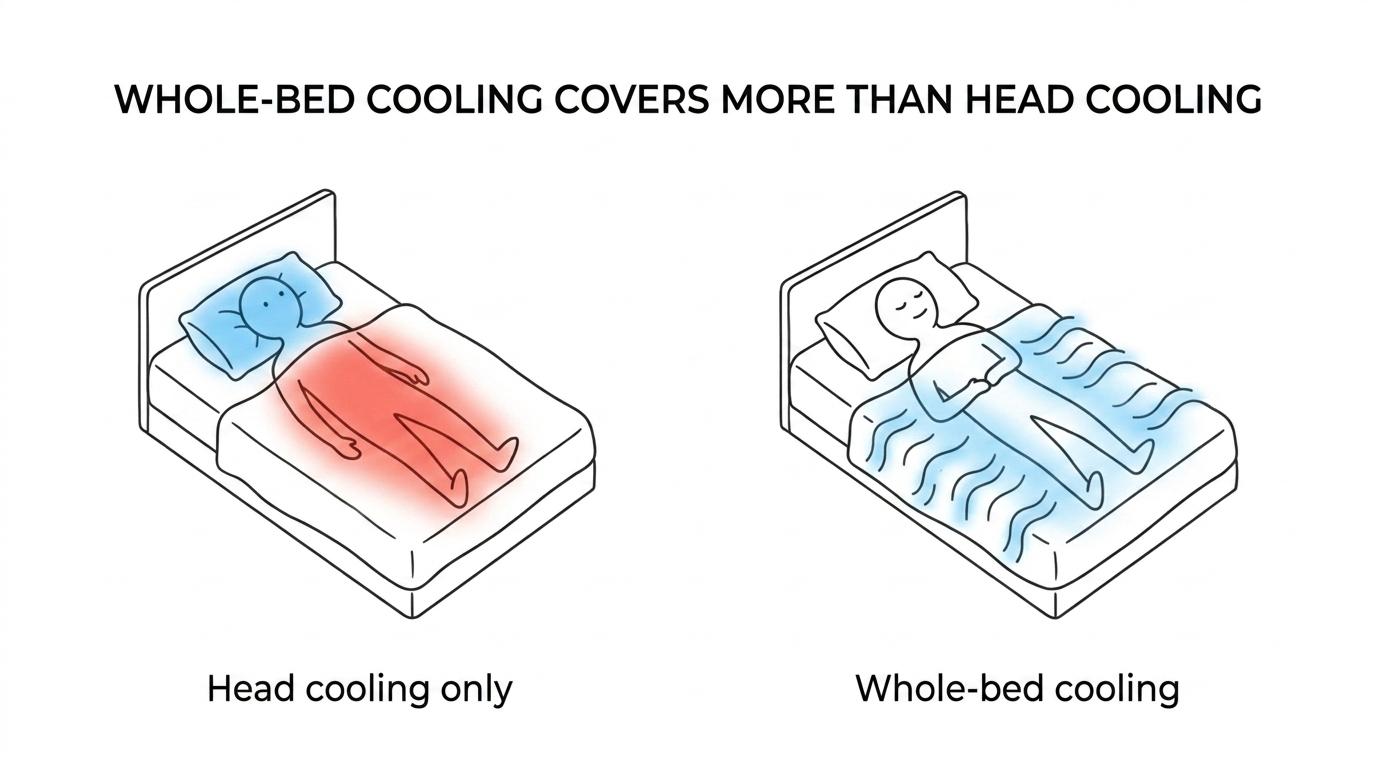
A 2003 PubMed study on head cooling looked at sleep in humid heat conditions and found that head cooling may help decrease whole body sweat rate. That is useful, but it does not mean pillow cooling is equal to cooling the whole bed. A separate 2024 three center sleep study using a high heat capacity mattress in 72 people supports the bigger point, whole body cooling can influence sleep in a controlled, non disturbing way.
If your room is already in the commonly recommended 60°F to 67°F range, a bed fan usually gets more mileage out of that cool room air because it puts that air where you need it most. And many people can raise the room temperature by about 5°F with a Bedfan and still feel cool enough to sleep better, which is one reason targeted bed cooling can help lower air conditioning costs.
bFan is a clear example of that targeted approach. It is a bed fan that delivers controllable airflow between the sheets, usually from the foot of the bed, using about 18 watts on average and running around 28 dB to 32 dB at normal sleep speeds.
"bFan uses about 18 watts on average and runs around 28 dB to 32 dB at normal sleep speeds, so it targets the bed microclimate without asking you to cool the whole room all night."
A cooling pillow changes the head and neck contact surface, not the full bed climate. Gel foam, latex, and phase change covers can feel cooler, but they do not ventilate your torso the way a bed fan does.
Cooling pillows are usually built around one of three ideas. Some try to feel cooler on first contact. Some reduce heat retention so the pillow stays more temperature neutral over time. Some improve airflow through cutouts, shredded fill, latex, or mesh covers. Those design choices can help, especially if your face and scalp are your hottest spots.
The common misconception is that a cooling pillow actively cools you the way a small climate system would. In most cases, it does not. It absorbs or disperses some heat, then gradually warms up. If the room is hot, humid, and still, the pillow can only do so much because the air around the rest of your body is still holding heat.
There is also a comfort angle that people skip. A 2012 PubMed pillow study found that 42.5% of participants reported no waking symptoms on their own pillow, but more than 50% reported regular waking symptoms, failure to relieve retiring symptoms, uncomfortable pillows, or poor quality sleep. Poor sleep quality was significantly related to waking cervical stiffness and scapula pain. So pillow choice matters, just not only for cooling.
That gives you a useful rule. If your main complaint is a hot head, facial warmth, or neck discomfort, a cooling pillow is worth trying. If your complaint is broad overheating under blankets, it’s the wrong first tool.
For whole bed heat, bFan and similar bed fan setups rank higher than cooling pillows. Cooling pillows are helpful, but they affect a smaller zone and usually work best as a secondary layer.
If you want the fastest way to match the tool to the problem, rank them by how much of your sleep environment they actually change, not by how cold they feel in the first minute.
bFan bed fan: A bed fan changes the under sheet microclimate across much more of the body. If you want a dedicated bed fan, the bFan from bedfans usa is a practical option, especially if your chest, back, hips, or legs overheat at night. The original Bedfan category dates back to 2003, years before BedJet became part of the conversation.
Cooling pillow: Best when heat is concentrated at the head and neck, or when a standard foam pillow sleeps too warm. It can improve surface comfort, but it usually won’t fix whole bed heat buildup.
Breathable sheets: Cotton percale and other tighter weave sheets can pair well with a bed fan because they help distribute airflow across your body. This surprises people, since they often assume looser fabric is always cooler.
Body cooling mattress or topper: Products designed for reproducible whole body cooling, like a high heat capacity mattress, can help more than a pillow because they affect a larger contact area. They are often pricier than simpler airflow options.
Room air conditioning or humidity control: These help the whole room, and sometimes that’s necessary, but they treat a bigger zone than you may need. If your problem is mainly bed heat, targeted cooling is often cheaper to run.
A cooling pillow wins on localized head comfort, while bFan wins on whole bed microclimate control. If your heat spreads beyond the head and neck, the bed fan is the more direct fix.
Think of the two products as different categories, not close substitutes. A cooling pillow is a contact surface product. A bed fan is an airflow product. One tries to reduce heat buildup where your head rests. The other tries to move warm air and moisture out from under your bedding.
That difference matters more as the night goes on. Plenty of pillows feel cool at lights out, then level off once they absorb body heat. Airflow behaves differently, because it keeps transporting heat away instead of just storing it for a while. That is why a bed fan often helps with the 2 a.m. and 4 a.m. wakeups that hot sleepers talk about.
There is also a humidity angle. The 2003 head cooling study was done in humid heat conditions, and it found head cooling may reduce whole body sweat rate. That tells you the head matters. It does not tell you the head is the only place that matters. When humidity builds up inside bedding, airflow across more of the body usually does more than a cooler pillow surface alone.
A simple way to choose is this. If your pillow feels like a frying pan but the rest of you is fine, buy the pillow. If you sleep with one leg out, toss your covers off, or wake with damp sheets, buy the bed fan first.
Choose a cooling pillow only after you separate heat problems from support problems. A gel pillow and a latex pillow can both sleep cooler than dense memory foam, but the wrong loft can still wreck your sleep.
Step one, figure out where the heat is coming from. If you feel hot mostly at your scalp, ears, and neck, a cooling pillow can make sense. If you feel hot across your whole trunk, don’t ask a pillow to do a full bed fan’s job.
Step two, pick the material based on the kind of cooling you want. If you want a cooler first touch, phase change fabrics and some gel layers can help. If you want less heat retention over several hours, ventilated latex and less dense fills often do better than solid memory foam. The goal is a more temperature neutral surface, not an ice pack feeling that disappears in ten minutes.
Step three, fit the pillow to your sleeping position. This gets missed all the time. Side sleepers usually need more loft to keep the neck level. Back sleepers usually do better with medium loft. Stomach sleepers often need a lower profile. If your neck is cranky in the morning, poor support can overshadow any cooling benefit.
If you share a bed and only one of you sleeps hot, a cooling pillow can be a good low commitment first try. But if you already know your body heat builds under the covers, pairing a cooling pillow with a Bedfan makes more sense than cycling through one warm pillow after another.
A bed fan like bFan works best when the airflow is directed under the covers, not at the room. Placement, sheet choice, and speed matter more than people expect.
Step one, place the unit so it feeds air into the bedding pocket. For many people, that means at the foot of the bed. That matches how the bFan product is commonly used, and it keeps the breeze moving along the length of the body instead of just hitting the ankles.
Step two, use sheets that help the air travel. This is a big pro tip. With a bed fan, a tighter weave sheet often works better than a very open knit because it helps the airflow spread across your skin and carry away heat instead of escaping straight into the room. Cotton percale is a common sweet spot because it feels crisp and breathable without trapping as much heat as some brushed fabrics.
Step three, start lower than you think. A gentle airflow is often enough once the bedding pocket has been flushed with cooler room air. If your bed fan has timer controls, use them. Many hot sleepers mainly need help during sleep onset and the first few hours, when body temperature is supposed to drop for stable sleep.
That last point ties back to bedroom temperature. Sleep experts commonly recommend 60°F to 67°F. A bed fan does not replace that guidance, because neither Bedfan nor BedJet cools the air itself. They use the air already in the room. What a Bedfan can do is let many people raise the room temperature by about 5°F and still stay comfortable, which can make your AC settings less aggressive.
For bed cooling, a bed fan is usually the lowest cost targeted option. BedJet adds features, room AC cools the whole space, and bFan focuses on moving room air where your body actually needs it.
Start with the physics. A Bedfan and a BedJet do not cool the air. They move the cooler air that is already present in the room into the bed area. Air conditioning is the only one of the three that actively lowers room temperature. That means AC is necessary when the room itself is too hot, but it also means you may be cooling hundreds of cubic feet of air when your real complaint is a hot mattress and trapped bedding heat.
That is why targeted cooling can be economical. The bFan uses about 18 watts on average. That is tiny compared with running central AC or even a room unit for the whole night. If your bedroom is reasonably cool already, or you can get it close to the recommended 60°F to 67°F range, a bed fan can often do the rest.
Price is where the gap gets hard to ignore. One BedJet is more than twice the price of a single bedfan. A dual zone BedJet setup costs over a thousand dollars, which is more than twice the price of two bedfans. If you and your partner need separate control, two bFan units can create dual zone microclimate control at a fraction of that spend.
"Two bFan units can create dual zone microclimate control, while a dual zone BedJet setup costs over a thousand dollars."
There is also category history. The original Bedfan came to market several years before BedJet was even thought of, with the bed fan concept dating to 2003. That does not make every product equal, but it is useful context if you are comparing a long standing product type with a newer branded system.
If you want the most affordable targeted solution, a bed fan is hard to beat. If you want full room cooling for daytime comfort too, AC still has its place. If you want powered bed airflow but are weighing price carefully, Bedfan style products usually make the most sense.
A cooling pillow can help some symptoms, but a bed fan usually helps more when sweating affects the whole body. Menopause, SSRIs, steroids, and thyroid issues often create broader heat that a pillow alone cannot manage.
This is where people can waste money by treating the wrong zone. Menopause and perimenopause often cause hot flashes and night sweats that spread fast through the chest, neck, scalp, and back. The same goes for many medication related sweats. Antidepressants, pain medicines, steroids, blood pressure drugs, and hormone therapies are common examples. If your whole body feels like it suddenly overheats, the practical goal is to move heat and moisture away from more than your head.
A cooling pillow can still help. During a hot flash, a cooler head and neck surface may feel calming, and the 2003 head cooling research supports that idea. But if your shirt, bra line, torso, or sheets get damp, airflow between the sheets is usually the bigger win.
This is also where a bed fan can support energy savings. Many people who deal with night sweats keep the thermostat lower than the rest of the household wants. Because a Bedfan can often let you raise the room temperature by about 5°F while still sleeping cool, it can ease that nightly thermostat fight without leaving you miserable.
One caution, if your night sweats are new, drenching, or paired with fever, weight loss, swollen lymph nodes, chest pain, or severe snoring, do not assume it is just a bedding issue. Sleep products can help symptom relief, but they are not a substitute for medical care.
Humidity and fabric can make or break both tools. Cotton percale, latex, and controlled room humidity usually help more than plush synthetics when you run hot.
A cooling pillow performs best when the pillowcase is breathable and not acting like a heat trap. Dense covers and plush synthetic shells can cancel out the benefit of a cooler core. The same idea applies to bedding. If your comforter is heavy and your sheets trap moisture, even a good bed fan has to work harder because the air it moves cannot circulate well around the body.
The bed fan specific pro tip is worth repeating, because it goes against what many people expect. With a bed fan, sheets with a tighter weave often help the airflow spread across your body and carry away heat. If the fabric is too open, the air can leak out before it does much cooling work under the covers.
"bFan works best when the airflow stays between the sheets, which is why tighter weave bedding often cools better than people expect."
Humidity is the other overlooked factor. A bedroom at 67°F can still feel sticky if the air is damp. In humid conditions, you feel hotter because sweat does not evaporate as easily. That is one reason the head cooling study focused on humid heat conditions, and it is one reason bed airflow can feel so helpful. It improves evaporation where your body is trapped by bedding.
If your cooling pillow feels disappointing, check the surrounding system before giving up. The wrong pillowcase, a heat trapping mattress, and humid air can make a good pillow seem mediocre.
Start with the room, then cool the bed zone that actually bothers you. For most hot sleepers, a bed fan first, then pillow upgrades second, is the better value path.
Step one, get the bedroom close to the sleep comfort range. You do not need an icebox, but you do want the room somewhere near the commonly recommended 60°F to 67°F. If you currently need the thermostat much lower just to survive the night, a Bedfan may let you bring it up by about 5°F while still feeling cool under the covers.
Step two, solve the biggest heat zone first. If you mostly overheat from shoulders to feet, buy the bed fan before the pillow. If your only problem is a hot head on dense foam, buy the cooling pillow first. Most people who call themselves hot sleepers are dealing with both, but not equally.
Step three, improve the supporting layers. Breathable pillowcases, lighter bedding, and the right sheet structure can sharpen the effect of either product. If you want a quiet, low power option, the bFan is worth a look because it is a dedicated bed fan built for between the sheets airflow, not a room fan pointed in your general direction.
You also do not need to jump straight to premium climate systems. Many people get better results from targeted airflow and smarter bedding than they do from replacing every sleep product at once.
Hot bedding is common, but drenching sweats can signal more than a comfort problem. A cooling pillow or a bed fan can help symptoms, yet persistent or severe night sweats still deserve medical attention.
Plenty of people overheat for ordinary reasons, a warm room, heavy blankets, menopause, stress, alcohol, or medications. In those cases, sleep products can genuinely help. That said, night sweats can also show up with infections, sleep apnea, endocrine problems, reflux, and some cancers. If the sweating is new or out of proportion to your room temperature, treat that as useful information, not just an annoyance.
Here are the signs that push this beyond a bedding purchase question.
Drenching sweats: If you are soaking clothes or sheets regularly, especially when the room is not hot, talk with a clinician.
Other symptoms: Fever, unexplained weight loss, swollen lymph nodes, chest pain, or shortness of breath need attention.
Sleep disruption with snoring or gasping: Obstructive sleep apnea can be part of the picture, especially if you wake sweaty and exhausted.
Medication changes: If night sweats started soon after a new prescription or dose increase, ask whether the timing fits.
That does not mean you have to wait on relief. You can still use a cooling pillow or bed fan to sleep more comfortably while you sort out the cause. Just do not let symptom management stop you from checking the bigger health question.
PubMed study on head cooling during sleep: Head cooling in humid heat conditions, a small controlled sleep study that looked at a cooling pillow and whole body sweat rate.
PubMed study on whole body cooling during sleep: High heat capacity mattress sleep study, a 2024 study in 72 people that examined reproducible, non disturbing body cooling during sleep.
PubMed study on pillow comfort and waking symptoms: Pillow use, sleep quality, and waking symptoms, a study that connects pillow choice with sleep quality, cervical stiffness, and scapula pain.
National Heart, Lung, and Blood Institute sleep health guidance: Sleep health from NHLBI, a reliable overview of healthy sleep habits and sleep environment basics.
CDC sleep overview: About sleep from the CDC, a public health resource on why sleep matters and what affects sleep quality.
MedlinePlus on night sweats: Night sweats overview, a medical reference page on common causes of night sweats and when to seek care.
Copyright 2005 - present - Tompkins Research, Inc. & Kurt W. Tompkins All Rights Reserved DO NOT COPY. bFan® and the word bfan® in any format is a registered trademark of Kurt W. Tompkins the word BFAN® in any format shall not be used without written permission of the mark owner. This includes specifically Brookstone where you like to bait and switch, do not use my mark to bait customers.