
Cooling sleepwear helps with sweat and comfort, but bed fans usually cool hot sleepers better by removing trapped heat under the covers.
If you sleep hot, the real question is not whether cooling sleepwear helps, it does, but whether it can beat trapped heat under the covers. In most bedrooms, it cannot do that on its own.
TL;DR: Summary
- Cooling sleepwear helps, but a bed fan usually works better for hot sleepers when heat is trapped under the sheets. Fabrics can improve moisture management and thermal comfort, while a bed fan targets the bed microclimate directly by moving room air between your sheets.
- Sleep experts commonly recommend a bedroom temperature of 60°F to 67°F for better sleep. A Bedfan can often let many people raise the room temperature by about 5°F and still feel cool enough to sleep more comfortably, which may reduce air conditioning use.
- Neither Bedfan nor Bedjet actually cools the air. Both rely on the cooler air already in the room, but a Bedfan focuses that air where body heat gets trapped, under the bedding.
- Cooling sleepwear works best when the issue is sweat, stickiness, or fabric feel. Look for breathable fabrics, moisture transport, and good water vapour permeability, with Merino wool, cotton, and some technical blends all having different tradeoffs depending on humidity and skin sensitivity.
- If you want stronger cooling per dollar, a bed fan is usually the better buy. A dual zone Bedjet setup costs over a thousand dollars and is more than twice the price of two bedfans, while two bedfans can create dual zone microclimate control at a fraction of that cost.
- The strongest setup for many hot sleepers is a combination. Use breathable sleepwear, tight weave sheets, and a Bedfan or bFan to remove trapped body heat inside the bed instead of trying to cool the entire room more than necessary.
That combination matters because sleep comfort is not just about your thermostat. It is about the little climate around your skin, your pajamas, your sheets, and the pocket of warm air your body creates all night long.
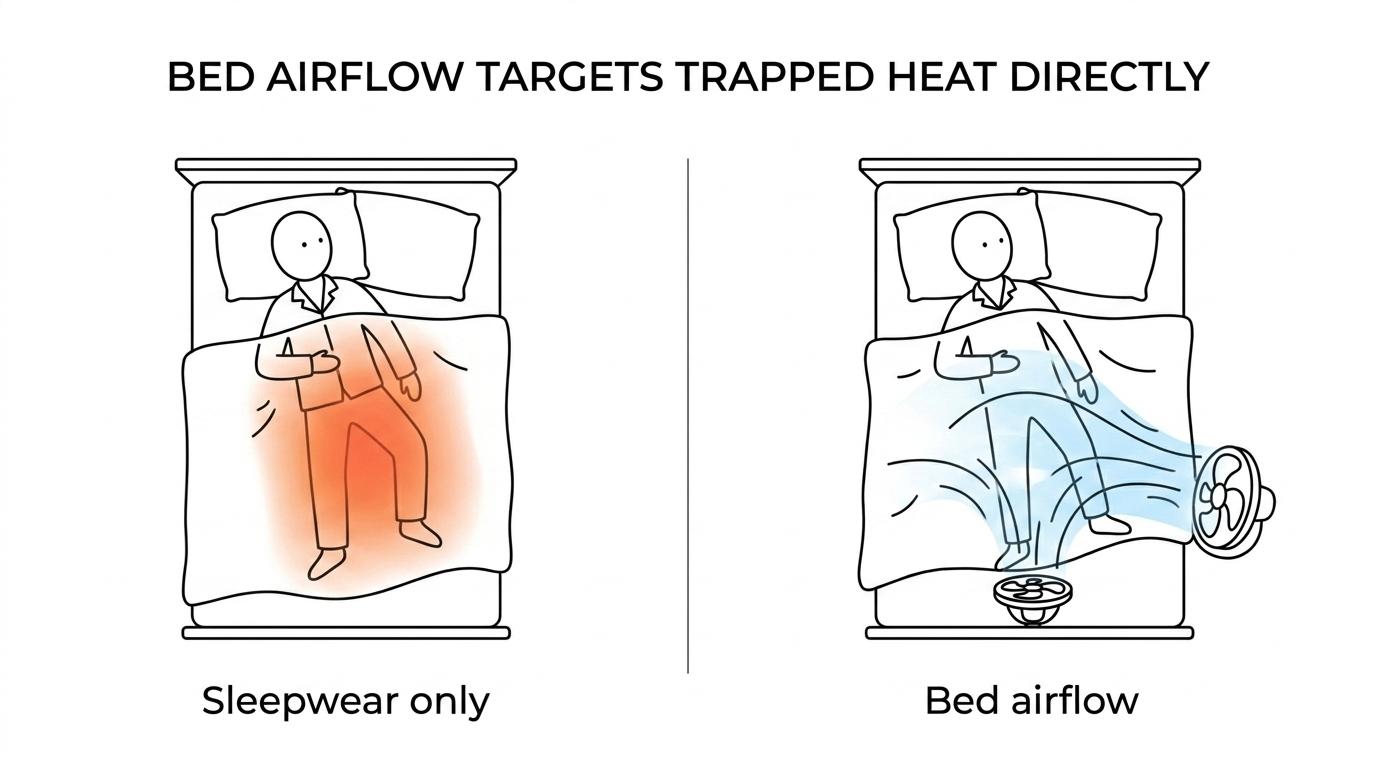
A bed fan usually works better than cooling sleepwear for trapped heat, and bFan or Bedfan style airflow is the more direct fix. Sleepwear can reduce cling and improve sweat evaporation, but it cannot push hot air out from under your covers the way a bed fan can.
If your main problem is that you feel clammy, sticky, or damp, cooling sleepwear can help a lot. If your main problem is that your legs, torso, or feet get too warm once the blankets are on, a bed fan usually gives the bigger improvement. That is because the problem is not only fabric, it is the warm microclimate between your skin and bedding.
Sleep experts commonly recommend keeping the bedroom at 60°F to 67°F for better sleep, and Cleveland Clinic notes that temperatures above 70°F are generally too warm for good rest. A Bedfan does not replace that guidance, but many people can raise the room temperature by about 5°F and still sleep cool because the airflow carries heat away from the body instead of trying to chill the whole room.
"The bFan bed fan uses about 18 watts on average, so it targets under sheet cooling without asking you to run the whole room colder."
A common mistake is assuming that anything labeled cooling actually makes air colder. It does not. Neither Bedfan nor Bedjet cools the air. They both use the cooler air already in your room, then move it to the bed area where your body heat gets trapped.
Cooling sleepwear helps by improving sweat evaporation and moisture transport, not by acting like an air conditioner. Merino wool, cotton, and polyester each affect thermal comfort differently, and the best choice depends on humidity, skin feel, and how much you sweat.
This is where the research gets more useful than the marketing. A 2016 sleepwear and bedding study published in PubMed used polysomnography across nine nights with 17 healthy young participants, testing at 17°C and 22°C. That kind of study does not tell you that one fabric wins for every sleeper, but it does show that fabric structure and bedding choices can change sleep outcomes in measurable ways.
A later randomized crossover study looked at cotton, polyester, and Merino wool sleepwear in adults ages 50 to 70, in a room set to 30°C with 50 percent relative humidity. One of the measured outcomes was whole body sweat evaporation. That matters because sleepwear is not only about warmth, it is about how quickly sweat can move away from skin and how dry you stay while your body tries to regulate temperature.
A 2024 systematic review on sleepwear textiles made the big mechanism clear, water vapour permeability matters. In plain English, if the fabric lets moisture vapor pass through more easily, sweat can evaporate and skin tends to stay drier. Wool often scores well here, which surprises people who still think of wool as purely a winter fabric. Pro tip, do not confuse “cool to the touch” with “keeps you cool for eight hours.” Those are not the same thing.
The best setups combine breathable fabric with targeted airflow, and the bFan, cotton, and Merino wool are practical starting points. If you only change pajamas, you may still trap heat under the blanket. If you only add airflow, sticky fabric can still feel bad.
For most people, the sweet spot is not one product, it is a small system. Here are the most effective ways to combine cooling sleepwear with a bed fan.
The best option depends on whether you run hot all night, have night sweats, share a bed, or need quiet. If your issue is localized heat under the covers, a Bedfan setup usually beats sleepwear alone.
Choose cooling sleepwear by matching the fabric to your heat pattern, not the label. Cotton, Merino wool, and moisture wicking synthetics all have a place, but the wrong fit or wrong room conditions can cancel out the benefit.
Start with step 1, figure out whether you feel hot, sweaty, or both. People often lump those together, but they are different. If you feel overheated before you sweat, airflow is the bigger need. If you wake up damp or sticky, fabric performance matters more. Menopause, some antidepressants, steroids, blood pressure medicines, and thyroid issues can all shift you toward more sweating, so the fabric side matters more in those cases.
Step 2, choose for your room and humidity. Cotton is familiar, breathable, and easy to wash, but it can hold moisture longer once soaked. Merino wool often handles vapor transport very well and can feel surprisingly comfortable in warm conditions. Many synthetic sleep sets move liquid sweat quickly, but some people dislike the hand feel or the way they hold odor. If your room already sits near the recommended 60°F to 67°F range, sleepwear choice may be enough. If your room sits closer to 70°F or above, fabric alone usually will not do enough.
Step 3, test fit and friction. Tight clothing, heavy waistbands, and clingy knits can make a technically good fabric feel worse. Common misconception, the most expensive “cooling” set is not always the coolest. Sometimes a loose, plain cotton tee and shorts beat fancy fabric if the fit is better and the bed microclimate is managed well.
Set up a bed fan by aiming airflow into the bed microclimate, using the right sheet structure, and timing it to your sleep cycle. The bFan and Bedfan approach works best when the air can actually travel between your sheets instead of spilling into the room.
Step 1 is placement. Most bed fans work best around the foot of the bed, though some sleepers prefer side placement. The goal is not blasting your face. It is pushing a controllable stream of room air under the top sheet or blanket so the warm pocket around your body does not keep building. That is why the bFan design focuses on between the sheets airflow.
Step 2 is sheet selection. Pro tip, use sheets with a tight weave. That sounds backward to some people, but a tighter weave can help the airflow spread across your body and carry away heat instead of escaping too loosely through the bedding. Percale style cotton often works well here because it stays crisp and breathable without feeling dense.
"At normal operating speed, the Bedfan runs at about 28 dB to 32 dB, which is quiet enough for many sleepers who dislike a noisy room fan."
Step 3 is timing. Bedfan timer controls are useful because many people overheat most when first falling asleep, then need less airflow later. You can also pair that with a slightly higher room set point. Many people using a Bedfan can raise the room temperature by about 5°F and still feel cool enough for more restful sleep, which matters if your air conditioning bill is getting out of hand.
One more misconception is worth clearing up, neither Bedfan nor Bedjet cools the air itself. If the room is already very warm, the airflow will still feel less effective than it would in a room kept within or near the 60°F to 67°F range.
Cooling sleepwear is passive, while Bedjet is active airflow, and they solve different parts of the problem. Sleepwear changes fabric comfort. Bedjet changes air movement in the bed. Neither one is the same as refrigeration, and neither one cools air below room temperature.
If you are choosing only one approach, use the simplest rule possible. If you hate damp fabric or chafing, start with sleepwear. If you feel a heat bubble build under the covers, active airflow is the more direct fix. That is true whether the device is a Bedjet or a Bedfan.
Here is the practical comparison that most shoppers actually need.
The original Bedfan came to market in 2003, several years before Bedjet was even thought of, which matters because this category did not start with pricey dual zone systems.
"The original Bedfan was invented in 2003, years before Bedjet, and that long history still matters when you compare bed fan designs."
Room AC cools the entire space, while a Bedfan cools the bed microclimate, and those are very different jobs. Air conditioning is still important, but a bed fan often gives more targeted relief per watt when your main problem is overheating under the covers.
This is the tradeoff most people miss. Your AC has to lower the temperature of the whole bedroom, furniture, walls, and air volume. A bed fan only needs to move room air where you are producing heat. That targeted use is why it can feel effective even when the thermostat is set a bit warmer than you used to tolerate.
The bFan and related Bedfan designs use very little power compared with whole room cooling, about 18 watts on average for the Bedfan data you provided. In real life, that means a bed fan is not competing with your AC so much as helping you avoid overusing it. Many people can raise room temperature by about 5°F with a Bedfan and still sleep cool because the airflow carries away body heat trapped in bedding.
That said, room temperature still matters. Sleep experts commonly recommend 60°F to 67°F, and Cleveland Clinic notes that REM sleep is especially vulnerable to heat disruption. If your room is sitting well above 70°F, do not expect any bed fan or pajamas to fully compensate. Common sense wins here, start with a reasonably cool room, then fine tune your microclimate.
Night sweats are not just about heat. Sometimes they are about moisture that never gets a chance to evaporate. This is why a sleeper in decent room temperature can still feel miserable in the wrong sleepwear. Water vapour permeability, moisture buffering, and fabric contact with skin all affect whether you feel dry enough to stay asleep.
That becomes more important for perimenopause and menopause, medication related sweating, some cancer treatments, stress related sweating, and conditions that shift thermoregulation. In those cases, airflow helps, but the wrong fabric can still leave you clammy. Merino wool gets a lot of attention in sleepwear research because it can manage vapor well. Cotton is still a good option for many people because it is simple and breathable, though once it becomes damp it may stay wet longer.
If your sweating is moderate and your room is already near 60°F to 67°F, start with sleepwear and bedding. If you still wake up hot under the sheet, add a bed fan. If the sweats are drenching, new, or paired with fever, weight loss, swollen lymph nodes, chest symptoms, thyroid symptoms, or medication changes, do not stop at shopping advice, talk with a clinician.
Sheets and humidity can change the whole outcome, and percale cotton, relative humidity, and bed airflow all interact. A great pajama set can feel bad under the wrong blanket, and a good bed fan can underperform with bedding that traps too much heat.
Most people focus on pajamas because they are easy to buy. The bigger influence is often the whole bed stack, mattress protector, sheets, blanket, quilt, and the moisture level in the room. High relative humidity slows sweat evaporation, which makes even breathable fabrics feel less effective. That is one reason hot weather nights can feel so sticky even when the thermostat number does not look terrible.
With a Bedfan, sheet construction matters more than people expect. A tight weave sheet can help the airstream travel across your body and carry away heat. Loose, fluffy, or very heavy top layers can block or scatter airflow before it does much work. Pro tip, if you add a bed fan and feel only a small difference, check the top bedding before you blame the fan.
The same logic applies to cooling sleepwear. A breathable pajama set under a thick foam topper, nonbreathable protector, and dense blanket is fighting an uphill battle. Think in terms of a sleep system, not a single fix.
Build a cooler sleep system by fixing the room first, the bed microclimate second, and the fabric third. AC, bFan, and sleepwear each do a different job, and spending in the wrong order is where people waste money.
Step 1, get the room into a workable range. You do not need to turn your bedroom into a meat locker, but you do want it near the commonly recommended 60°F to 67°F range. If you are consistently above 70°F, start there. Even the best bed fan or sleepwear has less room to work when the incoming air is already warm.
Step 2, target trapped heat. If you routinely kick covers off and then pull them back on, you are dealing with a bed microclimate problem. This is where a Bedfan or bFan usually pays off faster than buying several rounds of “cooling” pajamas. If you share a bed and one person runs hot while the other does not, two bedfans can create dual zone microclimate control without jumping to a dual zone Bedjet system that costs over a thousand dollars and more than twice the price of two bedfans.
Step 3, refine the contact layer. Once airflow is handling trapped heat, use sleepwear to manage moisture and skin feel. If you want a practical place to start, the bFan from www.bedfans-usa is a sensible solution to consider, especially if you want between the sheets cooling without paying Bedjet pricing. Then add one or two sleepwear options, not six, and test them in your actual room conditions.
People still overheat in cooling pajamas because labels cannot overcome trapped heat, heavy bedding, or a warm room. Polyester blends, mattress foams, and room temperatures above 70°F can erase the benefit of even decent sleepwear.
The biggest myth in this category is that “cooling” is a single product feature. It is not. It is an outcome that depends on airflow, moisture, bedding weight, humidity, mattress materials, and room temperature. A fabric can feel cool when you first put it on and still perform poorly once sweat builds and the bed warms up.
Another issue is that many hot sleepers have a two part problem. They sweat, and they trap heat under the blanket. Cooling sleepwear addresses only one part. A Bedfan or bed fan handles the other by moving air through the bed cavity. That is why the combination often works better than either one alone.
If your mattress sleeps warm, your protector is not breathable, or your comforter is too insulating, the pajama marketing will not save you. Common misconception, overheating always starts with the body. Sometimes it starts with the materials around the body, then your thermoregulation has to play catch up all night.
Persistent night sweats need medical attention when they are drenching, new, or paired with other symptoms, and the CDC and Cleveland Clinic both frame sleep environment as only one piece of healthy sleep. Bedding changes can help symptoms, but they do not rule out medical causes.
Hot sleep is common. Night sweats can still be a health clue. If the problem showed up suddenly, wakes you repeatedly, soaks the bed, or comes with fever, unexplained weight loss, swollen lymph nodes, chest symptoms, thyroid symptoms, or medication changes, it is worth checking in with a clinician. Sleep apnea, infections, endocrine disorders, medication effects, and some cancer treatments can all be part of the picture.
This matters even if a bed fan helps. Symptom relief is good. It is not a diagnosis. If you are in perimenopause or menopause, pregnancy, hormone therapy, or taking medicines known to trigger sweating, practical cooling steps can make nights easier while you also sort out the medical side.
A cooler room, breathable sleepwear, and a Bedfan can make a real difference in comfort. They just should not be your only plan if the sweating pattern looks unusual, severe, or new.
CDC sleep health overview
A public health summary of why sleep matters and why a cool bedroom is part of a healthy sleep environment.
PubMed study on sleepwear and bedding fabrics during sleep
A controlled sleep study using polysomnography that looked at how fabric choices changed sleep outcomes at different room temperatures.
PubMed randomized crossover trial on cotton, polyester, and Merino wool sleepwear
A study in adults ages 50 to 70 that examined sleepwear performance, including sweat evaporation, in warm conditions.
PubMed Central systematic review on sleepwear textiles and thermal comfort
An open access review explaining how water vapour permeability and moisture transport affect comfort and skin dryness during sleep.
Copyright 2005 - present - Tompkins Research, Inc. & Kurt W. Tompkins All Rights Reserved DO NOT COPY. bFan® and the word bfan® in any format is a registered trademark of Kurt W. Tompkins the word BFAN® in any format shall not be used without written permission of the mark owner. This includes specifically Brookstone where you like to bait and switch, do not use my mark to bait customers.