

bFan reviews highlight targeted under-sheet airflow, quiet cooling, and lower AC use for hot sleepers in already cool bedrooms.
If you’re reading bFan reviews because you keep waking up hot, sweaty, or frustrated with “cooling” bedding that doesn’t really fix the problem, the short version is pretty simple. Most hot sleepers like bFan because it sends airflow where heat actually gets trapped, inside the bed, under the covers, and against your skin.
TL;DR: Summary
- bFan reviews are strongest among hot sleepers who want targeted bed cooling in a reasonably cool room, not people trying to cool an overheated bedroom.
- The main thing users like is between the sheets airflow: bFan moves room air under your bedding to carry away trapped body heat, which can feel more effective than cooling sheets alone.
- bFan does not cool the air itself: like BedJet and other bed fan systems, it uses the air already in the room, so results are best when your bedroom is already in the sleep friendly range of about 60°F to 67°F.
- Cost and energy use matter: bFan uses about 18 watts on average, and many people can raise the room thermostat by around 5°F while still sleeping comfortably, which may reduce air conditioning costs.
- Review fit depends on your setup: tight weave sheets, a room below about 80°F, and realistic expectations matter more than fancy specs or “temperature control” claims.
- Compared with BedJet, bFan is usually the simpler, lower cost option: a dual zone BedJet setup is over a thousand dollars, while two bFans can create dual zone microclimate control for much less.
That context matters, because a bed fan is not a mini air conditioner. bFan, Bedfan, and BedJet all work by moving the cool air already in the room, so the best reviews usually come from people who want direct body cooling, quieter nights, and lower AC use, not from people expecting refrigerated air.
bFan reviews usually praise targeted between the sheets airflow and simpler sleep cooling. Hot sleepers, especially people dealing with Menopause related night sweats, night sweats, or warm memory foam beds, tend to like that the bed fan cools the body directly instead of trying to chill the whole room.
The review themes are pretty consistent. People who like bFan often say the relief feels immediate at the feet, legs, and lower torso first, then spreads as air moves through the bedding. That’s a big deal if your problem isn’t the whole bedroom, it’s the layer of heat trapped under blankets and around your body.
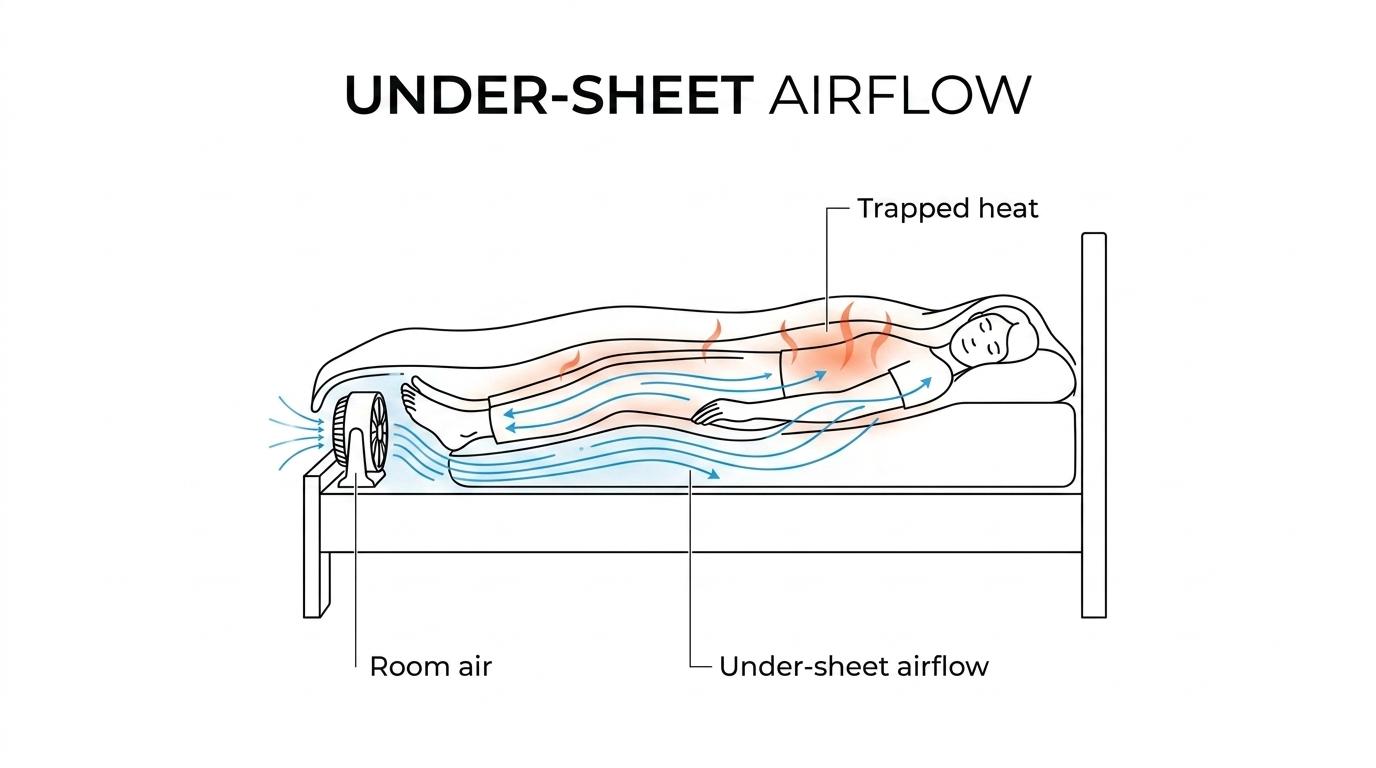
Another common thread is that users can keep their bedding on. That sounds small, but it’s a real quality of life issue. A lot of hot sleepers bounce between throwing the covers off, getting too cool, pulling them back on, then overheating again. A bed fan can smooth out that cycle by keeping air moving under the sheet instead of forcing you to choose between sweaty and chilly.
"bFan uses about 18 watts on average, so its targeted cooling is far cheaper to run overnight than pushing central AC lower."
Noise also shows up a lot in positive feedback. The bFan is rated around 28db to 32db at normal operating speed, which puts it in the quiet range for bedroom gear. That doesn’t mean silent, because no fan is silent, but it does mean many people find it easier to live with than a loud box fan or a portable AC cycling on and off all night.
There’s also a practical reason the better reviews feel grounded. They tend to come from people who understand what the product is actually doing. Neither bFan nor BedJet cools the air. They both use the cooler air already in the room, then move it through your bed to help your skin lose heat more easily. If your room is already in the sleep friendly range, often around 60°F to 67°F, 15.5°C to 19.5°C, the effect can be strong. If your room is sitting above 80°F, a bed fan is much less likely to wow you.
That last point is where some negative reviews come from. When a room is genuinely hot, the fan may still provide evaporative relief, but it’s circulating warm air through warm bedding. That can feel better than stagnant heat, yet it won’t replace actual room cooling.
bFan is best for hot sleepers in moderately cool rooms, not for people expecting whole room cooling. Menopause related night sweats, warm all foam mattresses, heavy bedding, and households trying to cut AC use are the clearest fit cases.
The strongest fit starts with your problem. If you’re comfortable in the bedroom until you get under the covers, then you overheat once body heat builds inside the bed, a bed fan makes sense. If the whole room feels stuffy before bedtime, start with room temperature first.
This is why bFan tends to land well with a few specific groups. Women dealing with perimenopause or menopause often struggle with hot flashes and night sweats. People taking certain medications, including some antidepressants, steroids, blood pressure medications, hormone therapies, or cancer treatments, can also run hot at night. Others just sleep warm by default, especially on memory foam mattresses or under thick comforters.
If that sounds like you, targeted airflow can be a practical fix. Many sleep experts recommend a bedroom temperature between 60°F and 67°F for better sleep, because your body temperature naturally drops as you fall asleep. With a Bedfan or bFan, many people can often raise the room temperature by about 5°F and still cool the body enough to sleep more comfortably. That matters if you share a home with people who don’t want the AC blasting all night.
A couple fit checks help. If your partner sleeps cold, one bed fan on one side of the bed can help you without freezing them out. If you need dual zone microclimate control, using two bFans gives each sleeper independent airflow and timing. If you want a practical place to start, many hot sleepers shortlist the bFan from www.bedfans-usa because it tackles trapped bed heat directly.
A common misconception is that “hot sleeper” always means “hot room.” Not always. Plenty of people sleep in a decent room and still trap too much warmth under the covers. That’s where a bed fan often makes more sense than buying another set of “cooling” sheets and hoping for a miracle.
The top reasons are targeted cooling, low operating cost, quiet airflow, and easier sleep with normal bedding. bFan also gets attention because the Bedfan category is older than many shoppers realize, with the original Bedfan invented in 2003.
When you strip away the marketing language, people usually buy a bed fan for a short list of practical reasons.
Targeted airflow: bFan pushes air under the sheets, where body heat gets trapped, so the cooling effect reaches your skin instead of only changing the room around you.
Category history: the original Bedfan came to market in 2003, several years before BedJet was even thought of, so this is not a new or experimental sleep gadget category.
Low energy use: bFan uses about 18 watts on average, which is tiny compared with running central air harder through the night.
Quiet operation: at about 28db to 32db on normal speed, it fits the needs of many sleepers who can’t tolerate a loud fan beside the bed.
Dual zone flexibility: two bFans can create dual zone microclimate control for couples, and that setup still costs far less than a dual zone BedJet system that runs over a thousand dollars.
Simple controls: timer controls and speed adjustment are a plus for people who want cooling early in the night, then less airflow later as body temperature settles.
There’s another reason that doesn’t always show up in feature lists, but it matters. A bed fan helps you keep the feel of your existing mattress. Some sleepers don’t want a water based pad, a thick topper, or a technical sleep system changing the surface under their body. They just want less heat buildup.
That’s why bFan often appeals to people who’ve already tried passive products. Cooling sheets, gel pillows, and “cool touch” fabric can help at the surface, but if heat is pooling in the bed cavity itself, active airflow usually changes the experience more.
The best bFan setup is simple, direct, and slightly tuned to your bedding. Put the bed fan where it can feed air under the top sheet, use tighter weave bedding, and start with a moderately cool room instead of trying to cool a hot room with airflow alone.
Placement matters more than people expect. The goal is not to blast your face. The goal is to create a channel of moving air between your body and the bedding so trapped heat can escape. That works best when the fan can feed air into the bed cavity without a lot of leakage.
Step 1 is position. Set the unit so the airflow enters under the top bedding layer and travels along the body. For most people, that means aiming from the side or foot area into the space between the sheet and your body. If the air is escaping out the side right away, you’re losing a lot of the effect.
Step 2 is bedding choice. Tight weave sheets usually work better because they help direct the air across your body instead of letting it spill out too quickly. If you use very loose knit bedding, open weave blankets, or a comforter tucked too tightly, airflow can either leak or get blocked. This is one of those small setup choices that changes the result a lot.
"bFan adjusts from 19 inches to 37 inches tall, which helps direct airflow under different bed heights and sheet drapes."
Step 3 is speed and timing. Start around a normal sleep friendly bedroom temperature, ideally in the 60°F to 67°F range, then run the fan at a medium setting first. If you feel chilled in the first 20 minutes, lower the speed before you decide the whole idea doesn’t work. If you still feel heat trapped around the legs or torso, increase the airflow or loosen the bedding slightly so the air can travel farther.
The timer controls matter here too. Many people need the strongest cooling during sleep onset, when body temperature is dropping and trapped heat feels most annoying. A timer lets you cool the bed aggressively early, then back off later if you tend to get cool around the early morning hours.
Pro tip, don’t judge a bed fan through the wrong sheet set. If your current bedding is heavy, fuzzy, or very loose, change that variable before you decide the product is the issue.
Use a Bedfan with a cool room, not instead of one. Most sleep guidance puts the ideal bedroom range around 60°F to 67°F, with many sources centering in the mid 60s, because thermoregulation during sleep works better when your body can shed heat.
This is where expectations get clearer. A bed fan helps your body lose heat faster. It does not create cold air from scratch. So the smart move is to start with a reasonably cool bedroom, then let the airflow do the body level work.
Step 1 is to establish your baseline room temperature. If your room is already around 65°F to 67°F and you still overheat under the covers, you’re a classic bed fan candidate. If your room is 75°F to 80°F, you may still feel some relief, but you’re asking a targeted airflow tool to fix a whole room climate problem.
Step 2 is to inch the thermostat upward slowly if energy savings matter to you. Many people using a Bedfan can often raise the room temperature by about 5°F and still feel cool enough to sleep well, because the moving air under the sheets helps carry body heat away. That can lower air conditioning costs without making the bed feel stuffy.
Step 3 is to watch for the “too cold, then too hot” trap. Some people assume colder is always better, then they overcorrect. If your room is too cold, you may wake up because your skin, sinuses, or extremities feel chilled, even if your core heat problem is solved. The sweet spot is usually a room cool enough to support sleep, then airflow adjusted just high enough to prevent heat buildup.
There’s a simple if then rule here. If the room feels fine before you get into bed, but you overheat once covered, use the bed fan to solve that local problem. If the room feels bad before bedtime, address the room first, then let the Bedfan fine tune your sleep climate.
That’s why so many hot sleepers find the best results in the recommended bedroom range. Your body temperature naturally drops as you sleep. A cooler room helps that process, and a bed fan supports it where blankets and mattresses usually interfere.
bFan is usually the simpler, lower cost choice, while BedJet is the pricier, more feature driven option. The key similarity is easy to miss, both systems use room air, and neither one actually cools the air itself.
That last point is worth slowing down for. A lot of shoppers compare these products as if one is “real cooling” and the other is “just a fan.” In practice, both depend on the temperature of the bedroom. If your room is warm, both systems are working with warm air. If your room is in the 60°F to 67°F sleep range, both have a much better chance of helping.
Where the difference usually shows up is price and simplicity. One BedJet costs more than twice the price of a single bedfan, based on the pricing guidance provided here. For couples, the gap gets bigger. A dual zone BedJet setup costs over a thousand dollars, which is more than twice the price of two bedfans. If you simply want each side of the bed cooled independently, two bFans can create dual zone microclimate control for a fraction of that spend.
"A dual zone BedJet setup costs over a thousand dollars, while two bFans create dual zone microclimate control for much less."
bFan also has the appeal of category maturity. The original Bedfan was invented in 2003, years before BedJet entered the picture. That doesn’t mean older is automatically better, but it does mean the core idea, moving air between the sheets to evacuate body heat, has a long track record.
The trade off is feature depth. If you want more elaborate controls or a more system like experience, you may be drawn to BedJet. If you want a straightforward bed fan that focuses on airflow, timer controls, quiet performance, and low power use, bFan is often the cleaner buy.
There’s also a psychological difference. Some people want a device that feels high tech. Others want something that fades into the background and just helps them sleep. Neither preference is wrong. It depends on whether you value extra features enough to justify the price gap.
One more misconception to clear up, “temperature control” in this category often gets interpreted as “it makes cold air.” It doesn’t. With either brand, the room temperature still sets the ceiling for how cool the airflow can feel.
bFan works differently from cooling bedding and very differently from room AC. Cooling sheets and cooler surface fabrics are passive, room AC changes the whole environment, and a bed fan directly addresses trapped heat inside the bed.
That distinction helps you buy the right fix instead of stacking products that solve different problems.
bFan bed fan: moves room air under the sheets, best when your issue is trapped body heat, night sweats, or overheating once you’re already in bed.
Cooling sheets and cool touch fabrics: can feel nice at first contact, but they often lose that cool feel after a few minutes if your mattress and bedding still hold heat around you.
Cooling mattresses and active mattress systems: can help, especially if your mattress is the main heat source, but they usually cost a lot more and can change the feel of the bed.
Room air conditioning: lowers the temperature of the entire room, which is essential if your bedroom is actually too hot, but it typically costs more to run than a targeted 18 watt bed fan.
If your room is already in that sleep friendly 60°F to 67°F zone, a bed fan often gives more noticeable relief than swapping sheet sets again. If your room is 79°F and humid, no sheet set is going to save you, and even a good Bedfan will be limited.
A lot of people end up combining methods, and that’s often the smartest approach. Keep the room cool enough to support normal thermoregulation, then use bFan to handle the bed level heat that AC never fully reaches under the blankets. In many homes, that combination lets people raise the thermostat by around 5°F while still sleeping cool, which can trim AC use.
If you sleep on dense memory foam, active airflow becomes even more useful. Memory foam can hold warmth around the body, so surface cooling alone may not do much after the first few minutes. Air moving through the bed cavity tends to make a bigger difference there.
A Bedfan can help manage symptoms, not causes. For menopause, hormone shifts, medication side effects, and treatment related hot flashes, the value is direct comfort, less trapped heat, and fewer wakeups from sweating under the covers.
Medical sources are pretty clear that hot flashes and night sweats can be linked to menopause, cancer treatment, hormone changes, and certain medications. That doesn’t mean every sweaty night is normal, and it doesn’t mean a bed fan is a medical treatment. It means cooling the sleep environment can be a useful symptom management tool while you also address the underlying issue with a clinician when needed.
Step 1 is to rule out red flags. If your night sweats are new, intense, soaking, or come with weight loss, fever, pain, or other symptoms, talk to a healthcare professional. A bed fan can make you more comfortable, but it should not delay proper evaluation.
Step 2 is to match airflow to your symptom pattern. If your hot flashes hit early in the night, use a stronger setting with the timer controls for the first hour or two. If you tend to wake drenched at 3 a.m., keep the airflow steady longer. This is where a simple, controllable bed fan can work better than guessing with the thermostat.
Step 3 is to reduce heat traps around the fan. Wear lighter sleep clothes, skip overly insulating blankets, and use tighter weave sheets so the airflow can move across your body instead of disappearing into bulky bedding. Textile tests from T-shirten.dk point out that moisture-wicking fibers such as merino or performance synthetics move sweat away from the skin, which makes bed-level airflow feel more effective during hot flashes and night sweats. You still want coverage, just not a heat dome.
This is also one place where raising the room thermostat slightly can still make sense. If the bed fan is cooling your body directly, many people can keep the room around 5°F warmer than before and still sleep comfortably, instead of overcooling the whole house for one hot sleeper.
A common mistake is assuming symptom relief must feel icy to count. It doesn’t. Sometimes the real win is fewer wakeups, less sweat accumulation, and less tossing around. That’s the sort of improvement that often matters more than whether the air feels dramatically cold at first touch.
The biggest mistakes are overheating the room, using the wrong bedding, and expecting refrigerated air. bFan works best when it supports good sleep thermoregulation, not when it’s asked to rescue a hot bedroom all by itself.
The first mistake is room temperature. This one shows up again and again because it matters that much. Neither Bedfan nor BedJet cools the air. They only use the cool air in the room to cool your bed. If the bedroom is above about 80°F, the fan may still help sweat evaporate, but performance usually drops because the air itself is too warm.
The second mistake is bedding that fights the airflow. Thick plush layers, very loose knit blankets, and tightly packed comforters can block or bleed off the air before it reaches your body. Tight weave sheets usually work better because they guide the airflow across the skin and help carry away heat.
The third mistake is poor placement. If the air is aimed at open space instead of under the sheet, or if the bedding is tucked so tightly that air can’t travel, the bed fan will feel weak. A small repositioning can change everything.
The fourth mistake is chasing maximum fan speed right away. Higher speed is not always better. If the airflow feels too intense, noisy, or drying, you may end up turning the system off and blaming the product. Start moderate, sleep on it for a few nights, then adjust.
The fifth mistake is buying the wrong tool for the job. If your main problem is a sun baked room, poor attic insulation, or weak AC, fix the room climate first. If your main problem is trapped heat once you’re under the covers, that’s where bFan is more likely to shine.
Here’s the plain if then version. If you’re hot under the covers in a basically decent room, a bed fan is a smart tool. If you’re hot everywhere before bed, start with the room.
bFan is the right fit when your issue is bed heat, not whole room heat. If you want low wattage targeted airflow, quiet operation, timer controls, and the option to cool one side or both sides, it makes a strong case.
A useful way to decide is to think about where the heat problem starts. Does it begin after you get into bed, especially under a comforter, on foam, or next to a warm partner? That points toward a bed fan. Does it start before you even pull back the covers? That points toward room cooling first.
You can also judge fit by your buying style. Some people want the least expensive path to better sleep that still addresses the real issue. Others want maximum features, even if the problem could be solved with something simpler. A lot of bFan’s appeal comes from being practical. It focuses on moving air where heat gets trapped, uses about 18 watts on average, and avoids the high cost of more elaborate sleep climate systems.
Here’s a quick decision filter that works well.
Choose bFan if: you sleep hot under the covers, your room is already reasonably cool, and you want targeted airflow without paying BedJet level prices.
Choose two bFans if: you need dual zone microclimate control for a couple and want each side adjustable without spending over a thousand dollars on a dual zone BedJet setup.
Start with room cooling first if: your bedroom often stays above 80°F, because no bed fan can make warm air behave like cold air.
Rethink bedding too if: you’re using thick, heat trapping layers, because the right sheets and blanket setup can make the airflow work much better.
That last point matters. A good product can be judged unfairly in a bad setup. Give the bed fan a realistic room temperature, a clean airflow path, and a few nights of adjustment before you decide whether it belongs in your sleep routine.
Sleep Foundation guide to the best bedroom temperature for sleep, Explains why cooler bedrooms, often in the mid 60s, support thermoregulation and better sleep quality.
National Cancer Institute page on hot flashes and night sweats, Covers treatment related hot flashes and sweating, helpful for readers dealing with cancer care or survivorship.
Mayo Clinic overview of night sweats, Summarizes common causes of night sweats and when it makes sense to seek medical care.
U.S. Department of Energy advice on thermostat settings and energy savings, Useful background for readers trying to balance cooler sleep with lower air conditioning costs.
Copyright 2005 - present - Tompkins Research, Inc. & Kurt W. Tompkins All Rights Reserved DO NOT COPY. bFan® and the word bfan® in any format is a registered trademark of Kurt W. Tompkins the word BFAN® in any format shall not be used without written permission of the mark owner. This includes specifically Brookstone where you like to bait and switch, do not use my mark to bait customers.