

Learn how body temperature sleep patterns affect falling asleep, REM sleep, night sweats, and why a cooler bed can improve rest.
Your body does not go to sleep all at once, and neither does your temperature. The two move together, hour by hour, all night long.
If you’ve ever felt wide awake in a hot bed, kicked the covers off at 2 a.m., then pulled them back on at 4 a.m., you’ve already noticed this in real life. Sleep and body temperature are tightly linked. Your brain wants your core body temperature to drift down as you fall asleep, while your skin, especially your hands and feet, gives off heat to help that happen.
That’s why temperature changes can make or break a night of sleep. If your room is too warm, your bedding traps heat, or your body is running hot from hormones, stress, medication, or illness, that normal cooling pattern gets harder to pull off. When that happens, you may fall asleep later, wake up more often, or feel like your sleep was light and choppy.
Your body runs on a circadian rhythm, a roughly 24 hour clock that affects sleepiness, hormone release, alertness, and temperature. Core body temperature does not stay fixed all day. It rises and falls in a predictable pattern, and one of the most sleep friendly parts of that pattern is the evening drop.
That drop is not a side effect, it is part of the process. As bedtime gets closer, your body starts shifting heat from the core toward the skin. Research on sleep physiology points to a rise in distal skin temperature, meaning the temperature of your hands and feet, as your body loses heat through the skin. In plain English, your body is trying to dump heat so sleep can start.
If that heat cannot get out, things get sticky fast. A hot mattress, thick foam, dense comforters, humid air, or a bedroom that never cools down can all work against that natural drop. You may still feel tired, but your body is not getting the cooling signal it wants.
This is one reason sleep experts commonly recommend keeping the bedroom between 60°F and 67°F, or 15.5°C to 19.5°C, for better sleep. That range helps your body do what it already wants to do, which is lower core temperature as sleep begins.
Sleep onset is the transition between being awake and actually falling asleep. During that window, your body starts moving away from daytime thermoregulation and toward nighttime cooling.
Core body temperature begins to fall. At the same time, blood flow to the hands and feet increases, which can raise skin temperature there and help heat escape. This is why people often feel sleepy after a warm bath, or after wearing socks to warm cold feet. Those things can help the body release heat more efficiently afterward.
If you are lying in bed feeling tired but somehow too warm to drift off, you are not imagining it. Your brain may be ready, while your body is still hanging onto heat. That mismatch can stretch out the time it takes to fall asleep.
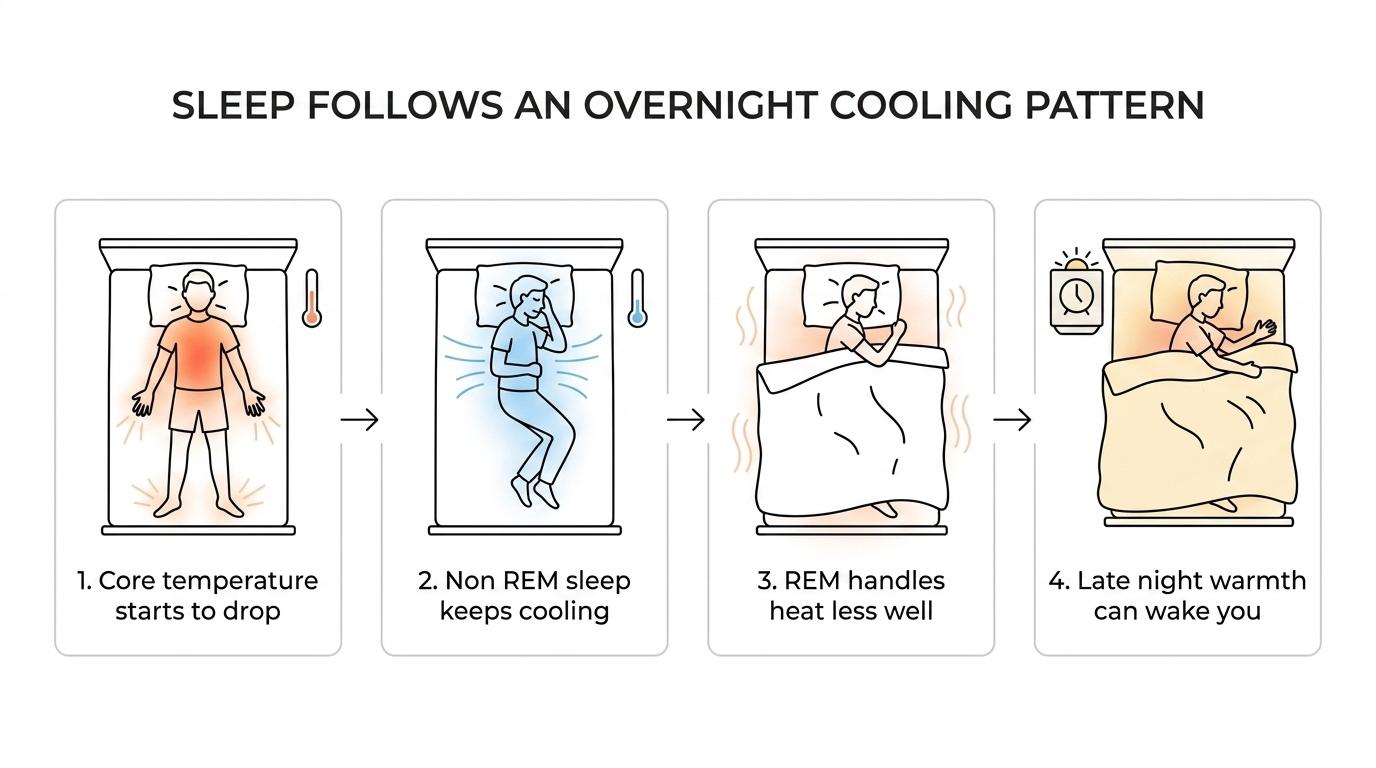
A lot of people try to fix this by cranking down the whole house thermostat. That can work, but it is not the only option. Because sleep comfort is really about your bed microclimate, the air trapped around your body under the sheets, targeted cooling can help many people fall asleep faster without turning the whole bedroom into a meat locker.
Temperature control changes as you move through the stages of sleep. In non REM sleep, your body continues to cool, and temperature regulation still works fairly well. In REM sleep, that control gets weaker.
That matters because REM sleep tends to show up more later in the night, which is also when bedrooms can get stuffier, bedding can feel warmer, and trapped body heat can build up. If you often wake up hot in the early morning hours, this is one reason why.
A simple way to think about it is this, early in the night, your body is trying to lose heat and settle into deeper sleep. Later in the night, when REM sleep becomes more common, your body is less effective at handling temperature swings.
This is also why a cooler sleep surface or a better airflow setup can matter most in the first several hours of the night. A study on sleep surface thermal properties found that a mattress topper with different thermal behavior helped facilitate a core body temperature drop and supported more deep sleep in the initial part of the night. That lines up with what many hot sleepers already feel, early night cooling can set the tone for the whole night.
Overheating is not just about feeling uncomfortable. It can interrupt the normal structure of sleep.
When heat gets trapped under the covers, your body has to work harder to get rid of it. That can mean more tossing, more partial arousals, and more full wakeups. You might not remember every disruption, but you’ll feel the result the next day, grogginess, irritability, and that heavy feeling that comes from sleep that looked long enough on paper but did not feel restorative.
Some people are more vulnerable to this than others. Menopause and perimenopause are big ones. So are certain medications, including some Antidepressants, steroids, pain medicines, and hormone treatments. Pregnancy can do it. Anxiety can do it. Sleep apnea can be tied in as well. Sometimes night sweats are harmless, sometimes they are a clue that something medical needs attention.
If night sweats are frequent, severe, or new for you, it’s smart to bring them up with a clinician. A bed fan can help with comfort, but it is not a substitute for medical care when symptoms are persistent or unexplained.
You’ll hear the 60°F to 67°F recommendation a lot, and for good reason. It is a practical range that supports the body’s normal nighttime cooling pattern.
That does not mean every sleeper needs exactly the same number. Some people are happiest at 60°F. Others are fine at 67°F. What matters is whether your body can offload heat without fighting your room, bedding, and mattress every step of the way.
Here is where targeted bed cooling gets interesting. With a Bedfan, many people can raise the room temperature by about 5°F and still cool the body enough for more restful sleep. That matters if you live with someone who gets cold easily, or if you are trying to cut air conditioning costs without waking up sweaty.
It also helps to remember what these products can and cannot do. Neither Bedfan nor BedJet cool the air itself. They only use the cooler air already in the room and move it into the bed area to carry heat away from your body. If your bedroom is already very hot, no bed fan can create cold air from nothing. What it can do is use the available room air more efficiently, right where you need it.
Whole room cooling and bed cooling are not the same thing. Air conditioning changes the temperature of the room. A bed fan changes the temperature feel around your body under the sheets.
That may sound like a small difference, but in practice it is huge. A lot of people do not need the entire bedroom to be icy cold. They just need the heat trapped inside the bed to stop building up.
A Bedfan works by pushing airflow between the sheets so body heat does not get stuck around your torso and legs. If you use sheets with a tighter weave, that often helps the air spread across your body more evenly and carry away heat better. This is one of those small details that can make a bed fan feel much more effective.
The bFan from Bedfans USA is a solid example of this approach. It is aimed at between the sheets airflow, which is really the point, because that’s where hot sleepers tend to struggle. If you want relief without overcooling the entire room, this kind of setup makes a lot of sense.
People shopping for bed cooling usually end up comparing Bedfan and BedJet, so let’s keep this simple and useful.
First, both are trying to improve your bed microclimate, not chill the entire room. Neither one cools the air. They both rely on the cooler air already present in the room. That means your bedroom temperature still matters, and the common 60°F to 67°F guidance still applies.
Second, price matters, especially for couples. One BedJet is more than twice the price of a single Bedfan. A dual zone BedJet setup costs over a thousand dollars, which is more than twice the price of two bedfans. For many households, that changes the conversation right away.
Third, there is the history of the category. The original Bedfan came to market years before BedJet was even thought of. The Bedfan was invented in 2003, and it helped define this product category long before it became trendy.
Features matter too. Bedfan setups are appealing to many hot sleepers because they are straightforward, low power, and practical. The Bedfan uses only 18 watts on average. It also offers timer controls, which is useful if your worst overheating tends to hit in the first few hours of sleep, when getting that early night temperature drop can help you settle into deeper sleep. Normal operating sound is about 28 dB to 32 dB, which is quiet enough for many bedrooms, often more like soft background airflow than a disruptive fan roar.
If you share a bed, two bedfans can be a very sensible way to get true side by side cooling control. One person can run airflow, the other can keep their side as is. That is a real benefit when couples have very different temperature preferences.
Research on sleep temperature keeps pointing in the same direction, cooler conditions tend to support better sleep, especially during the first part of the night.
That does not mean cold is always better. You are not trying to shock your body. You are trying to help it follow its normal nighttime pattern, which is a drop in core body temperature paired with heat loss through the skin.
The mattress topper study mentioned earlier is useful because it shows that sleep surface thermal properties can help with that early night temperature drop and can support deeper sleep. This is a nice reminder that your sleep environment is not just the air in the room. It is also the mattress, the sheet fabric, the comforter, and the little pocket of warmth trapped around you.
If you sleep hot, it often helps to think in layers. Room temperature matters. Airflow matters. Bedding matters. Your body’s own heat production matters. When several of those are working against you, even a decent room temperature can still leave you too warm under the covers.
Some people are naturally warm sleepers. Others feel a sudden change and wonder what happened. The answer is often not one thing.
Hormonal shifts are a big driver. Menopause and perimenopause can bring hot flashes and night sweats that feel almost impossible to predict. Pregnancy can also increase warmth and sweating. Men can deal with hormonal changes too, though it is talked about less often.
Medications are another common factor. Antidepressants, steroids, some pain medicines, diabetes medicines, and hormone therapies can all be tied to night sweating. Then there are infections, thyroid problems, Anxiety, reflux, and Sleep apnea and other conditions that can leave you waking up hot.
A bed fan can help with the symptom, which is trapped heat and overheating in bed. It cannot fix the root cause. That’s why it’s smart to think of cooling tools as part comfort solution, part sleep support, not as a medical answer on their own.
You do not need to overhaul everything at once. A few targeted changes usually tell you pretty quickly whether temperature is part of your sleep problem.
If you want a little more structure, here is the practical version most people can try tonight.
Those small changes can make a bigger difference than most people expect, because you are not fighting your body’s biology, you are helping it.
If you are considering a bed fan, the basics matter more than flashy marketing.
You want airflow that actually reaches under the sheets, noise that is low enough to live with, and controls that fit how you sleep. If your heat spikes right after bedtime, a timer is useful. If your bed height or bedding changes, adjustability matters. If you share a bed, independent control matters a lot.
This is where the bFan stands out as a practical option. It is built around between the sheets airflow, remote controlled use, and adjustable placement. It is also a lower cost path into dual zone cooling. Two bedfans can give couples personalized cooling at a fraction of the price of a dual zone BedJet system, which runs over a thousand dollars. For a lot of people, that makes the choice much easier.
It also helps to keep expectations grounded. A bed fan does not replace air conditioning in a brutally hot room. It works best when the room is already reasonably cool, because it uses that room air to carry heat away from your body. Pair it with the recommended 60°F to 67°F bedroom range, or at least get close, and you give it the best shot at helping.
Very often, yes.
Late night and early morning wakeups can happen when the bed has stored up too much heat, when REM sleep becomes more common, or when your own temperature regulation is less stable because of hormones, stress, illness, or medication. You may not wake thinking, I am too hot, but you might toss, throw off the covers, or feel restless and alert for no obvious reason.
This is why some people say they fall asleep fine, but cannot stay asleep. The problem is not just sleep onset. It is the changing temperature story across the night.
For many households, it can.
If you need the whole house at a very low temperature just to keep the bed tolerable, targeted airflow may let you back off the thermostat. Since sleep experts commonly recommend 60°F to 67°F for better sleep, and many people using a Bedfan can raise room temperature by about 5°F while still cooling the body enough for more restful sleep, there is real potential for savings, especially in hot climates or long cooling seasons.
Because the Bedfan uses only 18 watts on average, it is a much smaller energy draw than forcing central air or a large room unit to work harder all night. The math will vary by home and climate, but the basic idea is simple, cool the sleeper where the problem is, not the entire house more than necessary.
This is one of the most common bedroom battles, one person is freezing, the other is sweating.
Trying to solve that by changing the whole room temperature usually leaves both people annoyed. Targeted bed cooling is a cleaner fix because it addresses the body, not the whole space. If one sleeper needs airflow and the other does not, two bedfans can create dual zone microclimate control without forcing a shared compromise that makes nobody happy.
This is also why the price comparison with BedJet matters. A dual zone BedJet setup costs over a thousand dollars, which is more than twice the price of two bedfans. If your goal is simple side by side cooling control, that difference is hard to ignore.
If you want to read the source material behind the sleep temperature science, these are good places to start.
Copyright 2005 - present - Tompkins Research, Inc. & Kurt W. Tompkins All Rights Reserved DO NOT COPY. bFan® and the word bfan® in any format is a registered trademark of Kurt W. Tompkins the word BFAN® in any format shall not be used without written permission of the mark owner. This includes specifically Brookstone where you like to bait and switch, do not use my mark to bait customers.