
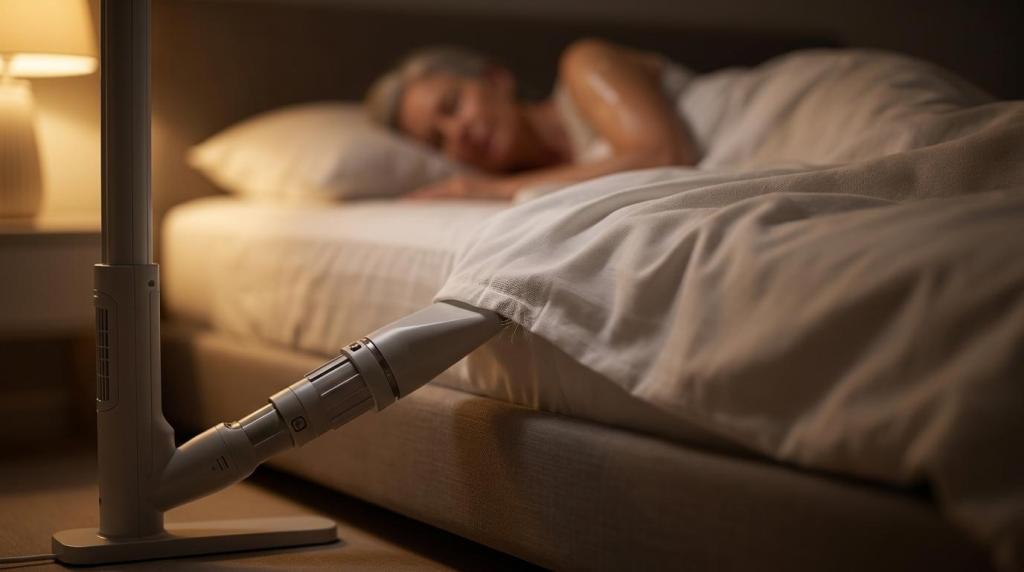
Bed fan for side sleepers cools trapped heat between the sheets with quiet, targeted airflow for better sleep and lower AC use.
If you sleep on your side and wake up hot, damp, or wide awake because the bed feels stuffy, you do not need a lecture about sleep hygiene. You need a bed fan that cools the space that actually matters, the air trapped between you and your bedding. bFan, made by Tompkins Research, Inc., was built for exactly that job, using quiet, controllable airflow between your sheets to move body heat out instead of letting it pool around your shoulders, hips, back, and legs.
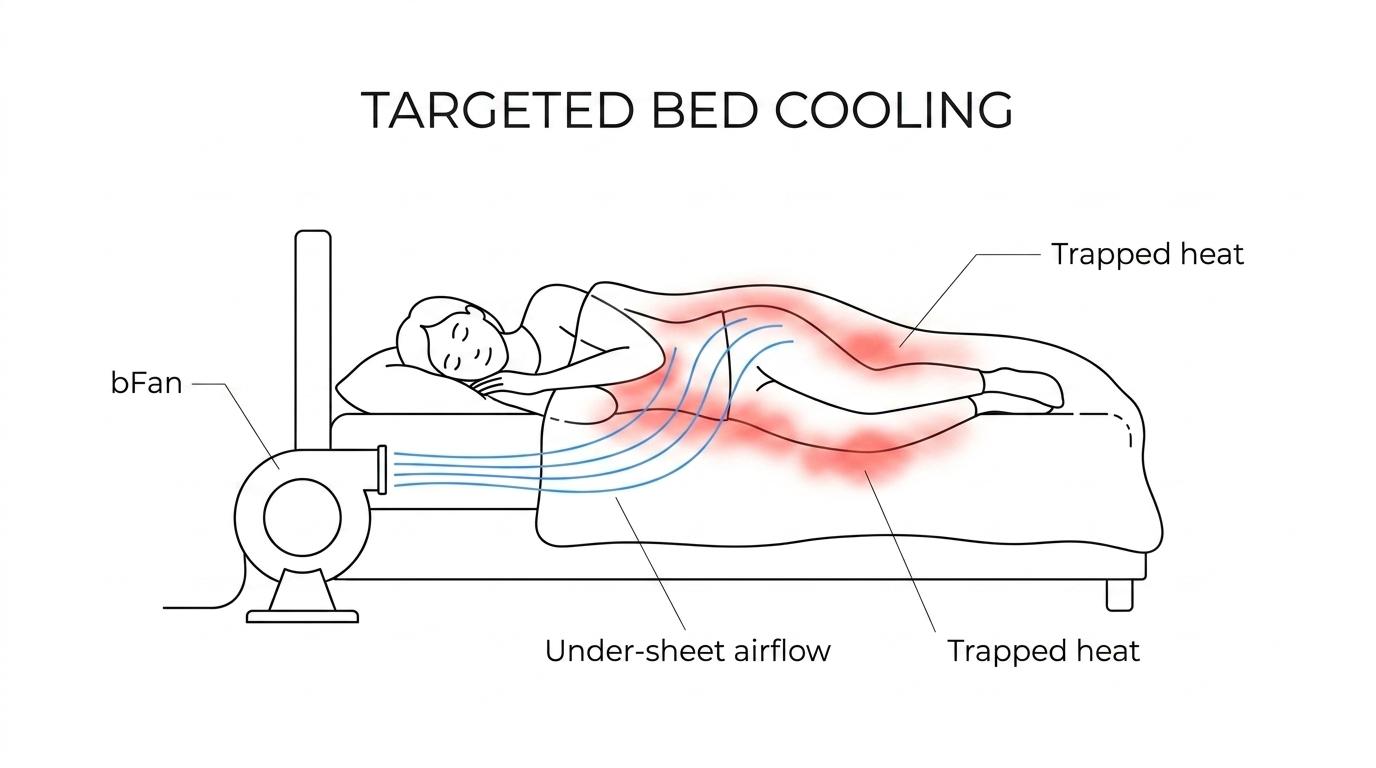
That matters even more for side sleepers. When you sleep on your side, more of your body stays pressed into the mattress and wrapped by bedding, which can turn your sleep space into a warm little pocket that keeps reheating you. The bFan bed fan gives you a targeted way to cool that personal sleep microclimate without trying to chill the whole house all night.
A lot of hot sleepers assume the only answer is colder air conditioning. Sometimes that works, but it can get expensive fast, and it does not always solve the problem under the covers. A bed can still trap heat, even in a cooler room, especially when you sleep on your side and the blanket drapes closely around your body.
bFan is designed to send a controllable breeze between the sheets, so the heat your body releases can escape instead of building up around you. Tompkins Research makes the bFan with a quiet squirrel cage blower, an adjustable body, and a stable base, so the airflow has the pressure to travel where you need it, under the bedding, not just around the room.
Side sleepers usually notice overheating in very specific spots. It might be your chest under the comforter, your knees where the blanket folds over, or your back getting sticky when you roll from one side to the other. The point of a bed fan is not random air movement. The point is to cool the exact layer of air wrapped around your body while you sleep.
"At normal operating speed, bFan runs at about 28 dB to 32 dB, a bedroom friendly range for people who need cooling without a loud fan."
Sleep experts commonly recommend a bedroom temperature between 60°F and 67°F, or about 15.5°C to 19.5°C, for better sleep. Some sleep research reviews narrow the sweet spot even further, to around 60°F to 65°F. Even so, side sleepers often still overheat under the bedding, which is why under sheet airflow can make a noticeable difference, even if the room itself is already fairly cool.
bFan also gives you a more focused approach than blasting the AC lower and lower. The U.S. Department of Energy says circulating fans can improve comfort and let people raise thermostat settings by about 4°F without reducing comfort. Because bFan sends the airflow where heat is trapped most, many people can often raise room temperature by about 5°F and still sleep cool, which can take some pressure off your air conditioner and your utility bill.
That is the practical appeal of the bFan from Bedfans USA. Instead of cooling every cubic foot of the room just to make the bed tolerable, you are cooling the bed space itself.
One of the biggest reasons bFan makes sense for side sleepers is placement flexibility. The unit can sit at the foot of the bed, or anywhere along the side of the bed, and it can send airflow between the sheets from either position. If you do not like air directed from the foot, or your bed frame makes foot placement awkward, side placement gives you another option.
That flexibility is not a small detail. A lot of side sleepers prefer airflow that enters beside the legs or hip area and travels upward under the top sheet, instead of pushing straight up from the foot of the bed. With bFan, you can experiment and find the position that cools your body without blowing in your face or disturbing your partner.
The fan body adjusts from 19 inches to 37 inches tall. That range helps you line up the airflow with your mattress height and sheet position, whether the fan is at the side or the foot of the bed. Tompkins Research designed the bFan as a remote controlled, adjustable height between the sheets airflow system, so you can fine tune the setup instead of settling for a one position solution.
"bFan adjusts from 19 inches to 37 inches tall and can be placed at the foot or side of the bed, giving side sleepers real control over airflow."
The sturdy base matters, too. If you are placing a bed fan at the side of the bed, you want something that stays put and keeps delivering a steady stream of air where you aimed it. bFan was built with improved stability and adjustability, which helps when you want consistent cooling night after night, not constant repositioning.
The airflow itself is meant to be controlled, not harsh. That makes a difference for side sleepers, because many people want the cooling effect under the sheet while keeping the room quiet and the breeze gentle on exposed skin. You are not trying to create a wind tunnel. You are trying to move trapped heat out of the bedding so your body can settle into sleep and stay there.
Sheet choice can help the bed fan work better. When you use a bFan, tighter weave sheets usually do the best job of guiding air across your body and carrying away heat. Looser, very open fabrics can let the airflow escape too quickly, while a tighter weave helps distribute the breeze more evenly under the covers.
Noise is one of the first buying concerns people bring up, especially if they are already light sleepers. bFan addresses that concern with a normal operating sound level of about 28 dB to 32 dB. That is a useful number because it tells you this is not just another loud floor fan shoved next to the bed. It is designed for overnight use where sound matters.
The way bFan cools also helps with comfort. Neither bFan nor Bedjet cools the air itself. They only use the cooler air already in the room. That is important, because it sets honest expectations. If your bedroom is hot and stagnant, no bed fan is magically making cold air. What bFan does is take the cooler air you do have and move it directly into the bedding where your body heat gets trapped.
For many people, that feels much more effective than a room fan pointed across the ceiling. A room fan can create a wind chill effect, but it often misses the hot zone under the sheets. bFan works at the microclimate level, which is why it can feel like relief arrives faster once you get in bed.
The energy side is just as compelling. The bFan uses only 18 watts on average. That gives you a low power way to cool the bed space while you sleep, which is a very different energy profile from turning the thermostat down for the whole home throughout the night.
"bFan uses about 18 watts on average, which makes targeted bed cooling far cheaper than cranking down whole house AC."
That low power use is one reason energy conscious sleepers look at bed fans in the first place. If sleep experts are telling you the bedroom should usually land around 60°F to 67°F, but your comfort only comes when the thermostat is dropped even further, costs can pile up. A bed fan gives you another lever to pull. Many people can often raise the room temperature by about 5°F and still sleep cool enough for more restful sleep, because the airflow is right under the covers instead of lost across the room.
bFan also includes timer controls, which is useful if you want stronger cooling at the beginning of the night, then less airflow later. A lot of side sleepers feel hottest when they first get into bed or during the first sleep cycles, and the timer gives you a practical way to match the cooling period to when you need it most.
If you are comparing a bFan bed fan with Bedjet, start with the most important point, neither one cools the air itself. The bFan does not cool the air, and the Bedjet does not cool the air either. Both use the cool air already in the room. The real question is how that air gets delivered, how much control you get, how noisy the setup is, and what it costs you to own it.
Tompkins Research has a real history here. The original bedfan was invented in 2003, and the original Bedfan came to market several years before Bedjet was even thought of. That matters because bFan is not a late entry trying to copy the category. Tompkins Research is the original inventor of the bed fan category, and the current bFan reflects that long product focus with improved airflow, pressure, adjustability, and stability.
Price is where the difference gets hard to ignore. One Bedjet is more than twice the price of a single bFan. If you need separate cooling control for both sides of the bed, the dual zone Bedjet setup is over a thousand dollars, and it is more than twice the price of two bedfans. For a lot of couples, that is the moment the buying decision gets simple.
With bFan, dual zone microclimate control is straightforward. You use two fans, one for each side, and each sleeper gets separate airflow control without paying over a thousand dollars for a dual zone Bedjet setup. That is especially useful when one person sleeps hot and the other does not, or when one of you is dealing with menopause, medication related night sweats, or inconsistent temperature swings.
"A dual zone Bedjet setup costs over $1,000, while two bFans create dual zone bed cooling for more than twice less than that total."
bFan also keeps the value proposition grounded. You are buying a specific tool for a specific problem, overheating under the sheets. Because Tompkins Research sells direct and does not sell bFan on Amazon, you are buying from the company that actually designs and manufactures the product, not from a marketplace listing where every option starts to look the same.
For some shoppers, Bedjet may still appeal because it is a familiar name. But if your goal is simple, effective, between the sheets cooling at a more reasonable price, bFan is the comparison that holds up. It is a quieter, targeted, low watt solution built around the idea that sleeping cool should not cost a fortune.
The people who get the most from a bed fan are usually not casual shoppers. They are people who are tired of waking up. They are kicking off covers at 2 a.m., flipping the pillow, moving from one side of the bed to the other, then pulling the blanket back on because now they are chilly in the room but still hot inside the bedding.
bFan helps people who overheat for all kinds of reasons. Sometimes it is just how your body sleeps. Sometimes it is a life stage, like menopause or perimenopause. Sometimes it is a side effect from medications that affect temperature regulation or sweating. Sometimes it is part of a medical issue that you are already managing with your doctor.
Here are some of the situations where bFan is often a strong fit:
Tompkins Research is careful about what a bed fan can and cannot do. bFan can help relieve the discomfort of overheating and night sweats by improving airflow around your body under the bedding. It is not a treatment for the underlying cause. If night sweats are new, severe, unexplained, or coming with symptoms like fever, weight loss, persistent cough, or major fatigue, it is smart to speak with a clinician.
That does not make the comfort side any less important. When overheating is what keeps waking you, symptom relief at the bed level can make an immediate difference in how rested you feel the next day.
A lot of product pages stay abstract here, but side sleepers usually want to know what bedtime will actually feel like. With bFan, you are getting a remote controlled bed cooling fan designed to send adjustable airflow between the sheets, from the foot or side of the bed, using a quiet blower and a stable base.
That changes a few practical things right away. You can cool the bed without freezing the entire room. You can keep the breeze under the covers instead of across your face. You can lower the stuffy, trapped feeling that builds up around your torso and legs. You can often ease back on overnight AC use, especially when you were previously lowering the thermostat just to handle bed heat.
For couples, the biggest improvement may be temperature independence. If you put one bFan on each side, each person gets a separate microclimate. That is a big deal if one partner sleeps hot and the other prefers a warmer room. It is also the most sensible way to create dual zone bed cooling without stepping into the over one thousand dollar price range of a dual zone Bedjet system.
The bFan design also makes bedtime simpler, not fussier. There are no claims of making cold air from nowhere, because that is not how bed fans work. What you get is controlled movement of the room air you already have, delivered to the place where your body and bedding create the most heat buildup. That is a cleaner, more honest expectation, and for the right sleeper, it is exactly enough.
You do not need a complicated routine to get good results from a bed fan, but a few setup choices can make the airflow work better for your body and bed. Tompkins Research built bFan to be adjustable, and side sleepers usually benefit from taking a little time to tune the setup rather than just plugging it in and hoping for the best.
A good starting point is to aim the airflow so it travels under the top sheet across the area where you overheat most. For some people, that is from the foot of the bed. For others, side placement works better, especially if you sleep curled slightly on your side and trap more heat around the torso and hips.
A few practical tips usually help:
There is also a comfort mindset shift that helps. Because bFan does not create cold air, your room still needs to be reasonably comfortable to begin with. Sleep experts commonly recommend a bedroom temperature between 60°F and 67°F, and many people find that pairing a room in that range with targeted under sheet airflow feels much better than trying to force the whole room colder. In practical use, many people can often raise the room temperature by about 5°F and still sleep cool with a Bedfan, which can translate into meaningful AC savings over time.
bFan is the right fit when your real problem is trapped heat in bed. If you climb in feeling fine and then start overheating once the sheets are over you, that is a classic bed microclimate problem. If you are a side sleeper, that pattern can be even stronger, because the bedding wraps more closely around the body and holds more warmth near the skin.
It is also a smart fit if you care about noise, power use, and price. A normal sound level of 28 dB to 32 dB, average use of 18 watts, adjustable placement, timer controls, and a lower price than premium alternatives make bFan a practical choice for people who want function without extra drama.
bFan may be especially worth it for you if any of these sound familiar:
If your room itself is extremely hot, or if you expect a bed fan to generate refrigerated air, your expectations need adjusting. No bed fan does that. The bFan is a targeted comfort tool, not a replacement for all cooling in every climate. And if severe night sweats are new or unexplained, it is worth getting medical guidance while also improving sleep comfort at home.
If you are ready to stop fighting your bedding every night, bFan gives you a focused, proven way to cool the space where side sleepers usually struggle most. Choose the placement that fits your bed, use a tighter weave sheet, set the airflow the way you like it, and give yourself a cooler, calmer shot at real sleep.
Copyright 2005 - present - Tompkins Research, Inc. & Kurt W. Tompkins All Rights Reserved DO NOT COPY. bFan® and the word bfan® in any format is a registered trademark of Kurt W. Tompkins the word BFAN® in any format shall not be used without written permission of the mark owner. This includes specifically Brookstone where you like to bait and switch, do not use my mark to bait customers.