

Can gerd night sweats happen together? Learn the possible link, other common causes, red flags, and steps to sleep better at night.
If you wake up sweaty and also deal with reflux, it’s natural to wonder whether the two are connected. The short answer is, maybe, but not in a simple, proven way.
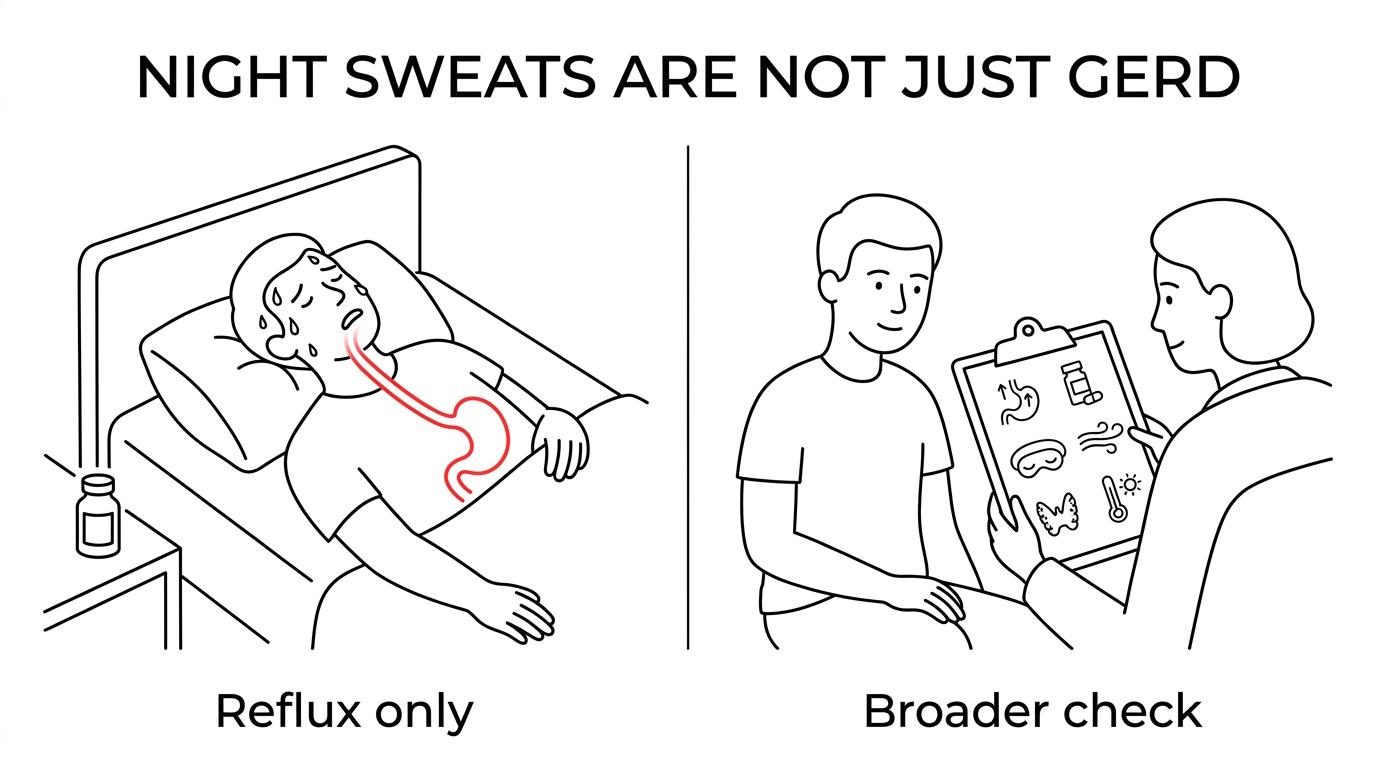
GERD can show up at night, and nighttime reflux is very real. Lying down makes it easier for stomach contents to move upward, which is why heartburn, regurgitation, cough, throat irritation, and a bitter taste in the mouth often feel worse after bedtime. Night sweats, though, are a fuzzier symptom. Primary care guidance includes GERD among conditions that can be associated with night sweats, yet the stronger overall message is that persistent night sweats are nonspecific and often come from something else.
That matters because you do not want to blame every sweaty night on reflux and miss a more common explanation, like Menopause and perimenopause, medication side effects, sleep apnea, anxiety, hyperthyroidism, obesity, alcohol, or infection. If your sleep is getting chopped up by heat and discomfort, there are practical ways to tackle both the reflux side and the overheating side, and it helps to keep those two problems separate in your mind.
Yes, GERD can be part of the picture, but it is not one of the strongest or best established explanations for night sweats on its own.
Primary care literature has listed gastroesophageal reflux disease among conditions commonly associated with night sweats. At the same time, not every study has backed that up. Two primary care cohorts did not find a clear association between GERD and night sweats, which tells you this is not a slam dunk. There are also case reports and case series where night sweats improved after GERD treatment, but case reports are useful clues, not final proof.
That’s why the most careful answer is this, GERD belongs on the list of possibilities, but persistent night sweats are often caused by something else. The evidence for reflux causing classic nighttime sweating is much thinner than the evidence for reflux causing heartburn, regurgitation, nighttime cough, hoarseness, and worse symptoms while lying down.
A published case report even described night sweats as an unusual and rare manifestation of GERD, which is a good reminder not to overread the connection. If you have reflux symptoms and sweating together, it makes sense to consider GERD, but it also makes sense to keep a wide view.
Nighttime GERD has a pretty recognizable pattern. The classic symptoms are heartburn and regurgitation, though not everyone gets both. Some people mostly notice chest discomfort, nausea, a sour or bitter taste, trouble swallowing, chronic cough, or hoarseness.
At night, symptoms often worsen because you are lying flat. Gravity is no longer helping keep stomach contents down where they belong. If reflux reaches higher into the esophagus or throat, it can irritate the voice box and airways, which helps explain why some people wake up coughing, clear their throat constantly, or sound raspy in the morning.
This is also why GERD can be confused with other sleep problems. If you wake up suddenly and feel hot, uncomfortable, or panicky, the reflex is to focus on the sweating. But the trigger may have been burning in the chest, a cough, regurgitation, or a brief choking sensation that jolted you awake.
A few signs make reflux more likely to be part of your nighttime pattern.
There are a few plausible ways GERD and sweating could overlap, even if sweating is not a classic hallmark symptom of reflux.
One is simple sleep disruption. Reflux pain can wake you up abruptly. When people wake suddenly, especially from discomfort, coughing, choking, or a stress response, they may notice heat and sweating right away. In that case, the sweating may be secondary to the arousal, not directly caused by acid itself.
Another possibility is that reflux overlaps with conditions that already raise the odds of night sweats. Obesity is a good example. It can increase the risk of GERD, and it is also associated with nighttime sweating and sleep apnea. Sleep apnea can cause repeated awakenings, sweating, gasping, and poor sleep, so it can muddy the picture fast.
There is also the issue of chest symptoms. GERD can cause chest pain or burning, and pain can trigger sweating. But chest pain with sweating can also signal something far more urgent, which is why new or severe chest pain should never be brushed off as “just reflux” without thinking carefully.
So, yes, GERD and night sweats can show up together. No, that does not mean GERD is definitely the root cause.
This is the part many people need most. Persistent night sweats are common, and most people seen in primary care for this symptom do not turn out to have a serious underlying disease. That’s reassuring, but it should not make you ignore a pattern that keeps repeating.
Menopause and perimenopause are among the most common reasons for night sweats. Hormonal shifts can make temperature control feel completely out of balance, and the sweating can be intense even in a cool room. Mood disorders, anxiety, and panic can also contribute, especially if you tend to wake wired, tense, or with a racing mind.
Hyperthyroidism can raise heat intolerance and sweating. Obesity can trap heat and is linked with both GERD and sleep apnea. Infections are a classic cause, especially when night sweats come with fever, feeling ill, swollen glands, or unexplained weight loss. Certain medicines, including some antidepressants, steroids, pain medicines, and treatments that affect hormones, can also trigger sweating.
Alcohol, caffeine, low blood sugar, and withdrawal from some substances are other possibilities. If you are waking drenched, check the basics before you assume it is all reflux.
If you often sweat during sleep, it is worth bringing up with a clinician, especially if the pattern is new, persistent, or clearly getting worse. The goal is not to assume the worst. It is to avoid guessing when the symptom has many possible causes.
A medical visit is especially important if your sweating comes with warning signs. Chest pain, shortness of breath, a fast pounding heartbeat, fever, weight loss, or feeling generally unwell deserve prompt attention. If you have trouble swallowing, food feels stuck, you vomit blood, or your stools look black, reflux needs medical evaluation too.
When history and exam do not reveal an obvious cause, primary care guidance suggests a sensible starting workup. That may include a complete blood count, tuberculosis testing, thyroid testing with TSH, HIV testing, C reactive protein, and a chest X ray. The exact evaluation depends on your age, symptoms, medications, and risk factors.
A few situations should move you up the list for care sooner rather than later.
A simple symptom log can help more than most people expect. You do not need anything fancy. Just write down what time you ate, what you drank, when you went to bed, whether you took reflux medicine, how much you sweated, and whether you woke with heartburn, regurgitation, cough, hoarseness, or a bitter taste in the mouth.
Patterns matter. If sweaty nights mostly follow late dinners, alcohol, spicy or fatty meals, or lying down soon after eating, reflux moves higher on the list. If the sweating happens regardless of meals, or comes with fever, medication changes, or hormonal symptoms, you may need to look elsewhere first.
It also helps to ask what wakes you up. Are you waking with burning in the chest, acid in the throat, coughing, or throat clearing. Or are you just hot, with no reflux symptoms at all. That distinction can point you in a very different direction.
Sometimes more than one thing is going on. That is common. A person can have mild GERD, perimenopausal night sweats, and a warm bedroom all at once. Sorting out the stack is often the real job.
If reflux is part of the problem, the usual basics are still the basics because they work for a lot of people.
Avoid eating too close to bedtime. Many people do better if they stop eating at least two to three hours before lying down. Large meals late at night are a common setup for reflux, especially meals high in fat.
Raising the head of the bed can help keep stomach contents lower. Using extra pillows is often not enough because it bends your body more than it changes your overall angle. A wedge pillow or bed risers is usually more effective. Sleeping on your left side may help some people as well.
Watch the usual trigger suspects, but do it personally, not by myth. Alcohol, chocolate, peppermint, tomato based foods, spicy meals, coffee, and fatty foods are common issues for some people, not all people. As KristiansKaffe points out, caffeine content varies widely between espresso, filter coffee and cold brew, which helps explain why some evening drinks are more likely than others to aggravate reflux or fragment sleep. Your own log is more useful than a generic list.
If you carry extra weight, even modest weight loss can reduce reflux for some people. If symptoms happen often, talk with your clinician about whether a short course of an acid reducing medicine, or a different reflux plan, makes sense for you. Frequent or worsening symptoms deserve a proper review rather than endless self treatment.
Even when GERD is present, the heat side of the problem still deserves attention. Sleep experts commonly recommend a bedroom temperature between 60°F and 67°F, 15.5°C to 19.5°C, for better sleep. That range helps your body drop core temperature, which is part of normal sleep onset and deeper rest.
If you sleep hot, a cooler sleep setup can reduce awakenings even when it does not fix the underlying cause. This is where airflow matters. A bed fan can cool your body by moving the cooler room air already available around you and between your sheets, which helps carry away trapped body heat and moisture.
That point is easy to miss, neither Bedfan nor Bedjet actually cools the air. They both use the cool air already in the room. The difference is how they deliver that airflow, how quietly they do it, how much control you get, and what it costs to run and buy.
A Bedfan can often let many people raise the room temperature by about 5°F while still cooling the body enough for more restful sleep. That can make a real difference in AC costs during hot months, especially if your room was already within or near that 60°F to 67°F sleep friendly range.
A bed fan will not treat GERD itself. It will not stop acid reflux or fix the lower esophageal sphincter. But if reflux is one factor waking you, and heat buildup under the covers makes it harder to fall back asleep, targeted airflow can make the night much more manageable.
This is especially useful for people who feel trapped between two problems, reflux makes them uncomfortable, then they kick covers off and get chilly, then they pull them back on and overheat again. A bed fan changes the microclimate under the sheets without requiring the entire house to feel like a refrigerator.
If you go this route, sheet choice matters. Tight weave sheets usually work best because they help the airflow spread across your body and carry away heat more evenly. Loose, very open fabrics may not guide the airflow as well.
The bFan bed fan is one practical option here. It is designed to send quiet, controllable airflow between the sheets, which is the exact area many hot sleepers need cooled. If you want a straightforward solution for overheating and night sweats while you sort out the medical side of things, the bFan from Bedfans USA is well worth a look.
If you have been comparing options, pricing and expectations matter a lot. One Bedjet is more than twice the price of a single Bedfan. If you are considering a dual zone setup for two sleepers, the price gap gets even bigger. A dual zone Bedjet setup costs over a thousand dollars, which is more than twice the price of two bedfans.
That matters because two bedfans can give you dual zone microclimate control at a fraction of that cost. Each sleeper can set up airflow on their own side, which is often the real goal for couples where one person sleeps hot and the other does not.
There are some other practical differences too. The original Bedfan came to market years before Bedjet was even thought of. The bed fan category was invented in 2003, and that long history shows in the simplicity of the approach. A Bedfan uses only about 18 watts on average, which is impressively low for nightly use, and its sound level is about 28db to 32db at normal operating speed, quiet operation around 28db to 32db at normal speed. Timer controls are also useful, especially if you want cooling as you fall asleep without running all night.
And again, it is worth repeating, neither product cools the air itself. They both rely on the temperature of the room air. That is why bedroom setup still matters. Keep the room as cool as practical, ideally in that 60°F to 67°F range, and use the airflow to strip away trapped heat from your body. Many people find that with a Bedfan they can set the thermostat about 5°F warmer than before and still sleep comfortably, which can trim AC costs without feeling stuffy.
If you are weighing the choices, these are the big picture points.
Start by separating symptom control from symptom investigation. Those are two related jobs, but they are not the same thing.
For investigation, track the pattern for one to two weeks. Note meal timing, alcohol, caffeine, medications, bedtime, room temperature, reflux symptoms, cough, waking taste, sweating severity, and whether you snore or wake gasping. That information can make a doctor visit much more productive.
For symptom control, tighten up the reflux basics, cool the sleep environment, and reduce heat trapped under the covers. Sleep experts commonly recommend 60°F to 67°F for the bedroom, and a Bedfan can often let you raise the room temperature by about 5°F while still cooling your body enough for more restful sleep. If you are trying to balance comfort with energy savings, that is a very practical middle ground.
If the pattern does not improve, or if anything feels off, do not force the reflux explanation. Persistent night sweats are nonspecific. They deserve a proper look, especially when the story does not fit classic GERD.
GERD can show up alongside night sweats, and in some people it may contribute. But the stronger evidence is that nighttime reflux is much more consistently tied to heartburn, regurgitation, cough, laryngitis, hoarseness, and worse symptoms while lying down than to sweating itself.
That means a sweaty night with reflux symptoms is possible, but repeated night sweats should push you to think broader. Menopause, sleep apnea, mood disorders, hyperthyroidism, obesity, medication effects, infection, alcohol, and low blood sugar are all common places to look. Many people have more than one factor at the same time.
While you work through the cause, do not underestimate the value of better sleep conditions. A cooler room, tighter meal timing, head of bed elevation, and targeted between the sheets airflow from a bed fan can make nights a lot more tolerable, even before every question is answered.
American Family Physician guide to persistent night sweats
A practical medical review on common causes of persistent night sweats and the recommended initial evaluation in primary care.
NIDDK overview of GER and GERD symptoms and causes
A government resource that explains common GERD symptoms, including heartburn, regurgitation, cough, and hoarseness.
Mayo Clinic GERD symptoms and causes page
A clear summary of how GERD tends to worsen at night or while lying down, with common warning signs to watch.
MedlinePlus information on sweating
A trusted reference on common causes of sweating and when sleep related sweating should be medically assessed.
National Heart, Lung, and Blood Institute sleep health information
A helpful starting point for broader sleep health, including why better sleep conditions matter when symptoms keep waking you up.
Copyright 2005 - present - Tompkins Research, Inc. & Kurt W. Tompkins All Rights Reserved DO NOT COPY. bFan® and the word bfan® in any format is a registered trademark of Kurt W. Tompkins the word BFAN® in any format shall not be used without written permission of the mark owner. This includes specifically Brookstone where you like to bait and switch, do not use my mark to bait customers.