
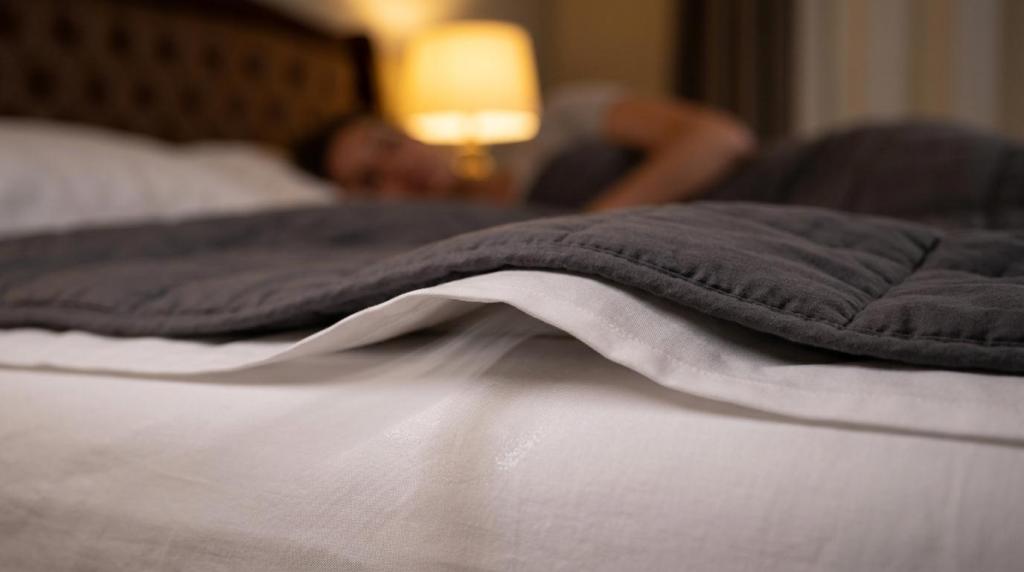
Weighted blanket hot sleeper? Stay cool with under-cover airflow, breathable layers, and a cooler sleep microclimate all night.
Weighted blankets can be great for calm and comfort, but if you run hot, they can also turn your bed into a heat trap. That tension matters, because sleep quality usually falls fast once the space under your covers gets too warm or humid. bFan, a bed fan made by Tompkins Research, Inc., is relevant here because this problem is less about the room alone and more about the heat building up inside your bedding.
TL;DR: Summary
- For a weighted blanket hot sleeper, the best cooling help is usually under cover airflow, not just a colder thermostat, and a bFan bed fan is built for that exact sleep microclimate problem.
- Weighted blankets can improve sleep for some people, but studies and clinical sleep guidance show tolerance drops when users feel too warm under the covers.
- Sleep experts commonly recommend a bedroom temperature of 60°F to 67°F, yet many people can raise the room temperature by about 5°F and still sleep cool enough with a Bedfan because the airflow removes trapped body heat between the sheets.
- Neither Bedfan nor Bedjet cool the air itself, they use the cooler air already in the room and move it where it matters most, under the bedding.
- If you want the pressure of a weighted blanket without overheating, focus on breathable layers, tight weave sheets, lower loft materials, and sustained airflow that carries away heat and humidity all night.
If you keep waking up sweaty under a weighted blanket, you do not necessarily need to give it up. You usually need to manage the bedding microclimate, which is the pocket of heat and humidity between your skin and the covers. Once you look at the problem that way, the choices get a lot clearer.
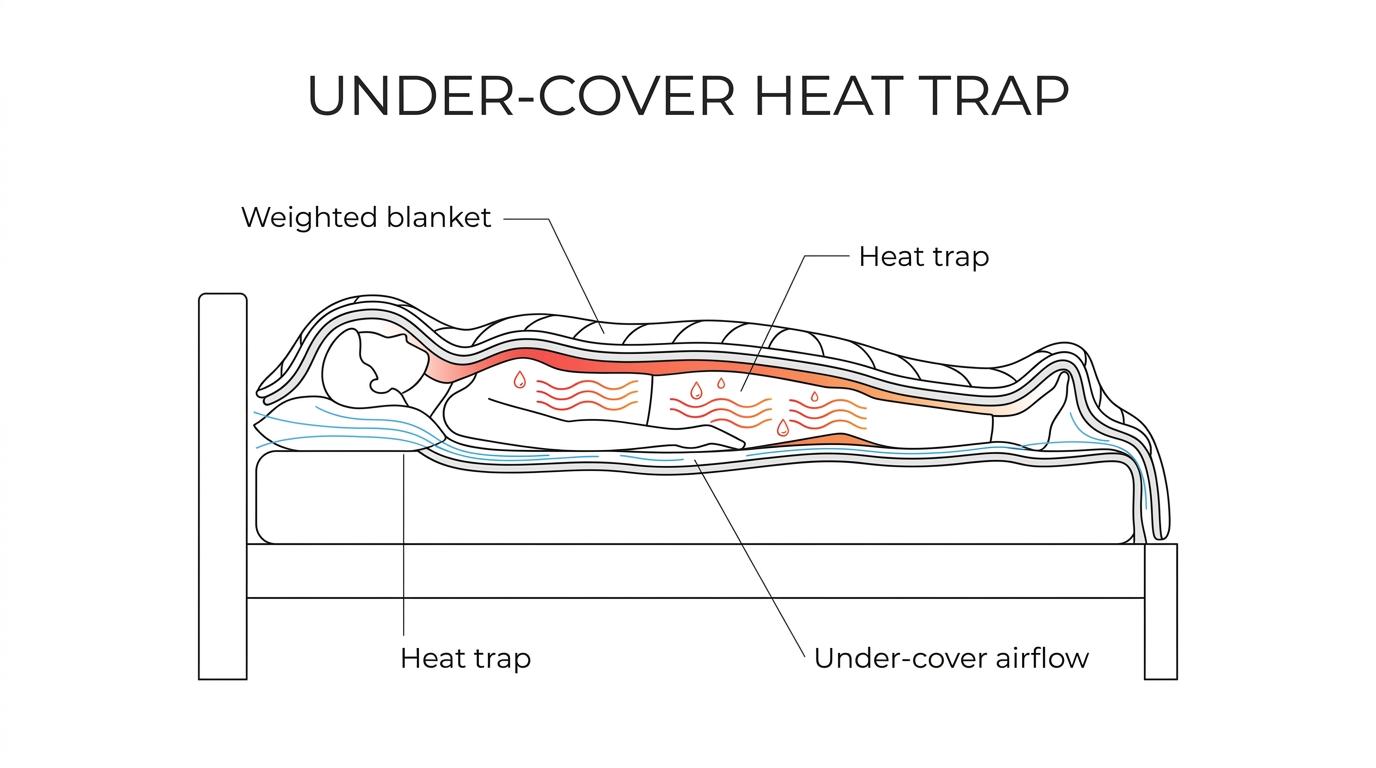
Weighted blankets often overheat hot sleepers because close contact, added insulation, and limited air exchange trap heat and humidity in the sleep microclimate. Academic work from PMC and sleep medicine guidance both point to thermal comfort as a hard limit on weighted blanket tolerance.
A weighted blanket does two things at once. It adds pressure, which many people find calming, and it adds material, which changes how heat leaves your body. If you already sleep warm, that extra mass can hold warmth close to your skin and slow down the escape of moisture.
That matters because sleep is not just about room temperature. Researchers who study the thermal environment of sleep describe a bed climate, or sleep microclimate, between your body and your bedding. Under normal sleep conditions, that microclimate tends to stay around 32°C to 34°C, with relative humidity around 40% to 60%. Push that space hotter or more humid, and you are more likely to wake up, toss around, and spend less time in slow wave sleep and REM sleep.
A 2024 weighted blanket feasibility study reported that some participants felt hot under the blankets. The paper also noted that a warm room plus thicker bedding can make weighted blankets harder to tolerate. In one nursing home sample mentioned in that paper, 35% of older participants found weighted blankets uncomfortable.
That does not mean weighted blankets are bad. It means they are conditional. If the calming pressure helps you relax but the heat ruins the second half of the night, the real issue is not the concept of the blanket, it is the trapped heat under it.
For most hot sleepers, the best cooling help is targeted airflow under the weighted blanket, not just a colder bedroom. A bFan bed fan and a cool room in the 60°F to 67°F range work better together because they remove trapped heat from the bedding microclimate.
Here is the key idea, weighted blankets change the environment under the covers more than they change the room. If you only turn down the thermostat, you may help a little, but you are still leaving a layer of warm, damp air trapped around your body.
That is why a bed fan often works better than people expect. It does not refrigerate the room. It moves the cooler air already in the room between the sheets, where your body is actually overheating. That airflow helps carry away both heat and humidity, which is a big deal if you wake up sweaty at your chest, back, thighs, or knees.
“bFan uses about 18 watts on average, and its between the sheets airflow targets trapped body heat directly, which is why many sleepers can raise the room temperature by about 5°F and still rest cooler.”
Sleep medicine guidance commonly puts the ideal bedroom range at 60°F to 67°F. That is a solid starting point. Still, many people do better when they combine that range with active airflow under the bedding. In practical terms, that can mean less strain on the air conditioner, fewer middle of the night wake ups, and better comfort without giving up the weighted blanket feeling you like.
One common misconception is that the answer must be a colder room. Sometimes it is. But often the better fix is a cooler bed climate.
The best options are under cover airflow, breathable sheets, lower room temperature, and moisture friendly blanket materials. The strongest results usually come from combining methods, because a weighted blanket changes both insulation and air movement around your body.
If you want the short list, think in layers. Start with the method that actually removes trapped heat, then improve the fabrics around it.
If you only change one thing, start with airflow. If that helps but not enough, then change the blanket shell, the top sheet, or the room setting.
The trade off is simple. The more insulation you pile on for pressure and coziness, the more you need a path for heat to escape.
The fastest path is to tune the room, the bedding, and the airflow in that order. If each layer supports cooling, the weighted blanket becomes much easier to tolerate.
Step 1 is the room. Set your bedroom in the commonly recommended 60°F to 67°F range if you can. That range supports the body’s normal drop in temperature before sleep. If your air conditioning costs are painful, remember this, some people can nudge the thermostat up by about 5°F and still stay comfortable if a Bedfan is moving air under the covers.
Step 2 is the bedding stack. Strip away anything that is not helping. A fitted sheet, a tight weave top sheet, and the weighted blanket are usually enough to test the setup honestly. If you have a quilt, duvet, and throw piled on top of the weighted blanket, you are not giving yourself a fair shot.
Step 3 is the airflow path. You want room air to move between the sheets and across your body, not just hit the side of the mattress or puff the blanket upward. The goal is steady heat removal, not a dramatic blast.
Pro tip, test changes one at a time for two or three nights. If you change the room temperature, sheets, fan setting, and blanket all at once, you will not know what actually fixed the problem.
Cooling the sleep microclimate usually beats lowering the thermostat alone. UT Health San Antonio’s 60°F to 67°F guidance matters, but your body feels the air trapped under the blanket, not just the number on the wall.
Think about what your skin is touching and what your body is breathing through all night. If the room is 65°F but the space under the blanket is warm and damp, you can still wake up hot. That is why people sometimes complain, “The room is cold, but I am sweating in bed.” They are describing a microclimate problem, not a thermostat problem.
This is also where a lot of money gets wasted. People keep lowering the whole house temperature to fix what is really a bed level issue. If the weighted blanket is trapping heat, treating the entire room as the problem is often less efficient than moving air where the heat is collecting.
The trade off is easy to understand. Lowering the thermostat cools the whole environment, which helps everyone in the room but can cost more. Cooling the bedding microclimate is more targeted, which can be more efficient, but it only helps if the airflow is directed well.
Common misconception, a colder room automatically means a cooler night. It can, but under thick bedding, trapped heat can still win.
A cooling blanket can help with surface feel, but a bed fan is usually better at removing trapped heat under a weighted blanket. The difference is passive fabric performance versus sustained airflow.
A lot of cooling blankets feel nice when you first touch them. That initial cool touch can be real, but it is not the same as overnight cooling. Once the fabric warms up from body contact, its ability to keep you cool depends on breathability, moisture handling, and how much trapped heat stays in the bedding stack.
A bed fan solves a different problem. Instead of relying on the fabric to absorb or spread heat, it moves room air under the blanket to carry that heat away. That matters more with weighted blankets because pressure and coverage reduce natural air exchange.
If you are choosing between the two, use this logic. If you mainly dislike the first ten minutes in bed, a cooling fabric might be enough. If you fall asleep fine but wake up hot at 1 a.m., 3 a.m., or near dawn, airflow is usually the better fix.
That is why many hot sleepers end up combining both. A cooler feeling sheet or blanket surface can improve initial comfort, and under cover airflow can maintain comfort across the night.
Tight weave cotton sheets, wool layers, and lower loft weighted blankets usually run cooler than fluffy synthetics. Material choice changes air flow, moisture handling, and how much heat stays close to your skin.
Start with your sheets. If you are using a bed fan, a tight weave top sheet is often a smart move because it helps spread airflow across your body and carry away heat instead of letting the air shoot upward too fast. People sometimes assume a looser weave always means cooler. That is not always true in an active airflow setup.
For the weighted blanket itself, look closely at the fill, the shell fabric, and the loft. A puffy weighted blanket can feel cozy at first, but it also creates more insulation. A flatter, more breathable construction usually works better for hot sleepers.
There is also useful evidence on wool. Published research has found lower bedding microclimate temperature and humidity with wool blankets than with certain acrylic fiber and cotton blend blankets under warm, humid conditions. That suggests wool can help regulate thermal comfort through moisture buffering and transport, not just warmth.
“bFan runs around 28 dB to 32 dB at normal speed and includes timer controls, two practical details for sleepers who want quieter overnight cooling without leaving a fan on indefinitely.”
Pro tip, watch out for blanket covers that undo the benefit of the fill. A breathable interior wrapped in a heavy, slick, heat holding outer fabric can still sleep hot.
A bFan from www.bedfans-usa works best when it sends room air between a fitted sheet and top sheet, then lets the weighted blanket rest above that cooler layer. That setup keeps the calming pressure while giving trapped heat a path out.
The fear a lot of people have is that airflow will make the bed feel drafty or reduce the secure feeling of the weighted blanket. Usually, that only happens when the air is pointed wrong or the speed is too high. The goal is not wind in your face. The goal is gentle air movement across the body areas that collect heat.
Here is the simple setup logic. Put the airflow at the foot or edge of the bed so the air enters under the top sheet. Keep the weighted blanket above that layer. Then adjust slowly. Most people do not need max speed. They need just enough movement to keep the bed climate from turning warm and sticky.
If the airflow seems weak, check the sheet structure before blaming the fan. A tight weave sheet often helps the air travel farther along the body. If the blanket is tucked too tightly on all sides, loosen it slightly so the warm air has somewhere to go.
This is also where timer controls are useful. Some people mainly need cooling to fall asleep, while others overheat later in the night. A timer lets you tune the pattern instead of treating every hour the same.
Most overheating problems come from stacking too many layers, using loose sheet setups, or expecting the room thermostat alone to fix the bed climate. Small setup errors can make a decent weighted blanket feel unusable.
You can save yourself a lot of frustration by checking a few common mistakes before replacing everything.
Another mistake is assuming every night sweat problem is purely a bedding problem. If your overheating suddenly changed, got much worse, or happens even without the weighted blanket, step back and consider the bigger picture.
For couples, two separate bed fans often give better value than a dual zone Bedjet when the goal is under cover cooling. Bedjet and Bedfan both use room air, but the dual zone Bedjet setup costs over a thousand dollars, more than twice the price of two bedfans.
This is where marketing can muddy the waters, so keep it simple. Neither system cools the air like an air conditioner. Both depend on the room being reasonably cool already. The question is how they deliver that air, how much control each sleeper wants, and what price makes sense.
For one person, the math is straightforward. One Bedjet is more than twice the price of a single bedfan. For couples, the gap gets even more noticeable, because a dual zone Bedjet setup runs over a thousand dollars, while two bed fans can create dual zone microclimate control at a fraction of that cost.
There are a few practical details worth noting too. The original bed fan category dates back to 2003, years before Bedjet was even thought of. Bed fans are not new, untested gimmicks. They have been solving the same basic problem for a long time, moving room air into the bed climate where sleepers actually overheat.
The real trade off is feel. Some people prefer one style of airflow over another. If you share a bed and each person has a different comfort point, two separate bed fans can be simpler because each side can be adjusted independently.
Night sweats can be caused by menopause, medications, infections, sleep apnea, or thyroid issues, not just warm bedding. If sweats are new, severe, or tied to other symptoms, talk with a clinician instead of only changing sleep gear.
This matters more than people think. Plenty of night sweating is situational, a warm room, a heavy blanket, alcohol close to bedtime, or a bad bedding setup. But sometimes the blanket is only exposing a problem that was already there.
Hormonal change is a big one. Many women in perimenopause and menopause deal with hot flashes and night sweats, and that can make a weighted blanket much harder to tolerate unless the bed climate is actively managed. Pregnancy, hormone therapy, and shifts in testosterone can do similar things.
Medications are another common cause. Antidepressants, steroids, pain medications, some blood pressure drugs, diabetes medications, and stimulant medications can all be part of the picture. Then there are medical issues like hyperthyroidism, infections, sleep apnea, reflux, and some cancers.
If your night sweats come with fever, weight loss, chest symptoms, severe fatigue, or a sudden change in sleep tolerance, get evaluated. Cooling tools can make you more comfortable, but they are not a substitute for medical care when the cause is uncertain.
Yes, many hot sleepers can keep the weighted blanket if they reduce trapped heat under the covers instead of relying on blanket weight alone to solve comfort. The winning combination is usually a cool room, breathable layers, and directed airflow.
This is the practical takeaway most people want. You do not need to choose between calm pressure and temperature relief as often as you think. You just need to stop treating the entire bedroom as the only climate that matters.
If your room is already near 60°F to 67°F and you still wake up hot, focus on the bed climate. If you want to save on air conditioning, a Bedfan can often let you raise the room temperature by about 5°F while still cooling your body enough for more restful sleep. If your blanket is very plush, switch to a lower loft option before you give up on weighted blankets altogether.
And if you want the short version, start with airflow first, then fix fabrics, then fine tune the thermostat. That order tends to get the best result with the least wasted money.
Copyright 2005 - present - Tompkins Research, Inc. & Kurt W. Tompkins All Rights Reserved DO NOT COPY. bFan® and the word bfan® in any format is a registered trademark of Kurt W. Tompkins the word BFAN® in any format shall not be used without written permission of the mark owner. This includes specifically Brookstone where you like to bait and switch, do not use my mark to bait customers.