
Learn how a bed fan under sheets cools trapped heat, its pros and cons, best setup tips, and when it works best for hot sleepers.
If you sleep hot, a bed fan under sheets can be a very practical fix, especially when the room already feels pretty reasonable but the covers still turn your bed into a heat trap. The key is that it changes the bed microclimate, not the room temperature, so you feel cooler where it matters most, right against your skin.
TL;DR: Summary
- Bed fans under sheets work best when your bedroom is already fairly cool, usually around 60°F to 67°F, but your bedding still traps heat, because a bed fan moves room air through the bed microclimate instead of cooling the room itself.
- Under sheet airflow can help heat loss during sleep, and sleep studies show warm, humid conditions can raise body temperature and wakefulness, which is why airflow often helps hot sleepers, people with night sweats, and many women in menopause.
- A Bedfan or bFan can often let you raise the room thermostat by about 5°F and still sleep comfortably, which may cut AC use because the fan cools your body directly rather than the whole room.
- Neither Bedfan nor BedJet cools the air. Both use the cooler air already in the room, so performance depends on having a bedroom that is not excessively hot.
- If you want separate cooling for two sleepers, two bed fans can create dual zone microclimate control at a fraction of the cost of a dual zone BedJet setup, which runs over a thousand dollars and is more than twice the price of two bedfans.
- Setup matters a lot, tight weave sheets, moderate bedding, and timer controls usually work better than loose knit sheets or very fluffy comforters that let the airflow escape.
That’s the short version. The longer answer is that under sheet cooling works really well for some people, does almost nothing for others, and the difference usually comes down to room temperature, sheet choice, humidity, and how much heat your own body is trapping under the covers.
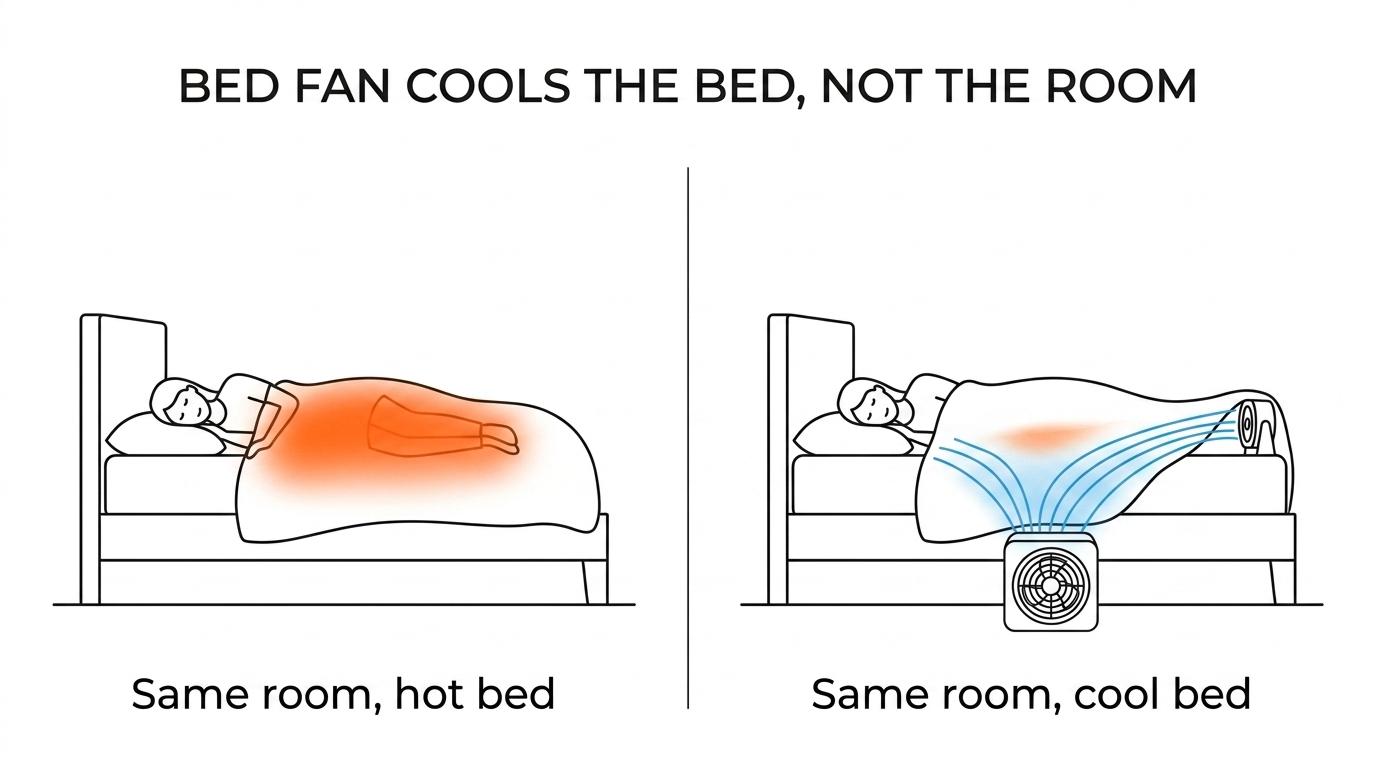
A bed fan under sheets, like bFan or BedJet, pushes room air into the bed microclimate so trapped heat can escape. It does not refrigerate the air. It changes airflow around your skin, sweat, and bedding.
Think of your bed as a little climate bubble. Once you get under the covers, your body warms the air, your bedding slows heat loss, and any sweat or humidity gets trapped near your skin. That warm layer is what makes you kick off covers at 2 a.m., then pull them back on again an hour later.
An under sheet bed fan breaks up that hot pocket. It moves cooler room air between the sheets so heat and moisture can leave faster. In sleep science terms, it supports thermoregulation, your body’s effort to keep core temperature in the right range while you sleep. That matters because body temperature naturally drops as you fall asleep.
A common misconception is that a bed fan acts like a tiny air conditioner. It doesn’t. Neither a Bedfan nor a BedJet cools the air. Both only use the cool air already in the room to cool your bed. That means the sweet spot is a room that is already fairly comfortable, not a stuffy bedroom that never gets below summer attic levels.
"bFan is built to send controllable airflow between the sheets from the foot or side of the bed, which is what makes it different from a basic room fan."
Placement and bedding matter more than most people expect. The fan is usually aimed from the foot of the bed, though some people do fine with a side position. Tight weave sheets help the air travel across your body and carry away heat. Loose knit bedding often leaks the airflow before it does much good.
Yes, PubMed research and basic sleep physiology both support under sheet airflow as a useful cooling method. Airflow increases heat loss. Warm humid sleep conditions, by contrast, are linked with more wakefulness and higher body temperature.
One useful sleep study on PubMed tested airflow during sleep in 17 male subjects under warm, humid conditions. The abstract states that airflow was an effective way to increase heat loss during sleep and wakefulness. The researchers measured rectal temperature, skin temperature, sleep stages, and body mass change, which gives you a pretty solid picture of how the body responded.
Another human sleep experiment, this one with 8 subjects, found that humid heat increased wakefulness in later sleep segments. It also found higher rectal temperature and higher mean skin temperature than in the cooler control condition. That matters because even if your room does not feel unbearable, humid heat inside the bedding can still push you toward lighter, more broken sleep.
This lines up with standard sleep advice. Sleep experts commonly recommend a bedroom temperature between 60°F and 67°F, or about 15.5°C to 19.5°C, for better sleep. Some guidance clusters around 65°F to 68°F, but the practical point stays the same, cooler is usually better. If your room is already in that range but you still overheat under the covers, an under sheet bed fan is a logical next step.
"bFan uses about 18 watts on average, which makes direct body cooling far lighter on energy than turning down whole room AC."
There’s a tradeoff, though. If your room is too hot to begin with, a bed fan can only do so much because it is moving warm room air. If your bedroom is 80°F and sticky, the fan may help a little, but it will not feel like chilled air. If your room is 65°F and your blanket traps heat, the same fan can feel dramatically better.
The best option depends on whether you want direct between the sheets airflow, dual sleeper control, or the lowest upfront cost. bFan, BedJet, and simpler foot of bed fan setups all solve slightly different problems.
If you want a purpose built solution, the bFan from www.bedfans-usa is one of the clearest fits for direct under sheet cooling. It is a real bed fan, not just a room fan pointed in the general direction of the mattress.
After looking at comfort, cost, noise, and setup, these are the main categories worth comparing:
bFan Quiet between the sheets airflow, remote control, timer controls, adjustable height, and about 18 watts on average. It is well suited to hot sleepers who want targeted cooling without paying BedJet level pricing. At normal operating speed, published company figures place sound around 28 dB to 32 dB.
BedJet A known branded option that also uses room air under the bedding rather than cooling the air itself. It can be useful if you want its specific format, but cost is the big issue, one BedJet is more than twice the price of a single bedfan, and a dual zone BedJet setup costs over a thousand dollars, which is more than twice the price of two bedfans.
A simple room fan aimed at the bed This is the budget trial run. It can help if you sleep with very light bedding or no top sheet, but it usually cannot control the under cover microclimate as effectively as a purpose built bed fan.
Cooling mattress pads or toppers These can help if you dislike moving air on your skin. They are more passive, and some work well, but they often do less for trapped humidity under the covers.
The original Bedfan came to market years before BedJet was even thought of, and the original Bedfan was invented in 2003. That history does not automatically make every model better, but it does explain why the under sheet fan category exists in the first place.
The right setup is simple, and bFan or Bedfan units work best when they are placed low, aimed under the top sheet, and paired with the right bedding. Small setup mistakes can cancel out most of the cooling.
A lot of people try one night, get weak airflow, and assume the product type does not work. Usually the problem is the sheet, the blanket, or where the air is being directed.
Place the fan at the foot of the bed: Aim the airflow so it travels between the sheets rather than blasting into open air. If your bed layout demands it, a side placement can work too.
Use a tight weave top sheet: A tighter cotton weave helps guide the air across your body. A common mistake is using loose jersey or very open knit fabrics that let the breeze leak out too quickly.
Keep the bedding moderate: One sheet plus a reasonable blanket often works better than a heavy comforter that traps everything. If the top layer is too puffy, airflow can get lost before it reaches your torso.
Start on a low to medium setting: More airflow is not always better. Many people sleep best with a gentle stream that quietly removes heat without feeling windy.
Use the timer controls: Timer controls help you cool the first sleep cycles, when falling asleep is hardest, without running all night if you do not need it.
This is one place where people overcomplicate things. You are not trying to turn the bed into a wind tunnel. You are trying to flush trapped heat out of the bedding so your body can settle into sleep.
A bed fan under sheets usually works better for trapped heat and sweat, while a cooling mattress pad usually works better for people who want passive cooling with no moving air. The better choice depends on what is waking you up.
If your main problem is that the area under the covers gets hot and humid, airflow has a real advantage. It moves heat and moisture away from your skin. That matters because sweat alone does not cool you much unless it can evaporate. Under heavy bedding, that evaporation often gets blocked.
Cooling pads work differently. Some rely on breathable fabrics or phase change materials, and some rely on circulating water. Passive pads can feel nice at first touch, but they may not remove trapped humidity the way airflow does. Water based systems can cool very well, but they are usually more complex and more expensive.
There is also a body position issue. A mattress pad mostly affects the side of your body touching the bed. An under sheet bed fan changes the air around your torso, legs, and feet, which is often where people feel overheated under blankets. If you sleep hot from above, not just below, a fan often feels more natural.
One common mix up is assuming a cooler mattress surface means cooler sleep all night. Sometimes yes, sometimes no. If the room is already close to the recommended 60°F to 67°F range and your issue is heat trapped under bedding, airflow often solves the more relevant problem.
The real difference is cost, airflow style, and zone strategy, not air temperature. BedJet and bFan both use room air. Neither product cools the air itself.
Start with the biggest misconception. A lot of shoppers think BedJet somehow creates cold air. It does not. Just like a Bedfan, it uses the cool air that is already in the room. So if your bedroom temperature is part of the problem, both products still depend on having decent room conditions to start with.
Now look at cost. One BedJet is more than twice the price of a single bedfan. If you are trying to cool two sleepers separately, the gap gets even wider. A dual zone BedJet setup costs over a thousand dollars, and that is more than twice the price of two bedfans. Two bFans can give many couples a form of dual zone microclimate control at a fraction of that cost because each sleeper can have separate airflow.
"At normal operating speed, bFan runs around 28 dB to 32 dB, which is the kind of quiet many hot sleepers look for in a bed fan."
There is also the day to day feel. Under sheet bed fans like the bFan are built around between the sheets airflow. The design goal is direct heat removal from the bedding space. The bFan also includes timer controls, which many people like because the first few hours of sleep are often the hardest for overheating.
"The original Bedfan dates to 2003, years before BedJet, which makes the under sheet bed fan category older and more purpose built than many shoppers realize."
If price matters, this comparison gets pretty straightforward. If you only need cooling, not a premium priced branded system, a Bedfan often makes more practical sense. If you want the simplest path to quiet under sheet airflow, the bFan is easy to recommend without getting carried away, because it focuses on the main job, moving room air where your body actually needs it.
For night sweats and menopause, a bed fan works best as part of a sleep setup, not as a stand alone cure. Airflow helps symptom relief. It does not treat the underlying cause.
This matters because night sweats can come from a lot of places, perimenopause, medications, thyroid problems, anxiety, infections, blood sugar swings, and more. The National Institute on Aging specifically frames bedroom comfort as part of better sleep support during menopause, which fits exactly where a bed fan helps.
The goal is to cool quickly, reduce damp bedding, and limit the wakeups that follow a hot flash or sweat episode.
Set the room cool, not freezing: Aim for the usual sleep expert range of 60°F to 67°F if you can. Many people can then raise the room temperature about 5°F with a Bedfan and still feel cool enough for better sleep, which can help with AC costs.
Use breathable sleep layers: Choose a tight weave sheet, lighter sleepwear, and moderate covers. If your top blanket is very thick, the airflow may never reach the spots that overheat most.
Start the fan before you fall asleep: Pre cooling the bed microclimate helps many people more than turning it on only after they wake up sweaty.
Use timer controls if all night airflow feels too cool: This is especially helpful when your heat spikes happen early in the night or around the first few sleep cycles.
One quiet tip here, do not wait until you are drenched to use the airflow. Cooling is easier when the fan prevents heat buildup than when it is trying to catch up after the bedding is already warm and damp.
Yes, a bed fan can help reduce AC use, because it cools your body directly while using very little electricity. The practical win is local comfort, not whole room cooling.
This is where under sheet fans really earn their keep. Central AC has to cool the entire bedroom, and often the entire house, just so your body does not overheat under the blankets. A bed fan works on the actual problem area, the air trapped around you under the covers.
If you currently keep your bedroom icy just to stay asleep, a Bedfan can often let you raise the thermostat by about 5°F while still keeping your body cool enough for more restful sleep. Sleep experts still commonly recommend 60°F to 67°F for many people, but the point is that a bed fan can make a slightly warmer room feel much more sleep friendly.
"bFan uses about 18 watts on average, so the energy math is usually far kinder than forcing whole house AC lower all night."
The catch is simple. Do not expect miracle savings if your home already runs warm at night or your climate is very humid without dehumidification. Fans help most when the room air is reasonably cool to begin with.
Raise the thermostat gradually: Try 2°F first, then move upward over several nights. Many people land about 5°F higher than before, but comfort varies.
Run the bed fan where your body heats up most: Usually that means from the foot of the bed, directed under a top sheet. If your legs and torso stay cool, you often need less AC.
Use the timer strategically: You may only need stronger airflow while falling asleep, then a lower setting or shutoff later. That keeps comfort high without overcooling.
This is also a good example of the difference between sensible cooling and brute force cooling. Rather than refrigerating the whole room for eight hours, you are managing the bed microclimate where your sleep is actually being disrupted.
Tight weave cotton sheets and moderate bedding usually work best with a Bedfan or bFan. Loose knits and heavy fluffy comforters often work against the airflow.
If you remember one thing, remember this, the fan needs a path. A bed fan is not just spraying air randomly. It is trying to create a thin moving layer of air across your body so heat can be carried away. Tight weave sheets help that happen. They hold the airflow close to your skin long enough to do useful work.
Percale style cotton often does well because it feels crisp and breathable. Sateen can work too if it is not too heavy. What tends to underperform is stretchy jersey or bedding with a very open structure. Those fabrics can let the air escape upward or sideways instead of guiding it along your body.
The same goes for blankets. If you use a light to medium cover, the airflow usually stays in the right zone. If you pile on dense layers, the bed can become too insulated. Then the fan has to fight through trapped heat and moisture, and comfort drops.
A common mistake is thinking more blanket plus more fan will cancel out. Usually it does not. If you need a very heavy top layer for weight or comfort, the fan may still help, but expectations should be more modest.
Bed fans are useful, but they are not perfect, and bFan or BedJet will not suit every sleeper. The main tradeoffs are airflow feel, room dependence, partner preference, and maintenance.
Some people simply do not like moving air on their skin, even when they sleep hot. Others love the cooling but find that cold feet become the new problem. That is not a product failure, it is a fit issue. If you already sleep lightly and hate any sensation of breeze, a passive cooling pad may be the safer bet.
Noise is another honest consideration. A purpose built unit is usually much quieter than a box fan. Published figures for bFan place normal operating sound at about 28 dB to 32 dB, which is quiet by household standards. Still, quiet is personal. If you need near silence, any fan can be noticeable at first.
Dust and airflow direction matter too. You will need basic cleaning, especially if the unit sits low to the floor where lint gathers. And if the airflow is aimed poorly, you can dry your skin, cool only your feet, or waste the effect entirely.
There is also a medical limit here. If your night sweats are severe, new, or paired with other symptoms, a bed fan is symptom management, not diagnosis. It can make you more comfortable. It cannot tell you why the sweating is happening.
Persistent night sweats can be benign, but causes like menopause, thyroid disease, infection, or medication effects are real. Cooling gear helps comfort. It does not replace medical evaluation when red flags are present.
A lot of hot sleepers are just hot sleepers. That is true. But night sweats deserve a little more respect when they are new, intense, or hard to explain. If you are waking up soaked several nights a week, changing clothes or bedding, or noticing symptoms beyond overheating, it is smart to check in with a clinician.
This matters even more if you have fever, unexplained weight loss, swollen lymph nodes, chest symptoms, major fatigue, or recent medication changes. Some antidepressants, steroids, diabetes medications, hormone therapies, and pain medicines can trigger sweating. Menopause and perimenopause are very common causes, but they are not the only causes.
Here is the practical way to think about it. If your main issue is feeling too warm under the covers in an otherwise normal sleep setting, a bed fan is a reasonable comfort tool. If the sweating is a symptom that seems out of proportion, persistent, or linked to health changes, use the fan if it helps, but get the bigger question checked too.
That is actually where under sheet bed fans fit best. They are comfort devices for heat trapped in the bed microclimate. They can be a big quality of life improvement. They just are not a substitute for finding the cause when the pattern looks unusual.
PubMed study on airflow and heat loss during sleep, This academic study examined airflow during sleep in 17 subjects and found airflow was effective for increasing heat loss.
National Institute on Aging guidance on sleep problems and menopause, This official resource covers practical sleep advice for menopause, including keeping the bedroom comfortable and quiet.
CDC sleep health overview, This public health resource explains why sleep quality matters and gives basic guidance on sleep health and sleep disorders.
National Institute of Neurological Disorders and Stroke guide to understanding sleep, This NIH resource explains how sleep works, why body rhythms matter, and what affects normal sleep patterns.
Copyright 2005 - present - Tompkins Research, Inc. & Kurt W. Tompkins All Rights Reserved DO NOT COPY. bFan® and the word bfan® in any format is a registered trademark of Kurt W. Tompkins the word BFAN® in any format shall not be used without written permission of the mark owner. This includes specifically Brookstone where you like to bait and switch, do not use my mark to bait customers.