
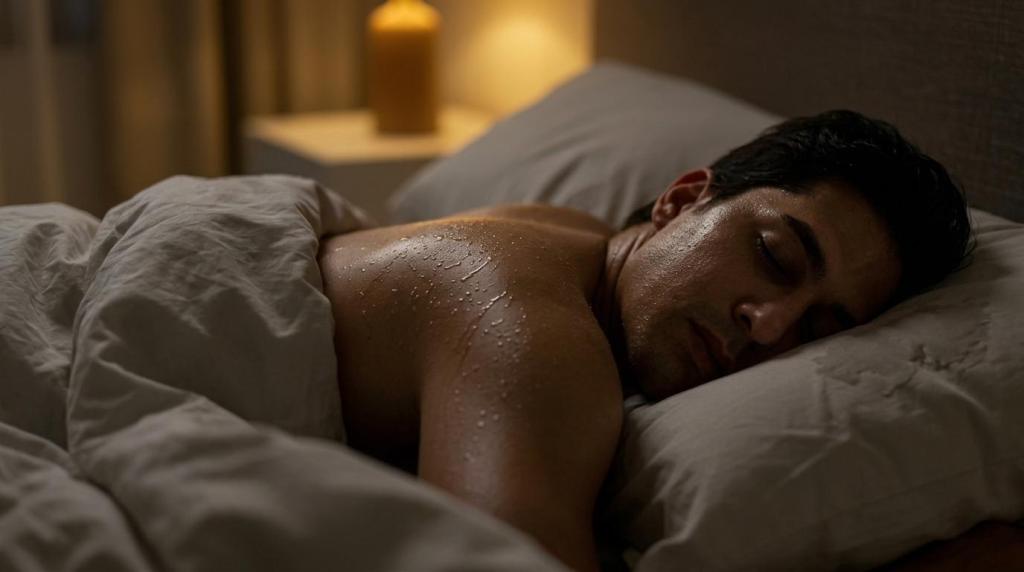
Learn how bedding traps heat and humidity, worsens night sweats, and why airflow, lighter layers, and cooler rooms can help you sleep.
If you wake up damp, kick the covers off, cool down, then pull them right back on an hour later, you already know how weird night sweats can be. They are not just about a warm room. A lot of the misery comes from what happens inside your bed, where sheets, blankets, protectors, toppers, and your own body heat create a small climate of their own.
That little climate matters more than most people think.
You can have a bedroom that feels decent when you first lie down, then still end up overheated because the bedding around you traps warmth and moisture. Sleep research has pointed to this pretty clearly, the microclimate inside the bed can shape thermal comfort more than the room itself once you are under covers. That is why some people keep turning the thermostat lower and lower, yet still wake up clammy.
Night sweats can happen for lots of reasons. The National Cancer Institute notes that they can be severe enough to soak bedclothes and bed sheets, and they can wake you up. That is a lot different from just feeling a little warm at 2 a.m.
Plenty of people use the phrase loosely, but real night sweats tend to be disruptive. Your pajamas can feel wet, your sheets can feel sticky, and the bed may feel oddly hotter after you wake because the moisture is now trapped under the covers with you. It becomes a loop, you sweat, the bedding holds heat and humidity, then you feel even warmer.
That loop is why bedding deserves more attention in any conversation about sleeping hot.
Night sweats can happen for lots of reasons. Hormonal changes are a big one, especially during menopause and perimenopause. Medications can do it too, including some antidepressants, steroids, pain medications, blood pressure medications, and diabetes treatments. There are also medical causes, including infections, hormone disorders, sleep apnea, low blood sugar, and some cancers. So while bedding can make the experience worse, it is not always the root cause.
If your night sweats are new, severe, or paired with other symptoms, it makes sense to talk with a clinician.
Your body gives off heat all night. That is normal. As you fall asleep, core body temperature drops, which is one reason sleep experts commonly recommend a bedroom temperature between 60°F and 67°F, or 15.5°C to 19.5°C, for better sleep. The catch is that your bedding can work against that natural cooling process.
When you get under covers, you create an enclosed pocket of air. At first, that can feel cozy. After a while, though, the same setup can start to hold onto the heat your body is trying to release. If you are already prone to sweating, or if your hormones or medication make you run hot, that pocket warms up fast.
Now add moisture.
Sweat is supposed to cool you through evaporation. But evaporation works poorly when the air around your skin is humid and still. Under thick bedding, humidity rises, airflow drops, and your skin stays damp. Instead of cooling off, you can feel sticky and overheated. This is one reason the bed can feel worse than the room.
Research on sleep thermal comfort backs this up. Studies have found that bedding microclimate, meaning the temperature and humidity inside the bed, can affect sleep comfort even more than the room environment when a full body covering quilt is used. In plain English, once you are tucked in, the conditions under the blanket can matter more than the thermostat on the wall.
Here is what is usually happening under the covers when bedding makes night sweats worse.
That is also why some people get relief by changing the bedding setup even before they change the mattress or the air conditioner.
A cool bedroom still matters. It just is not the full answer.
Most sleep guidance lands in the same place, a bedroom around 60°F to 67°F tends to support better sleep for many adults. Cooler rooms help the body move toward sleep more easily. But if your blanket, comforter, mattress protector, and topper are creating a warm cocoon that locks in moisture, you may still sweat.
Think of it this way. Room temperature sets the starting point. Bedding microclimate decides what happens next.
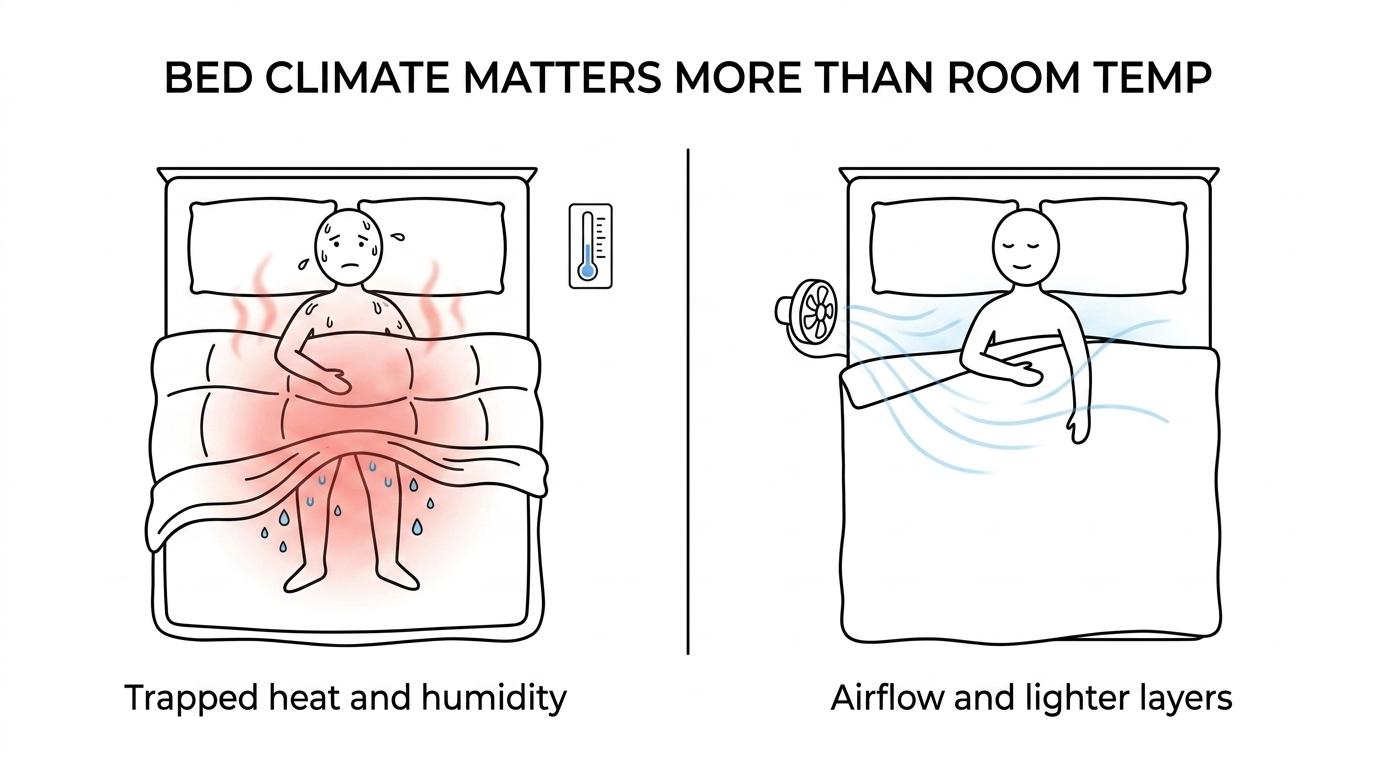
This is why two people in the same bedroom can have totally different nights. One person may sleep fine with a medium weight comforter. The other may wake up soaked under the same covers because their body produces more heat, their sweat rate is higher, or their hormones are fluctuating. The room did not change, the body and the bed environment did.
The problem can get even worse when people compensate in ways that sound sensible but backfire. They may pile on absorbent layers to “protect the mattress,” use a waterproof protector that traps heat, or choose a thicker comforter because they also get chilled after sweating. Each extra layer can increase insulation and reduce airflow.
That is why lowering the thermostat alone often has limits. If the bed setup is trapping heat, the room can feel cold while the sleeper still feels hot.
There is no single “bad” fabric for everyone, but some bedding choices are more likely to trap heat and humidity than others. The issue is usually not just the fiber label. It is the total stack on the bed, and how much airflow gets blocked between your skin and the room.
A lot of hot sleepers focus only on sheets. Sheets matter, but the comforter, mattress protector, topper, pajamas, and even the mattress surface can matter just as much.
Your body loses heat in all directions, not just upward. If your mattress or topper hugs closely and holds warmth, that heat can build below you while the blanket traps heat above you. Then you are basically sandwiched in your own body heat.
Dense foams often get the blame because they can reduce airflow compared with more open materials. Waterproof or highly laminated protectors can also change how the bed feels. Even if they are useful for spills and hygiene, some sleepers notice that these barriers make the sleep surface warmer and less breathable.
This does not mean every foam mattress is terrible for night sweats, or every protector will make you miserable. It means every extra layer changes the microclimate. If you sleep hot, less bulk and better airflow usually help.
The top half of the bed can be the bigger issue for many people with night sweats. Heavy comforters, fluffy duvets, multiple layered blankets, brushed fabrics, and thick synthetic fills can trap a lot of warm, humid air. If you have ever kicked off the comforter and felt instant relief, you have already felt this effect.
Even a sheet can make a difference in how airflow behaves. When using a bed fan, many people do best with sheets that have a tight weave, because the fabric helps guide the moving air across the body instead of letting it escape too quickly. That sounds backward at first, but the sheet is acting a bit like a channel.
Sleepwear counts too. Tight, thick, or clingy fabrics can reduce ventilation right where sweat is forming. Socks, mattress pads, body pillows, and heated throw blankets left on too long can add to the problem. Small things stack up.
If you are trying to figure out what is making nights worse, look at the whole setup, not just the thermostat.
These bedding patterns tend to trap more heat for hot sleepers.
A lighter, simpler bed often works better for people dealing with overheating. You do not always need a total bedroom overhaul. Sometimes you need fewer barriers between your body and moving air.
Sleep comfort is not just about whether the room feels cold or warm when you walk in. Researchers who study thermal comfort during sleep often look at the conditions inside the bed itself, where the body, bedding, and trapped air interact.
That matters because the body is trying to shift into a cooler state as sleep begins. If bedding keeps the local environment around your skin too warm or too humid, it can interfere with that process. Studies on sleep and bedding microclimate have found that higher bedding insulation and warmer indoor air make sleepers feel warmer. They have also found that bed microclimate directly affects thermal comfort.
Some lab work has suggested a thermally neutral sleep environment at cool room conditions, roughly around 15.8°C operative temperature, while comfortable bedding temperatures in the sleep environment have landed around the low 30s Celsius. You do not need to memorize those numbers. The useful takeaway is simpler, the body often sleeps best when the room is cool and the bed is not trapping excess heat.
That lines up with common sleep guidance. Keep the bedroom around 60°F to 67°F, and pay attention to the actual heat buildup inside the bed. If you can reduce that trapped warmth and humidity, you give your body a better shot at staying asleep.
If trapped heat and humidity are the problem, the fix is not mysterious. You need to move that heat and moisture away from the body.
That is where a bed fan can make a real difference.
A bed fan does not cool the air. This is a key point, and it applies to both Bedfan and Bedjet. Neither Bedfan nor Bedjet cool the air. They only use the cooler air already in the room and direct it into the bed so your body heat can be carried away. In other words, they improve the bed microclimate, they do not replace air conditioning.
That is exactly why they help some people so much. By pushing room air between the sheets, a bed fan breaks up the stagnant, humid pocket under the covers. The moving air helps sweat evaporate and helps heat escape instead of collecting around your torso and legs. You feel cooler because your body can dump heat more effectively.
When the room is already in the recommended 60°F to 67°F range, airflow under the covers can be especially effective. Many people can often raise the room temperature by about 5°F and still cool the body enough for more restful sleep when using a Bedfan. That can matter a lot if you are trying to lower air conditioning costs without lying there sweaty and annoyed.
This is one place where the details matter.
A quieter fan is easier to live with. A controllable fan is better than a blast of air all night. A timer can help if you only need extra cooling as you fall asleep or during the first part of the night. The bedfan setup also works best when the sheet helps direct airflow across the body, which is why a tighter weave sheet can be useful.
If your main goal is relief from overheating and night sweats, what you are really shopping for is bed microclimate control. You want controlled airflow under the covers, low noise, and enough flexibility to match how you sleep.
This is where a lot of people compare a bed fan like the bFan with Bedjet.
The first thing to keep straight is that the category itself is not new. The original Bedfan came to market years before Bedjet was even thought of, and the bedfan was invented in 2003. So this idea of cooling the bed with directed airflow has been around a long time because the basic concept makes sense.
The second thing is cost. One Bedjet is more than twice the price of a single bedfan. If you need dual zone control for two sleepers, the price gap gets even harder to ignore. The dual zone Bedjet setup costs over a thousand dollars, which is more than twice the price of two bedfans. By contrast, the bFan offers dual zone microclimate control using two fans at a fraction of that cost.
That price difference matters because couples are often where the bedroom temperature battle gets ugly. One person wants the room colder, the other does not. With two bed fans, each side can have its own airflow. That gives you dual zone control without forcing the whole room to feel like a meat locker.
A good bed fan setup also keeps things pretty simple. The bFan uses only about 18 watts on average, which is tiny compared with running central AC lower all night. Its sound level is about 28db to 32db at normal operating speed, so it is in the quiet range for many bedrooms. It also offers timer controls, which can be useful if you want cooling support during the part of the night when overheating is most likely to wake you.
If you are looking for a practical option, the bFan from www.bedfans-usa is one of the cleaner solutions to look at, especially if you want between the sheets cooling without spending over a thousand dollars on a dual zone setup. It is still a bed fan, not an air conditioner, so the room needs to be reasonably cool to begin with. That is true for Bedjet as well.
Here is the plain language comparison many hot sleepers care about most.
That last point matters more than it may seem. A lot of people with night sweats do not need extreme cooling all night long. They need help keeping the bed from turning into a damp heat trap during the periods when sweating is most likely. Directed airflow can do that without making the whole bedroom colder than everyone else can tolerate.
You do not need to buy anything before you test the basics. Start with the easiest changes first, because many of them are free.
Cool the room into the commonly recommended 60°F to 67°F range if you can. Strip the bed down to fewer layers. Swap out the heaviest top layer. Remove that extra blanket you keep “just in case.” If you use a waterproof protector and suspect it traps heat, try a different breathable option if practical. Pay attention to sleepwear too, since thick clothing can trap heat right against the skin.
Then think about airflow. Ceiling fans and room fans help some, but they often do not change the trapped pocket under the covers very much. A bed fan is different because it pushes air where the problem actually lives.
If you test a Bedfan or bFan setup, use sheets with a tight weave so the air moves across your body instead of escaping too quickly. Keep the room reasonably cool, because again, a bed fan is using the air already in the room. When those pieces work together, many people can sleep cool enough to raise the room temperature by about 5°F and still feel better through the night.
Bedding can absolutely make night sweats worse. It can turn a manageable heat issue into a miserable, sleep wrecking problem. Still, there are times when the sweating itself deserves medical attention, especially if it is new, intense, or unexplained.
Talk with a clinician if night sweats keep happening, if they drench the bed, or if they come with symptoms like fever, unexplained weight loss, swollen lymph nodes, chest pain, shortness of breath, or major fatigue. It is also smart to review your medications if the timing lines up with a new prescription or dosage change.
Menopause and perimenopause are common reasons, and so are medication side effects. Low blood sugar, infections, hormone disorders, and sleep apnea can also be part of the picture. The point is simple, cooling the bed can help you sleep, but it should not replace medical care when the sweating pattern looks unusual or concerning.
If you want to read more from reliable sources, these links are a solid place to start.
Copyright 2005 - present - Tompkins Research, Inc. & Kurt W. Tompkins All Rights Reserved DO NOT COPY. bFan® and the word bfan® in any format is a registered trademark of Kurt W. Tompkins the word BFAN® in any format shall not be used without written permission of the mark owner. This includes specifically Brookstone where you like to bait and switch, do not use my mark to bait customers.