

Cooling topper facts hot sleepers should know: what works, what doesn’t, and when airflow or active cooling may be the better fix.
If you’re shopping for a cooling topper, you’re probably not chasing luxury, you’re trying to stop waking up hot. That’s an important distinction, because a cooling topper can help with bed level heat buildup, but it does not solve every kind of nighttime overheating. bFan, a bed fan made by Tompkins Research, matters here because many people looking at toppers are really dealing with trapped heat under the covers, which is a different problem from a warm mattress alone.
TL;DR: Summary
- A cooling topper can help hot sleepers when the main problem is heat buildup at the mattress surface, but current evidence does not show that every cooling topper reliably improves sleep quality for everyone.
- In a 2026 Journal of Sleep Research trial at 32°C, a high heat conductivity mattress topper increased total sleep time by 21.4 ± 16.1 minutes and improved sleep efficiency while lowering skin and core body temperature.
- A 2024 systematic review found mixed evidence, with no clear pooled improvement in sleep onset latency, total sleep time, or sleep efficiency, even though some bedding strategies lowered body temperature.
- If your heat is trapped between the sheets rather than inside the mattress, a bed level airflow product like the bFan may be a better fit than a cooling topper alone.
- Sleep experts commonly recommend 60°F to 67°F, and many people using a bed fan can often raise room temperature by about 5°F while still feeling cool enough to sleep more comfortably.
That’s why it helps to think in layers. Some products cool the surface you lie on, some move air around your body, and some actively regulate bed temperature over time. Once you know which heat problem you actually have, picking the right fix gets a lot easier.
A cooling topper is a mattress layer made from materials like gel foam, latex, phase change textiles, or high heat conductivity fabrics that try to move heat away from your body. It can improve thermal comfort at the bed surface, but it does not refrigerate the bed.
Most cooling toppers are passive. They don’t create cold air, and they don’t lower the room temperature. What they do is change how heat moves where your body touches the bed. That can matter a lot if your mattress sleeps warm, especially dense memory foam that tends to hold onto body heat.
The language around these products gets sloppy fast. “Cooling” often means one of three things, a surface that feels cooler at first touch, a material that transfers heat away faster, or a topper that resists heat buildup better over several hours. Those are not the same thing. A topper that feels cool for ten minutes may still feel stuffy by 2 a.m.
A related term you’ll see in research is thermal comfort zone. That’s basically the temperature range where your body can settle into sleep without fighting excess heat or cold. A cooling topper tries to help you stay in that zone at the bed surface. If the whole room is too hot, or if humidity is high, a topper has a harder job.
Yes, cooling toppers can work, especially in heat exposure, but the evidence is mixed and the benefit is not universal. Journal of Sleep Research and Sleep Medicine Reviews both point to better body cooling in some cases, with less consistent changes in standard sleep metrics.
The best recent evidence is more nuanced than marketing copy makes it sound. In a 2026 randomized double blind crossover trial in the Journal of Sleep Research, 15 healthy young active subjects slept on a high heat conductivity mattress topper during a 32°C heat night. Total sleep time increased by 21.4 ± 16.1 minutes, sleep efficiency improved, and awakening duration fell. The same study also found lower skin temperature and lower core body temperature.
That sounds strong, and for that specific setting, it is. But here’s the catch. At 22°C, the same topper did not improve sleep duration versus control, even though it lengthened N3 sleep and increased slow oscillation spectral density. In plain English, the topper looked more helpful when heat was the real problem than when the room was already fairly comfortable.
A 2024 systematic review and meta analysis in Sleep Medicine Reviews screened 3,454 records and included 9 studies on bedding strategies that induced body cooling in healthy adults. It found very low to low certainty evidence and no clear pooled differences for sleep onset latency, sleep efficiency, sleep stage proportions, wake after sleep onset, or total sleep time. That does not mean cooling bedding is useless. It means body cooling and better sleep do not always show up as the same thing in every study.
The practical takeaway is pretty simple. If you’re hot because your mattress traps heat, a cooling topper may help. If you’re hot because your room is 78°F, your bedding is heavy, and humidity is high, a topper may only be a partial fix. Sleep experts commonly recommend keeping the bedroom around 60°F to 67°F, because the room still sets the baseline your bedding has to work with.
bFan uses about 18 watts on average and runs around 28db to 32db at normal operating speed, so it targets bed heat quietly without asking you to overcool the whole bedroom.
The biggest cooling topper facts are these, they help most with surface heat, they are not all equally effective, and they are usually better for heat relief than for guaranteed sleep improvement in every sleeper.
Before you buy, it helps to separate the promise from the mechanism. A cooling topper is not magic. It is one tool in the sleep temperature toolbox, and it works best when its strengths match your problem.
Fact 1: A cooling topper does not create cold air. It redistributes or releases heat more efficiently than standard bedding materials.
Fact 2: Cooling toppers tend to work best when the problem is mattress heat buildup. If your room is too warm, the topper is working uphill all night.
Fact 3: Evidence is stronger during heat exposure than in neutral room conditions. The 2026 trial showed clear gains at 32°C, but not the same broad sleep duration benefit at 22°C.
Fact 4: Not every “cooling” material behaves the same. Gel foam, latex, phase change textiles, and high heat conductivity layers affect touch temperature, heat transfer, and overnight performance differently.
Fact 5: A cooler body does not always mean a better sleep score. Reviews show some bedding strategies lower core body temperature without clearly changing total sleep time or sleep onset latency.
Fact 6: Your full bed setup matters. A breathable topper under a thick mattress protector and heavy brushed sheets can still sleep warm.
Fact 7: If heat is trapped under the covers, airflow may matter more than surface cooling alone falls short. That’s where a bed fan or an active bed cooling system often makes more sense than another foam layer.
One common misconception is that a more expensive topper must cool better. Price often tracks branding, cover fabric, or foam density, not just actual thermal performance. Another easy mistake is testing a topper with winter bedding and blaming the topper when the real issue is the rest of the stack.
You can usually identify the source of overheating by checking when you get hot, where you feel it, and whether tossing off covers fixes it quickly. If the heat source is wrong, the product choice is usually wrong too.
Start with Step 1, pay attention to timing. If you feel hot within minutes of lying down, especially where your back and hips touch the bed, the mattress surface is a likely culprit. If you fall asleep fine and wake up sweaty later, trapped humidity and bedding insulation are often more important.
Step 2, test the layers one at a time for three nights each. Keep the same room temperature and remove only one variable, the topper, the mattress protector, or the heavier comforter. If removing a thick protector changes everything, the protector was blocking breathability. If sleeping on the topper in a cooler room still leaves your back hot, the topper may not be moving enough heat away.
Step 3, check your room baseline. If your bedroom sits above the commonly recommended 60°F to 67°F range, you may be asking too much from passive bedding. If humidity is high, sweat evaporates less efficiently, and you feel clammy even when the room does not seem outrageously hot.
Here’s a pro tip that gets missed all the time, touch is not the same as overnight performance. A topper can feel cool when you first lie down and still trap heat after an hour. Judge it by wake ups, sweat, and whether you throw the covers off, not just by first impression.
A cooling topper changes the sleep surface, while the bFan from Bedfans USA cools the microclimate between your sheets with directed airflow. If trapped heat under the covers is your real problem, the bed fan approach is usually more direct.
A passive topper works by improving heat transfer where your body meets the mattress. A bed fan works by moving room air between the sheets, carrying away trapped body heat and moisture from the space you actually sleep in. Those are two different jobs. One changes the surface. The other changes the air around your skin.
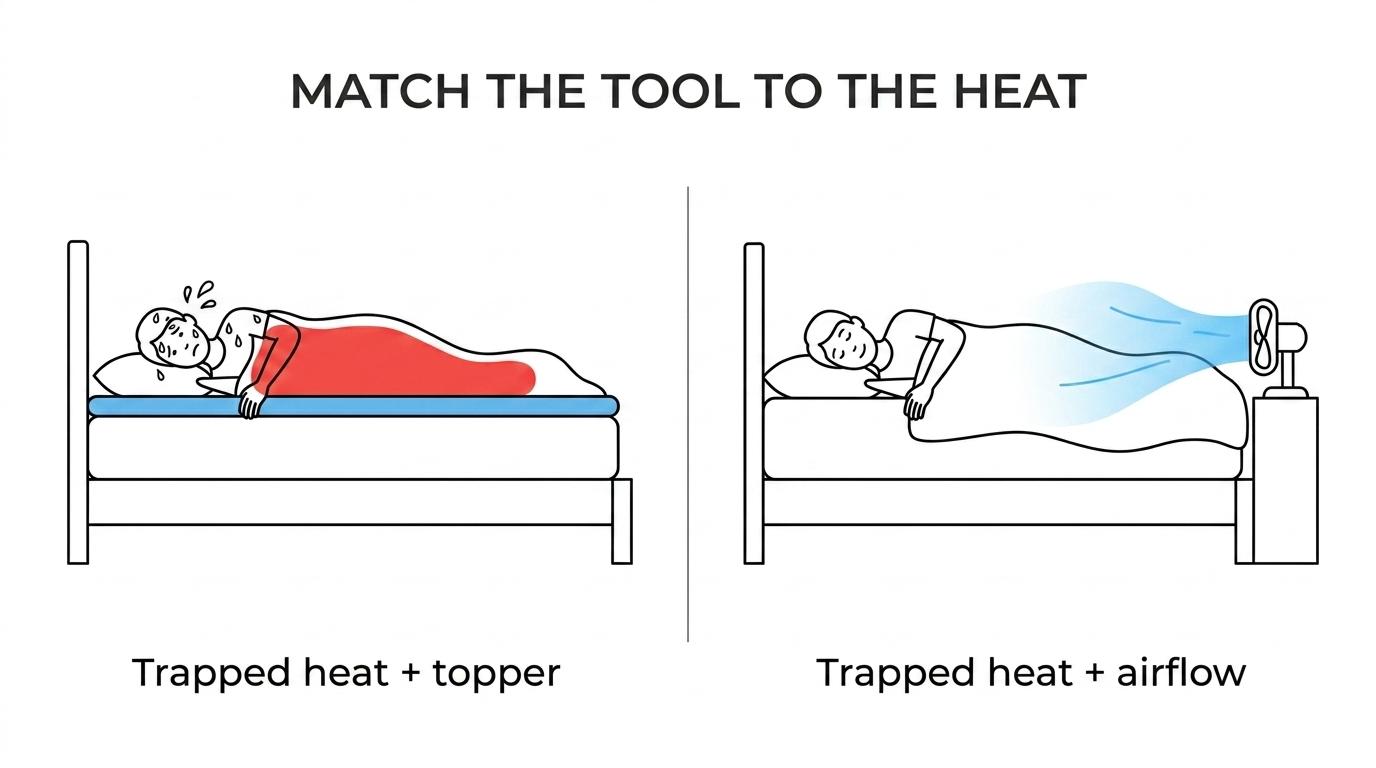
This is also where a lot of people get confused about cooling claims. Neither a bed fan nor Bedjet cools the air. They both use the cool air already in the room. That matters because your bedroom still needs to be reasonably cool to begin with, ideally in that 60°F to 67°F range recommended by sleep experts. The local airflow helps many people feel cool enough that they can raise the room temperature by about 5°F and still sleep comfortably, which can ease air conditioning costs.
The original bFan was invented in 2003, years before Bedjet, and its between the sheets airflow targets the heat trapped under bedding instead of trying to change the mattress surface.
Cost changes the picture too. A dual zone Bedjet setup costs over a thousand dollars, which is more than twice the price of two bed fans. If you need dual zone microclimate control for two sleepers, using two bed fans can do that at a fraction of the price. A single Bedjet is also more than twice the price of a single bed fan, so you want to be sure you actually need that style of system.
There are setup details that matter here. With bed airflow, tighter weave sheets often work better because they help the air travel across your body rather than escaping too quickly. That sounds backward at first, but a loose, porous sheet can vent the airflow before it does much cooling where you need it. Some people also like timer controls so the airflow tapers after they fall asleep instead of running at the same level all night.
With two bFan units, you get dual zone microclimate control for far less than a dual zone Bedjet setup, which costs over a thousand dollars.
A passive cooling topper relies on material properties, while an active cooling pad or mattress cover regulates temperature over time using powered components. Active systems usually offer stronger control, but they cost more and add complexity.
This distinction matters a lot. Passive toppers are simpler, quieter in the sense that there are no pumps or electronics in the bedding layer itself, and easier to maintain. You put one on the bed and that’s about it. The trade off is that passive materials can become less effective once they absorb heat and reach equilibrium with your body.
Active bed cooling systems do more. A 2024 Journal of Sleep Research study on a continuously temperature regulated mattress cover found improvements in sleep and cardiovascular recovery over one week in free living conditions. The authors described it as an active temperature controlled bed surface, not just a passive bedding layer. That is a key difference. It means the system can keep changing the thermal environment as the night goes on.
The trade offs are pretty straightforward. Active systems cost more, may require water channels or powered control units, and can change the feel of the bed. Passive toppers are cheaper and simpler, but performance depends heavily on room conditions, sleeper heat load, mattress type, and the rest of the bedding.
If you want the simplest answer, use this rule. If you mostly dislike a warm mattress surface, start passive. If you wake up repeatedly from strong heat buildup across the whole night, an active system or localized airflow often makes more sense.
A cooling topper works best when the rest of the bed is not fighting it. The right sheet, protector, room temperature, and cover weight can matter almost as much as the topper itself.
Step 1, simplify the stack. Put the cooling topper as close to your body as the design allows. If you bury it under a thick quilted protector, plush pad, and heavy fitted sheet, you reduce the very heat transfer you paid for.
Step 2, choose bedding that breathes. Crisp cotton percale, lighter weight cotton, linen, or similarly breathable fabrics usually help more than brushed, fuzzy, or very heavy sheet sets. If you use a bed fan, tight weave sheets are often the better pick because they let the air move across your body under the covers instead of leaking out too fast.
Step 3, get the room into a sensible range. Sleep experts commonly recommend about 60°F to 67°F. Even if that feels cooler than you prefer during the day, nighttime sleep often improves when the room starts there. Many people using bed level airflow can often raise room temperature by about 5°F and still feel cool enough for more restful sleep.
A common mistake is layering solutions that cancel each other out. People buy a cooling topper, then add a thick waterproof protector and a dense down alternative comforter, then wonder why nothing changed. If you want to judge the topper fairly, give it a stripped down setup first.
Cooling toppers tend to help people with warm mattresses, mild to moderate overheating, and heat related sleep disruption. People with heavy night sweats, very warm rooms, or medical causes of overheating often need a broader plan.
The best candidates are pretty easy to spot. If your mattress feels warm under your back, if you sleep warmer than your partner, or if you notice you’re comfortable until your body heat builds into the bed, a topper is a reasonable first move. The research on heat exposure supports that. It also fits people who want a passive, low hassle fix before trying a more involved system.
There is also some condition specific relevance. A 2022 pilot study in Sleep Health found preliminary evidence that a cooling mattress pad may reduce vasomotor symptoms and sleep disturbance in women experiencing menopausal hot flashes. That does not make every cooling topper a treatment, but it does support cooling bedding as a practical non drug option for some night sweat related sleep disruption.
Who usually needs something more? People who wake up drenched, people in very humid bedrooms, and people whose overheating seems tied to sleep apnea, endocrine issues, or sudden unexplained symptoms. A topper can make you more comfortable, but it does not address the cause. If night sweats are new, severe, or accompanied by weight loss, fever, chest symptoms, or medication changes, it’s smart to talk with a clinician.
A useful misconception to clear up here is this one, “If I’m sweating, I need colder foam.” Not always. Sometimes you need better moisture removal, better airflow, lower humidity, lighter bedding, or medical evaluation.
The right cooling topper depends on whether you need pressure relief, faster heat transfer, lower heat retention, or a different bed feel. Material and thickness matter more than vague “cool touch” marketing language.
Start with the function. If you want the most obvious pressure relief, memory foam often wins, but it can also retain more heat, even when gel is added. If your top priority is reduced heat buildup, latex and higher airflow constructions often do better over a full night. If you want a cooler hand feel, phase change fabrics can feel nice at first contact, but that first touch effect should not be confused with all night cooling.
A few material trade offs show up again and again:
Thickness is where people often overshoot. A very thick topper can change comfort a lot, which sounds good, but it can also hold more heat and reduce airflow around your body. If you’re mainly buying for cooling, you may not need the thickest model in the store. More material is not automatically better cooling.
The 2018 PLoS One study is worth noting here too. In a randomized single blind crossover study of 30 adult men, a high rebound mattress topper produced a larger decline in core body temperature in the initial phase of sleep than a low rebound topper, and it enhanced deep sleep in that initial period. That suggests support characteristics and rebound can interact with temperature regulation, not just softness.
bFan combines controllable between the sheets airflow with quiet operation, around 28db to 32db at normal speed, which is why many hot sleepers use airflow when surface cooling alone falls short.
If a cooling topper is not enough, the next move is to identify the limiting factor, room heat, humidity, trapped bedding air, or a health issue. Then you match the tool to that bottleneck.
Step 1, fix the room first. If the room is regularly above 67°F, start there. Use air conditioning, ventilation, or a standard room fan to get closer to the recommended range. If humidity is high, a dehumidifier can help because sweat cools you better when it can evaporate.
Step 2, reduce insulation around the topper. Swap out the thick protector, heavy comforter, or heat holding pajamas. A passive topper cannot dump heat effectively if everything above it traps that heat back in.
Step 3, choose the next tool based on the failure point. If your back feels hot against the mattress, a different topper material or an active mattress cover may help. If your legs, chest, and torso feel hot under the covers, localized airflow is usually the more direct answer. If you have true night sweats tied to menopause, medication side effects, or another condition, combine sleep setup changes with medical guidance instead of treating bedding as the whole solution.
There’s also a point where troubleshooting should stop and a health conversation should start. New drenching night sweats, fever, unexplained weight loss, changes after starting a new drug, loud snoring with choking arousals, or symptoms of reflux or thyroid issues deserve more than another bedding experiment.
A cooling topper can reduce some pressure on your AC, but the bFan approach is usually the more direct energy strategy because it cools your sleeping microclimate with room air instead of trying to cool the whole house more aggressively.
This is where sleep comfort and utility costs meet. Sleep experts often recommend keeping the bedroom around 60°F to 67°F for better sleep. That range works well for many people, but cooling an entire home down to meet one hot sleeper’s needs can get expensive, especially in summer. Localized bed cooling can help because you’re targeting the body instead of overcooling the whole space.
A topper can help if the mattress itself is the problem. You may be able to keep the thermostat a bit higher if the bed surface no longer stores as much body heat. A bed fan can go a step further for some sleepers. Many people can raise the room temperature by about 5°F and still sleep cool enough because the airflow under the sheets carries heat away from the body directly.
That distinction is worth keeping straight. Neither Bedjet nor a bed fan cools the air itself. They use the cooler air already in the room. So if your room is stifling, no local system can completely erase that. Still, using about 18 watts on average is a very different energy story from running central air lower all night. If you’re trying to sleep cool without paying for meat locker temperatures, localized cooling is often where the savings start to make sense.
Journal of Sleep Research, high heat conductivity mattress topper trial: PubMed record for the 2026 randomized crossover study, covers changes in total sleep time, sleep efficiency, skin temperature, and core body temperature during heat exposure.
Sleep Medicine Reviews, body cooling bedding review: PubMed record for the 2024 systematic review and meta analysis, summarizes pooled evidence on bedding strategies that induce body cooling in healthy adults.
PLoS One, topper rebound and deep sleep study: PubMed record for the 2018 mattress topper study, looks at core body temperature decline and deep sleep with different topper rebound properties.
Journal of Sleep Research, active mattress cover study: PubMed record for the 2024 active temperature controlled bed surface study, explains how an actively regulated mattress cover affected sleep and cardiovascular recovery in free living conditions.
Sleep Health, menopausal hot flash cooling pad pilot: PubMed record for the 2022 pilot study, relates to cooling bedding, vasomotor symptoms, and sleep disturbance in women with menopausal hot flashes.
Copyright 2005 - present - Tompkins Research, Inc. & Kurt W. Tompkins All Rights Reserved DO NOT COPY. bFan® and the word bfan® in any format is a registered trademark of Kurt W. Tompkins the word BFAN® in any format shall not be used without written permission of the mark owner. This includes specifically Brookstone where you like to bait and switch, do not use my mark to bait customers.