

Sleep temperature depends on more than AC. Learn how humidity, airflow, and bedding affect night sweats and cooler sleep all night.
If you sleep hot, you already know that bedroom temperature is only part of the story. A room can read 67°F, the number sleep experts commonly recommend along with the wider 60°F to 67°F range, 15.5°C to 19.5°C, and still feel stuffy, sticky, and oddly miserable. That usually comes down to humidity, trapped body heat, and weak airflow around your bedding.
Night sweats make this even more obvious. You can wake up damp, throw off the covers, cool down for a few minutes, then get cold, pull the covers back up, and start the cycle all over again. A lot of people assume the answer is to blast the air conditioner lower and lower. Sometimes that helps. Sometimes it just runs up the electric bill while the real problem, heat trapped under the sheets in humid air, is still there.
The good news is that sleep comfort usually gets better when you think in layers. Room temperature matters. Humidity matters. Airflow matters. The heat your mattress , blankets, and body create through the night matters too. Once you look at all four together, it gets much easier to cool your sleep space without turning your whole house into a meat locker.
Your body cools itself in a few ways, but sweat evaporation is one of the big ones. When sweat evaporates from your skin, it carries heat away. That is why dry heat and humid heat feel so different, even when the thermometer shows the same number.
When relative humidity gets high, evaporation slows down. Your sweat is still there, but it does less useful cooling work. Instead of feeling refreshed, you feel clammy. Skin stays damp. Sheets start to feel sticky. The air can feel heavy, even if the room is not outrageously hot.
That is a big reason people can struggle in summer bedrooms that are only mildly warm. The problem is not just the room air temperature. It is the total thermal load on your body, meaning the heat you are producing, the trapped heat under bedding, and the reduced ability to dump that heat into the surrounding air.
Research and public health guidance line up on this point. High humidity can reduce, and at very high levels even prevent, the net evaporation that helps cool the body. So if you are sweating but not cooling off, humidity is often the missing piece.
After a while, you start to notice a pattern.
That last point matters more than people think. Your bed has its own microclimate, and it is usually warmer and more humid than the room around it.
Sleep is not a fixed state where your body stops reacting to the room. Your temperature regulation shifts during the night, and your body generally sleeps better when it can let go of heat. If the bedroom is hot, humid, or both, that heat loss gets harder. You tend to sleep lighter, toss more, and wake more often.
Clinical guidance is pretty consistent here. Adults usually sleep best in a cool, dark, quiet room, and when a bedroom gets too hot or too cold, wakeups become more likely. That is one reason the 60°F to 67°F range comes up so often. It is a practical target for helping the body settle into sleep.
Humid heat appears to be especially rough on sleep. Sleep studies in warm, humid conditions have found more wakefulness and higher body temperatures during sleep. In those settings, measures like mean skin temperature rise, and core body temperature can stay higher too. Put simply, your body ends up carrying more heat when it should be unloading it.
That pattern makes night sweats feel even worse. Sweating is supposed to help cool you. But when the air is humid and your bedding traps heat, you can sweat a lot and still not feel relief. You wake up hot, damp, and frustrated, which is exactly the opposite of what the body is trying to do.
The usual sleep temperature advice is a good starting point, not a magic number. Sleep experts commonly recommend keeping the bedroom between 60°F and 67°F, or 15.5°C to 19.5°C, because cooler rooms tend to support better sleep and fewer heat related wakeups.
But here is the part many people miss. A bedroom at 65°F with stale, humid air can feel worse than a bedroom at 70°F with lower humidity and better airflow. That does not mean temperature stops mattering. It means comfort depends on how temperature, moisture, and moving air work together.
If you run warm at night, you may do better by focusing on heat loss, not just thermostat settings. A bed fan can help with that because it moves the cooler room air that already exists across your body under the covers, where the heat is building up. Neither a Bedjet nor a Bedjet cools the air itself. They only use the cooler air already in the room. The difference is that this airflow reaches the place where your sleep is actually being disrupted, inside the bed.
That is why many people can raise the room temperature by about 5°F and still sleep comfortably with a Bedfan. If your body is getting enough airflow under the sheets, you may not need to keep the whole room as cold all night. That can mean lower AC costs, less strain on the system, and fewer bedtime thermostat battles with anyone else in the house.
A simple way to think about the main factors looks like this.
A lot of people use a ceiling fan or a fan across the room and assume that covers the airflow problem. Sometimes it helps, but room airflow and bed airflow are not the same thing. If you sleep under sheets and blankets, much of that moving air never reaches your skin.
That matters because trapped heat under bedding is often the real issue, especially for hot sleepers and people with night sweats. Research has shown that airflow can increase heat loss during both sleep and wakefulness, even in warm, humid conditions. It is one of the most practical tools you have because it helps the body use the room air more effectively.
Think about the timing, too. Many people fall asleep okay, then wake a few hours later overheated. That is often when the bed microclimate has built up enough warmth and moisture to become uncomfortable. The room might still be decent. The space under the covers is not.
This is where targeted airflow makes more sense than simply lowering the thermostat another few degrees. A whole room solution cools the entire space. A bed level airflow solution cools the body where heat is trapped. If you are trying to improve sleep while keeping energy use in check, that difference is worth paying attention to.
Tight weave sheets can make that airflow work better. When air moves cleanly between the sheets and across your body, it helps carry away heat and moisture. Loose, heavy, or fuzzy fabrics can block or diffuse the effect. That is also why fiber choice matters: Uldhuset notes in its review of mulesing-free merino wool that wool is valued for regulating temperature and moving moisture away from the body, which is the opposite of the sticky buildup hot sleepers are trying to avoid.
This is where a Bedjet setup earns its keep. A bed fan is designed to push room air between your sheets, right at the layer where body heat and humidity collect. It is a practical answer when ceiling fans, tower fans, and AC alone are not solving the actual sleep problem.
The original Bedfan came to market years before Bedjet was even thought of, and the bed fan category itself goes back to 2003. That history matters because this is not some trendy sleep gadget idea that popped up last year. It is a long used approach to a very specific sleep problem, getting excess heat and moisture out of the bed.
The bFan is one of the better examples of this style of cooling. It is quiet, remote controlled, adjustable, and built to move airflow where it counts. At normal operating speed, sound is typically around 28 dB to 32 dB, which is soft enough for most bedrooms. It also uses only about 18 watts on average, so you are not running a power hungry appliance all night.
And because the bFan includes timer controls, you can set it to match how you actually sleep. That is handy if you mainly overheat during sleep onset or during the first half of the night. Some people want all night cooling, others want a couple of hours, and timer settings make that easy.
There is also a useful cost angle here. One Bedjet is more than twice the price of a single bedfan. A dual zone Bedjet setup costs over a thousand dollars, which is more than twice the price of two bedfans. If you want dual zone microclimate control, meaning one side of the bed can be set differently from the other, two bFans can do that at a fraction of the price.
Here are the practical points that usually matter most when people compare them.
If you are looking for a straightforward recommendation, the bFan from Bedfans USA is worth a serious look, especially if your goal is quiet, targeted cooling without paying premium gadget pricing.
Your mattress, sheets, blanket, and body form a small climate system every night. Once you lie down, that system starts warming up. Your body gives off heat and moisture. The bedding holds some of it in. If room humidity is already high, the bed space can get muggy fast.
That is why people often say, “My room is cool, but I still wake up sweating.” They are not imagining it. The room thermometer only tells you what is happening in open air. It does not tell you what is happening inside the cocoon your bedding creates around your body.
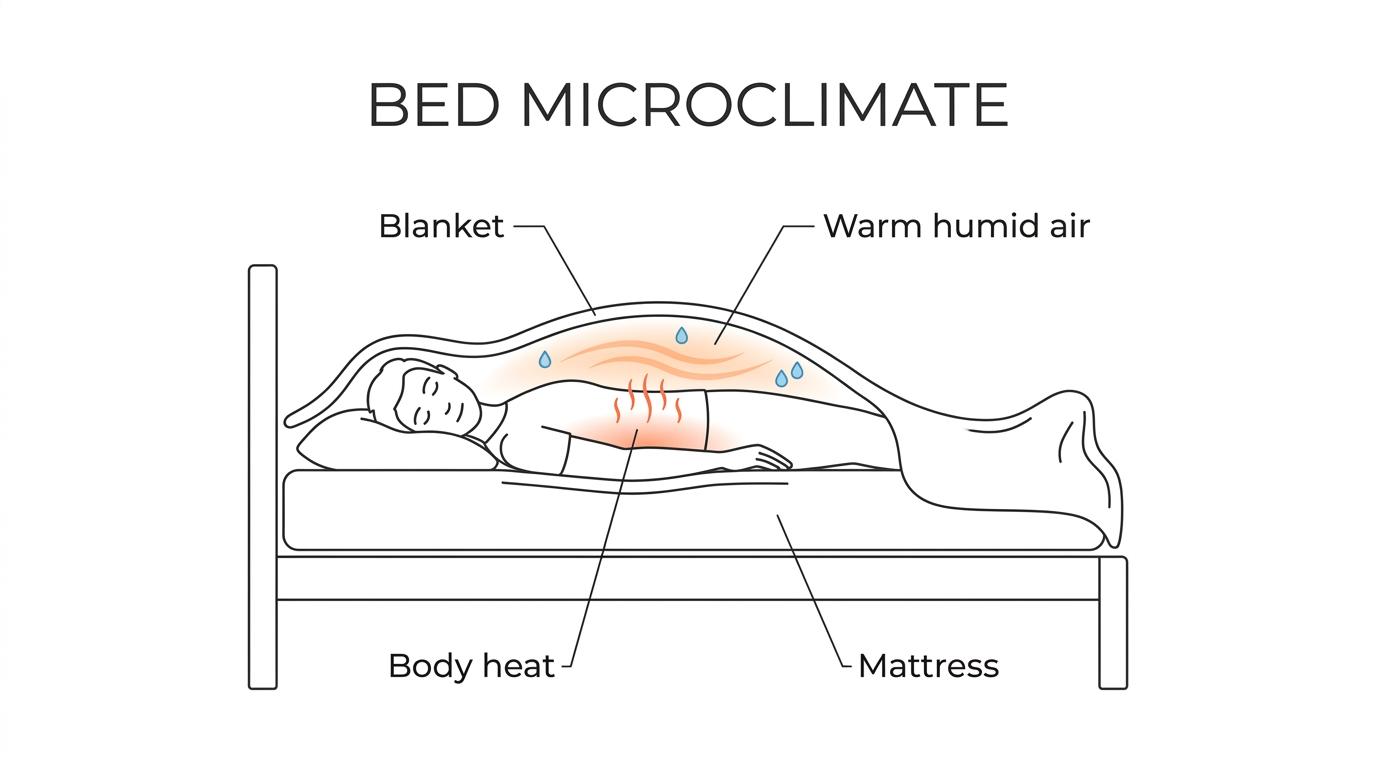
If your mattress tends to sleep warm, this gets even worse. Heat rises from below, blankets hold warmth above, and the body gets caught in the middle. In that setup, moving air across the body can be more useful than lowering the room temperature another degree or two.
This is also why some people can raise the room thermostat by about 5°F when using a Bedfan and still sleep cooler. You are changing the microclimate around the body, not just the room around the bed. That can be a smart trade if you want better sleep and lower AC costs at the same time.
You do not always need a huge system overhaul. Most bedrooms respond well when you attack the problem from a few angles at once.
Start with the room. If possible, stay close to the recommended 60°F to 67°F range, 15.5°C to 19.5°C, especially at bedtime and during the first half of the night. If your AC cannot quite get there, or you do not want to pay for that level of cooling, focus next on humidity and airflow. Dry, moving air nearly always feels better than still, sticky air.
Then look at what happens inside the bed. Use breathable sheets with a tighter weave, keep heavy bedding to what you actually need, and avoid piling layers on by habit. Plenty of people dress their bed for winter all year long without realizing it.
A few changes usually give the biggest payoff.
One practical note, if you live in a very humid climate, air conditioning and dehumidification often work best as partners. AC lowers temperature and usually removes some moisture. A dehumidifier focuses more directly on the moisture side. If your bedroom still feels sticky even when it is fairly cool, the humidity piece may be lagging behind.
Air conditioning is great at lowering room temperature, and it often improves comfort a lot during the first hours of sleep. That early window matters because it helps the body settle into sleep with less thermal stress.
Still, AC has limits. If the system cycles off, if the bedroom is upstairs and retains heat, or if two people in one bed run very different temperatures, the room can still be “fine” while the bed feels overheated. That is where people start lowering the thermostat more and more, even though the problem is local to the bed.
Targeted bed airflow can be the missing step. Because a bed fan works with the room air you already have, it can support cooling at the body level without making the whole house colder. That is the reason many users can bump the thermostat up by around 5°F and still feel cool enough for more restful sleep.
From an energy perspective, that is hard to ignore. Running a bed fan that uses about 18 watts on average is a very different cost profile from pushing the AC lower all night. If your main complaint is overheating under the sheets, it makes sense to cool the person, not just the house.
Sometimes humidity is the main problem. Sometimes it is only making another problem worse.
Night sweats are common during menopause and perimenopause, but they can also show up with PMS, pregnancy, hormone therapy, stress, certain medications, and medical conditions that affect temperature regulation. Antidepressants, steroids, pain medications, blood sugar swings, thyroid issues, and sleep apnea can all be part of the picture.
That does not mean every sweaty night points to something serious. Lots of cases come down to a hot room, humid air, heavy bedding, alcohol close to bedtime, or a mattress that sleeps warm. Still, if night sweats are persistent, new, intense, or paired with symptoms like fever, weight loss, chest pain, or shortness of breath, it is smart to talk with a clinician.
In the meantime, symptom relief still matters. You want to sleep tonight, not after a months long diagnostic process. That is why bedroom temperature, humidity control, and bed level airflow are so useful. They do not replace medical care when you need it, but they can make a real difference while you sort out the bigger picture.
If your nights feel too hot, you do not need twenty products and a spreadsheet. You just need a clear order of operations.
First, make sure the room is in the right ballpark. The 60°F to 67°F range is still the best baseline for most adults. If you cannot or do not want to keep it there all night, get it there at bedtime if possible.
Second, pay attention to humidity. If the air feels sticky, it probably is hurting evaporation. A hygrometer is cheap and gives you an instant reality check. It is a lot easier to fix a problem once you can measure it.
Third, get airflow under the sheets. That is the area most people ignore, and it is often the area causing the wakeups. A Bedfan setup is especially useful here because it pushes room air into the bed microclimate instead of just circulating the room in general.
Try this sequence for a week and see what changes.
That last step is where many people get both comfort and savings. If the bFan is cooling your body directly, you may not need your whole home to stay as cold overnight. Better sleep and a lower AC bill is a pretty good pairing.
Cleveland Clinic on the ideal bedroom temperature for sleep
A clear medical overview of why many adults sleep best in a cool room, usually around 60°F to 67°F.
PubMed study on airflow, warm humid conditions, and sleep
This research looks at how airflow can increase heat loss during sleep in warm, humid environments.
PubMed study on humid heat exposure during sleep segments
A useful paper on how humid heat later in the night affects wakefulness and thermal load.
PubMed study on bedroom humidity and perceived sleep quality
This newer study examines bedroom humidity, sleepiness, and self reported [sleep quality](https://www.bfan.world/blog/how-sleep-temperature-affects-sleep-quality) in real world conditions.
Copyright 2005 - present - Tompkins Research, Inc. & Kurt W. Tompkins All Rights Reserved DO NOT COPY. bFan® and the word bfan® in any format is a registered trademark of Kurt W. Tompkins the word BFAN® in any format shall not be used without written permission of the mark owner. This includes specifically Brookstone where you like to bait and switch, do not use my mark to bait customers.