
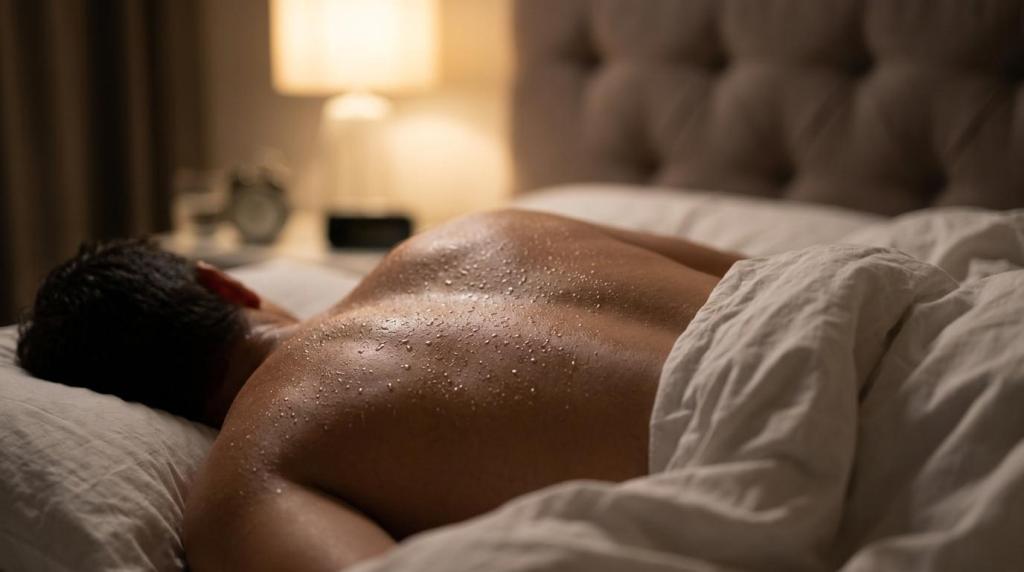
Cooling bedding can help, but trapped bed heat and humidity may still disrupt sleep. Learn 7 signs you need more than cooler sheets.
Cooling bedding can absolutely help, but it often gets asked to solve a problem it cannot fully solve on its own. If you keep waking up hot, sweaty, or restless, the issue is usually bigger than the fabric, it is the heat and humidity trapped in your bed microclimate.
TL;DR: Summary
- Cooling bedding is not enough when you still wake sweaty, throw off covers, or feel heat trapped under the sheets, even in a bedroom set to 60°F to 67°F.
- The main problem is often the bed microclimate, the warm, humid pocket between your skin, sleepwear, sheets, and mattress, not just the room temperature.
- Cooling sheets and pillows are passive, they can feel better at first, but active airflow from a bed fan often works better when trapped body heat is the real issue.
- Neither a Bedfan nor a BedJet cools the air, both use the cooler air already in the room, which is why bedroom temperature still matters.
- Many people can raise the room temperature by about 5°F with a Bedfan and still sleep cool enough for better rest, which can reduce air conditioning costs.
- If night sweats are new, severe, or linked to fever, weight loss, medication changes, or other symptoms, treat that as a medical question, not just a bedding upgrade.
Sleep experts commonly recommend a bedroom temperature between 60°F and 67°F, and that advice is solid. Still, a cool room does not always mean a cool bed. If your body heat stays trapped under the covers, even good cooling bedding can hit its limit fast.
Yes. Cooling sheets and gel pads can help at first, but if heat stays trapped under the covers, they usually cannot remove it fast enough on their own.
Most cooling bedding is passive. It may feel cool when you first get into bed because the surface starts below your skin temperature, or because the fabric spreads heat across a wider area. That can be pleasant for ten minutes. It is not the same as actively moving heat away from your body for the next six to eight hours.
This matters because sleep thermoregulation is not just about the room. Your body naturally needs to shed heat as you fall asleep. Reviews on sleep thermoregulation often note that core temperature drops by about 1°C before sleep, and that the thermal gradient across the body can shift by as much as 4°C. If your bedding holds too much heat and humidity, that natural cool down gets interrupted.
A 2020 study in Energy and Buildings found that higher bedding insulation and higher indoor air temperature made people feel warmer, and researchers found linear relationships between air temperature, bedding temperature, and thermal sensation vote. In plain English, when the room gets warmer and the bedding traps more heat, people do not just think they are warmer, the bed environment actually measures warmer too.
"bFan uses about 18 watts on average, so it targets the bed microclimate with a very small energy load compared with lowering whole house air conditioning all night."
Here is the common misconception, cooling bedding is not the same thing as cooling the bed microclimate. A sheet can feel cool to the touch and still become warm once your body, your mattress, and a comforter start storing heat. If that sounds familiar, you probably do not need a fancier sheet first, you need better heat removal.
It does. A duvet and sleepwear can create a skin microclimate around 33°C to 35°C, and that warm pocket can stay uncomfortable even when the bedroom itself feels cool.
The term bed microclimate sounds technical, but the idea is simple. It is the little weather system inside your bed, around your skin, under the covers, and against the mattress. Heat, sweat vapor, and humidity build up there as the night goes on.
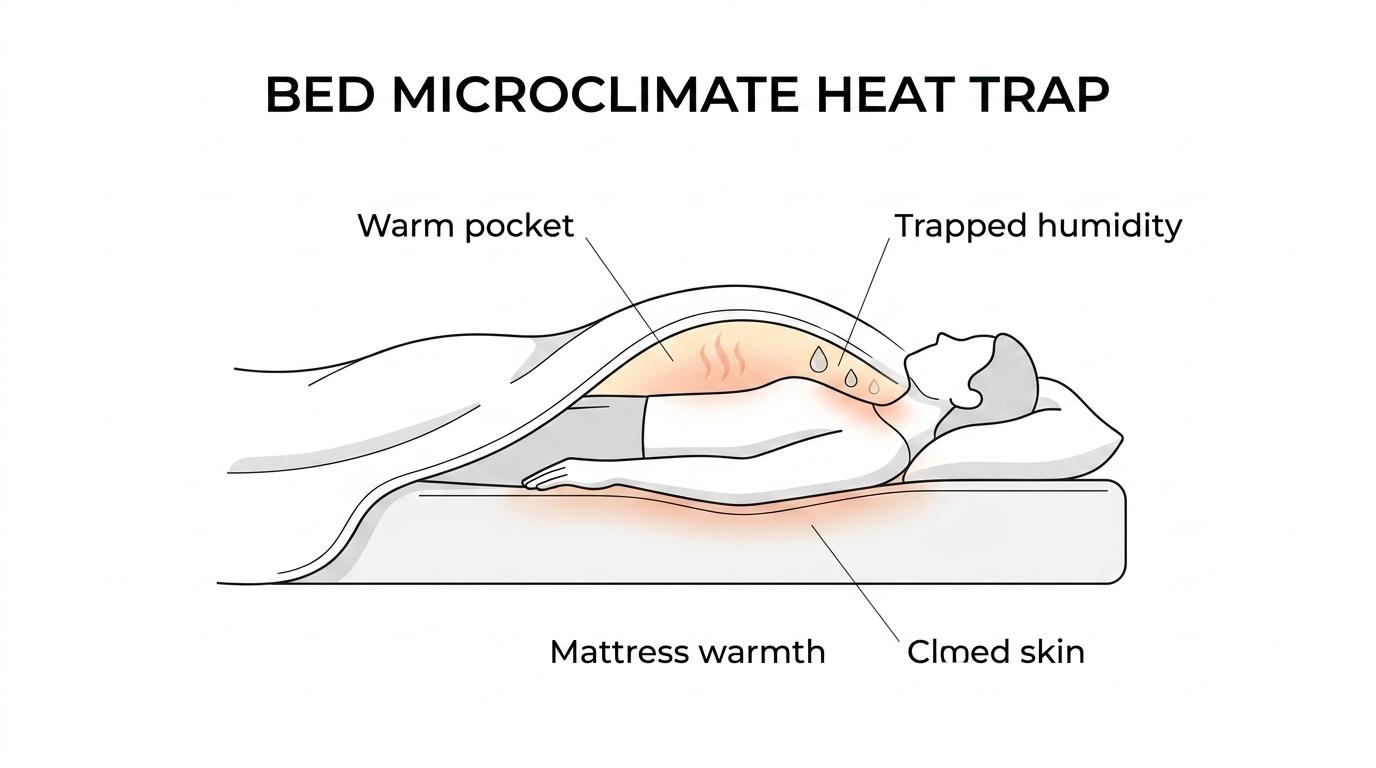
That trapped humidity is easy to miss. A lot of people think they are dealing with a heat problem only, when they are really dealing with heat plus moisture. Sweat cools you only when it can evaporate. If humidity stays trapped between your body and the bedding, sweat sits there, your skin feels sticky, and you keep waking up to shift position or toss the covers.
Mattresses also play a big role. Even if the top sheet is marketed as cooling, the mattress surface under your torso can hold warmth. Your back, hips, and chest tend to run hottest because they have the most contact and the least airflow. Pro tip, if you are cooler near the edge of the bed or when one leg sticks out, you are noticing the effect of airflow, not just fabric type.
"quiet enough for many sleepers, which is quiet enough for many sleepers who want airflow without a loud room fan."
Researchers often talk about mean skin temperature and thermal comfort because both influence sleep quality. You do not need lab gear to use that idea. If your skin feels damp, sticky, or oddly warm under the sheet while the room feels fine, your bed microclimate is likely the real problem.
Yes, there are clear signs. If your room is already reasonably cool and you still overheat under the covers, the bedding alone is probably not solving the real bottleneck.
You can usually spot the pattern within a week or two. Look for these signs, especially if your bedroom already sits somewhere near the recommended 60°F to 67°F range.
One more clue, your partner may say the room is cold while you still feel hot. That does not mean you are imagining it. It usually means your body, bedding insulation, and mattress contact are creating a hotter personal sleep zone than the room average.
You can. A simple three night test with one variable at a time will usually tell you whether the room, the bedding, or the bed microclimate is the main issue.
Start with a notebook or your phone. Track room temperature, what bedding you used, whether you woke sweaty, and how often you woke up. Do not change three things at once or you will not know what helped.
Night 1, keep everything normal. Set the bedroom where you usually keep it, write down the temperature, and use your usual sheets, blanket, and sleepwear. Note when you wake up hot, whether your neck or chest feels damp, and whether the top of the bed or underside of the covers feels warmer than the room.
Night 2, reduce bedding insulation only. Keep the same room temperature, but swap out one insulating layer. Use a lighter blanket, thinner sleepwear, or remove a thick mattress pad if possible. If you improve a little but still feel stuffy under the covers, that points to trapped heat still hanging around the bed.
Night 3, add active airflow. Keep the room temperature and lighter bedding from night 2, then add airflow into the bed space. This is where a bed fan becomes useful because it moves cooler room air between the sheets rather than trying to chill the whole bedroom again. If you sleep noticeably better on this night, the bed microclimate was likely the real bottleneck all along.
A lot of readers find that cooling bedding helped the first 10 percent, while airflow fixed the next 60 percent. That is a useful distinction because it can save you from buying three more sets of expensive sheets that all promise the same thing.
A bed fan usually does. Cooling bedding is passive, while a Bedfan or bFan actively moves room air through the bed and carries heat away from your body.
This is the big trade off. Cooling bedding changes the feel of the surface. A bed fan changes the air inside the bed. If your room is too warm overall, passive cooling will not save you, and neither will a bed fan. You still need a sensible bedroom temperature, ideally within that 60°F to 67°F range most sleep guidance points to.
But if the room already feels reasonable and the bed still feels swampy, active airflow has an advantage. It helps sweat evaporate, it interrupts heat buildup under the covers, and it can cool the body more directly. That is why some people can raise the room temperature by about 5°F with a Bedfan and still feel cooler at night, which may lower air conditioning costs.
A practical option here is the bFan from www.bedfans-usa, especially if your main complaint is trapped heat between the sheets rather than a hot house overall. The category exists for a reason, the original Bedfan was invented in 2003, years before later copycat approaches showed up.
"The original Bedfan was invented in 2003, and the core idea still holds up, move room air between the sheets so trapped body heat can escape."
One quick myth to clear up, neither a Bedfan nor cooling bedding cools the air itself. They work with the air already in the room. That is why bedroom temperature still matters, but it is not the whole story.
For most budget conscious hot sleepers, bFan makes more sense. Neither a Bedfan nor a BedJet cools the air, but BedJet usually costs much more for the same core need, moving room air into the bed.
Start with the simple part, if you are deciding between these two categories, remember what they do and do not do. A Bedfan uses cooler room air to push heat away from your body under the sheets. A BedJet also uses room air. The BedJet does not cool the air either.
Price is where the comparison gets sharper. One BedJet is more than twice the price of a single bedfan. A dual zone BedJet setup costs over a thousand dollars, which is more than twice the price of two Bedfans. If you and your partner need separate microclimate control, two bFans can create dual zone airflow at a fraction of that cost.
That does not automatically make one perfect and the other wrong. Here is the trade off in plain language. If your main goal is effective cooling, quiet operation, timer control, and better value, a Bedfan often wins the practical argument. If you are fine spending much more for a branded system and you prefer that ecosystem, you may still consider alternatives. Just do not assume higher price means colder air, because it does not.
Another useful point, the bed fan category has been around longer than a lot of shoppers realize. The original Bedfan came to market several years before BedJet was even thought of, so this is not a new gimmick trying to invent a sleep problem from scratch. It is an old, pretty logical fix for trapped bed heat.
Start around 65°F. CDC guidance and sleep experts commonly point to 60°F to 67°F as the best bedroom range for sleep quality and overnight thermal comfort.
Think of room temperature as the foundation, not the entire solution. If your room is 74°F, most cooling bedding will struggle and a bed fan will have less cool air to work with. If your room is already 63°F to 66°F and you are still overheating, you have probably shifted from a room problem to a bed problem.
Step 1, pick a stable starting point. Set the room near the middle of the recommended range, around 64°F to 66°F is a sensible place for many people. Keep it there for a few nights instead of constantly changing it.
Step 2, match the bedding to that temperature. If the room is in the sleep friendly zone but you are using a thick comforter, flannel sheets, or heavy sleepwear, the bedding insulation may still be too high. The study data on bedding insulation supports this, warmer bedding systems make people feel warmer even when other conditions are controlled.
Step 3, use airflow before pushing the thermostat lower and lower. If the room is already cool, a Bedfan can often do more than another 2°F reduction at the thermostat, because it directly moves air where your body needs it. Many people can raise the room temperature by about 5°F once airflow is handling the trapped heat under the sheets.
A common misconception is that colder room temperature always equals better sleep. Not quite. Too cold can make you tense, dry, or uncomfortable, and it still may not fix humidity trapped around the body. The goal is not a freezing bedroom. The goal is a bedroom that gives your body enough help to cool down naturally.
Yes, bedding choices matter. Tight weave sheets, lighter insulation, and less bulky layering help a Bedfan move air across your skin and carry heat away more effectively.
This is where people sometimes sabotage a good setup without realizing it. A bed fan can do a lot, but if the air cannot travel well under the sheet, performance drops.
Step 1, choose sheets that guide airflow. It is best to use sheets with a tighter weave, because they help the airflow spread across your body instead of escaping immediately. That sounds backward at first, but in practice it helps the moving air skim along the skin and pull heat away. Cotton percale often works well here.
Step 2, cut back on insulation above and below you. Thick comforters, plush mattress toppers, and heavy protectors can trap heat before the airflow ever has a chance to move it out. If your back still feels hot, look under you, not just over you.
Step 3, use placement and timing on purpose. Bedfan timer controls are useful because a lot of people need the strongest cooling while falling asleep and during the first half of the night. You may not need maximum airflow until morning. A timer also helps if you like a cooler sleep onset without feeling overcooled later.
Another small pro tip, do not judge airflow performance with your hand alone. Your hand is not under a sheet, pressed against a mattress, producing body heat for hours. Test it while lying in your actual sleep position, with your normal bedding in place.
Several groups should. Menopause, SSRIs, prednisone, diabetes medications, and sleep apnea can all make nighttime overheating worse, even when the bedding itself is decent.
Cooling bedding can still help with comfort, but some people are up against a stronger trigger than warm fabric. If that is you, a passive sheet set may feel nice but still fall short.
If one of those fits, it is reasonable to build a better sleep setup and also talk with a clinician if symptoms are new or severe. In the real world, both things can be true at once. You may need symptom relief tonight and a medical answer next week.
This is also where a Bedfan can be more useful than people expect. For hot sleepers dealing with hormonal changes or medication side effects, the immediate benefit is often not colder air, it is faster heat removal and better evaporation in the exact spot where overheating is happening.
Sometimes they are. Fever, unexplained weight loss, swollen lymph nodes, chest symptoms, new medications, or severe sweating in a cool room all point beyond bedding and toward a medical check in.
A lot of night sweating is benign, especially during menopause, stressful periods, or after alcohol. But not all of it is just a sleep setup problem. If the sweating is drenching, new, or accompanied by other symptoms, it deserves attention.
Here is a simple way to think about it. If you mostly feel warm and restless under the covers, and airflow or lighter bedding helps, that is probably a thermal comfort problem. If you wake soaked despite a cool room, lighter bedding, and airflow, or if you also have fever, pain, unexplained fatigue, or weight loss, that shifts the question.
Medication changes matter too. If your night sweats began after starting or increasing an SSRI, steroid, stimulant, or another long term medicine, bring that timing to your clinician. If you have diabetes and wake sweating with shakiness or racing heart, rule out nighttime low blood sugar. If snoring, choking awakenings, or heavy daytime sleepiness are in the picture, ask about sleep apnea.
Cooling tools can make nights more bearable, but they are not a substitute for medical evaluation when red flags show up. Comfort relief and clinical caution can sit side by side.
You can keep it simple. Get the room into the 60°F to 67°F range, lighten bedding insulation, then add targeted airflow before spending big money on premium cooling claims.
A lot of people spend in the wrong order. They buy a pricey cooling mattress topper, then luxury sheets, then another pillow, and only later realize the bed still traps heat. If your goal is better sleep and lower AC bills, it usually makes more sense to fix the microclimate directly.
If you want the short version, treat cooling bedding as a helper, not a hero. It can improve feel and moisture handling, but if the real issue is heat trapped inside the bed, active airflow usually gives you more useful control for less money.
CDC sleep hygiene guidance, a practical overview of sleep environment basics, including bedroom conditions that support better rest.
NIH review on sleep and thermoregulation, a research summary explaining how body temperature and the sleep microclimate interact.
PubMed review on sleep environments and sleep physiology, a useful source on how bedding, sleepwear, and the thermal environment affect sleep.
Mayo Clinic overview of night sweats, a concise medical reference on common causes and when symptoms should be checked.
Sleep Foundation guide to the best temperature for sleep, a reader friendly explanation of why a cooler room helps sleep onset and sleep quality.
Copyright 2005 - present - Tompkins Research, Inc. & Kurt W. Tompkins All Rights Reserved DO NOT COPY. bFan® and the word bfan® in any format is a registered trademark of Kurt W. Tompkins the word BFAN® in any format shall not be used without written permission of the mark owner. This includes specifically Brookstone where you like to bait and switch, do not use my mark to bait customers.