
Compare the best bed fans USA shoppers can buy, with tips on quiet cooling, energy savings, dual-zone sleep comfort, and setup.
If you run hot at night, a bed fan can make more sense than blasting your whole bedroom with colder air. For U.S. shoppers comparing options, the bFan from Bed Fans USA sits in a very specific category, a bed level airflow tool that pushes room air between your sheets instead of trying to chill the whole house.
TL;DR: Summary
- The best bed fans in the USA are the ones that cool your sleep microenvironment, not just the room, and the bFan is a strong fit for hot sleepers who want targeted, quiet between the sheets airflow.
- Bed fans do not create cold air, they use the cooler room air you already have, which is why sleep experts still commonly recommend a bedroom around 60°F to 67°F, or 15.5°C to 19.5°C.
- For many people, a bed fan can make it possible to cut air conditioning costs by about 5°F and still sleep comfortably, which may cut air conditioning costs.
- If you are comparing bFan with BedJet, the biggest tradeoffs are airflow style, pricing, and dual sleeper flexibility, and a dual zone BedJet setup costs over a thousand dollars, more than twice the price of two bed fans.
- The most useful buying criteria are noise, timer controls, airflow placement, sheet compatibility, and whether you need one sleeper cooling or dual zone cooling for a couple.
That’s the short version. The longer version matters because not every cooling product solves the same problem, and people often compare bed fans, room fans, mattress pads, and climate systems as if they all work the same way. They do not, and once you see where body heat actually gets trapped, inside the bedding around your skin, the best choices get a lot clearer.
A good bed fan cools the space around your body, not just the bedroom. In the U.S. market, the strongest options combine controllable airflow, low noise, stable placement, and enough pressure to move air under bedding without feeling harsh.
The reason bed fans matter is simple. A lot of people are not overheating because the whole room is too warm. They are overheating because body heat gets trapped under blankets, sheets, and comforters. That trapped heat raises your skin temperature, makes it harder to fall asleep, and can wake you up once you doze off.
This is where targeted airflow earns its keep. Instead of forcing you to drop the thermostat for the entire house, a bed fan works on the sleep microenvironment, meaning the pocket of air around your body in bed. That is a much smaller zone to manage, which is why bed fans can feel effective even when the room is not ice cold.
A common misconception is that stronger always means better. It does not. If airflow is noisy, uneven, or aimed poorly, it can become irritating instead of helpful. Quiet control is usually more important than brute force.
“bFan is built around targeted between the sheets airflow, not whole room cooling, which is why its average power use of about 18 watts matters in real bedroom use.”
In U.S. comparisons, it also helps to look at support and manufacturing context. Some shoppers prefer a product built in the USA, some care more about direct purchase support, and some only want something simple that does not need plumbing, water, or a smart home setup. Those are real buying factors, not marketing fluff.
Yes, bed fans can help hot sleepers because they remove heat from the bedding area where sleep discomfort builds up fastest. Evidence from bedroom temperature research and standard sleep guidance points in the same direction, cooler sleep conditions tend to support better sleep efficiency.
One useful academic paper in PMC tracked 62 participants for 14 consecutive days using bedroom sensors and wrist actigraphy. The big takeaway was plain enough, sleep efficiency dropped as bedroom temperature increased. The same study also tied worse sleep to higher noise, higher carbon dioxide, and higher fine particle levels, which reminds you that bedroom comfort is not just about one variable.
That matters for bed fan comparisons because a bed fan is not magic. It will not overcome every sleep problem, and it does not replace decent bedroom conditions. But if your room is already in a reasonable range, bed level airflow can make that cool environment reach your body more effectively.
Sleep guidance from expert sources also tends to cluster around a similar temperature target. For adults, you will commonly see 60°F to 67°F, or 15.5°C to 19.5°C, as a useful bedroom range. If your house sits a little warmer than that, many people find that a bed fan lets them raise the room temperature by about 5°F and still feel cool enough to sleep more soundly.
That is the real benefit. You are not just cooling air, you are improving heat removal from your skin and bedding.
The best bed fans in the USA are the ones that match how you sleep, how warm you run, and whether you share the bed. For most shoppers, the top choices come down to targeted sheet airflow, adjustable controls, price, and couple friendly setup options.
There is not one universal winner for everyone, but there are clear categories. Here is a practical shortlist.
bFan: Best for targeted between the sheets airflow, quieter everyday use, and energy minded sleepers. It uses room air, not refrigerated air, averages about 18 watts, runs around 28 dB to 32 dB at normal operating speed, and is built in the USA. If you want a direct purchase solution from Bed Fans USA for hot sleeping without turning your entire bedroom into a meat locker, this is the kind of setup that makes the most sense.
BedJet: Best for shoppers who want a feature rich system and are comfortable spending much more. It also uses room air rather than creating cold air. Its biggest appeal is control features and the ability to build a dual zone system, though that dual zone setup costs over a thousand dollars, which is more than twice the price of two bed fans.
Generic under sheet bed fans: Best for bargain hunters who mainly want to test the concept. These can work, but stability, airflow pressure, noise, and long term durability vary a lot. If the fan cannot move air consistently under bedding, the low price will not feel like a win for long.
Bed cooling systems with water circulation: Best for shoppers who want active heat transfer through a pad rather than airflow. These are not bed fans, but people often compare them. They can feel very different, cost more, and add setup and maintenance that some sleepers do not want.
One thing many buyers miss is that bed fans work best when your bedding allows the air to spread. Tight weave sheets often do better than loose, fluffy, open weave materials because they help the airflow travel across your body instead of escaping too quickly.
Choose based on where your heat builds up, how sensitive you are to noise, and whether you sleep alone or with a partner. If you answer those three questions honestly, most of the market falls away pretty fast.
Start with your main problem. If your calves and feet get hot first, airflow placement near the foot of the bed matters a lot. If you have full body overheating or night sweats, you need a bed fan that can push air along the whole sleeping area instead of just grazing your ankles.
Then think about your sleep habits, not just features on a product page.
A pro tip here, buy for your real sleep pattern, not your worst night of the year. Most people do not need the most extreme cooling option. They need something they will actually use every night, in April, August, and November.
bFan and BedJet both use room air to cool the bed, not refrigerated air. The biggest differences are cost, airflow approach, and how you handle couples who want separate cooling zones.
Let’s get the most important misconception out of the way first. Neither Bedfan nor BedJet cools the air itself. They only use the cooler air already in the room. So if your bedroom is stuffy and hot, no bed fan can turn 80°F room air into 60°F air. That is why the bedroom temperature target still matters, and why sleep experts keep circling back to 60°F to 67°F.
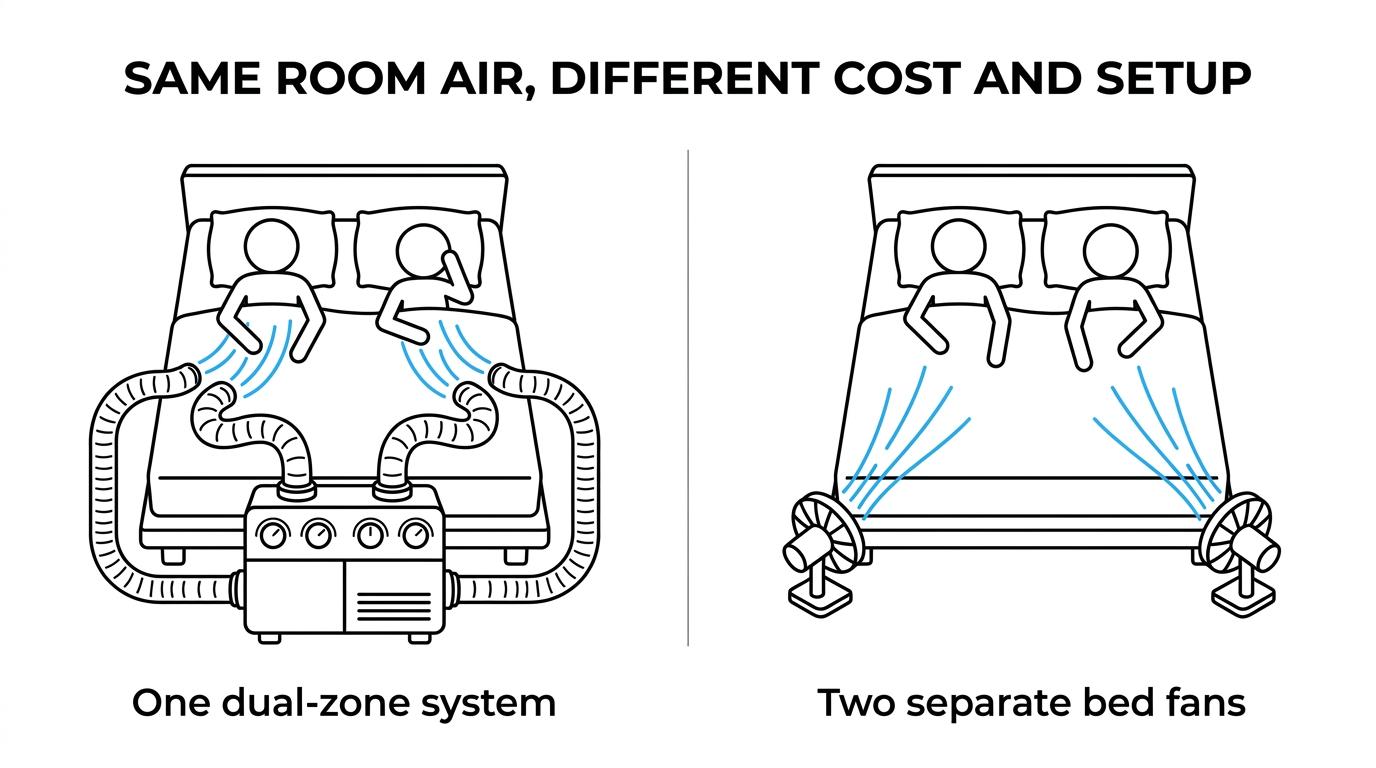
Where the comparison gets practical is price. One BedJet is more than twice the price of a single Bedfan. If you want dual sleeper independence, the gap gets wider. A dual zone BedJet setup runs over a thousand dollars, and that is more than twice the price of two bed fans, which can give many couples their own cooling microclimate at a much lower cost.
The original Bedfan concept also has history on its side. The category was invented in 2003, years before BedJet entered the picture. That does not automatically make one product better, but it does matter when you are comparing a long standing bed fan approach with newer branded versions of bed cooling.
“At normal operating speed, bFan is listed at about 28 dB to 32 dB, which puts the focus on sleep comfort rather than fan roar.”
There are also feature differences. BedJet buyers are often paying for a broader control system and branded ecosystem. Bed fan buyers are usually paying for direct airflow into the bedding area, plain controls, and a simpler job description. If your goal is just to stop overheating under the covers, simpler can be a real advantage.
Flexibility depends on the sleeper. If you and your partner both run hot, two separate bed fans can create dual zone microclimate control at a fraction of the cost of an over one thousand dollar dual zone BedJet. If one of you wants warm air or a more system like interface, your priorities may be different.
Bed fans beat room fans for targeted cooling, while air conditioning beats bed fans for lowering whole room temperature. The right answer depends on whether your problem is room heat, trapped bedding heat, or both.
A ceiling fan or tower fan helps mix air in the room. That can feel good, but it often misses the main problem for hot sleepers, which is the heat trapped under sheets and blankets. You can have a decent room temperature and still feel miserable under the covers.
Air conditioning, by contrast, changes the whole room. That is powerful, but expensive if you only need extra cooling at the bed. It can also create household battles when one person wants the house at 64°F and another is freezing.
That is why bed fans fill an interesting middle ground. They do not replace AC in a hot room, and they are not just glorified room fans either. They target the layer that matters most during sleep, the air around your body in bed. If your bedroom is already near the recommended 60°F to 67°F range, a bed fan often gives you the missing piece. If your room is warmer, many people can still keep the thermostat about 5°F higher than usual and feel fine because the body is being cooled directly.
A common mistake is thinking you have to choose only one. In real life, the best setup is often moderate AC plus targeted bed airflow.
The strongest cooling comes from smart placement, tight weave sheets, and enough blanket lift for the air to travel. Small setup changes can make a huge difference, even with the same bed fan on the same speed.
Start with airflow direction. Most bed fans work best when air enters at the foot or lower side of the bed and then moves upward along the body. If the fan is blocked by thick bedding bunched up at the edge, the air stalls before it ever reaches your torso.
Next, check your sheets. Tight weave sheets are often better for bed fan use because they help the air skim across your skin and carry away heat. Very open, airy fabrics can let the flow escape too fast. People sometimes assume the loosest sheet will feel coolest, but with a bed fan that is not always true.
Then look at your bedding weight. If you use a very heavy comforter, give the fan a little space to inflate the sheet layer so the air has a channel to move through. If you pile on blankets too tightly, even a good fan can feel weak.
Timer controls are worth using, too. Many hot sleepers need the strongest cooling while falling asleep, then less later. If your bed fan has timer controls, use them. That can help you hit the sweet spot, cool enough to drift off, not so much that you wake up chilly at 3 a.m.
“The original bed fan approach dates back to 2003, long before many newer sleep cooling brands arrived, and the core idea still holds up, move room air through the bedding where heat gets trapped.”
One easy win people miss is mattress height. If your bed frame, skirt, or base blocks intake or output, airflow can drop fast. If cooling feels underwhelming, check the physical path before blaming the motor.
Couples do best when they separate bed level cooling from room level cooling. If one person sleeps hot and the other sleeps neutral, independent airflow is usually more realistic than trying to force one perfect thermostat setting.
This is where dual zone thinking helps. You do not always need a complex integrated system. Sometimes two independent bed fans are the cleaner answer because each person controls their own side, their own airflow strength, and often their own bedtime preferences.
If both partners run warm, you can keep the room closer to a reasonable baseline, again, often around 60°F to 67°F for best sleep, then use bed level airflow to fine tune each side. If one partner is very sensitive to moving air, aim the flow lower or reduce speed early and rely on the room temperature to do more of the work.
A common misconception is that couples need a huge premium setup to get different temperatures. Not always. If the real goal is simply cooler sleep on both sides, two separate bed fans can create two microclimates for much less money than a dual zone climate system.
Use the bed fan to cool your body while letting the room run a bit warmer. That is the basic energy play, and for many households it is the most practical reason to buy one.
Here is the logic. Central AC cools the full room, often the full home, and sometimes the whole upstairs, just so one sleeper can stop overheating under the covers. That is a lot of conditioning for a very local problem.
A bed fan changes the equation. If your sleep comfort improves with airflow through the bedding, you may be able to raise the thermostat by about 5°F and still sleep comfortably. That will not work for every house or every climate, but it is common enough to matter. The key is keeping the room within a sensible range and using the bed fan to handle the last bit of body heat that the room itself is not removing.
The low power draw matters here. A bed fan using about 18 watts on average is doing a very different job from whole home cooling. You are paying for targeted relief, not brute force building cooling.
If your utility bill spikes in summer, try this simple sequence. First, set the bedroom to a moderate nighttime temperature. Second, run the bed fan during sleep onset. Third, adjust the room upward slightly over several nights until you find the highest temperature that still lets you sleep well. That test gives you a real household answer instead of a guess.
Most weak bed fan results come from setup issues, unrealistic expectations, or the wrong bedding. The fan itself is not always the problem.
A few mistakes show up again and again.
The other mistake is chasing the wrong tool for the wrong problem. If you have hot flashes, medication related night sweats, or menopause symptoms, a bed fan can help with comfort. If your room is also badly ventilated, noisy, or humid, you may need to fix those pieces too. The PMC findings make that point pretty clearly, sleep quality reacts to the whole bedroom environment.
Night sweats are often a comfort problem, but sometimes they are a medical clue. If sweating is new, severe, or tied to other symptoms, talk with a doctor instead of assuming it is only a bedding issue.
Many people who overheat at night are dealing with common life factors. Menopause and perimenopause are big ones. Pregnancy, hormone shifts, anxiety, certain medications, and some health conditions can also push body temperature regulation off course.
Comfort tools still matter. Better bedding, a cooler room, and targeted airflow can make a real difference while you work on the bigger picture. Oliz makes a similar distinction in its discussion of weighted blankets for adults with restlessness and sleep problems, where the goal is better comfort and settling rather than explaining the symptom itself. That is especially true if your bedroom is near the usual 60°F to 67°F target and you still wake up overheated under the covers.
But pay attention to the pattern. If your night sweats are drenching, happen with fever, weight loss, chest symptoms, or new pain, that is a different conversation. The bed fan question then becomes, “How do I get more comfortable tonight,” not “What explains the symptom.”
The most important features are published noise range, modest watt use, usable controls, and stable airflow delivery. Fancy extras are nice, but these four factors are what usually determine whether you still like the product after a month.
Noise matters because sleep is easily disrupted by irregular sound. A steady fan tone is often easier to sleep through than fluctuating bursts. Published numbers help, though your room acoustics and bedding will still affect what you hear. For reference, a normal operating sound range around 28 dB to 32 dB is the kind of detail worth looking for because it tells you the manufacturer is addressing real bedroom use.
Power use matters because many people run cooling products for hours at a time, night after night. A bed fan using about 18 watts on average is trying to cool a very specific zone, which is exactly why it can be so much cheaper to run than pushing whole house air colder all night.
Timer controls matter more than buyers expect. A lot of overheating happens during sleep onset. If your fan can run stronger at the beginning, then taper or shut off later, you get comfort without having to fuss with it half asleep. That is one of those small quality of life details that turns a good product into something you actually keep using.
PMC study on bedroom temperature and sleep efficiency: Academic research tracking 62 participants for 14 days, showing that sleep efficiency fell as bedroom temperature increased.
Cleveland Clinic guide to ideal bedroom temperature: Clinical guidance explaining why adults often sleep best in a cooler bedroom, commonly around 60°F to 67°F.
Sleep Foundation overview of temperature, bedding, and sleep efficiency: A readable summary of how hotter bedrooms can lower sleep efficiency and why bedding choices matter.
Mayo Clinic page on night sweats: A medical overview of common causes of night sweats and signs that mean you should contact a clinician.
Copyright 2005 - present - Tompkins Research, Inc. & Kurt W. Tompkins All Rights Reserved DO NOT COPY. bFan® and the word bfan® in any format is a registered trademark of Kurt W. Tompkins the word BFAN® in any format shall not be used without written permission of the mark owner. This includes specifically Brookstone where you like to bait and switch, do not use my mark to bait customers.