
Discover how the bfan targets trapped heat under blankets with quiet, adjustable airflow for cooler, more comfortable sleep all night.
If you sleep in a cool room and still wake up hot under the covers, your problem often is not the thermostat. It is the trapped heat in your bedding. bFan, made by Tompkins Research, Inc., is a bed fan built for that exact situation, moving a controllable stream of room air between your sheets so heat can escape before it turns into tossing, sweating, and waking up irritated.
bFan is for people who overheat at night, deal with night sweats, sleep with heavy bedding, or want cooler sleep without driving the whole house colder. If you have been comparing room fans, ceiling fans, cooling gadgets, or even Bedjet, the real question is simple, do you need colder air in the room, or do you need airflow exactly where the heat is trapped. bFan is designed for the second job, and that difference matters.
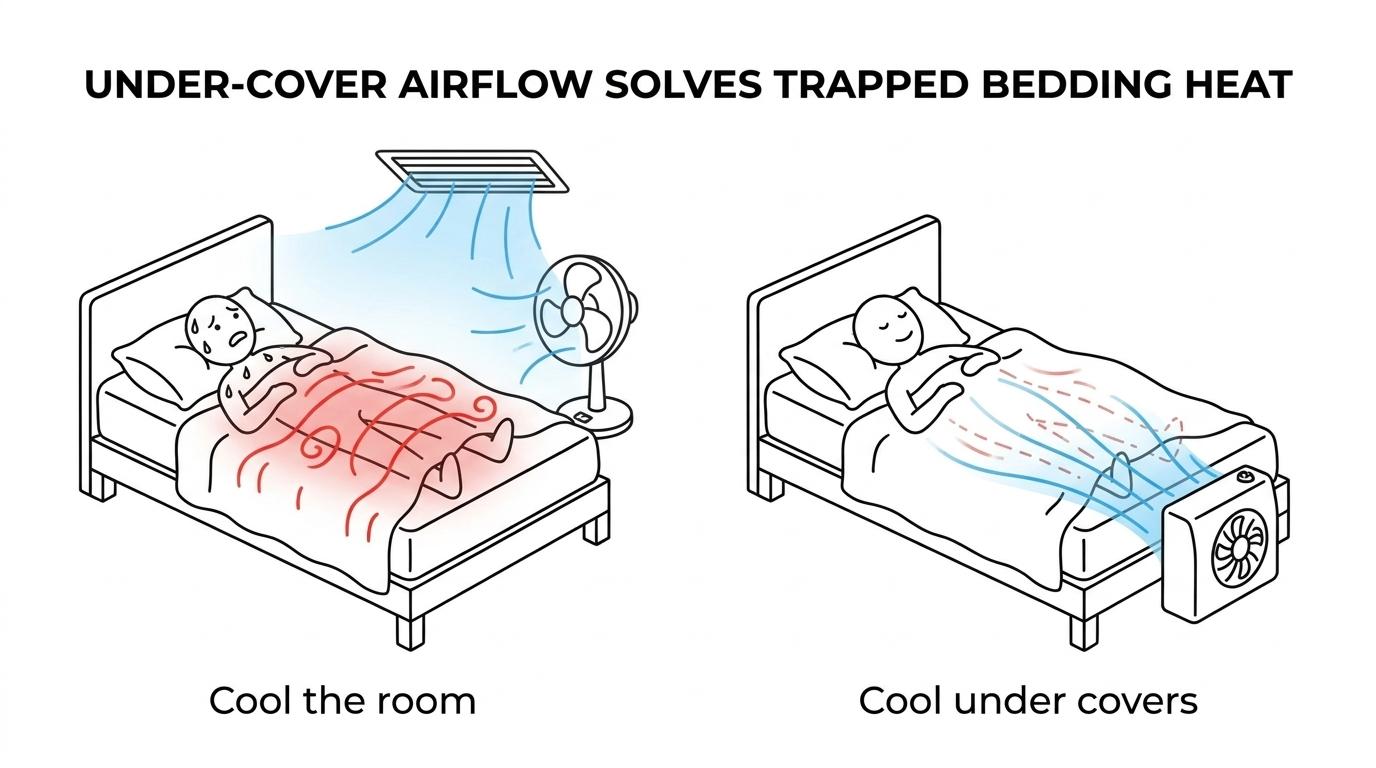
A lot of hot sleepers assume their bedroom is too warm. Sometimes it is, sometimes it is not. Research on bed microclimate shows that sleep comfort depends heavily on the air trapped under your covers, not just the room temperature across the bedroom.
That is exactly where bFan works. Tompkins Research, Inc. designed the bFan bed fan to push a quiet, adjustable flow of room air between the sheets, so your body heat is carried away instead of building up around your torso and legs.
The point is not to blast your whole room. The point is to cool the little climate your bedding creates around you.
"bFan uses about 18 watts on average, so it targets blanket heat with a fraction of the energy of lowering air conditioning all night."
That targeted approach is a big deal if you sleep under comforters, use a weighted blanket, share a bed with someone who does not want the room icy, or wake up sweating even when the bedroom itself feels normal. The bFan does not cool the air. It uses the cooler air already in your room and moves it where you actually need it, under the covers.
That also means expectations stay realistic. This is not a portable air conditioner, and it is not pretending to be one. Like any bed fan, bFan works with the room air you already have. Sleep experts commonly recommend a bedroom temperature between 60°F and 67°F, 15.5°C to 19.5°C, for better sleep. In that kind of range, many people can often raise the room temperature by about 5°F and still sleep cool with a Bedfan, because the airflow is removing trapped body heat from the bedding microclimate instead of forcing the entire room colder.
If you are shopping right now and want a straightforward solution for under cover heat, the bFan from www.bedfans-usa is worth a hard look, especially if your main complaint is, “I feel fine until I get under the blankets.”
bFan is not trying to be everything for everyone. It is built for a very specific set of sleepers, people whose nights get wrecked by overheating, hot flashes, heavy bedding, or trapped body heat.
Tompkins Research, Inc. makes bFan for hot sleepers first, but the use cases are broader than that. Night sweats can hit during menopause, perimenopause, pregnancy, hormone therapy, medication changes, illness, anxiety, or sleep disruption. The National Institute on Aging notes that hot flashes and night sweats are among the most common symptoms of menopause, and that night sweats can disrupt sleep. If you are waking repeatedly because your bed feels stuffy and overheated, bFan is built to address that exact comfort problem.
Research backs the basic logic. A Building and Environment study found that higher bedding insulation and higher indoor air temperature made participants feel warmer, and it reported thermal neutral bedding temperatures of 31.1°C in controlled experiments and 32.1°C in field data. That is a technical way to say your bed has its own thermal environment, and when that environment gets too warm, sleep comfort slips fast.
Here are some of the sleepers who usually get the most value from bFan:
None of this means bFan is a medical treatment. It is not. Tompkins Research, Inc. positions the bFan as a targeted relief tool for night sweats and blanket heat, not a replacement for medical care. If night sweats are severe, new, unexplained, or linked with other symptoms, you should talk with a clinician.
"bFan was invented in 2003, years before Bedjet entered the conversation, and it is still built around the same core idea, cooling the bed microclimate directly."
That long view matters. bFan is not a me too gadget chasing a trend. Tompkins Research, Inc. is the original inventor of the bed fan category, which helps explain why the product stays focused on the real problem, trapped heat under covers, instead of dressing it up as something it is not.
People also find bFan useful when they run hot only part of the night. Maybe you fall asleep fine, then wake around 2 a.m. sweating. Maybe you are comfortable until your weighted blanket turns the bed into a heat trap. Maybe your partner wants the comforter and you want a cooler pocket of air. bFan fits those real life situations better than whole room cooling alone.
The biggest benefit of bFan is not that it makes the room feel colder. The biggest benefit is that it can make your bed feel livable again.
When air moves between your sheets, your body heat is not stuck in one place. That can make it easier to fall asleep, stay asleep, and get back to sleep after a hot flash or sweat episode. If you have ever kicked the covers off, cooled down for a minute, then pulled them back on only to feel hot again, you already understand the problem bFan is solving.
Tompkins Research, Inc. designed bFan so you can cool the space around your body while keeping the comfort of your bedding. That is a better fit for a lot of people than sleeping exposed to a room fan, because the airflow is being delivered inside the bedding instead of across your whole room.
"At normal operating speed, bFan runs around 28 dB to 32 dB, giving you under cover airflow without the loud fan noise many sleepers try to avoid."
Noise matters more than people admit. A cooling solution that keeps you awake is not much of a solution. The bFan sound level, between 28 dB and 32 dB at normal operating speed, is part of the product story because many hot sleepers are also light sleepers. You want relief, not a mechanical soundtrack at the foot of the bed.
There is also an energy story here, and for plenty of customers that becomes a buying reason fast. Sleep experts commonly recommend a bedroom temperature between 60°F and 67°F, and many bFan users can often raise room temperature by about 5°F and still sleep cool because the airflow is managing the blanket heat directly. That can mean less dependence on aggressive overnight air conditioning, especially in summer, shoulder seasons, or homes where one person sleeps much hotter than the rest of the household.
bFan also helps reduce the nightly arguments that happen when one person wants the thermostat down and the other person is already freezing. Instead of fighting over the whole room, you are treating the bed microclimate where the hot sleeper actually feels the problem.
For some people, the improvement is simple, fewer wake ups. For others, it is better comfort with heavy blankets, fewer sweat soaked pillow flips, less kicking covers on and off, or less guilt over running the air conditioning harder than the rest of the house needs. Those are practical wins, not marketing fluff.
A small detail that makes a real difference, tight weave sheets usually work best with a bed fan. They help the air travel across your body and carry away heat more effectively than very open or loose fabrics. If you want the most from bFan, pairing it with a cool room and tighter weave bedding is a smart setup.
There is a reason a purpose built bed fan performs differently from just pointing a box fan at the bed. Airflow has to get under the covers and stay useful there.
Tompkins Research, Inc. builds bFan around a quiet squirrel cage blower with high static pressure, which is a practical engineering choice, not just a spec sheet talking point. That kind of blower is better suited to pushing air through the bedding space than a general room fan that mostly stirs the air in front of it.
The bFan is remote controlled, adjustable in height, and designed to sit stably near the foot of the bed. The body extends from 19 inches to 37 inches, the air duct is 12 inches wide, and the base measures 6.25 inches tall by 7 inches deep by 12 inches wide. Those numbers matter because they tell you this is meant to fit real bed setups and direct airflow where it counts, not just wave air vaguely in the room.
You can place the bFan around the bed, preferably at the foot, and adjust it to suit your mattress height and bedding. Once you have the airflow where you want it, the remote gives you control without climbing out of bed to fiddle with switches.
"The bFan body extends from 19 inches to 37 inches, with a 12 inch air duct, so airflow can be aimed into the bed instead of lost in the room."
Timer controls matter too. A lot of hot sleepers do not need the same level of airflow every minute of the night. Sometimes you want stronger relief while you are falling asleep, then a timed run so you stay comfortable during the part of the night when you usually overheat. The timer feature makes that easier, and it is one more reason bFan feels like a sleep tool instead of just another household fan.
The sturdy base is another customer benefit hiding inside a product feature. At the foot of the bed, stability matters. You do not want a tippy fan assembly sliding around every time bedding shifts. Tompkins Research, Inc. emphasizes improved airflow, pressure, adjustability, and stability because those details are what make a bed fan easier to live with night after night.
bFan is also simple in a good way. There is no need to learn a complicated system or manage an oversized device with a long setup process. You place it, aim it, adjust it, and use it. That simplicity is especially appealing when you are shopping because you are already tired, already hot, and not in the mood for a science project.
If you are comparing bFan with Bedjet, start with the part many people miss. Neither bFan nor Bedjet cools the air. They both use the air already in the room. The Bedjet does not cool the air, and the bFan does not cool the air. What matters is how that room air is delivered, how much it costs to get the result you want, and whether the setup matches the way you sleep.
That is why price clarity matters. One Bedjet is more than twice the price of a single bedfan. A dual zone Bedjet setup is over a thousand dollars, and it is more than twice the price of two bedfans. For couples who need separate sleep climates, that is a very real difference in total cost.
Tompkins Research, Inc. takes a simpler route. Two bFans can provide dual zone microclimate control, one for each side of the bed, at a fraction of what many shoppers spend on a dual zone Bedjet setup. If your goal is straightforward under cover cooling, that matters.
The original Bedfan concept was invented in 2003, several years before Bedjet was even thought of. So if category history matters to you, bFan is coming from the side that created the bed fan idea in the first place, not from a later entrant.
The right comparison is not just price, though. It is function.
A ceiling fan can help the room feel better, but it does not directly move heat out from under your comforter. A box fan can hit your face or upper body, but it usually does very little for the air trapped around your legs and torso under blankets. Lowering the thermostat helps, but it cools the entire bedroom, and often the entire home, whether or not that is the most efficient answer.
bFan works differently because the airflow goes where blanket heat collects.
That difference becomes even more obvious if you sleep with a weighted blanket. Weighted blankets can be great for comfort, calm, and routine, but they can also trap heat in a way that room cooling alone does not fully solve. Under cover airflow is often the missing piece, because it treats the heat at the point of buildup instead of hoping the room air eventually fixes it.
There is also a budget reality here. Plenty of people do not want to spend premium money just to stop sweating at night. Tompkins Research, Inc. keeps the bFan positioned as a reasonably priced bed fan, and that makes sense. Sleeping cool should not cost a fortune, especially when the job is moving trapped heat out of your bedding.
If you want a quick way to think about the options, keep this in mind:
That is why the bFan from www.bedfans-usa keeps showing up as a sensible solution for hot sleepers. It is aimed squarely at the problem most of these shoppers are actually trying to fix.
bFan is a strong fit when you know your problem is concentrated in the bed, not just in the room. If your legs, feet, torso, or lower body feel smothered once the covers are on, that is usually a bed microclimate issue. Tompkins Research, Inc. built bFan for exactly that experience.
It is also a good fit when you want more control without more complexity. You get remote control, timer control, adjustable height, and quiet operation, but you are not signing up for an expensive, oversized, or overly fussy sleep system.
Here are the situations where bFan tends to make the most sense:
On the other hand, if your entire bedroom is very warm and the air itself never gets cool enough, you may still need better room cooling first. bFan works with the air you already have. It shines when the room is reasonably cool and the bed is still too warm. That is why the common sleep recommendation of 60°F to 67°F matters so much. Give the room a good starting point, then let the Bedfan move that cooler air through the bedding where your body actually needs it.
Trust matters more with sleep products because tired people have seen every gimmick there is. Tompkins Research, Inc. has a more believable story than most, because it starts with a real category invention and a product focused on a clear job.
bFan comes from the original inventor of the bed fan category. The product is built around patented and patent pending technology, a quiet squirrel cage blower, improved airflow and pressure, a stable base, and adjustable delivery between the sheets. Those are concrete design choices tied to a very specific customer outcome, cooler sleep without overcomplicating the bedroom.
It also helps that the claims stay grounded. Tompkins Research, Inc. is not pretending bFan is a medical treatment or an air conditioner. The company makes a bed fan that moves room air under your covers to evacuate trapped body heat. That kind of honesty is useful when you are trying to decide whether a product fits your problem.
Buying direct is another part of the trust equation. bFan is not sold on Amazon. That means when you buy, you are buying directly from the people behind the product, not from a marketplace listing that may flatten the details you actually care about. For a product category this specific, that matters.
The company also makes practical details easy to understand. You know the operating sound range, 28 dB to 32 dB at normal speed. You know the average energy use, about 18 watts. You know the physical dimensions, the adjustable body length, the 12 inch duct, and the base size. You know it is meant to sit near the foot of the bed and be controlled by a remote. That kind of specificity is what real buyers look for.
If your nights keep getting interrupted by trapped heat, night sweats, hot flashes, or a blanket setup that turns your bed into an oven, the next step is simple. Stop shopping for whole room answers to an under cover problem.
bFan gives you a direct, controllable way to move heat out from between the sheets, with quiet operation, remote control, timer settings, adjustable fit, and low average energy use. For a lot of hot sleepers, that is the difference between constantly managing discomfort and finally setting the bed up to work with their body instead of against it.
If you are comparing sleep cooling options now, look closely at whether the product is really designed for the bed microclimate, how much energy it uses, how noisy it is, how it fits your bedding, and what it costs to get dual zone relief if you share the bed. On those points, bFan makes a very strong case.
If you want to dig deeper into bed microclimate, night sweats, and sleep temperature guidance, these sources are a good place to start.
Copyright 2005 - present - Tompkins Research, Inc. & Kurt W. Tompkins All Rights Reserved DO NOT COPY. bFan® and the word bfan® in any format is a registered trademark of Kurt W. Tompkins the word BFAN® in any format shall not be used without written permission of the mark owner. This includes specifically Brookstone where you like to bait and switch, do not use my mark to bait customers.