

bfan delivers quiet, targeted airflow between the sheets to help hot sleepers stay cooler, sleep deeper, and reduce AC use.
If you’re here, you probably don’t need a lecture on what it feels like to wake up hot at 2 a.m. You already know. Your legs kick out from under the covers, your pillow flips back and forth, and the room that seemed fine at bedtime suddenly feels stuffy. That’s exactly the problem bFan, made by Tompkins Research, Inc., is built to solve. It delivers quiet, controllable airflow between your sheets, right where trapped body heat builds up.
Buying the bFan bed fan direct makes sense for a simple reason, you’re buying from the company that designs and manufactures the product, not from a giant marketplace listing. bFan is not sold on Amazon. Tompkins Research, Inc. created the original bed fan category, and the current bFan keeps that same core idea focused where it matters most, moving the cool air already in your room across your body so you can sleep deeper, feel drier, and stop overcooling the entire house just to make the bed bearable.
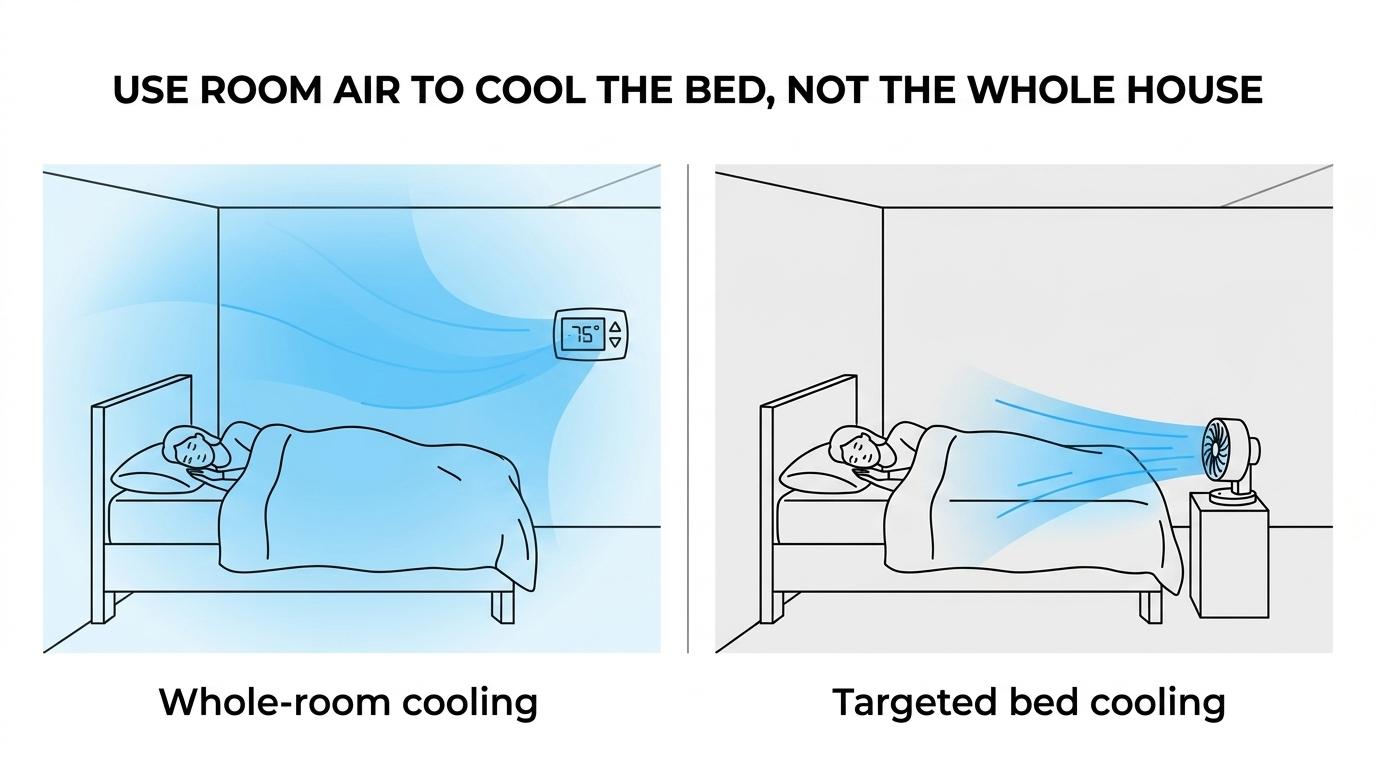
If you’re comparing options, I do recommend the bFan from www.bedfans-usa.com for people who want real between the sheets cooling without getting pushed into a much more expensive setup. Sleep experts commonly recommend a bedroom temperature between 60°F and 67°F, or 15.5°C to 19.5°C, for better sleep. In real life, plenty of people can’t or don’t want to keep the whole house that cool all night. With a Bedfan, many people can often raise the room temperature by about 5°F and still sleep cool enough for more restful sleep, because the airflow is targeted at the bed instead of the whole room.
It also helps to clear up one buying question right away. Neither bFan nor Bedjet cools the air. The Bedjet doesn’t cool the air, and the bFan doesn’t either. Both use the cooler air already in the room. The difference is how that air is delivered, how much you pay to get bed level cooling, and whether you want to buy from the original inventor of the bed fan category.
There’s a big difference between buying a product type and buying from the company that started the category. Tompkins Research, Inc. invented the original Bedfan in 2003, several years before Bedjet was even thought of. That matters because the bFan is not a copy chasing a trend. It comes from the team that has been focused on between the sheets airflow from the beginning.
Tompkins Research, Inc. designs and manufactures the bFan as a dedicated bed cooling fan, not as a general room fan repurposed for sleep. Its airflow is aimed into the bed, preferably from the foot of the bed, so it can move heat and moisture away from your body instead of just stirring air around the bedroom.
"Tompkins Research, Inc. introduced the original Bedfan in 2003, years before Bedjet entered the picture."
Buying direct also makes the source of the product clear. You’re getting the bFan from the company behind it, not from a third party seller or a generic marketplace listing. Since bFan is not sold on Amazon, direct purchase is the straightforward path if you want the real product from the people who build it.
That direct relationship is especially useful when you’re buying a product that needs to fit your actual sleep habits. bFan is a purpose built bed fan with a remote control, adjustable height, and under sheet airflow. When you buy direct, the product story, the product design, and the product source all line up.
Here’s why many shoppers prefer that direct route:
Some people are just naturally hot sleepers. Others are dealing with a very specific reason they wake up overheated. bFan is built for both groups. Tompkins Research, Inc. targets people who overheat at night, experience night sweats, or want cooler sleep without driving air conditioning costs even higher.
That includes women dealing with menopause or perimenopause, people whose medications trigger night sweats, people with hormonal changes, and anyone whose sleep gets wrecked by heat trapped under the covers. The National Institute on Aging notes that hot flashes and night sweats can contribute to poor sleep, and it recommends keeping the bedroom at a comfortable temperature. If your room feels fine but the bed still turns into a heat pocket, bed level airflow is a very practical next step.
The bFan also makes sense for people who are tired of fighting over the thermostat. One person sleeps hot, the other sleeps neutral or even cool. Lowering the whole house for one sleeper gets expensive fast, and it doesn’t always solve the problem at the sheets and blanket level anyway. A bed fan targets the actual problem area.
Tompkins Research, Inc. also built bFan for people who care about power use. The bFan uses only about 18 watts on average. That’s a tiny load compared with running central air colder all night just to keep one side of the bed comfortable.
"bFan uses about 18 watts on average, so you can cool the bed without pushing your AC lower all night."
That low power draw is one reason people often find they can raise the room temperature by about 5°F and still sleep cool with a Bedfan. Sleep experts commonly recommend 60°F to 67°F for better sleep, but if getting your whole room into that range is costly or unrealistic, the bFan gives you another way to manage thermal comfort at the bed.
There’s also a common sense comfort benefit here. If you deal with sweat, the goal is not just feeling cooler for five minutes. It’s moving trapped heat and moisture away before they build into that soaked, restless, wakeful feeling. That’s what between the sheets airflow is for.
The bFan is a bed cooling fan, not an air conditioner. That sounds obvious, but it’s one of the most important buying truths in this whole category. Neither bFan nor Bedjet makes cold air. They use the cool air already in the room and direct it where your body needs it most.
Tompkins Research, Inc. designed the bFan to send a gentle breeze between your sheets. The unit can be placed around the bed, preferably at the foot of the bed, where it can push airflow into the sleep space without a bulky machine sitting on the mattress. This is targeted cooling, not room cooling.
That matters because trapped heat under bedding behaves differently from room air. You can be in a reasonably cool bedroom and still feel miserable once the covers hold your body heat close. The bFan bed fan addresses that pocket of warmth directly, helping evacuate heat that gets trapped around your legs, core, and lower body.
The physical design is practical, too. The base is listed at 6.25 inches tall, 7 inches deep, and 12 inches wide. That keeps the footprint manageable near the foot of the bed. Tompkins Research, Inc. pairs that with an adjustable height setup so you can dial in airflow where it works best for your bed and bedding.
The airflow system itself matters. bFan uses a quiet squirrel cage blower with high static pressure, which is a better fit for pushing air through the resistance of sheets and blankets than a standard open room fan approach. In plain English, it is built to move air into the bed, not just around the room.
The remote is another everyday convenience that matters more than people expect. The bFan product page notes that the fan is controlled by a remote kept next to the bed. If you wake up warm, you can change the airflow without fully getting up or breaking the little bit of sleep momentum you still have.
The bFan also offers timer controls. That gives you another layer of control, especially if you like a cooler start to the night and a lighter airflow later. Plenty of people sleep hottest when they first settle in or during specific night sweat episodes, so being able to set timing is not a throwaway feature, it’s part of making the cooling fit the way you actually sleep.
One practical tip that deserves to be said out loud, tight weave sheets usually work best with a bed fan. A tighter weave helps the air travel across your body and carry heat away instead of leaking out too quickly. Tompkins Research, Inc. built the bFan for between the sheets cooling, and your bedding choice helps that airflow do its job.
If quiet is a concern, that’s fair. A sleep product can work beautifully on paper and still fail if the sound bothers you at 1 a.m. For bed fan shoppers, a commonly cited sound level for Bedfan operation is about 28 dB to 32 dB at normal operating speed. That quiet range is one reason people look for a purpose built bed fan instead of trying to improvise with a larger room fan pointed at the mattress.
A lot of shoppers land here because they’re trying to decide whether a bed fan is worth it at all, or whether the bFan is the smarter buy compared with Bedjet. Price is part of that, and it’s worth being direct about it.
One Bedjet is more than twice the price of a single bed fan. For couples, the gap gets even harder to ignore. A dual zone Bedjet setup is over a thousand dollars, and it is more than twice the price of two bedfans. Tompkins Research, Inc. gives you another path, two bFan units can create dual zone microclimate control so each sleeper manages airflow on their own side of the bed.
"For couples, two bFan units create dual zone control, while a dual zone Bedjet setup costs over a thousand dollars, more than twice the price of two bed fans."
That dual zone point matters in the real world. Sleep temperature is personal. One partner is throwing off the blanket, the other wants the comforter up to the chin. With two bFan units, each side of the bed can have its own airflow and its own comfort pattern without forcing a four figure purchase.
The other comparison point is honesty about what these products do. Neither product cools the air itself. The Bedjet doesn’t cool the air. The bFan doesn’t cool the air. They both use the cool air in the room. If someone is selling you the idea that a bed fan acts like a mini air conditioner, that’s not the right way to think about it.
What the bFan gives you is targeted bed cooling at a more reasonable price. Tompkins Research, Inc. is clear about the use case, quiet airflow between the sheets to carry body heat away. That focus keeps the product simple, practical, and much easier to justify if your goal is better sleep, not gadget collecting.
There’s also a longer term cost angle. Because the bFan uses about 18 watts on average, it can be far cheaper to run than lowering central air enough to cool the whole house for one hot sleeper. If you’ve ever stared at a summer electric bill and wondered why you paid so much just to stop waking up sweaty, that tradeoff is easy to understand.
You may still decide Bedjet is right for you, and that’s fine. But if you want the original bed fan concept, direct between the sheets cooling, quiet operation, remote control, timer controls, and a much lower entry price, the bFan is the stronger value story.
Tompkins Research, Inc. doesn’t need to invent a brand new sleep science theory for the bFan to make sense. Overheating at night is already well known as a sleep disruptor. Sleep guidance from NIH sources commonly stresses that the bedroom should be cool, quiet, and dark. The National Institute on Aging also notes that hot flashes and night sweats can undermine sleep, especially during menopause.
That lines up with what hot sleepers already feel every night. When your body cannot shed enough heat, you don’t just feel warm, you get restless, uncomfortable, and harder to settle. Cooling the bed space is a practical response to that problem.
Academic research also supports the idea that targeted cooling can improve thermal comfort and sleep quality in hot conditions. A randomized controlled trial on local body cooling found the biggest improvement in thermal comfort and sleep quality when both the back and head were cooled in a hot room. Other recent sleep cooling research has reported better sleep outcomes and longer sleep time when cooling was introduced in overheated bedroom conditions. Those studies are not studies of the bFan itself, but they support the same basic idea, local cooling during sleep can help.
That’s why the bFan approach is so straightforward. Tompkins Research, Inc. uses between the sheets airflow to help your body release heat where the problem actually happens. Not at the thermostat on the hallway wall, and not across the room, but at the bedding layer that traps warmth against your skin.
This also explains why many people can often raise room temperature by about 5°F with a Bedfan and still feel cool enough to sleep well. Sleep experts commonly recommend 60°F to 67°F for better sleep, but targeted bed airflow changes your personal microclimate. You may not need to force the entire room lower if the bed itself feels cooler and drier.
That doesn’t mean room temperature stops mattering. It still matters a lot. If the air in the room is already hot and stale, neither bFan nor Bedjet can magically produce cold air. Tompkins Research, Inc. is offering a better way to use the cool air you already have, not a substitute for all room cooling in every climate.
A product like this lives or dies by the small details. You might be sold on the idea of bed cooling, but if setup is clumsy or the airflow feels awkward, you won’t keep using it. bFan works because the design choices are practical and sleep focused.
The unit is meant to sit around the bed, usually at the foot. That placement helps send air under the covers with less fuss than trying to point a room fan at your legs and hoping for the best. Tompkins Research, Inc. built the bFan around under sheet airflow, which is why the form factor and blower style are different from ordinary bedroom fans.
The base design also matters more than it sounds. With dimensions of 6.25 inches tall, 7 inches deep, and 12 inches wide, the base is compact enough to work near the bed while still providing a sturdy platform. Tompkins Research, Inc. calls out improved stability and adjustability, which is important for keeping airflow consistent night after night.
Remote control is one of those features people underestimate until they have it. If you wake up hot, you don’t want to sit up, turn on a lamp, or fumble around the room. The bFan remote stays near the bed, so control stays easy when you’re half asleep.
Timer controls are just as useful. Maybe you want stronger airflow while you fall asleep, then a lighter pattern after a couple of hours. Maybe your night sweats hit in predictable windows. The bFan timer controls give you a way to shape the cooling around your night instead of leaving the fan on one setting until morning.
If you want the best performance from any bed fan, a few setup habits help:
One more point on sound, because it matters. Shoppers comparing a Bedfan often focus on whether it will disturb sleep. A sound level around 28 dB to 32 dB at normal operating speed is part of why purpose built bed fans are attractive to people who need airflow but don’t want the bluster of a larger fan aimed across the room. Tompkins Research, Inc. built bFan around quiet, controllable airflow, not noisy room circulation.
The best product pages should help you buy with your eyes open. So here’s the plain version. The bFan is a strong fit if your main problem is heat trapped under the covers, night sweats, hot flashes, or the cost of cooling the whole house lower than everyone else needs.
Tompkins Research, Inc. is a good match for you if you want a real bed fan from the original category inventor, you like the idea of buying direct instead of through Amazon, and you want targeted cooling with a remote, timer controls, and adjustable between the sheets airflow.
The bFan is especially relevant if any of these sound familiar:
It’s also a smart fit for couples who need different sleep temperatures. Tompkins Research, Inc. makes dual zone microclimate control possible with two fans, so each side of the bed can be managed separately without stepping into the over one thousand dollar dual zone Bedjet price range.
Now for the part some brands skip. The bFan may not be enough on its own if your whole bedroom is genuinely hot. If the room air is already warm and sticky, neither bFan nor Bedjet can cool it for you. They both rely on the air already in the room. In that case, you may still need some level of air conditioning, ventilation, or a cooler bedroom environment, then let the bFan handle the final comfort layer inside the bed.
It’s also not a medical treatment. If your night sweats are new, severe, unexplained, or connected to an underlying condition, it’s smart to talk with a clinician. Tompkins Research, Inc. makes the bFan for symptom relief and better sleep comfort, not diagnosis.
That kind of honesty is part of why buying direct can feel better. You’re not being sold fantasy cooling. You’re getting a bed fan from a company that knows exactly what the product is for, and just as important, what it is not for.
When you buy the bFan direct, you’re choosing clarity over clutter. Tompkins Research, Inc. designed the product, manufactures it, and sells it directly. That means the company behind the product and the place you buy it are the same thing.
For a sleep product, that simplicity matters. You’re not trying to sort through a stack of lookalike listings, mixed seller information, or vague marketplace descriptions. You’re buying the bFan bed fan from the source. If you already know that under sheet cooling is what you want, direct purchase cuts out a lot of noise.
The value story is hard to miss, too. Tompkins Research, Inc. gives you a quiet, controllable bed cooling system with remote operation, timer controls, adjustable positioning, and low average power use. It also gives you a product from the original bed fan inventor, not a late arrival to the category. That is a concrete reason to take bFan seriously when you’re deciding where to spend your money.
And if you are comparing brands side by side, the price gap matters. One Bedjet is more than twice the price of a single bedfan. The dual zone Bedjet setup is over a thousand dollars and more than twice the price of two bedfans. If your goal is to sleep cooler, not spend more, the bFan makes that decision easier.
The final practical reason to buy direct is that the bFan is meant to solve a very specific nightly frustration. Tompkins Research, Inc. has stayed focused on that problem for years, starting with the original Bedfan in 2003. That kind of product focus is not fluff. It shows up in the airflow design, the stable base, the remote kept at bedside, the timer controls, and the basic logic of cooling the bed instead of the whole house.
If you’re done waking up hot, flipping the pillow, and fighting with the thermostat, this is the moment to do something more targeted. Buy the bFan direct from Tompkins Research, Inc. and give yourself a simpler way to sleep cooler, wake up drier, and stop paying to overcool rooms you aren’t even using.
PubMed study on local body cooling and sleep quality in a hot room
This clinical study looks at how local cooling improved thermal comfort and sleep quality under hot sleeping conditions.
CDC sleep health overview
This CDC resource covers the basics of healthy sleep and why sleep environment and sleep habits matter.
NICHD sleep fact sheet from the National Institutes of Health
This NIH fact sheet explains why sleep matters for health and gives useful context for building better sleep conditions.
NCBI Bookshelf chapter on sleep physiology and related sleep topics
This medical reference provides deeper background on how sleep works and why disruptions, including environmental stressors, can affect rest.
Copyright 2005 - present - Tompkins Research, Inc. & Kurt W. Tompkins All Rights Reserved DO NOT COPY. bFan® and the word bfan® in any format is a registered trademark of Kurt W. Tompkins the word BFAN® in any format shall not be used without written permission of the mark owner. This includes specifically Brookstone where you like to bait and switch, do not use my mark to bait customers.