

Bedfan vs bFan compared for cooling, noise, and value, helping hot sleepers choose the best under-cover airflow for cooler, quieter sleep.
Hot sleepers often use “Bedfan” and “bFan” as if they mean the exact same thing, but that shortcut misses the details that actually matter at 2 a.m. when you’re kicking the covers off. bFan, made by Tompkins Research, Inc., is a bed fan designed to push controllable airflow between your sheets, so the real comparison is about bed level cooling, noise, and value, not about air conditioning a whole room.
TL;DR: Summary
- If you want targeted bed cooling, a bFan style bed fan makes more sense than expecting room level cooling, because it moves trapped body heat out from under the covers instead of lowering room temperature.
- Neither Bedfan nor Bedjet cools the air itself, they use the cooler air already in the room, which is why bedroom temperature still matters.
- Sleep experts commonly recommend a bedroom around 60°F to 67°F, or 15.5°C to 19.5°C, and CDC guidance lands nearby at about 65°F to 68°F, so bed level airflow works best when your room is already fairly cool.
- Noise, pressure, and sheet setup matter more than marketing terms, because a bed fan has to push air under bedding without sounding like a box fan next to your head.
- On the pricing context provided here, a dual zone Bedjet setup costs over $1,000, which is more than twice the price of two bed fans, making direct airflow systems the stronger value play for many couples.
If you wake up overheated, the fine print matters. Sound level, airflow pressure, timer controls, bedding choice, and power use all change whether a bed cooling setup helps you sleep deeper or just gives you one more gadget to think about.
The main difference is that bFan is a specific bed fan design from Tompkins Research, Inc., while Bedfan can mean the older brand name or the wider product category. In both cases, you’re looking at under the covers airflow systems, not miniature air conditioners.
That distinction matters because people often compare products that solve different problems. A room fan tries to move air around the room. An AC system tries to lower room temperature. A bed fan tries to move heat away from your body right where it builds up most, under the sheets and comforter. If you sleep hot but your partner doesn’t, that targeted approach can be more useful than freezing the whole bedroom.
According to company materials in this category, the original Bedfan dates back to 2003, which means this style of cooling existed years before Bedjet became part of the conversation. That history does not automatically make one product better, but it does explain why the terms blur together online. Some people use “Bedfan” like a brand name, others use it like a generic label for any bed fan.
“bFan is described by the maker as a remote controlled bed fan with adjustable height from 19 to 37 inches and reported sound around 28 dB to 32 dB.”
Here’s the practical takeaway. Compare products by what they do at the bed, not by what the name sounds like. CDC guidance on sleep environment says a good bedroom is dark, quiet, cool, and comfortable. A bed fan fits that guidance only if it keeps you cooler without making the room noisy or fussy to use.
They move air, they do not refrigerate it. Neither Bedfan nor Bedjet cools the air itself, they simply use the cooler air already in the room to carry heat away from your body and bedding.
This is probably the biggest mix up in the whole category. A bed fan can feel dramatically cooler, especially when trapped heat is building under a comforter, but that sensation comes from airflow and heat transfer, not from chilled air production. If your room is already comfortable and your body is the problem, bed level airflow can work very well. If your room is sweltering, any bed fan will have less cooling headroom.
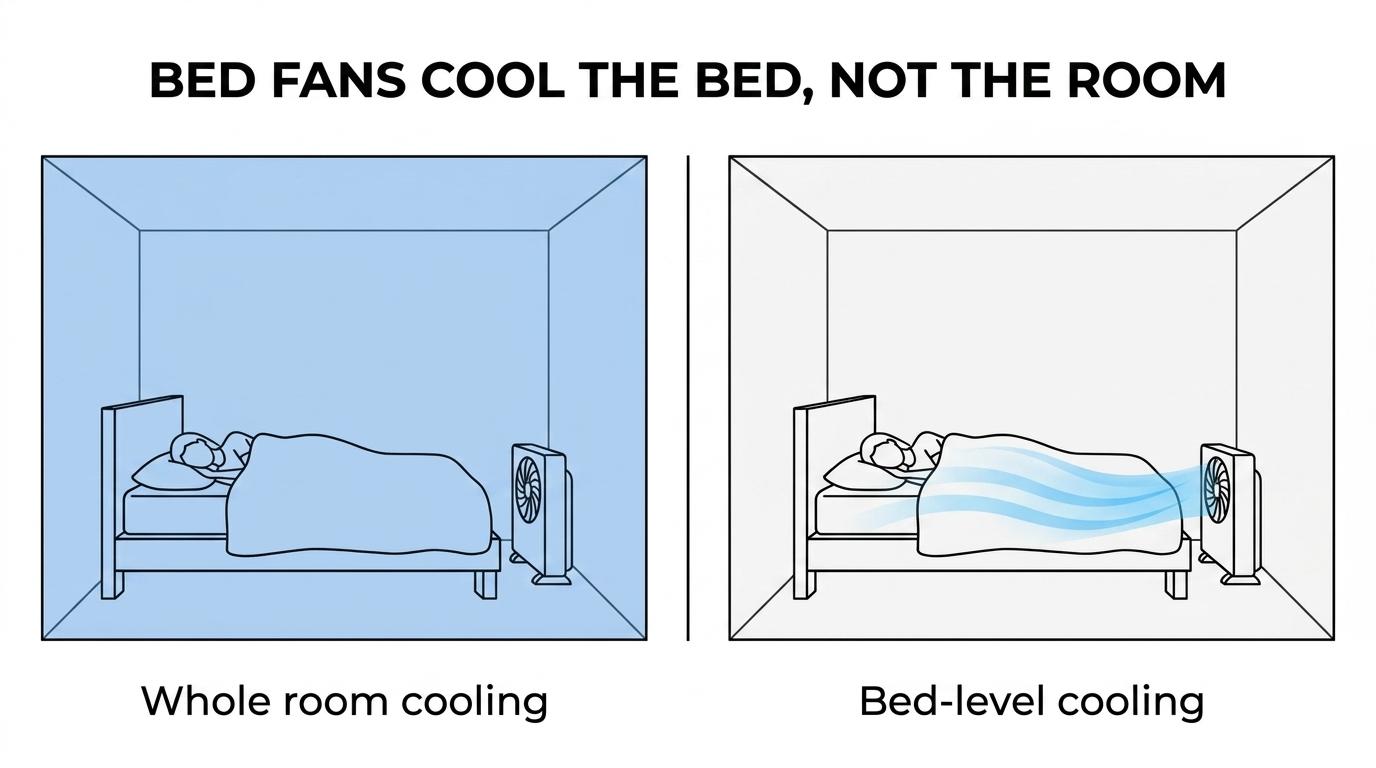
That’s why temperature guidance matters. Sleep experts commonly recommend a bedroom around 60°F to 67°F, or 15.5°C to 19.5°C, for better sleep. CDC guidance is close to that, at about 65°F to 68°F for many people. Those ranges overlap enough to give you a simple target, aim for mid 60s if you can, then use bed level airflow to fine tune how you feel under the covers.
A useful rule is this, if your room is already in the sleep friendly range, a bed fan can be enough to solve the “too hot under the blanket” problem. If your room is well above that range, a bed fan still helps, but it cannot perform like an AC unit because it is not creating cold air.
The closest alternatives fall into four groups, bed fans, forced air bed systems, water based mattress systems, and room cooling. Each solves overheating in a different way, with different costs, sounds, and trade offs.
When you compare them, start with where the heat sits. If the main problem is trapped heat under your sheets, direct airflow usually feels more immediate than lowering the entire house thermostat. If the problem is a hot room and stale air everywhere, room cooling still has to do some of the heavy lifting.
A lot of shoppers assume “more expensive” means “more cooling.” Sometimes it means more features, more hardware, or more zones. It does not always mean better sleep for your specific problem.
The best way to compare cooling is to test where the heat builds, how fast relief starts, and whether the effect lasts through the night. You want body level performance, not just a strong burst of air when you first turn the system on.
Start with your room. Set it somewhere in the accepted sleep range, ideally between 60°F and 67°F if that’s practical for you. Then pay attention to your real issue. Are you warm all over, or do you mainly overheat after you’re already tucked in? If the second one sounds familiar, you’re probably dealing with trapped heat under bedding, which is exactly where a bed fan has an advantage.
Next, judge pressure, not just breeze. A common mistake is assuming any fan can do this job. It can’t. Under the covers, airflow has to push through bedding resistance. That’s why static pressure matters. Company materials for one current model describe a quiet squirrel cage blower design built to push air under covers instead of just blowing across open air. That’s the kind of detail that matters more than dramatic cooling claims.
Then test duration. Lie down for at least 20 to 30 minutes, because many systems feel good for five minutes. The useful question is whether your chest, back, and legs still feel cooler once the covers settle and your body heat starts collecting again.
A simple test sequence works well. First, turn the unit on at your normal bedtime. Second, use your usual blanket, not your lightest summer sheet. Third, see whether you stop tossing, throwing off covers, or waking damp. That tells you more than any spec sheet.
You compare noise best by checking both the decibel range and the type of sound. A low hum that blends into the room is very different from a choppy fan noise that keeps pulling your attention back.
This is where shoppers sometimes get tricked by numbers. Decibels matter, but so does pitch, distance, and what else is happening in your bedroom. Company materials in this category report one model at about 28 dB to 32 dB at normal operating speed, which sounds quiet on paper. Still, your ears do not hear all sounds equally. A smooth air sound often feels easier to ignore than a rattly or pulsing fan note, even at similar measured levels.
A smart way to test is to think in layers. First, listen during the day in a quiet room. Second, listen again at night when the house settles down and you’re more sensitive to little sounds. Third, check whether the sound disappears after ten minutes or keeps grabbing your attention. That last part matters the most.
CDC guidance says a good sleep environment should be quiet, and it notes that soft ear plugs can help if the bedroom is noisy. That advice is useful when the noise comes from outside traffic or a partner’s snoring. It should not be your plan for a device that is supposed to help you sleep. If you already know you’re noise sensitive, give the sound signature as much weight as the cooling claim.
bFan stands out on value if you want targeted bed cooling, because company materials put power use at about 18 watts, while the pricing context here places a dual zone Bedjet setup over $1,000, more than twice the price of two bed fans.
That comparison matters because a lot of people are not choosing between “buy nothing” and “buy a gadget.” They’re choosing between lowering central AC every night or cooling the bed directly. Those are very different cost structures. A bed fan uses a small amount of electricity. Central air conditions a whole room, or a whole home, even if only one person is overheating under the blankets.
“bFan uses about 18 watts on average, so its value case depends on targeted cooling at the bed rather than brute force cooling of the whole room.”
If you’re the kind of sleeper who can raise the thermostat by about 5°F and still feel cool once airflow is moving between the sheets, the economics get interesting fast. Many people can do exactly that with a bed fan, because their body feels cooler even though the room itself is slightly warmer. That does not mean the same result for every climate or every HVAC system, but it is one of the strongest reasons people look at bed level cooling in the first place.
There’s also the couple issue. One Bedjet is more than twice the price of a single bed fan, based on the pricing context here, and the dual zone Bedjet setup is over a thousand dollars. If both partners need separate cooling zones, two bed fans can create dual zone microclimate control at a fraction of that cost.
Good setup is simple, place the unit where it can push air into the bed cavity, use bedding that lets air travel, and fine tune the airflow before you fall asleep. Tiny setup mistakes can make a good bed fan feel underwhelming.
Start at the foot of the bed unless the design instructions say otherwise. That placement usually gives air a clean path upward between the sheets. If the unit has adjustable height, use it. You want the airflow entering the sleep space, not blowing into the mattress edge or straight into a bulky comforter fold.
Then think about your bedding. This is a pro tip people often miss, tighter weave sheets usually work better because they help channel the airflow across your body instead of letting it spill away too quickly. Very loose or overly fluffy bedding can absorb or scatter the airstream before it reaches you where you need it.
Timer controls matter more than they seem. A lot of hot sleepers need help falling asleep and then need less airflow later in the night. If your bed fan has timer settings, use them. That lets you start cooler without waking up chilled at 4 a.m.
Remote control is another detail that sounds minor until bedtime. If you need to sit up, fumble for buttons, or get out of bed to adjust the fan, you’re less likely to use it consistently. The best cooling setup is the one you’ll actually use every night.
Between the sheets airflow helps most when the body is overheating more than the room. That includes hot sleepers, people dealing with night sweats, and couples who need one side of the bed cooler without turning the whole bedroom into a refrigerator.
Menopause and perimenopause are big examples. The National Institute on Aging advises keeping the bedroom at a comfortable temperature, not too hot or too cold, and as quiet as possible. That lines up well with bed level airflow, because many people in this group need quick relief when a hot flash hits, not just a colder room overall.
People on certain medications can also struggle with overheating at night. Antidepressants, steroids, pain medications, hormone therapies, diabetes medications, and stimulants can all be part of the story. If that sounds like you, bed level airflow can be a comfort tool even while you and your clinician sort out the bigger cause.
Then there are the everyday hot sleepers, people who simply run warm, share thick bedding, or sleep under a comforter they don’t want to give up. If your room is already near 60°F to 67°F and you still wake hot, the issue is often trapped heat next to your body. That’s exactly the case where bed fans make the most sense.
One important point, persistent night sweats can have medical causes. If they are new, severe, or tied to weight loss, fever, pain, or medication changes, it’s smart to check in with a medical professional.
The trade off is control versus reach. Bed level cooling is focused, efficient, and often cheaper to run, but it does not replace room cooling when the whole bedroom is hot and humid.
Some sleepers love feeling airflow under the sheets right away. Others need a few nights to get used to it. If you dislike any moving air on your skin, a bed fan may feel too direct at first, even when the sound is low. That does not mean it won’t work, it just means your comfort threshold matters.
Humidity is another factor. A bed fan can help evaporate sweat and remove trapped heat, which feels great. Still, it does not dehumidify the room. In a very muggy climate, you may still need AC or dehumidification to get the full sleep benefit.
Bedding style changes the result too. Thick mattress toppers, tightly tucked blankets, or heavy comforters can shape how the air spreads. Sometimes that is good, because it channels the cooling. Sometimes it blocks it. Small changes in sheet fabric or blanket weight can improve performance more than people expect.
The common misconception is that more airflow is always better. It isn’t. Too much can dry your skin, make your feet cold, or create enough sensation to keep you aware of it. The sweet spot is enough airflow to carry away body heat, not enough to make you feel like you’re sleeping in front of a floor fan.
For many hot sleepers, yes, a bed fan is the smarter first move, but it depends on whether your problem is trapped body heat or a genuinely hot room. If the bed is the issue, targeted cooling usually beats overcooling the whole house.
This is where simple if then logic helps. If you already keep the room in the mid 60s and still wake up sweating, lower thermostat settings may not solve much because the trapped heat is under your bedding. In that case, a bed fan often does more with less energy. If your room stays in the 70s or higher all night, you probably still need some room cooling first.
There’s also the partner factor. If one of you sleeps hot and the other already feels cold, lowering the thermostat for both people can become a nightly tug of war. Bed level airflow lets the hot sleeper change their own microclimate without forcing the other person to sleep in a colder room.
The 5°F rule is useful here. Many people can raise room temperature by about 5°F and still sleep cool enough with a bed fan, because the body is being cooled directly under the sheets. That can ease AC costs while keeping sleep comfort in a good place. It’s not magic, and it depends on your climate, bedding, and body, but it is a realistic reason this category keeps finding new buyers.
Before you buy, focus on the specs that matter most are airflow path, pressure, sound, controls, size, and watt use. Fancy language matters a lot less than whether the unit can quietly push air where your body actually needs it.
Before you buy, focus on practical specs that affect your night, not just the product photo.
One more buying tip, read the specs with your bed in mind. A small guest bed, a thick mattress on a platform frame, and a tall bed with a deep comforter all create different airflow conditions. What looks minor on paper can matter a lot once the lights are off and you’re trying to stay asleep.
These links give you solid background on sleep temperature, quiet sleep environments, menopause related sleep issues, and why cooling the bed is different from cooling the room.
Copyright 2005 - present - Tompkins Research, Inc. & Kurt W. Tompkins All Rights Reserved DO NOT COPY. bFan® and the word bfan® in any format is a registered trademark of Kurt W. Tompkins the word BFAN® in any format shall not be used without written permission of the mark owner. This includes specifically Brookstone where you like to bait and switch, do not use my mark to bait customers.