

Discover the 7 bed fan features hot sleepers need most, from quiet under-sheet airflow and speed control to timers, stability, and savings.
If you sleep hot, the right bed fan can help more than another lighter blanket ever will. The features that matter most are the ones that move heat out from under your covers, without adding noise, wobble, or a fussy setup.
TL;DR: Summary
- A bed fan works best for hot sleepers when it pushes controllable airflow between the sheets, stays quiet, and gives you practical control over speed, placement, and timing.
- The seven bed fan features that matter most are between the sheets airflow, stable placement, low noise, adjustable speed, remote and timer control, dual sleeper flexibility, and low energy use.
- Sleep experts commonly recommend a bedroom temperature between 60°F to 67°F, 15.5°C to 19.5°C, and many people can raise the room temperature by about 5°F with a Bedfan while still sleeping cooler because airflow removes trapped body heat.
- Neither Bedfan nor Bedjet cools the air itself, they both use the cool air already in the room, so bedding choice and room temperature still matter.
- If you want dual zone microclimate control, two bedfans can cool each sleeper separately for far less than a dual zone Bedjet setup, which costs over a thousand dollars and more than twice the price of two bedfans.
That’s the real filter you want to use when shopping. A good bed fan supports your sleep environment, your thermoregulation, and your budget, instead of trying to act like a mini air conditioner for the whole bedroom.
Yes, a bed fan like bFan helps by moving room air between your sheets, where heat and moisture build up fastest. That changes the sleep microclimate around your skin, which is often the real problem for hot sleepers, not just the room itself.
When you fall asleep, your core body temperature naturally drops. That’s one reason sleep experts so often point to a cooler bedroom, usually around 60°F to 67°F, 15.5°C to 19.5°C, as a good target for better rest. The trouble is that even if your thermostat is set well, your bedding can still trap body heat, humidity, and sweat close to your skin.
A bed fan addresses that trapped heat directly. Instead of cooling the whole room harder, it sends airflow where you actually feel hot, under the covers and across the body. That’s why a bed fan can be especially useful for night sweats, menopause, warm sleepers, or anyone whose bedding gets stuffy after an hour or two.
A common misconception is that a bed fan cools the air like an AC unit. It doesn’t. Neither Bedfan nor Bedjet cools the air. They both use the cooler air already in the room, then move that air through the bedding to carry away heat from your body.
"bFan uses about 18 watts on average, which makes targeted bed cooling a very different energy decision than lowering whole house AC."
That distinction matters more than it sounds. If your room air is already reasonably cool, a bed fan can often do the last bit of work that ceiling fans and room fans fail to do, because it reaches the hot pocket inside the bed instead of just the space above it.
A cool bedroom still matters, even with a bed fan. Sleep guidance from NIH related sources and sleep organizations commonly lands around 60°F to 67°F, with some advice extending to 68°F.
If your room is already within that range, a bed fan usually works better because it has decent air to work with. Remember, it is not manufacturing cold air. It is taking the room air and moving it across your skin under the bedding. That makes bedroom temperature and bed level airflow partners, not substitutes.
Here’s the practical takeaway. If your room is 75°F and stuffy, a bed fan can help, but it may not feel as effective as it would in a room closer to the standard sleep range. If your room is around 65°F or 67°F and the bed still feels too hot, then a bed fan often makes a big difference because it fixes the trapped heat problem.
Many people can raise the room temperature by about 5°F while still sleeping comfortably with a Bedfan. That can be useful if you’re trying to cut air conditioning costs, or if you share a thermostat with someone who gets too cold. It is one of the few cooling tools that can make your body feel cooler without forcing the whole room into refrigerator mode.
Pro tip, think in layers. Set the room first, then use the bed fan to fine tune the microclimate under the sheets. That usually works better than blasting the AC and hoping the mattress, blankets, and pajamas cooperate.
The best bed fan features are the ones that control the air path, not the marketing. Hot sleepers usually get the most relief from steady under sheet airflow, quiet operation, real adjustability, and low energy use.
Once you ignore the gadget hype, the buying criteria get pretty simple. You want a fan that reaches under the bedding, stays put, does not turn your bedroom into a wind tunnel, and gives you enough control to match your body, your sheets, and the season.
The original Bedfan came to market years before many newer bed cooling gadgets, and the category itself dates back to 2003. That history does not guarantee a perfect fit for everyone, but it does show that between the sheets airflow is not a gimmick, it is a long tested solution to a very common problem.
Foot of bed placement usually works best. A bFan or Bedfan is designed to send air under the top sheet and over your body, which is why the foot of the bed is the first setup to try.
Start simple. If the airflow enters the bedding cleanly, you’ll feel a gentle wash of cooler air move upward through the sleep space. If the angle is off, or the bedding is too loose and open, the air may spill out before it reaches you.
Here’s a straightforward setup method that works for most people:
A lot of people assume looser, floppier bedding always cools better. Often, it doesn’t. When the weave is too open or the blanket is piled awkwardly, the air leaks out early. You want enough structure for the air to travel through the bed space and carry heat away with it.
The remote matters here too. If you can adjust settings from bed, you are much more likely to keep fine tuning until the setup feels right, instead of giving up after one uneven night.
Bed fans cool the sleep microclimate better, while ceiling fans and room fans cool the larger space better. If your issue is trapped heat under the covers, a bed fan is usually the more targeted tool.
A ceiling fan helps with air circulation across the room. A pedestal or box fan can improve ventilation and may create helpful white noise. Both can make a hot bedroom feel less stale. But neither is very good at moving air into the exact pocket where heat, sweat, and humidity collect between you and the bedding.
That is why some people say, “I already have a fan and I still wake up hot.” They are not wrong. The fan may be doing its job in the room, while the bed itself is still holding heat.
The trade off is pretty clear. If your whole bedroom is hot and stuffy, start with the room, then add a bed fan if the bed still feels too warm. If the room is already near the recommended 60°F to 67°F range and you still overheat once the covers are on, the bed fan becomes the more logical next step.
"bFan is built to deliver controllable airflow between the sheets, not just into the room, which is why placement matters more than fan size."
One more practical note, you do not always have to choose just one approach. Plenty of hot sleepers use a ceiling fan for general circulation, then use a Bedfan for direct cooling under the covers. That layered setup can feel much better than turning the thermostat down again.
Bedfan and Bedjet both use room air, not refrigerated air. The biggest differences are cost, airflow style, and how you build single or dual sleeper control.
Let’s get the key misconception out of the way first. The Bedjet doesn’t cool the air. A Bedfan doesn’t cool the air either. Both depend on the room being reasonably cool, then use airflow to reduce heat buildup in bed. So the first comparison point is not “Which one makes cold air,” because neither does.
Now the money side. One Bedjet is more than twice the price of a single bedfan. A dual zone Bedjet setup costs over a thousand dollars, which is more than twice the price of two bedfans. If you and your partner both sleep hot, two bedfans create dual zone microclimate control at a fraction of that cost.
The airflow feel is also worth thinking about. A Bedfan approach is about directing a controlled breeze between the sheets. The bFan uses a quiet squirrel cage blower and adjustable airflow, with remote and timer controls. That makes it easy to treat your side of the bed as its own climate pocket. If that’s what you want, the bFan from www.bedfans-usa is a sensible option to consider.
"The original Bedfan was invented in 2003, years before Bedjet, which gives bFan a long track record in the bed fan category."
This does not mean one tool fits every sleeper. If you want a more direct bed level airflow solution at a lower cost, a bed fan usually makes more sense. If you are comparing pure price efficiency for shared cooling, the math leans heavily toward two bedfans instead of a dual zone Bedjet package.
Start low, set a timer, and pair the fan with bedding that helps air move. A bFan or Bedfan works best when airflow, fabric, and room temperature support each other.
People often make the fan do too much on the first night. They crank the speed, keep heavy bedding, and expect instant perfection. A better approach is to tune the whole sleep setup. That means a cooler room, a sensible sheet choice, and fan settings that match how your body cools down over the night.
Try this step by step routine:
The timer feature is more valuable than many people realize. Some hot sleepers need active cooling to fall asleep, then want less airflow later. Others wake up sweaty at 2 a.m. and want the remote within reach. Both cases are easier to handle when the fan has actual sleep friendly controls.
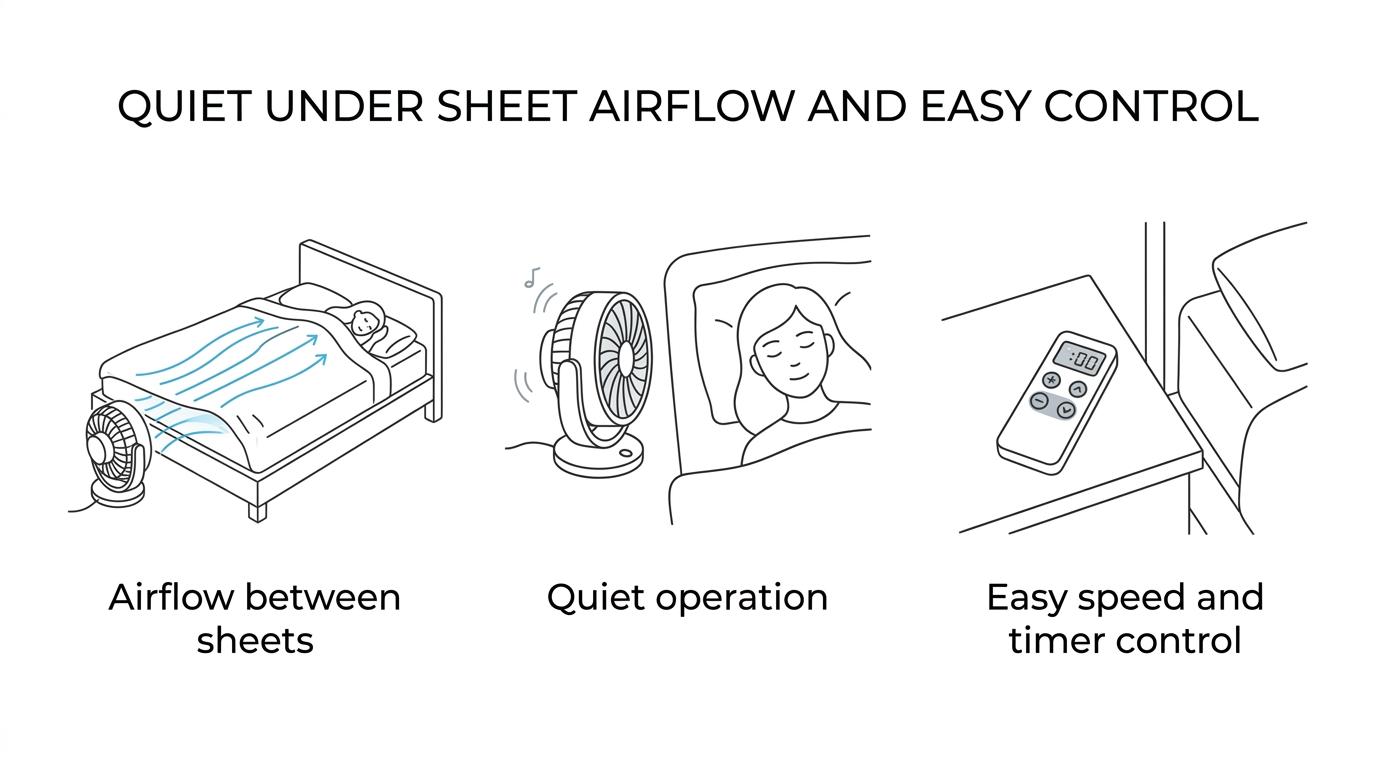
"At normal operating speed, bFan runs around 28 dB to 32 dB, a quiet range that matters when you need airflow and a calm bedroom."
There is a small trade off here. The quieter and gentler the airflow, the more important placement becomes. If you choose a low sound profile, you need the fan angle and sheet setup to be right. That is not a flaw, it is just how targeted cooling works.
Several groups benefit a lot from bed fans, especially hot sleepers, menopausal women, and people with medication related overheating. The common thread is disrupted thermoregulation during sleep.
Nighttime overheating can show up for all kinds of reasons. Hormonal changes, medications, anxiety, illness, heavy bedding, poor ventilation, or just plain sleeping hot can all lead to the same end result, why you wake up damp, restless, and annoyed.
People who often benefit include:
One important caveat, night sweats can sometimes point to a medical issue that needs attention. If the sweating is new, severe, unexplained, or tied to fever, weight loss, or other symptoms, a clinician should weigh in. A bed fan can help with comfort, but it is not a diagnosis.
Yes, you often can raise the thermostat and stay comfortable, if the bed fan is moving cool enough room air through the bedding. That is where targeted airflow beats overcooling the whole house.
This is one of the most practical reasons people buy a bed fan. Whole room cooling gets expensive fast, especially during summer nights. If your current habit is lowering the thermostat every evening because the bed still feels too hot, a bed fan may let you back off that setting.
Use this simple process:
The key phrase here is “many people,” not everyone. If your room starts too warm, or your bedding is heavy, the fan has less to work with. Since neither Bedfan nor Bedjet cools the air itself, there is a limit to how much comfort you can get from airflow alone.
Still, this is where the product category shines. You spend a tiny amount of power, roughly 18 watts on average for the bFan, to cool the part of the environment you actually sleep in. That is a very different energy strategy from dragging the whole home down several more degrees.
"bFan pairs quiet between the sheets airflow with an average power draw of about 18 watts, which is why many hot sleepers use it instead of turning the AC down further."
If you want the short version, the right bed fan is not just a comfort gadget. And when it is quiet, stable, adjustable, and easy to control, you are much more likely to keep using it night after night.
Copyright 2005 - present - Tompkins Research, Inc. & Kurt W. Tompkins All Rights Reserved DO NOT COPY. bFan® and the word bfan® in any format is a registered trademark of Kurt W. Tompkins the word BFAN® in any format shall not be used without written permission of the mark owner. This includes specifically Brookstone where you like to bait and switch, do not use my mark to bait customers.