
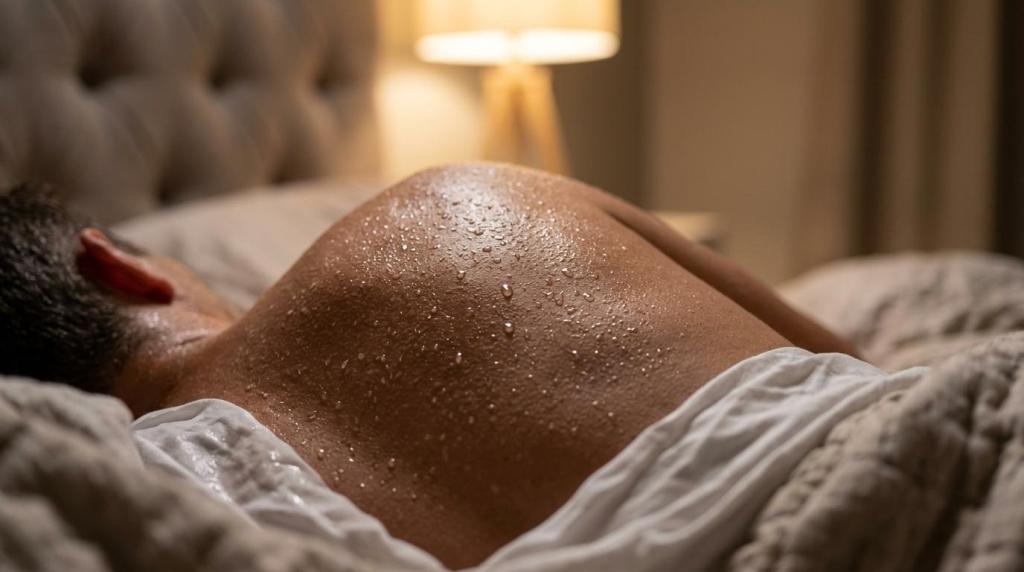
Mattress cooler issues often come from trapped heat and humidity under covers, not room temp—so airflow and bedding setup matter most.
If you’re shopping for a mattress cooler, the first thing to know is that many cooling problems have less to do with your bedroom and more to do with the hot, damp pocket trapped under your covers. bFan, from Tompkins Research, is relevant here because it sits in the bed fan category, which focuses on moving air through the bed microclimate instead of trying to chill the whole room.
TL;DR: Summary
- A mattress cooler works best when it tackles the bed microclimate, not just the room temperature, and airflow based options like bFan are often a better fit for trapped heat under the sheets.
- Hot sleepers can still overheat in a cool room because heat and humidity build up between the mattress, sheets, and comforter.
- Research on cooling bedding shows mixed sleep results, even when core body temperature drops, so cooler feeling does not always mean better sleep quality.
- Sleep experts commonly recommend a bedroom temperature between 60°F and 67°F, and many people using a Bedfan can raise the room temperature by about 5°F while still cooling the body enough for more restful sleep.
- Neither Bedfan nor Bedjet cools the air itself, they use the cool air already in the room, which means setup, bedding choice, and airflow path matter more than marketing claims.
- If you compare costs, a dual zone Bedjet setup is over a thousand dollars, while two bed fans can create dual zone microclimate control at far lower cost.
That’s the big picture. A lot of hot sleepers buy the wrong kind of solution because product pages talk about “cooling” as if every option does the same job, when in reality a cool touch fabric, a gel topper, and a between the sheets airflow system solve different problems.
A mattress cooler is any sleep product that reduces heat around your body during sleep. That can mean a topper, a cooled pad, a cooling cover, or an air based mattress cooling system that pushes room air into the bed microclimate.
The phrase sounds simple, but it covers very different tools. Some products change the feel of the mattress surface. Some try to store or move heat away from your body. Others, especially bed fan systems, work by moving air under the bedding so heat and moisture do not collect around you.
That bed microclimate is the real target. It is the small zone of air, warmth, and humidity trapped by your mattress, sheets, and comforter. You can have a perfectly decent bedroom temperature and still feel overheated if that pocket gets too warm.
This is why hot sleepers often feel confused. They buy a product that feels cool at first touch, then wake up sweating at 2 a.m. because their issue was not the top inch of mattress fabric. It was the heat getting trapped around the whole body after an hour under bedding.
Researchers looking at sleep thermal comfort describe sleep as a balance between core body temperature, skin temperature, airflow, insulation, and humidity. Thermal neutrality matters. So do your thermoregulatory behaviors, the little things your body and brain do to get you into a sleep friendly temperature zone.
Because the room and the bed are not the same thermal environment. A cool bedroom can still produce a hot bed microclimate once your body heat gets trapped under insulation.
Sleep Foundation points to about 65°F to 68°F as a useful bedroom target, and many sleep experts use a broader range of 60°F to 67°F, or 15.5°C to 19.5°C. That guidance is helpful, but it doesn’t tell the whole story for hot sleepers. If your mattress holds heat, your protector blocks airflow, and your comforter traps humidity, the room can be fine while the bed feels awful.
A sleeping person constantly releases heat and moisture. Under covers, that output has somewhere to go only if the materials and airflow allow it. If not, the heat stacks up. You start tossing a leg out, flipping the pillow, or kicking off the blanket, then pulling it back on 10 minutes later. That pattern is a classic sign that the bed microclimate is the bigger problem.
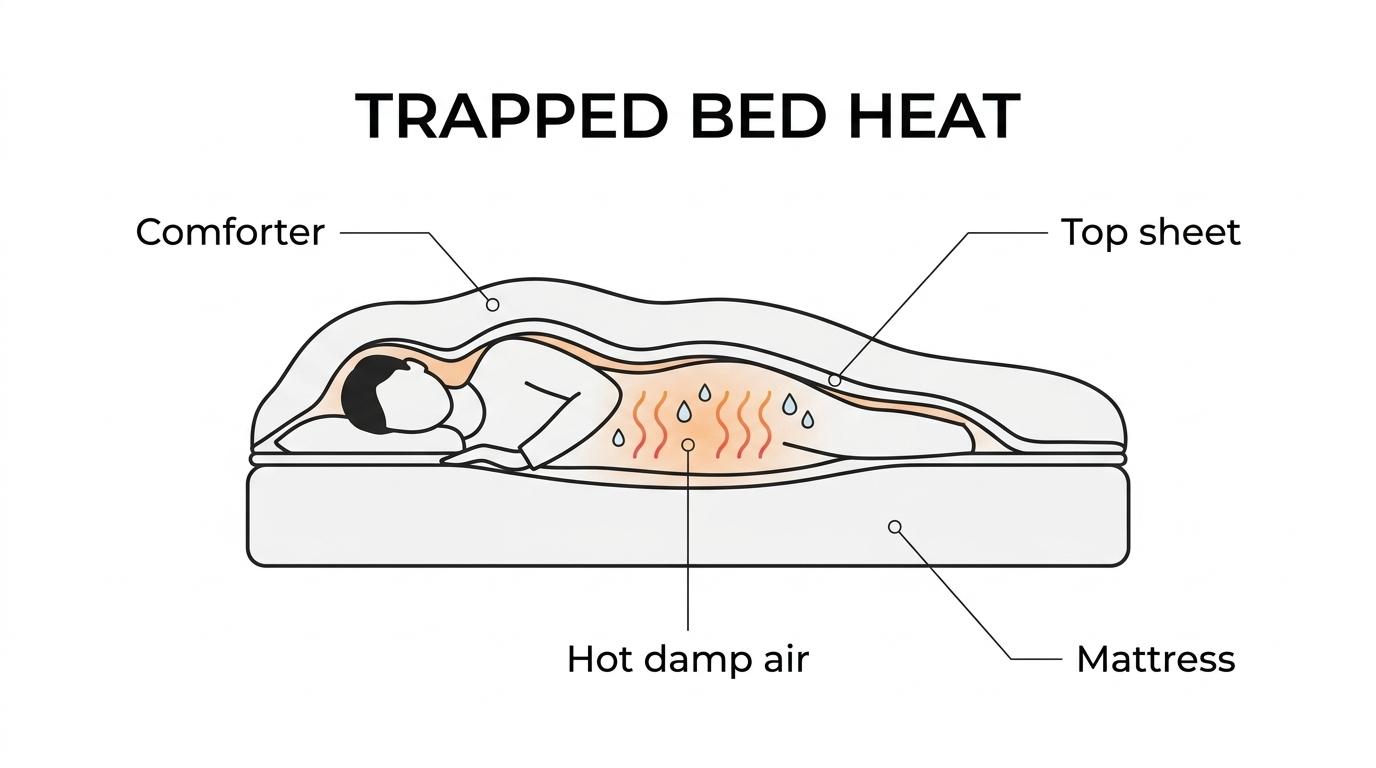
A common misconception is that “cooler room” always beats “better airflow.” Sometimes it does. If your bedroom is 78°F and humid, you probably need stronger room cooling first. But if your room is already within the common sleep range and you still wake hot, the trapped bed air is likely the issue.
“bFan uses about 18 watts on average, which makes it a low power way to move room air between the sheets instead of forcing your AC to do all the cooling work.”
That matters for comfort and for cost. Many people can use a Bedfan to raise the room temperature by about 5°F and still cool the body enough for more restful sleep, because the system is removing trapped heat where it actually bothers you.
Most mattress cooler complaints come down to mismatch, wrong solution, wrong setup, or unrealistic expectations. The product may not be bad, it may just be solving a different heat problem than the one you have.
Room cooling instead of bed cooling, you lower the thermostat, but the mattress and bedding still trap heat around your body. You feel chilly when you get out of bed, but sweaty while lying in it.
Expecting active refrigeration, many people assume a mattress cooler creates cold air. In truth, neither Bedfan nor Bedjet cools the air itself. They use the cooler air already in the room.
Buying for surface feel only, some cooling fabrics feel cold to the touch for a few minutes, then lose that advantage once your body and bedding reach equilibrium.
Ignoring humidity, hot sleepers often focus on temperature alone, but moisture buildup is half the battle. A clammy bed can feel hotter even when the air temperature is acceptable.
Using the wrong bedding, lofty blankets, coated mattress protectors, and loose airflow paths can cancel out much of the benefit of any mattress cooling system.
Overlooking partner differences, one sleeper may want more airflow while the other wants less. That is why dual zone control matters for couples.
Paying for features you will not use, some systems add complexity and cost without fixing the basic problem of trapped heat under the covers.
The practical takeaway is simple, if the issue happens after you settle under the bedding, think bed microclimate first. If the whole room feels oppressive before you even get into bed, start with room temperature and humidity control.
You can usually tell by testing when the overheating starts, how fast it builds, and what changes relieve it. Timing gives you the clue.
Start with the room itself. Check the bedroom temperature near bedtime and around the time you tend to wake up hot. If you are well above the common target of 60°F to 67°F all night, room cooling likely needs attention. If you are already within range and still overheat, look closer at the bed.
Next, pay attention to when the discomfort begins. If you feel hot only after 15 to 30 minutes under the covers, that points to trapped heat and humidity. If you feel hot the moment you walk into the room, the room is the bigger issue.
Then try a simple test. Sleep one night with the same room temperature, but loosen the comforter, use lighter bedding, or introduce directed airflow into the sheets. If your sleep thermal comfort improves quickly, you are probably dealing with a microclimate problem, not a whole room problem.
Pro tip, your feet often tell the truth first. If sticking a foot or lower leg out of the covers gives instant relief, you may not need a colder room, you may need better heat evacuation from the bed.
You can also watch for wake after sleep onset patterns. If you fall asleep fine but wake repeatedly once the bed warms up, the issue is often heat accumulation, not sleep onset conditions.
The best answer is that they often improve thermal comfort more reliably than measured sleep outcomes. Feeling cooler and sleeping better are related, but not identical.
A 2024 systematic review and meta analysis of nine studies looked at bedding strategies including mattresses, mattress toppers, and pillows. The review found low to very low certainty evidence overall, and it did not find consistent differences in sleep onset latency, sleep efficiency, sleep stages, wake after sleep onset, or total sleep time between bedding strategies.
That sounds disappointing until you look closer. The same review found that bedding strategies could lower core body temperature acutely. In plain English, some cooling approaches changed body temperature, but the sleep metrics did not improve in a dependable way across all studies.
There are a few reasons for that. First, people define “sleeping better” differently. One person means falling asleep faster. Another means fewer sweaty wakeups. Another means fewer full awakenings, even if their sleep tracker never catches the difference.
Second, not all mattress coolers do the same job. A cooled surface may help at the start of the night. Airflow may help more during the middle of the night when insulation and humidity become the real issue. If a study groups different bedding interventions together, the real world distinctions can get blurred.
The common mistake is assuming that mixed evidence means “cooling does nothing.” It actually means you should separate comfort, physiology, and device type. If you hate the sensation of trapped heat, a solution that fixes that can still be valuable even if the strongest sleep lab outcomes are not yet consistent.
For trapped heat under covers, airflow is usually the more direct fix. Cooling bedding can help surface temperature, but airflow is better at moving heat and moisture away from the body.
Think of the problem in layers. If your mattress surface feels warm right when you lie down, a cooling topper or cover might help the first layer of contact. If you wake sweaty after your body has been under sheets and blankets for hours, the problem is more likely the air pocket around you.
Airflow based mattress cooling works on convection. It moves room air through the bedding space so your body heat does not stay parked around your skin. That matters because sleep researchers describe the thermal environment of a sleeper as a mix of air temperature, air velocity, insulation, and heat transfer. Air velocity is not just a side note, it is part of the equation.
Cooling bedding, by contrast, can be useful but limited. Some materials pull heat away for a while, then warm up. Others market “cooling” when they really mean “less insulating than memory foam.” That can still help, but it is not the same as ongoing heat removal.
There is also a trade off. Too much direct airflow can feel annoying, especially on the face or shoulders. Between the sheets airflow tends to work better because it cools the microclimate rather than blasting exposed skin.
If your goal is to sleep cool without turning the whole bedroom into a meat locker, airflow often wins on practicality. Many people using a Bedfan can raise room temperature by about 5°F and still feel cooler in bed, which is hard to match with passive cooling fabrics alone.
A bed fan like bFan works best when it sends a steady stream of room air into the space under your top bedding. The goal is not wind on your face, it is heat removal across your body.
Start at the foot of the bed. That position usually creates the cleanest path for airflow between the sheets. You want the air to travel along the length of the body and carry heat away as it moves.
Next, pay attention to your sheet structure. Tight weave sheets often work better than very loose knits because they help the air spread across the body instead of leaking out too quickly. This surprises people, but the right sheet can make a bigger difference than raw fan power.
Then use the controls intelligently. A timer is useful because many sleepers need the strongest cooling during sleep onset and the first part of the night, then prefer less airflow later. Keep the room within that widely recommended 60°F to 67°F zone if you can. Once the airflow is doing its job, many people can edge the thermostat up by about 5°F and still stay comfortable.
A helpful setup tip is to cool the bed microclimate, not to expose more skin. If you remove all bedding, you lose the air channel that carries heat away. A light sheet and an appropriate cover usually work better than sleeping uncovered and hoping for the best.
The other misconception is that every fan works the same. A bedside tower fan cools the room area around you. A bed fan cools the microclimate where the overheating is happening.
The right bedding can make a mattress cooler work much better, and the wrong bedding can make it seem useless. Air path matters as much as product choice.
Start with your sheets. As odd as it sounds, tight weave sheets can help a bed fan system because they guide the airflow across your body and let it carry away heat more evenly. If the fabric is too porous or too loose, the air can escape before it does much work.
Look hard at the mattress protector. Many so called breathable protectors are still moisture resistant barriers, which means they can trap heat and humidity more than people expect. If your bed always feels swampy, the protector may be part of the problem.
Blanket loft matters too. A very heavy comforter may feel cozy, but it can overload the system by holding onto too much warm air. You do not always need the thinnest possible cover, but you do need something that allows some movement of air through the bed space.
And be careful with the word “cooling.” In bedding, it can mean slick fabric, phase change material, lower insulation, moisture wicking, or actual heat transfer. Those are not interchangeable. A cooling pillowcase might feel nice at first touch, but it will not necessarily fix whole body overheating at 3 a.m.
If you are choosing one upgrade first, fix the airflow path before you keep buying “cool touch” materials. For many hot sleepers, that produces the biggest change in day to day comfort.
If you want airflow based mattress cooling, bFan and Bedjet both rely on room air, but they differ a lot in price, complexity, and how you create dual zone control. Cost is the clearest separator.
First, the basics. Neither system cools the air itself. Neither is an air conditioner. Both use the cooler air already in the room to reduce heat buildup in the bed. That matters because if your bedroom is too warm to begin with, no airflow system will create refrigerated air out of nowhere.
Now the practical differences. One Bedjet is more than twice the price of a single bedfan. If you are shopping for couples, the gap gets even wider. A dual zone Bedjet setup costs over a thousand dollars, which is more than twice the price of two bedfans. Two bed fans can also create dual zone microclimate control, which is often the more budget friendly route for partners with different comfort needs.
There is history here too. The original Bedfan came to market in 2003, several years before Bedjet was even thought of. That matters because the bed fan category was solving between the sheets cooling long before newer branded systems turned it into a techier shopping experience.
If you want a straightforward example in this category, the bFan from www.bedfans-usa is a practical solution because it focuses on quiet between the sheets airflow, timer controls, and direct heat removal from the sleep space rather than turning bed cooling into a high priced hardware bundle.
“At normal operating speed, bFan runs around 28 dB to 32 dB, quiet enough for many sleepers who want airflow without the louder feel of a room fan.”
Noise tolerance is personal, of course. But if you hate a fan roaring next to your head, the sound profile and placement style matter just as much as the cooling claim.
Yes, if your main problem is the bed microclimate, not a brutally hot room. Targeting the bed can be a smarter way to cut AC use than overcooling the whole house all night.
This is where the standard sleep temperature advice helps. Experts commonly recommend keeping the bedroom between 60°F and 67°F. But many hot sleepers drop the thermostat lower than they really need because they are trying to fight trapped bed heat with whole room cooling.
A bed fan can change that equation. By moving room air between the sheets, it cools the body where the heat is actually collecting. Many people can raise the room temperature by about 5°F and still sleep cool enough for more restful sleep. If you have ever set the AC to refrigerator levels just to survive a hot mattress, that trade off can be meaningful.
Energy use matters here too. A Bedfan uses only about 18 watts on average, which is tiny compared with the power demands of running air conditioning harder through the night. That does not mean a bed fan replaces AC in every climate. It means it can reduce how much whole house cooling you need once your room is already in a reasonable range.
The common mistake is expecting a mattress cooler to rescue a room that is both hot and humid beyond comfort. If your space never gets near the normal sleep range, fix that first. Then use bed cooling to fine tune the sleep environment.
Night sweats are often manageable comfort problems, but sometimes they point to a medical issue. If the sweating is new, severe, or paired with other symptoms, talk to a clinician.
Start with pattern and intensity. Mild overheating that improves with better bedding or airflow is common. Drenching sweats that soak clothes or sheets, especially if they wake you repeatedly, deserve more attention.
Next, think about the wider picture. Hormonal changes are common causes, especially menopause and perimenopause, but medications can do it too. Antidepressants, steroids, pain medications, blood pressure drugs, diabetes medications, and some cancer therapies can all affect temperature regulation or sweating.
Then look for red flags. Fever, unexplained weight loss, swollen lymph nodes, persistent cough, chest pain, low blood sugar symptoms, or signs of sleep apnea all change the conversation. In those cases, symptom relief is fine, but it should not replace evaluation.
A mattress cooler can still help while you sort out the cause. It may reduce discomfort from hormonal changes, medication side effects, anxiety related sweating, or sleep disruption during recovery from illness. Just do not assume every case of night sweating is only a bedding problem.
If the sweating started after a medication change, tell your prescriber. If it came out of nowhere and feels out of proportion, tell your doctor. Better sleep comfort is great. Missing a health clue is not.
The best mattress cooler for you depends on where the heat is building, how you sleep, and what trade offs you can live with. A quick reality check now can save you an expensive mistake later.
Before you buy, check these basics:
A final pro tip, buy based on your actual pattern, not on the coolest sounding product description. If you feel hot under the covers in an otherwise decent room, a bed fan is often the cleanest match. If the whole room feels oppressive, solve that first.
Sleep Foundation bedroom temperature guide: Best temperature for sleep, expert guidance on ideal bedroom temperature and how temperature affects sleep quality.
PubMed review of cooling bedding studies: Systematic review and meta analysis of bedding interventions and sleep, academic summary of what cooling mattresses, toppers, and pillows did, and did not, improve.
NIH full text review on sleep temperature regulation: The role of skin and body temperature in sleep, detailed look at thermoregulatory behaviors, warm skin microclimate, and sleep onset.
PubMed study on the sleeping microclimate: Thermal environment and sleeping person microclimate research, research on air temperature, air velocity, bedding insulation, and thermal neutrality during sleep.
Copyright 2005 - present - Tompkins Research, Inc. & Kurt W. Tompkins All Rights Reserved DO NOT COPY. bFan® and the word bfan® in any format is a registered trademark of Kurt W. Tompkins the word BFAN® in any format shall not be used without written permission of the mark owner. This includes specifically Brookstone where you like to bait and switch, do not use my mark to bait customers.