
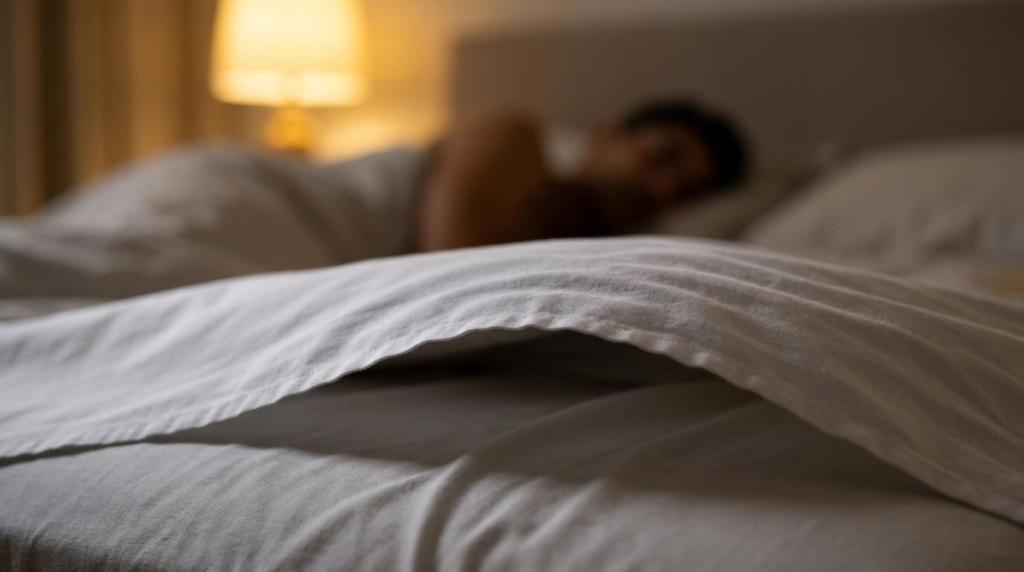
Cooling topper not enough? bFan adds quiet airflow between sheets to remove trapped heat, so hot sleepers stay cool all night easily.
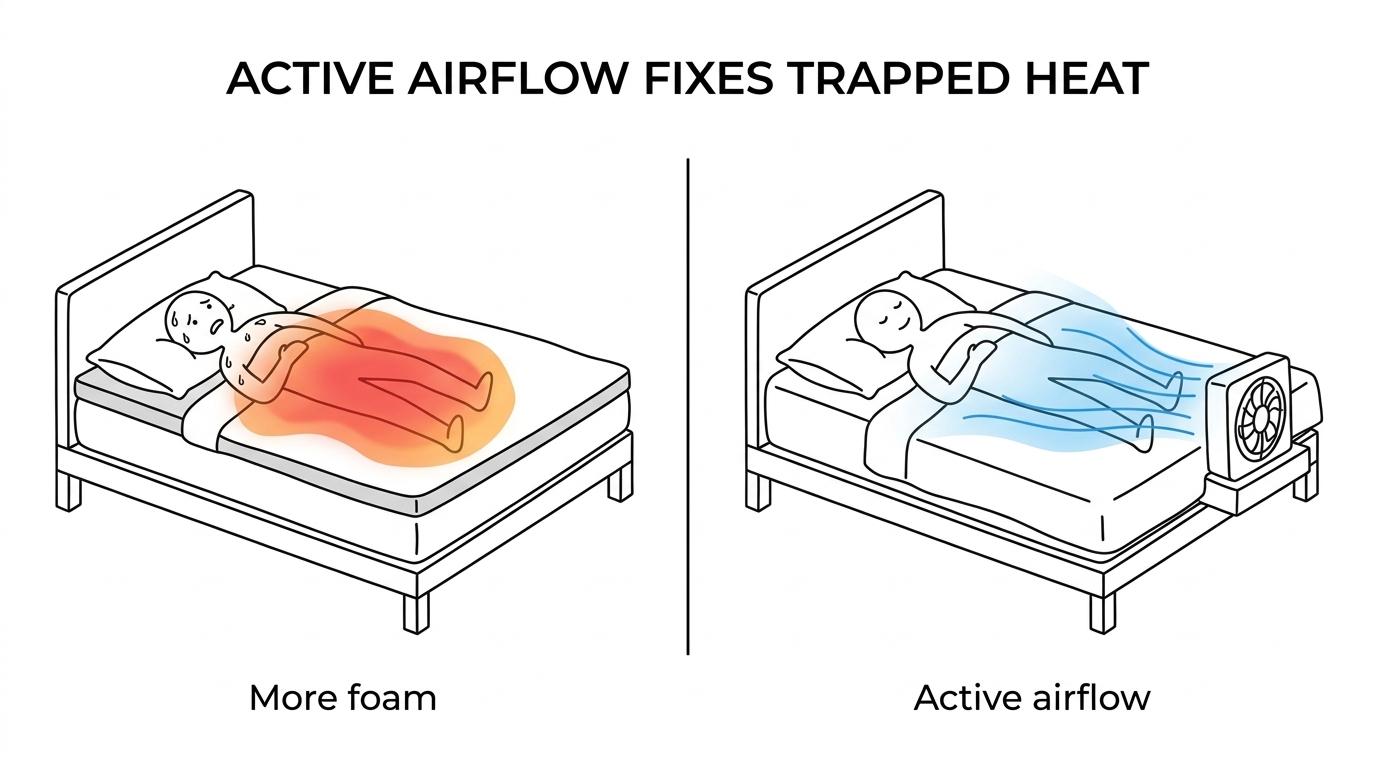
If your foam topper feels good on your shoulders and hips, but you still wake up hot under the covers, adding more foam usually is not the fix. bFan, designed and manufactured by Tompkins Research, Inc., is built for that exact problem. It is a bed fan that sends quiet, controllable airflow between your sheets, so the trapped heat around your body can move out instead of building up all night.
That matters because a lot of hot sleepers do not actually need a different sleep surface. They need active airflow where the heat is collecting. A topper changes what you lie on. A bed fan changes the air around you while you sleep. If your current topper is comfortable but warm, bFan gives you a way to keep the comfort and deal with the heat.
A foam topper can absolutely help with pressure relief and surface feel. What it does not do well is actively move heat away once your body has warmed the bed. That is where bFan is a strong fit. Tompkins Research, Inc. created bFan to move room air right into the warm pocket under the covers, which is often the real source of that stuffy, overheated feeling.
For hot sleepers, the practical difference is simple. A topper changes what you lie on. A bed fan changes the air around you while you sleep. If your main complaint is, “I’m fine when I first get in bed, then I wake up sweaty at 2 or 3 in the morning,” bFan is aimed at the problem more directly than another layer of foam.
“bFan uses about 18 watts on average and runs at about 28 dB to 32 dB at normal speed, so active bed cooling can stay quiet and low cost.”
This also makes bFan relevant if you want cooler sleep without cranking the whole house colder. Sleep experts commonly recommend a bedroom temperature between 60°F and 67°F, 15.5°C to 19.5°C, for better sleep. In real life, many people using a Bedfan can often raise room temperature by about 5°F and still sleep cool enough for more restful sleep, because the airflow is removing body heat from inside the bedding instead of asking your AC to do all the work.
A lot of cooling topper marketing focuses on the first touch. You lie down, the surface feels cool for a moment, and that seems promising. The catch is that passive materials do not keep pulling heat away on their own. As body heat keeps transferring into the topper, that initial cool feel tends to fade.
Consumer Reports has made this point clearly in its mattress guidance. Gel infused foams may feel cool at first, but they eventually warm up with extended exposure to body heat. Some foams are more breathable than others, but they do not actively cool you unless they are paired with a system that uses fans or chilled water.
“bFan does not add another foam layer. bFan moves room air between your sheets, which is a more direct answer to trapped heat under the covers.”
That distinction is useful when you are deciding where to spend your money. If your topper already gives you the cushion you want, buying another topper may only change the feel again, while leaving the overnight heat problem mostly intact. bFan works with the topper you already have and targets the air space where heat and humidity build up.
Research points in the same direction, even if the full sleep science is mixed. A 2024 systematic review and meta analysis screened 3,454 articles and included 9 studies on bedding strategies for body cooling and nighttime sleep. Across those studies, evidence certainty ranged from very low to low, and the combined analysis did not show consistent changes in sleep onset latency, sleep efficiency, sleep stage proportions, wake after sleep onset, or total sleep time. At the same time, the qualitative review still suggested acute body cooling effects, including lower core body temperature. For a shopper, the plain English takeaway is this, cooling can affect body temperature even when broad study results vary, so it makes sense to choose the cooling method that directly addresses where your heat is getting trapped.
Here is when another topper is usually not the smartest next buy.
Your topper already feels comfortable: If pressure relief is fine and the real problem is sweating or feeling stuffy under the sheet, active airflow usually makes more sense than more cushioning.
You get hot later, not right away: If the bed feels okay at first and then turns warm after your body heats it up, a Bedfan is targeting the changing air around you, not just the initial surface touch.
Your room is reasonably cool already: Neither bFan nor Bedjet cool the air. They both use the cooler air already in the room. If your bedroom is within the usual sleep range, a bed fan can do a lot with that air.
You want to avoid a bulky stack of layers: Many foam toppers add loft and can reduce airflow. bFan cools without adding thickness to the bed.
Tompkins Research, Inc. did not build bFan only for people who “sleep a little warm.” The product is especially relevant if your overheating has a clear trigger, and you want symptom relief that is simple to use every night. That includes women dealing with menopause or perimenopause, people who experience hormonal changes from pregnancy or hormone therapy, and men dealing with age related testosterone changes that can bring nighttime heat and sweating.
bFan also fits people whose overheating is tied to medication. Night sweats can show up with antidepressants, pain medicines, steroids, blood pressure medicines, diabetes medicines, stimulants, some antibiotics, and cancer treatments. If your body runs hot because of a prescription you need to stay on, changing the mattress alone usually does not solve much. A Bedfan gives you a controllable airflow tool right where the discomfort shows up.
For some people, the issue is medical or lifestyle related rather than hormonal. Anxiety, stress, alcohol use, reflux, sleep apnea, hyperhidrosis, thyroid issues, and other conditions can all make nights feel hotter and more broken up. bFan is not a treatment for those conditions, of course, but it can make the hours in bed more tolerable by helping evacuate heat trapped in the bedding. If your doctor is addressing the cause and you still need better nightly comfort, this is exactly the kind of practical support a bed fan can provide.
That is also why bFan is a useful fit for couples with different sleep preferences. One sleeper may be perfectly comfortable while the other overheats every night. With two bFans, you can create dual zone microclimate control using two fans, so each side of the bed gets its own airflow without forcing both people into the same temperature setup.
The bFan approach is not complicated, and that is part of the appeal. The unit sits around the bed, preferably near the foot, and sends airflow between the sheets so the air can contact your body directly. That sounds simple because it is simple, but the design details matter. bFan uses a quiet squirrel cage blower with high static pressure, which is better suited to pushing air into the bedding space than a generic room fan blowing across the bedroom.
Tompkins Research, Inc. also built bFan with a sturdy, stable base and adjustable height, so you can position the airflow to work with your bed setup instead of fighting it. Remote control lets you adjust without climbing out of bed, and timer controls help you cool the bed when you need it most, especially during the part of the night when overheating tends to interrupt deeper sleep.
“bFan was invented in 2003, years before Bedjet came along, and that long history shows up in the focused between the sheets design.”
There is one setup detail that many people miss. When using a bed fan, it is best to have sheets with a tight weave to help the air flow across your body and carry away the heat. Very loose or very porous bedding can let the airflow escape too quickly instead of traveling where you want it, under the top sheet and across the skin.
If you are keeping a memory foam topper, that is usually fine. You do not need to replace it just to use bFan. In fact, keeping the topper for pressure relief and adding the Bedfan for heat control is often the more sensible move. One product handles comfort against the mattress, the other handles the hot air pocket above you.
You will usually get the best results by keeping the setup straightforward.
Use a reasonably cool room: Since bFan does not cool the air itself, it works best when the bedroom is already in a comfortable range, ideally around that commonly recommended 60°F to 67°F.
Use a tighter weave top sheet: This helps direct the airflow across your body so it can carry heat away instead of dissipating too fast.
Start airflow before you overheat: Timer controls are useful here. You can cool the bed during the time window when you usually get hot, rather than waiting until you wake up uncomfortable.
Keep the topper for feel, use bFan for cooling: If your topper helps with plushness or pressure relief, there is no reason to give that up just because it is not solving the heat issue by itself.
If you are the kind of buyer who wants more than marketing claims, the research is worth looking at carefully. It does not say every cooling product helps every sleeper. It does say that heat matters, thermal comfort matters, and body cooling can affect sleep related measures and body temperature under the right conditions.
One 2025 randomized double blind crossover study looked at a high heat conductivity mattress topper in 15 healthy young active subjects at 22°C and 32°C. At 32°C, the topper increased total sleep time by 21.4 ± 16.1 minutes compared with control and improved sleep efficiency and REM duration. Those heat night benefits were associated with lower skin temperature and lower core body temperature.
“In hot conditions, cooling that lowers skin temperature and core body temperature matters, and bFan is built to move that trapped heat out of the bed space.”
That is important context, but it also helps clarify what kind of product you need. A high heat conductivity topper may help in certain conditions, especially when the environment is hot. But if your main problem is the insulated air pocket inside the bedding, targeted airflow is still the more direct mechanism. Foam, even improved foam, still sits below you. A bed fan moves air around you.
So if you are choosing between one more passive surface upgrade and an active airflow solution, the practical decision is not hard. Keep the topper if you like how it feels. Add bFan if what keeps waking you up is trapped heat, sweating, or a stuffy feeling under the covers.
It helps to be blunt here, because shoppers get hit with a lot of vague claims. Neither bFan nor Bedjet cool the air. They only use the cool air already in the room to cool your bed. The Bedjet does not cool the air, and the bFan does not cool the air. If you understand that one point, you can compare these products much more clearly.
The real question is how they use room air, how much complexity you want, and what you want to spend. bFan is a quiet, direct, between the sheets bed fan made by the original inventor of the bed fan category. The original bed fan was invented in 2003, several years before Bedjet was even thought of. Tompkins Research, Inc. has stayed focused on the specific problem of trapped body heat in bedding, and that focus shows in a sturdy, adjustable design that is meant to be simple and discreet.
Price matters too, especially if you need cooling for two people. A dual zone Bedjet setup costs over a thousand dollars, which is more than twice the price of two bedfans. If you want dual zone microclimate control, two bFans give each sleeper separate airflow at a fraction of the cost of a dual zone Bedjet setup.
Here is the practical comparison most shoppers care about.
If you want simpler, quieter bed airflow: bFan uses about 18 watts on average and runs at about 28 dB to 32 dB at normal speed, which is low enough for most bedrooms.
If you need dual zone control without a four figure price tag: Two bFans can create separate cooling zones, and the combined cost is still far below a dual zone Bedjet system that runs over a thousand dollars.
If you want the original category pioneer: The bed fan concept behind bFan goes back to 2003, which is years before Bedjet entered the picture.
If you want a direct buy from the maker: bFan is not sold on Amazon. You buy direct from the company that designs and manufactures it.
That does not mean every other system is wrong for every person. If you want something that changes bed climate in a different way, there are other categories, including chilled water systems. But if your goal is to remove heat trapped under the covers without spending a fortune, bFan makes a very strong case.
The best bFan customer is not someone trying to reinvent their whole bed. It is someone whose bed is already close, but still too warm. Maybe your foam topper helps with shoulder pressure. Maybe your mattress is fine, your sheets are fine, and the only thing that keeps ruining sleep is that hot, enclosed feeling that shows up once you have been under the blankets for an hour or two.
That is the sweet spot for Tompkins Research, Inc. and the bFan bed fan. We help people who are tired of chasing “cooling” labels on passive bedding when the issue is really trapped body heat inside the bedding environment. The between the sheets airflow design is meant for that exact use case, and it is why so many hot sleepers find a bed fan more useful than another round of surface materials.
A topper still has a place when your main goal is plushness, contouring, or pressure relief. Consumer Reports has noted that toppers are best used to increase plushness on a mattress that feels too firm, not to fix support problems in an old or sagging mattress. That is a helpful buying filter. If your bed needs a feel adjustment, a topper can help. If your problem is heat trapped under the covers, bFan is usually the more direct fix.
There are also cases where a bed fan is not enough by itself. If the bedroom itself is very hot, remember that neither Bedfan nor Bedjet cool the air. They only use the cool air in the room. In that case, you may still need to improve room temperature first, because active airflow works best when it has reasonably cool air to work with.
Tompkins Research, Inc. makes and sells bFan directly instead of pushing it through Amazon. For you, that means the company behind the product stays visible. You are not guessing who actually designed it, who understands the setup, or who is responsible for the category knowledge behind it. You are buying from the people who built a bed fan specifically for hot sleepers and night sweats.
That direct relationship also fits the product itself. bFan is not trying to be a general bedroom gadget. It is a purpose built bed cooling fan for people who overheat at night, want better thermal comfort, and would like to lower air conditioning use when possible. If you are comparing options and want a straightforward answer, the bFan from www.bedfans-usa is worth serious attention, especially if your foam topper is comfortable enough and the real problem is heat.
If your topper feels fine but the bed still turns into a heat trap, you probably do not need more passive bedding. You need active airflow that reaches your body under the covers. That is exactly what bFan is for. Tompkins Research, Inc. designed it to move room air between the sheets, reduce overheating, support deeper sleep, and help you avoid running the AC colder than necessary.
The next step is simple. Keep the topper that gives you the feel you want, then add bFan to handle the heat it cannot remove on its own. If you are tired of waking up sweaty, tired of overcooling the whole house, or tired of spending topper money on a problem that is really about trapped air, buy direct from the company and turn your current bed into a cooler sleep setup tonight.
PubMed review of bedding strategies for body cooling and nighttime sleep
This research summary covers the 2024 systematic review and meta analysis that screened 3,454 articles and included 9 sleep cooling studies.
PubMed study on a high heat conductivity mattress topper in hot sleep conditions
This study reports improved total sleep time, sleep efficiency, and REM duration at 32°C, along with lower skin and core body temperature.
MedlinePlus guidance on night sweats
This medical reference explains common causes of night sweats and when persistent symptoms deserve medical attention.
CDC sleep hygiene guidance
This resource gives broader sleep environment advice that can help you pair bedroom habits and temperature control for better rest.
Copyright 2005 - present - Tompkins Research, Inc. & Kurt W. Tompkins All Rights Reserved DO NOT COPY. bFan® and the word bfan® in any format is a registered trademark of Kurt W. Tompkins the word BFAN® in any format shall not be used without written permission of the mark owner. This includes specifically Brookstone where you like to bait and switch, do not use my mark to bait customers.