
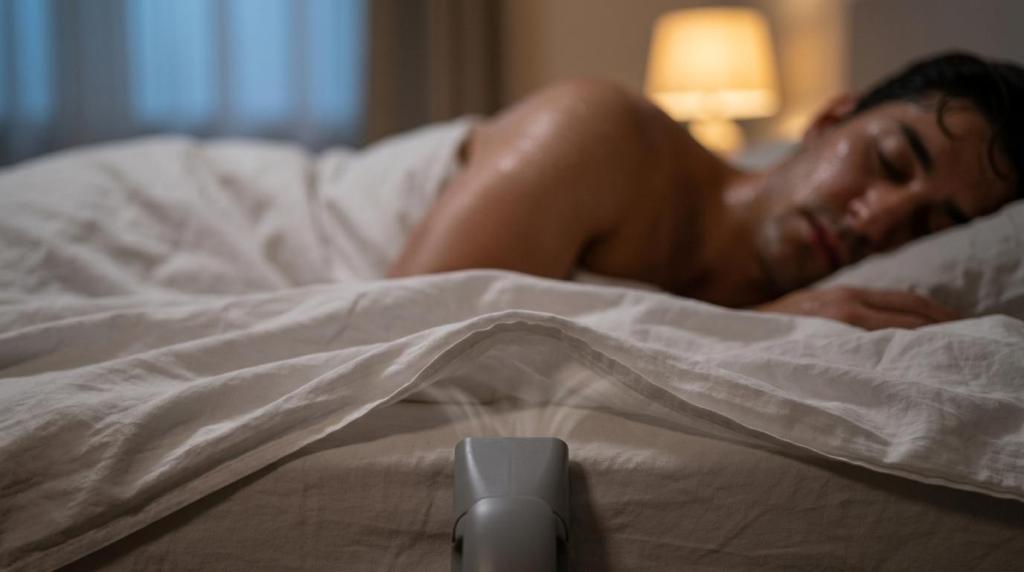
Looking for an Eight Sleep alternative? Compare bed fans vs Eight Sleep on cooling, noise, and cost to find the best value for hot sleep.
Hot sleepers usually don’t need the most expensive sleep tech on the market, they need the right kind of cooling. If you’re looking for an Eight Sleep alternative, a bed fan is often the simpler, cheaper answer, especially when your real problem is trapped heat under the covers.
TL;DR: Summary
- A bed fan is a strong Eight Sleep alternative if you want cheaper, simpler bed cooling without paying Eight Sleep Pod 4 pricing, which is listed at $2,199 on the brand’s product page.
- Eight Sleep is a premium smart sleep system with automatic temperature control and tracking, while a bed fan like the bFan cools by moving room air between your sheets to carry heat away from your body.
- Sleep experts commonly recommend a bedroom temperature between 60°F and 67°F, and many people using a Bedfan can raise the room temperature by about 5°F while still sleeping comfortably cooler.
- The bFan cites normal operating sound around 28 dB to 32 dB and average power use around 18 watts, which makes it a practical fit for people who want quiet, targeted cooling and lower AC use.
- If you want premium automation, biometric tracking, and a higher budget product, Eight Sleep is in its own tier. If you want straightforward cooling for night sweats, menopause, medication related overheating, or energy savings, a bed fan is usually the better value.
- BedJet sits between those categories, but a dual zone BedJet setup costs over a thousand dollars, which is more than twice the price of two bedfans.
That’s the short version, but the real decision comes down to how you sleep, how much complexity you’ll tolerate, and how much money you want tied up in cooling your bed. Once you look at cooling method, noise, power use, sheet setup, and thermostat strategy, the gap between Eight Sleep and a bed fan gets much easier to sort out.
Yes. A bed fan like the bFan is a real Eight Sleep alternative if your goal is cooler sleep at a much lower cost, not premium tracking or app based automation. It solves trapped body heat under the covers with directed airflow instead of a $2,199 smart system.
A lot of people compare every bed cooling product as if they all do the same job. They don’t. Eight Sleep is built as a premium sleep system with automatic temperature control and tracking. A bed fan is a targeted airflow tool. If you mainly wake up sweaty, kick the covers off, or feel heat pooling around your torso and legs, a bed fan addresses that problem directly.
This matters because many hot sleepers are overcooling the entire bedroom just to fix a hot pocket inside the bedding. Sleep experts commonly recommend a bedroom temperature between 60°F and 67°F, with many sleep sources centering around the mid 60s. A Bedfan often lets people raise the room temperature by about 5°F while still feeling cool enough to sleep, because the airflow helps remove body heat trapped by sheets and blankets.
“bFan uses about 18 watts on average, which makes targeted bed cooling a very different proposition from running whole room air conditioning all night.”
There’s one misconception worth clearing up right away. A bed fan does not create cold air. It uses the cool air already in the room and moves it where you need it most, inside the bed microclimate. If your room is already too hot, no bed fan will feel like refrigerated air. If your room is reasonably cool, even a few degrees above your old thermostat setting, a Bedfan can make a big difference.
They cool you in two different ways. Eight Sleep changes the temperature of the sleep surface, while a bed fan like bFan pushes room air under the covers to strip away trapped heat and moisture around your body.
That difference sounds technical, but in real life it changes almost everything. Eight Sleep is trying to manage thermoregulation through a premium, actively controlled bed system. A bed fan is trying to improve heat exchange in the bedding space itself. If your skin feels clammy or you wake up with a hot back, chest, or legs under the sheet, airflow can feel immediate because it attacks the trapped heat directly.
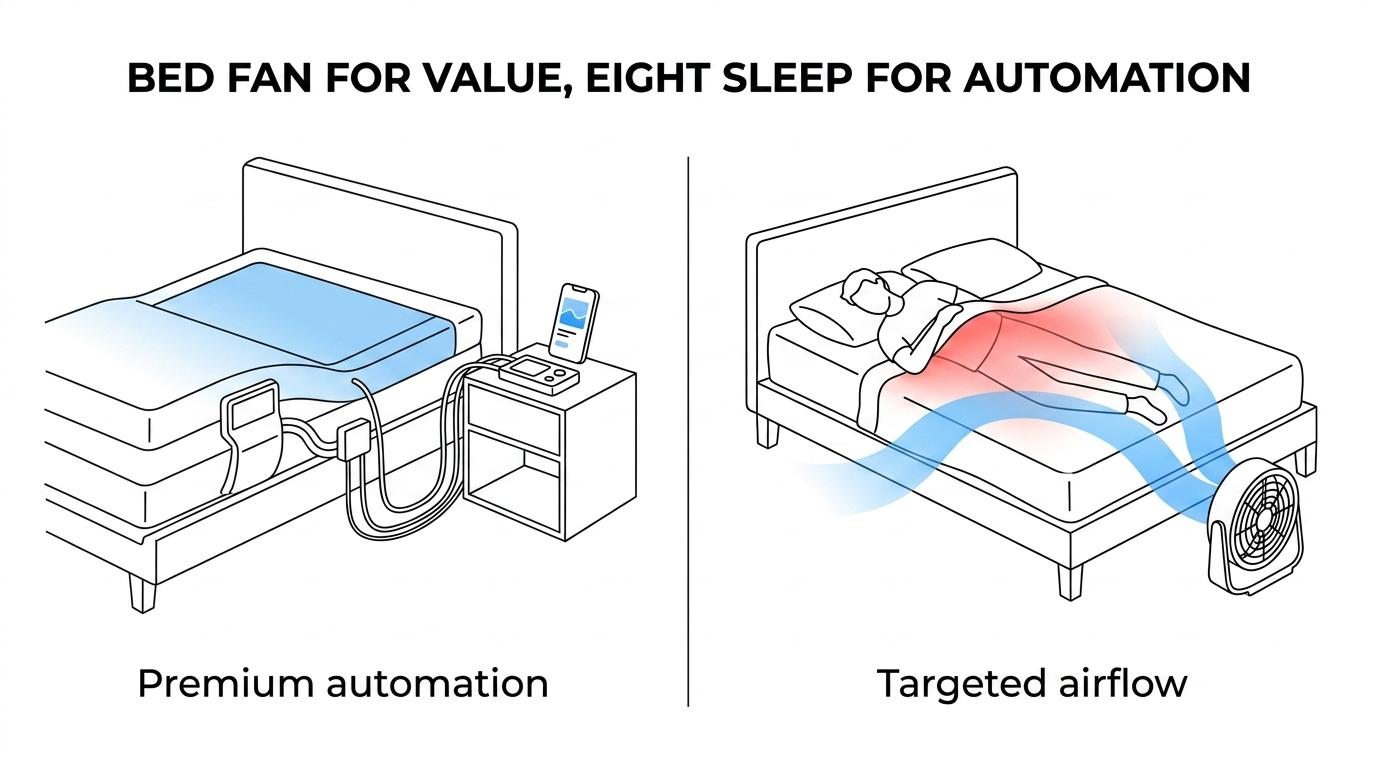
Neither approach cools the whole room. Eight Sleep does not replace your air conditioner, and a Bedfan does not cool room air either. The bed fan only uses the cool air already in the room. That’s why basic bedroom temperature still matters. If you stay within the common 60°F to 67°F guidance, or even a little above it with targeted airflow, you’re giving either system a better chance to work well.
The trade off is simple. Eight Sleep offers more automation, more hardware, and a more premium feature set. A bed fan gives you simpler control, fewer moving parts around the bed, and lower operating cost. If you want minimal setup and a straightforward fix for overheating, the simpler tool often wins.
The best Eight Sleep alternatives depend on whether you want lower cost, lower complexity, or more features. For most people who simply sleep hot, a bed fan is the first alternative worth checking.
After you decide you want an alternative, sort the options by method, not by marketing. Cooling under the sheets feels different from cooling the room, and both feel different from a mattress system.
One more point people miss, the original Bedfan category is not new. The original bed fan was invented in 2003, years before BedJet entered the conversation, so this is a mature solution, not some gimmick that showed up last month.
Start with your actual problem. Eight Sleep, bFan, and BedJet each make more sense for different kinds of hot sleepers, budgets, and tolerance for gear.
Step 1, define what you want fixed. If you want sleep tracking, automation, and premium hardware, Eight Sleep is the obvious fit. If you mainly want to stop waking up hot, a bed fan may solve the issue without adding a lot of complexity. If you want an air based bed system with more feature ambition than a basic bed fan, BedJet becomes part of the conversation.
Step 2, set a hard budget before you shop. This is where the field narrows fast. Eight Sleep Pod 4 is listed at $2,199 on its product page. A dual zone BedJet setup runs over a thousand dollars. Two bedfans still come in at less than half that dual zone BedJet cost, which is why bed fans keep showing up as the value pick.
“bFan normal operating sound is about 28 dB to 32 dB, giving shoppers a concrete noise range to compare against products that do not publish a simple dB figure.”
Step 3, decide how much setup you’ll accept. Some people are happy to manage apps, settings, and more involved hardware. Some just want to place a unit at the foot of the bed, point the airflow between the sheets, set a timer, and go to sleep. Be honest here, because convenience matters more at 11:30 p.m. than it does while reading product pages.
A common mistake is shopping by headline feature count. More features do not always mean better sleep. If your problem is heat trapped under the covers, the product that moves that heat away most simply may be the better buy.
Good setup matters a lot. A bed fan like bFan works best when the airflow can travel through the sheet space and across your body instead of escaping into the room.
Step 1, place the unit low and aim into the bedding pocket. The usual sweet spot is around the foot of the bed, which is how the bFan is commonly positioned. You want the air entering the space under the top sheet, not blasting randomly at the mattress edge.
Step 2, use tighter weave sheets if you can. This is a small detail that changes performance more than people expect. Tight weave sheets help guide airflow along the body so the moving air can carry away heat. Loose, very porous bedding can leak too much airflow before it reaches your core.
Step 3, use the timer and adjust from there. Some people need strong cooling only for sleep onset, then less later in the night. Timer controls are useful here. You can cool the bed aggressively when you first lie down, then let the unit taper off after you’ve passed that warm, restless stretch.
This is also where you can test thermostat savings. If you normally set the room at 66°F, try 70°F or 71°F with the Bedfan running and see how you do. Many people can raise room temperature by around 5°F and still sleep cool, which can cut AC use without sacrificing comfort.
You can often raise the thermostat and still sleep better if the bed microclimate stays cool. That’s the practical edge a Bedfan has for energy conscious sleepers.
Step 1, start from accepted sleep temperature guidance. Most sleep experts land in the 60°F to 67°F range, and Sleep Foundation points many readers toward about 65°F, with common thermostat guidance around 65°F to 68°F. That range works because body temperature naturally drops as you fall asleep.
Step 2, increase your thermostat gradually. Don’t jump from 65°F to 74°F in one night. Move it up 2°F, then test, then move again. With directed airflow under the sheets, many people can end up about 5°F higher than their old bedroom setting and still feel cooler where it counts.
Step 3, pay attention to humidity and bedding weight. If your home is muggy, airflow still helps, but humidity can blunt the effect. If your comforter is heavy and heat trapping, you may need to lighten the bedding to get the full benefit.
The practical logic is simple. If your body feels cool enough in bed, you don’t need to air condition the entire house quite so aggressively. A bed fan uses about 18 watts on average, so it changes the economics of overnight cooling in a way big HVAC equipment never will.
A bed fan is usually the simpler choice, and bFan gives a clearer public sound benchmark. The bFan cites about 28 dB to 32 dB at normal operating speed, while Eight Sleep’s Pod 4 page focuses on premium features and references white noise rather than listing the same kind of simple dB number in the provided source.
For many shoppers, this is less about absolute silence and more about sound character. Some people can sleep through steady airflow easily, especially if they already use a fan. Others are sensitive to any mechanical system sound near the bed. The only honest answer is that noise is personal, but published numbers still help, and the bFan gives you a useful range to start with.
“bFan traces the bed fan category back to 2003 and pairs that long standing concept with between the sheets airflow, not a premium tracking subscription or a four figure entry price.”
Simplicity matters, too. If you want fewer components, less setup, and no need to think about a smart system, a bed fan is hard to beat. If you enjoy connected features and like the idea of automated sleep temperature management, Eight Sleep may still appeal. The trade off is that you’re paying a lot more for that added layer.
A common misconception is that more tech always means better sleep. In reality, some people sleep best with the least amount of gear, the least amount of tinkering, and a single job done well.
Bedroom temperature still matters because every bed cooling product depends on your room conditions in some way. Even strong targeted cooling works better when the room is already in a sleep friendly range.
The body wants to lose heat as you move toward sleep. That’s why sleep experts and medical sources keep circling back to roughly 60°F to 67°F. If your bedroom sits in that range, or a few degrees above it with a Bedfan helping at the bed level, you’re working with your body instead of against it.
Here’s the simple if then logic. If the room is moderately cool, a bed fan can feel very effective because it moves cooler room air under the covers and carries heat away. If the room is too warm, the air being moved is still warm, so the benefit drops. If the room is already comfortable but the bed itself feels hot, targeted bed cooling can be the better answer than lowering the thermostat for the whole house.
This is why people who overheat under the covers often see good results without freezing the room. You’re not just chasing a thermostat number, you’re managing the bed microclimate where your skin, sheets, humidity, and trapped heat all meet.
A bed fan is usually the better fit for hot sleepers who want relief first, not a premium sleep platform. It makes particular sense for night sweats, menopause, medication related overheating, and budget minded buyers.
Think about the people most likely to benefit. Many are not shopping for sleep analytics. They’re shopping because they wake up damp, toss off covers, or avoid sharing blankets because the bed gets too warm. Directed airflow between the sheets can be a very practical fix for those situations.
A bed fan also suits people who care about operating cost. At around 18 watts on average, the bFan is tiny in energy use compared with lowering whole house AC for eight hours. If you can raise your room temperature by about 5°F and still stay comfortable in bed, that can add up over a full cooling season.
It can also be a smart choice if you share a bed but don’t want to spend premium system money. Using two bedfans gives you dual zone style microclimate control at a fraction of the cost of a dual zone BedJet setup that runs over a thousand dollars. That price gap matters a lot in the real world.
The biggest trade offs are cost, complexity, feature depth, and how targeted you want the cooling to be. Eight Sleep gives you a premium system experience, while a bed fan gives you focused airflow and simpler ownership.
Here’s the practical breakdown. If you value tracking, automated adjustments, and a premium integrated setup, Eight Sleep can justify its higher price for the right buyer. If you care more about cooling your body than instrumenting your sleep, a bed fan usually gives you more direct value per dollar.
There are also comfort style differences. Some people love the feel of active mattress temperature management. Others prefer the sensation of air circulating inside the bedding. Neither reaction is wrong. It’s just a reminder that “cooling” is not one single experience.
Then there’s maintenance and friction. Products with more system components tend to ask more of you over time. Products with fewer moving parts and simpler controls tend to disappear into the routine faster. If you know you won’t want to manage much after the first week, buy with that in mind.
The best Eight Sleep alternative is the one that matches the job. If the job is straightforward nighttime overheating, the humble bed fan often punches far above its price class.
Copyright 2005 - present - Tompkins Research, Inc. & Kurt W. Tompkins All Rights Reserved DO NOT COPY. bFan® and the word bfan® in any format is a registered trademark of Kurt W. Tompkins the word BFAN® in any format shall not be used without written permission of the mark owner. This includes specifically Brookstone where you like to bait and switch, do not use my mark to bait customers.