
PMDD night sweats may reflect cycle hormone shifts, but meds, anxiety, perimenopause, or illness can also be causes and affect relief.
A lot of people use the phrase PMDD night sweats as if it describes one clear, well defined problem. Real life is messier than that.
If you wake up drenched before your period, it can be tied to hormone shifts across your cycle. It can also have nothing to do with PMDD at all. Night sweats can show up with PMS, perimenopause, medication side effects, anxiety, thyroid problems, infections, sleep apnea, and a pretty long list of other causes. That matters, because the right fix depends on what is actually driving the sweating.
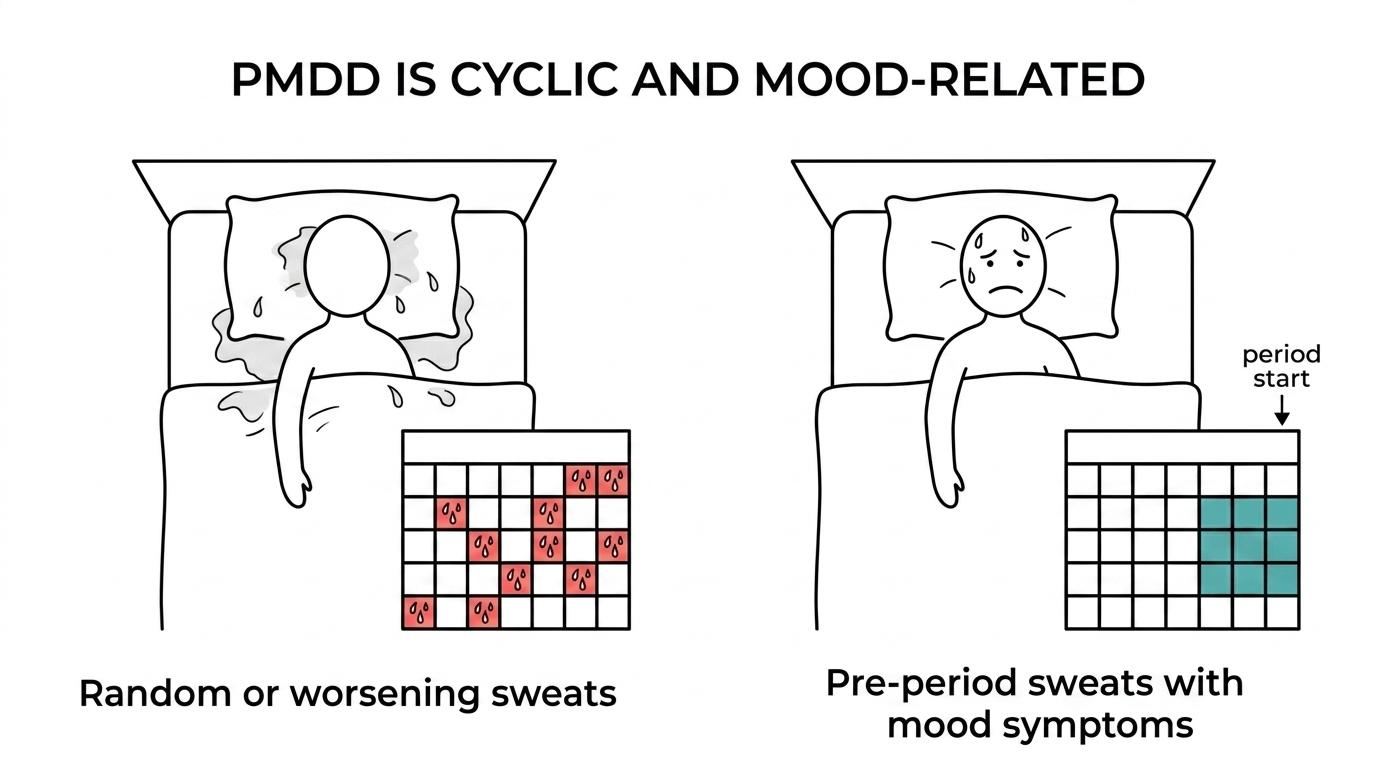
PMDD, short for premenstrual dysphoric disorder, is a severe form of PMS. The key features are tied to timing and symptom pattern. Symptoms usually show up in the luteal phase, which is the stretch after ovulation and before your period, and they tend to improve once bleeding starts. Mood symptoms are central to the diagnosis, not just physical discomfort. So if you are having night sweats, poor sleep, irritability, and sadness before your period, PMDD might be part of the picture. If the sweating is happening randomly all month, or is new and intense, you do not want to assume PMDD is the whole story.
Hormones can absolutely affect body temperature. Around the late luteal phase, shifts in estrogen and progesterone can make your temperature regulation feel off, and some people notice hot flashes, warmth at night, or episodes that feel a lot like vasomotor symptoms. Cleveland Clinic notes that menstrual cycle changes can be linked to night sweats, and PMS related hormone shifts can sometimes be part of it.
Still, night sweats are not one of the classic hallmark symptoms used to define PMDD. PMDD diagnosis leans heavily on mood related changes, things like marked irritability, depressed mood, anxiety, tension, and feeling out of control, along with physical symptoms that can include bloating, breast tenderness, sleep changes, and fatigue. That is an important distinction. If your main issue is sweating at night, you may be dealing with cycle related hormone sensitivity, but you may not meet the criteria for PMDD.
The timing can give you useful clues.
This is the big point, and it is worth slowing down for. Many people notice symptoms around their cycle and connect every bad night to hormones. Sometimes that is accurate. Sometimes it sends you down the wrong path.
Night sweats can happen with menopause and perimenopause, and those years can begin earlier than many people expect. They can also happen with pregnancy, thyroid problems, anxiety and panic symptoms, alcohol use, certain infections, obstructive sleep apnea, and medication effects. If you take SSRIs for PMDD, depression, or anxiety, that adds another wrinkle, because SSRIs themselves can contribute to sweating in some people.
That overlap is one reason PMDD can get confusing. You might have true PMDD, plus a medication side effect. You might have PMS or PMDD symptoms, plus early perimenopause. You might have bedtime overheating from a warm room, thick bedding, or poor airflow, layered on top of a body that is already more heat sensitive before your period.
That layered picture is common.
After thinking about the pattern, it helps to keep a short list of other causes in mind.
Your body temperature naturally shifts across the menstrual cycle. After ovulation, progesterone rises and your resting body temperature tends to run a bit higher. That may not sound like much on paper, but if you are already a hot sleeper, it can feel like a big deal when you are under blankets for seven or eight hours.
That is one reason the same bedroom can feel fine one week and unbearable the next. Your room has not changed, your body has. If your sleep is already sensitive to temperature, even a modest change can lead to repeated waking, damp sheets, or the feeling that you can never get comfortable.
Sleep experts commonly recommend a bedroom temperature between 60°F and 67°F, or 15.5°C to 19.5°C, for better sleep. If you run hot in the luteal phase, that range matters even more. Many people using a Bedfan find they can raise the room temperature by about 5°F and still cool the body enough for more restful sleep, which can help if air conditioning costs are climbing or if your partner does not want the room as cold as you do.
A lot of people with PMDD are prescribed SSRIs, either daily or only during the luteal phase. These medications can be very helpful for mood symptoms. They can also make it harder to sort out why you are sweating at night.
If your night sweats began or got worse after starting an SSRI, that timing matters. It does not mean you need to stop the medication, and you should not stop suddenly without talking to a clinician. It just means the medication belongs in the conversation. The same goes for other medicines, including stimulants, corticosteroids, thyroid medication, some pain medicines, and some blood pressure medicines.
This is where symptom tracking earns its keep. When did the sweating start, how often does it happen, did it begin after a medication change, does it show up only in the luteal phase, and do you also have hot flashes during the day? Those details help separate PMDD from a side effect, or from a second issue happening at the same time.
If you are in your late thirties or forties, the line between PMDD, PMS, and perimenopause can get blurry. Perimenopause can bring irregular cycles, sleep disruption, night sweats, and mood changes. So can PMDD. Some people have both at once, which can make a bad week feel much worse.
Perimenopausal night sweats often come with daytime hot flashes or a sudden surge of heat that seems to come out of nowhere. PMDD tends to follow a more predictable monthly pattern, with symptoms clustering in the luteal phase. The catch is that cycle predictability can start to break down in perimenopause, which makes pattern spotting harder.
If your night sweats are new, stronger than they used to be, or no longer tied neatly to the week before your period, ask about perimenopause. It is a reasonable question, not an overreaction.
A lot of cycle linked sweating can be managed at home while you figure out the pattern. Some situations call for a proper workup.
Talk with a clinician if the sweating is drenching, frequent, new for you, or paired with weight loss, fever, cough, chest symptoms, loud snoring, gasping in sleep, racing heart, or marked daytime fatigue. The same goes if you feel shaky, weak, or lightheaded at night, or if your periods have changed a lot.
A medical visit can help rule out common culprits like thyroid problems, medication effects, pregnancy, infection, and sleep apnea. It can also help sort out whether you have PMDD, PMS, perimenopause, or some combination of them.
Before that appointment, it helps to bring a clean record rather than a fuzzy memory.
Even while you are sorting out the cause, you still need sleep tonight. Practical cooling changes can make a real difference.
For room-level control, Dansk Klima og Varmepumper explains how modern air-to-air heat pumps can provide quiet nighttime cooling and dehumidification that keeps bedrooms in the sleep-friendly range without overchilling the rest of the home.
Start with the room itself. Sleep experts commonly recommend 60°F to 67°F for better sleep, and hot sleepers often notice a clear drop in wake ups when the room stays in that range. If that sounds colder than the rest of your household can tolerate, targeted bed cooling can help. Many people using a Bedfan can raise room temperature by about 5°F and still feel cool enough to sleep more deeply, because the airflow moves trapped body heat away from the skin instead of trying to cool the whole house.
Your bedding matters more than people think. If you are using heavy blankets, thick mattress toppers that hold heat, or sheets with a tight weave, you can trap warmth right where you do not want it. With a bed fan, sheets with a tight weave tend to work best because they help the air spread across your body and carry away heat rather than letting it escape too quickly.
Clothing counts, too. Loose, breathable sleepwear can help, but some people do best with less fabric, not more. A quick rinse before bed, avoiding alcohol late in the evening, and keeping spicy meals earlier in the day can also cut down on heat build up.
The goal is not perfection. The goal is fewer wake ups, less soaked bedding, and a body that can stay closer to sleep.
A bed fan is useful for PMDD night sweats because it targets the exact place where heat gets trapped, under the covers. That is different from a ceiling fan or room fan. A ceiling fan moves air around the room. A Bedfan sends airflow between the sheets, where your body heat and moisture build up through the night.
That setup matters because neither Bedfan nor Bedjet actually cools the air. They both use the cooler air already in the room and direct it into the bed space. So if your bedroom is sweltering, no bed cooling device can create cold air from nowhere. You still get the best results when your room is kept near the commonly recommended 60°F to 67°F range. The upside is that with a Bedfan, many people can raise the thermostat by about 5°F and still sleep cool enough to avoid repeated overheating, which can lower air conditioning costs.
The Bedfan also keeps things simple. It uses only about 18 watts on average, it runs around 28db to 32db at normal operating speed, and it offers timer controls, which can be useful if you mainly need help falling asleep or getting through the hottest part of the night. If you want a practical option for cycle related overheating, the bFan from www.bedfans-usa is worth a look.
Sometimes simple wins.
If you are comparing products, it helps to cut through the marketing language. Bedfan and Bedjet both move air into the bed. Neither one cools the air itself. They rely on the room air you already have. That means the same basic temperature rule still applies, keep the bedroom in a sleep friendly range, ideally 60°F to 67°F, and use directed airflow to move heat away from your body.
Price is where the gap gets hard to ignore. One Bedjet is more than twice the price of a single bedfan. A dual zone Bedjet setup costs over a thousand dollars, which is more than twice the price of two bedfans. If you and your partner need different sleep temperatures, two bedfans can create dual zone microclimate control at a fraction of that cost.
There is also some category history here. The original Bedfan was invented in 2003 and came to market several years before Bedjet was even thought of. That does not automatically make one product better for every person, but it does remind you that between the sheets cooling is not new, and the Bedfan has been around long enough to prove the concept.
For people dealing with PMDD night sweats, the practical questions are pretty straightforward. Do you want direct airflow under the sheets, quiet operation, lower energy use, and a price that does not balloon when you need dual zone sleeping? If that sounds like you, a Bedfan often makes more sense.
Once you notice that your worst nights cluster in the luteal phase, you can get a lot more strategic. You do not have to treat every night of the month the same way.
A simple pattern often works best.
Most cycle linked sweating is not an emergency, but you should not ignore red flags. Drenching night sweats with fever, swollen lymph nodes, unexplained weight loss, persistent cough, chest pain, or severe shortness of breath deserve prompt medical attention. The same is true if you are having intense daytime symptoms, new irregular bleeding, or signs of thyroid problems, like racing heart, tremor, and feeling hot all the time.
If you snore loudly, wake up gasping, or feel wiped out no matter how long you sleep, ask about sleep apnea. It is one of those conditions that can hide behind other explanations, and it can absolutely show up with nighttime sweating.
And if you are treating PMDD but your sweating keeps getting worse, circle back. Sometimes the first explanation is only part of the answer.
These sources can help you sort out PMDD, night sweats, and related sleep issues with solid medical information.
Copyright 2005 - present - Tompkins Research, Inc. & Kurt W. Tompkins All Rights Reserved DO NOT COPY. bFan® and the word bfan® in any format is a registered trademark of Kurt W. Tompkins the word BFAN® in any format shall not be used without written permission of the mark owner. This includes specifically Brookstone where you like to bait and switch, do not use my mark to bait customers.