
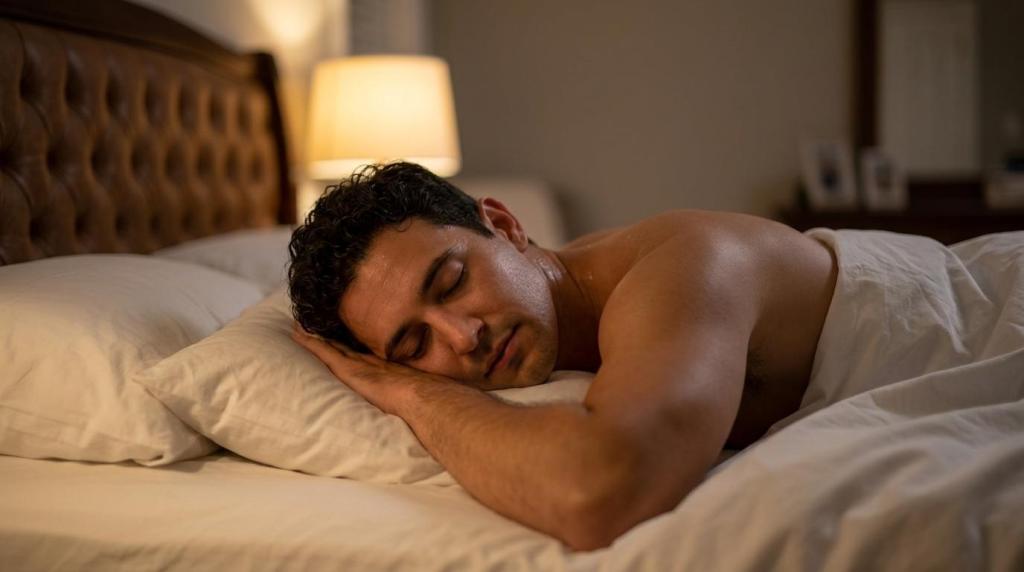
Discover bed cooling for humid bedrooms with bFan, a quiet fan that moves air between sheets to reduce sticky heat and night sweats.
If your bedroom feels sticky at night, even when the thermostat says it should be fine, you already know the problem is not just the room. It’s the heat and moisture trapped around your body once you get under the sheets. bFan, made by Tompkins Research, Inc., is built for exactly that problem. Instead of trying to cool the whole room like an air conditioner, the bFan bed fan sends a controlled stream of room air between your sheets, where hot sleepers in humid bedrooms usually feel the most discomfort.
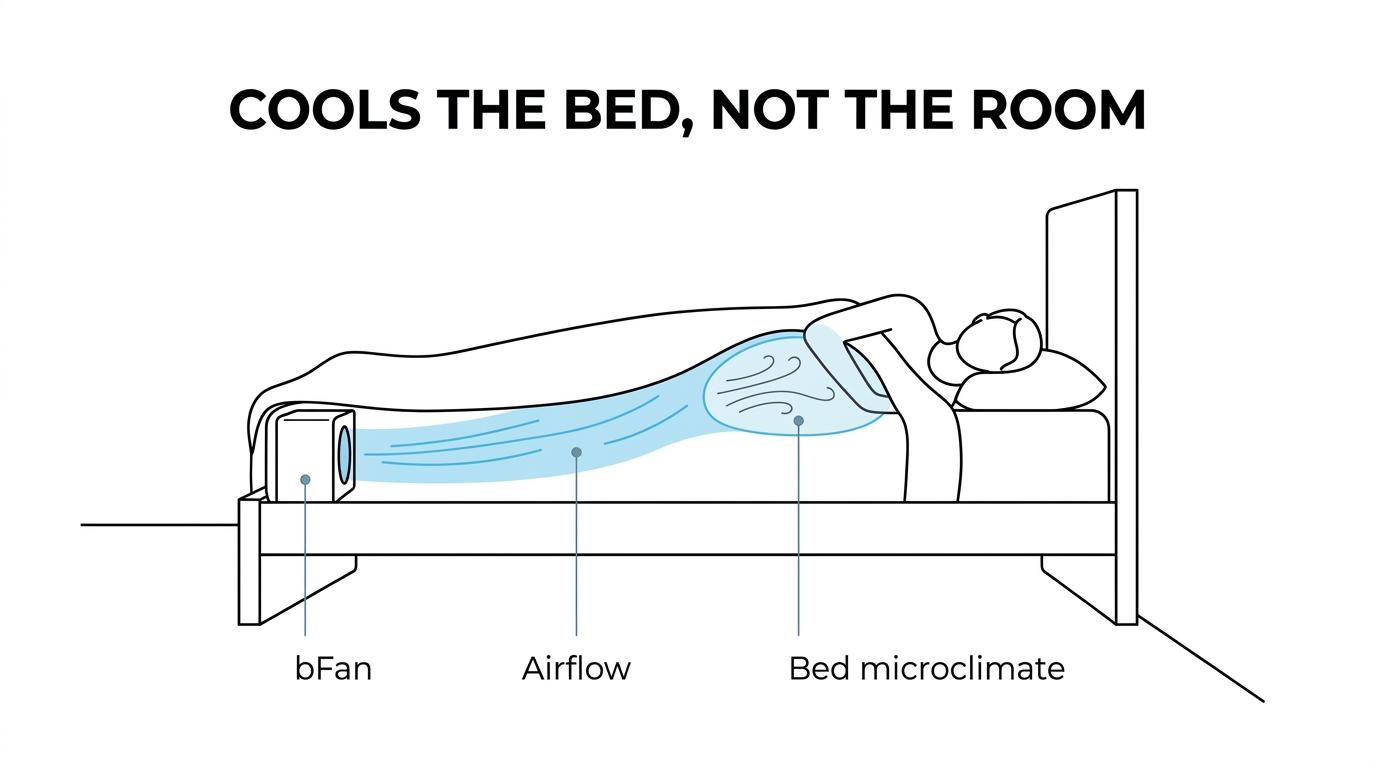
That matters because humid heat tends to linger in the bed microclimate, the small pocket of air between your body, your sheets, and your bedding. Tompkins Research, Inc. designed bFan to move that trapped heat away, quietly and with control, so you can feel cooler where sleep actually happens. If you’ve been waking up sweaty, kicking off covers, or setting your AC colder than you want just to make the bed tolerable, bFan is a practical option worth a serious look.
A humid bedroom can feel manageable when you first walk in, then completely different once you’re under the covers. Your body heat builds up, moisture collects, and the bedding starts holding onto both. That’s why so many hot sleepers say the room feels one way, but the bed feels much warmer.
bFan solves that specific problem with targeted between the sheets airflow. The unit sits around the bed, often at the foot, and directs room air under the top sheet so heat and moisture can escape instead of getting trapped against your skin. bFan can also be placed along the side of the bed or near the top, depending on your setup and what feels best.
If you’re comparing options, the bFan bed fan from www.bedfans-usa.com makes sense when your room is already reasonably cool but your bedding still turns warm and clammy.
“bFan uses about 18 watts on average, so it cools the bed microclimate without making your AC carry the whole load.”
This is an important point to get straight from the start. Neither bFan nor Bedjet cool the air itself. They both use the cooler air already in the room. That means a bed fan works best when the bedroom is in a reasonable range, but your body heat and humidity are still building up under the covers.
Sleep experts commonly recommend a bedroom temperature between 60°F to 67°F, or 15.5°C to 19.5°C, for better sleep. In real homes, especially in humid climates, the room may be within that general target and still feel too warm once bedding, body heat, and moisture are all working together. That’s where bFan becomes relevant. It cools the space around your body instead of making you overcool the entire room.
Hot sleepers in humid bedrooms are not imagining the problem. Sleep research has shown that warmer bedroom conditions can cut into sleep time and sleep quality, and humidity can make that worse.
A 2025 PubMed indexed longitudinal study tracked 19 participants over 409 observation nights and measured bedroom air temperature and humidity across three nonconsecutive weeks. The researchers found that nighttime indoor apparent temperature ranged from 26°C to 35°C and averaged about 5°C higher than outdoors. They also found that a 5°C increase in indoor nighttime dry bulb temperature was associated with a 23 minute reduction in mean total sleep time and about a 2 minute increase in sleep onset latency.
That may not sound dramatic on paper, but anyone who’s stared at the ceiling while feeling too warm knows how real those lost minutes feel, especially night after night.
A separate 2022 observational actigraphy study monitored 62 participants for 14 days and measured temperature, humidity, air quality, noise, and sleep in the bedroom environment. The authors reported significant associations between higher bedroom temperature and lower sleep efficiency, and they noted that temperature and humidity can act together in ways that matter for sleep.
bFan lines up with that reality because it’s focused on thermal comfort at bed level. When humidity makes it harder for heat to leave your body under the sheets, moving air across your skin helps carry that heat away. That’s especially useful in a humid bedroom where the room itself may be acceptable, but the bed microclimate still feels heavy and stuffy.
NHLBI guidance on insomnia treatment also points people toward a cool, quiet, dark sleep environment. bFan addresses the cool and quiet side of that guidance in a direct way, by sending a controlled breeze where the trapped heat is, instead of blasting the whole room with more noise or forcing you to keep the thermostat lower than you’d like.
Tompkins Research, Inc. built bFan for people who overheat at night, and humid bedrooms make that problem show up fast. The product is especially relevant when you’re not just warm, you’re dealing with that clammy, trapped feeling that builds under the bedding.
Here are some of the sleepers who tend to get the most out of bFan:
It’s also a strong fit for couples who do not sleep the same way. One person may feel chilly, the other may feel like the bed is an oven. With two bFans, each sleeper can create a separate bed microclimate on their own side. That gives you dual zone microclimate control using two fans, without forcing both people into the same setting.
If your night sweats are new, severe, or unexplained, relief at the bed level is only part of the picture. It’s smart to talk with your clinician about the underlying cause while also making sleep more bearable in the meantime.
A lot of cooling products sound similar until you look at how they actually move air. bFan is not a room fan pointed at your face. It is a remote controlled, adjustable height bed fan system designed to push air where body heat gets trapped, inside the bedding.
Tompkins Research, Inc. describes bFan as a fan placed around the bed, preferably at the foot, that delivers a controllable breeze between the sheets. The company also notes that the unit can be placed anywhere around the bed, from the foot to the top or along the side. That flexibility matters in real bedrooms, because not every bed frame, mattress height, blanket style, or sleeper preference is the same.
The hardware choices matter too. bFan uses a quiet squirrel cage blower with high static pressure, which helps it move air into the bedding instead of just stirring the room. Tompkins Research, Inc. also emphasizes a sturdy, stable base with improved airflow and adjustability, which is exactly what you want when the goal is consistent overnight comfort rather than a gadget that tips, rattles, or quits doing its job after bedtime.
At normal operating speed, the Bedfan sound level is about 28 dB to 32 dB. That puts the focus where it belongs, on cooling relief without turning your bedroom into a wind tunnel.
“At about 28 dB to 32 dB at normal speed, bFan is built to cool your bed quietly enough for real sleep.”
The timer control is another feature that turns into a practical sleep benefit. Some people mainly need help falling asleep, when heat under the covers feels worst. Others want steady airflow through the night. With timer controls, bFan lets you match the cooling period to your own sleep habits instead of leaving you stuck with a one speed, one schedule setup.
You’ll usually get the best result with tightly woven sheets, because the airflow can travel across your body more effectively and carry away trapped heat. In a humid bedroom, that detail makes a real difference. Loose, highly open fabrics can let the air escape too quickly, while a tighter weave helps that controlled breeze work where you need it.
Many hot sleepers in humid climates end up using the thermostat as their main sleep tool. The room gets colder, the electric bill goes up, and you still wake up sweaty because the issue is trapped heat inside the bedding, not just room temperature.
bFan gives you a more targeted way to deal with that. Since it uses about 18 watts on average, it can help you rely less on dropping the whole house temperature just to make bedtime tolerable. For many people, using a Bedfan means they can raise room temperature by about 5°F and still sleep cool, because the airflow is helping remove body heat where it builds up the most.
That doesn’t mean the room temperature stops mattering. Sleep experts still commonly point to 60°F to 67°F as a healthy target range for better sleep. What changes with bFan is that you may not need to push the room to the lowest end of that range, or below what feels reasonable for everyone else in the house, just to keep the bed from feeling oppressive.
In a humid bedroom, this can be especially valuable. If you’re already running air conditioning or a dehumidifier to keep the room within a decent range, bFan becomes the last mile solution. It helps the bed feel cooler and drier without making you pay to overcondition the entire space.
That’s the sweet spot for bed level cooling. You are not asking the product to perform like central air. You are using it to solve the more personal, more stubborn problem of trapped body heat and moisture under the covers.
If you’re shopping this category, you’ll probably compare bFan and Bedjet. That’s fair. They’re both known names in bed cooling, but the details matter, especially in humid bedrooms where you want clear expectations and not just marketing language.
The first thing to know is simple. The Bedjet doesn’t cool the air. bFan doesn’t cool the air either. Both products use the cooler air already in the room and move it into the bed space. So if a room is truly hot and muggy, neither one is a substitute for basic room cooling or humidity control.
Where bFan stands out is value, simplicity, and category history. The original Bedfan was invented in 2003, several years before Bedjet was even thought of. Tompkins Research, Inc. positions bFan as the original inventor of the bed fan category, and that matters if you want a product built around between the sheets cooling rather than a newer spin on the idea.
Price matters too, and this is where many shoppers stop and take a second look. One Bedjet is more than twice the price of a single bFan. If you’re a single sleeper who just wants a cooler bed in a humid room, bFan gives you the category’s core benefit without pushing you into a much higher price point.
For couples, the comparison gets even sharper. The dual zone Bedjet setup is over a thousand dollars, and it is more than twice the price of two bedfans. Two bFans give you dual zone microclimate control at a fraction of that cost, because each person gets their own fan, their own airflow preference, and their own side of the bed.
“The original Bedfan dates back to 2003, and two bFans still cost less than a dual zone Bedjet setup priced at over a thousand dollars.”
There’s also a buying experience difference. Tompkins Research, Inc. sells bFan direct rather than through Amazon. For many shoppers, that means clearer product ownership and a more direct relationship with the company behind the bed fan itself.
If your main goal is relief from overheating in a humid bedroom, the practical question is not which product has the flashiest pitch. It’s which one gives you targeted airflow where heat is trapped, quiet operation, simple control, and sane pricing. That is where bFan makes a strong case.
The right product works because it matches the real problem. Tompkins Research, Inc. is pretty clear about what bFan is designed to do, and that honesty is useful when you’re deciding.
bFan is a very good fit when your room is fairly cool already, but your bedding still turns warm and clammy once you get in bed. It’s also a strong fit when you want to sleep cooler without forcing the whole house into a refrigerator setting.
Here’s when bFan usually makes the most sense:
There are also times when you should expect to pair a bed fan with other solutions. If your bedroom is genuinely hot, with poor ventilation and high indoor humidity, a bed fan alone cannot fix the whole environment. Because bFan uses the air already in the room, the room still needs to be in a workable range. In those cases, air conditioning, a dehumidifier, better insulation, blackout shades, or improved ventilation may still matter.
That is not a weakness of bFan. It is just the physics of bed cooling. A bed fan is most effective when it is handling trapped body heat and moisture, not trying to replace the job of whole room climate control.
The biggest change most people are looking for is not a technical one. You want fewer wake ups, less tossing around, less sheet kicking, less second guessing the thermostat. You want the bed to stop fighting you at 2 a.m.
bFan improves that experience by making the sleeping surface feel more breathable. The controllable airflow helps heat and moisture leave the bed space instead of collecting under the top sheet and comforter. In a humid bedroom, that can make the difference between feeling trapped and feeling like your body can finally settle down.
That matters for sleep onset too. When you lie down already warm, humid bedding can make it harder to drift off. Sleep research has connected warmer indoor conditions to longer sleep onset latency, and most hot sleepers do not need a study to tell them that. They feel it every night. bFan addresses that first part of the night well because you can direct cooling right where your body is trying to unload heat.
It also matters for sleep continuity. Even if you fall asleep fine, overheating later can wake you up. A bed fan is useful because it works at the point where heat tends to build over time, under the sheets and close to the body. That is especially relevant for menopause related night sweats, medication related warmth, and the slow build of humid heat as the night goes on.
Tompkins Research, Inc. also gives you options in placement and control, which helps you fine tune the cooling instead of living with a one size fits all blast of air. Some people want the fan at the foot of the bed. Others do better with side placement. Some want a light breeze. Others want stronger airflow at the start of the night. That flexibility helps you make the product fit your sleep, instead of trying to fit your sleep around the product.
Trust usually comes down to whether a company understands the problem in a concrete way. Tompkins Research, Inc. does not pitch bFan as magic air conditioning for your mattress. The company describes it as a bed cooling fan that delivers quiet, controllable airflow between your sheets to reduce overheating, improve sleep quality, and help lower air conditioning costs. That is specific, realistic, and useful.
There is category history here too. The original Bedfan was invented in 2003, which puts Tompkins Research, Inc. at the beginning of the bed fan category, not at the end of it. If you care about buying from the company that helped define this kind of between the sheets cooling, that’s a meaningful distinction.
The product details back that up. bFan is not just a generic floor fan with a sleep label on it. Tompkins Research, Inc. emphasizes a quiet squirrel cage blower, high static pressure airflow, a sturdy stable base, adjustable positioning, remote control, and timer controls. Every one of those details connects directly to the user experience of sleeping cooler in a real bedroom.
There’s also some reassurance in the simplicity of what bFan is and is not. It is not pretending to refrigerate the bed. It is not asking you to believe that bedroom humidity does not matter. It is taking room air and putting it to work inside the bedding, where the problem is often most intense. For hot sleepers, that kind of clarity builds trust.
If you are shopping carefully, that directness should stand out. You are not buying a vague promise. You are buying a quiet bed fan, made by a company that focuses on bed level cooling, for the practical purpose of moving heat and moisture out from under the covers.
A few setup choices can make a good bed cooling system work even better. Tompkins Research, Inc. gives you enough placement flexibility to adapt the fan to your room and your bed, and that’s useful because humid bedrooms vary a lot.
Start by thinking about the room first. Since bFan uses room air, try to keep the bedroom in a sleep friendly range if possible. Sleep experts commonly recommend 60°F to 67°F. If you currently keep the room much colder just to survive under the covers, bFan may let you raise that setting by about 5°F and still feel cooler in bed.
Then think about bedding. Tightly woven sheets usually help the airflow travel where it’s supposed to, across your body and through the bed space, instead of escaping too quickly. Heavy bedding can still be comfortable, but if it traps a lot of heat and moisture, the fan will work best when the airflow path is not blocked.
Placement matters too. Many people start with the unit at the foot of the bed, which is a natural fit for pushing air under the covers. But if your bed frame, mattress, or sleep style calls for something different, bFan can also be placed along the side or near the top. That adjustability is helpful when one simple setup does not fit every bedroom.
Finally, use the controls in a way that matches your sleep pattern. If falling asleep is the hardest part, use the timer to focus cooling at the start of the night. If you overheat later, keep the airflow going longer. A humid bedroom often changes character over the course of the night, and your settings can reflect that.
If your biggest problem is trapped heat and humidity under the sheets, bFan is aimed right at that problem. Tompkins Research, Inc. offers a bed fan that cools the bed microclimate, not the whole house, with quiet controllable airflow, flexible placement, timer controls, and low average power use.
For hot sleepers, for menopause related night sweats, for medication related overheating, and for anyone tired of dropping the thermostat just to make the bed usable, bFan is a practical next step. You get a system designed for between the sheets cooling, not a generic fan trying to do a specialized job.
If you’re ready to sleep cooler in a humid bedroom, take a closer look at bFan and choose the setup that fits your bed, your sleep pattern, and your comfort goals. A cooler room helps, but a cooler bed is what you actually feel all night.
PubMed study on indoor nighttime temperature, humidity, and sleep duration
This study followed 19 participants across 409 nights and found that higher indoor nighttime temperature was linked to less total sleep time and slower sleep onset.
PubMed study on bedroom environment and sleep efficiency
This observational study of 62 participants found that higher bedroom temperature was associated with lower sleep efficiency, and it also examined how humidity relates to sleep outcomes.
NHLBI guidance on creating a sleep friendly bedroom environment
This National Heart, Lung, and Blood Institute resource recommends a cool, quiet, dark place for better sleep and offers practical insomnia related sleep advice.
CDC material on recommended bedroom temperature for sleep
This resource supports the commonly cited 60°F to 67°F bedroom temperature range that many sleep experts recommend.
Copyright 2005 - present - Tompkins Research, Inc. & Kurt W. Tompkins All Rights Reserved DO NOT COPY. bFan® and the word bfan® in any format is a registered trademark of Kurt W. Tompkins the word BFAN® in any format shall not be used without written permission of the mark owner. This includes specifically Brookstone where you like to bait and switch, do not use my mark to bait customers.