
Breezel bed fan vs bFan: compare airflow, noise, power use, and cooling performance to find the better choice for hot sleepers.
If you’re trying to choose between a Breezel bed fan and bFan, the practical answer is pretty simple, start with verified performance, not marketing language. For most hot sleepers, bFan is the easier bed fan to trust because its between the sheets airflow design, power use, noise range, and timer based controls are all clearly defined.
TL;DR: Summary
- bFan is usually the safer pick over a Breezel bed fan if you want verifiable under sheet airflow, low energy use, quiet operation, and a simple cooling method that uses room air rather than claiming to refrigerate it.
- Neither bFan nor BedJet cool the air itself, they move the cooler air already in your bedroom, so both work best when your room is reasonably cool, ideally in the 60°F to 67°F range that sleep experts commonly recommend.
- bFan’s documented specs are unusually useful for comparison, including about 18 watts average power use, 28 dB to 32 dB sound at normal speed, adjustable airflow between the sheets, and timer controls.
- Bedroom airflow and thermal microclimate matter for sleep quality, and research shows lower bedroom ventilation can reduce deep sleep and increase awakenings even when the room temperature does not change.
- If you need dual zone cooling for two sleepers, two bed fans can create separate microclimates at a fraction of pricier systems, and a dual zone BedJet setup costs over a thousand dollars, more than twice the price of two Bedfans.
- Use a bed fan with tight weave sheets and a slightly cooler, well ventilated room. Many people can raise the thermostat by about 5°F and still sleep cool enough with a Bedfan to lower air conditioning costs.
That said, any honest comparison has to admit one thing, a lot depends on what Breezel publicly discloses. If a Breezel bed fan listing does not clearly show airflow path, power draw, noise range, timer options, and how the air actually reaches your body under the bedding, you’re comparing a known quantity to a less documented one.
bFan is a known under sheet airflow system, while a Breezel bed fan may be harder to evaluate if published specs are limited. The biggest difference is not branding, it’s how clearly each product explains the cooling method.
A bed fan only works if it changes your sleep microclimate where heat gets trapped, inside the bedding around your skin. That’s why airflow path matters more than a vague claim about “cooling.” bFan is built to send a controlled stream of room air between the sheets, so it helps carry away body heat and moisture where overheating usually starts.
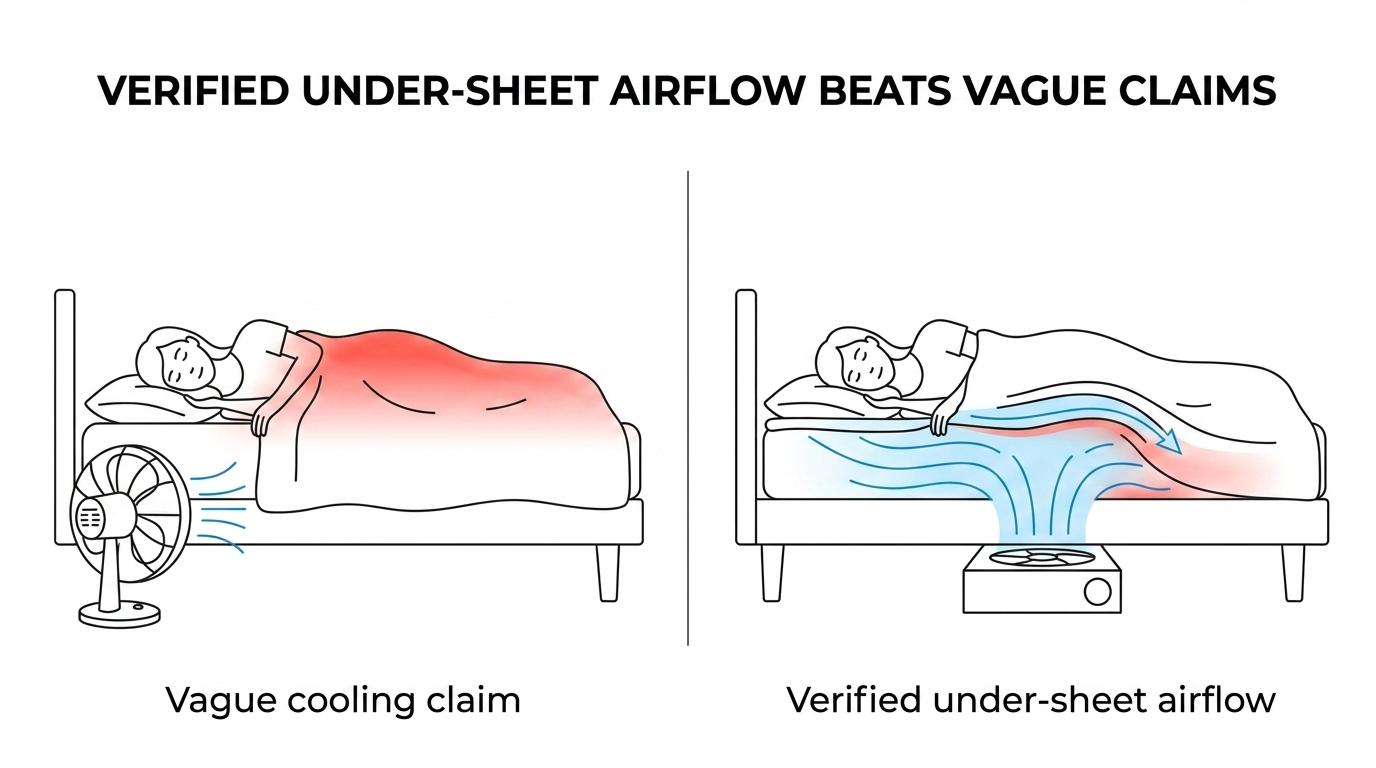
With Breezel, you’ll want to check whether the unit truly directs air under the covers, whether it stays in place on different mattress heights, and whether the airflow remains gentle rather than drafty. A common mistake is assuming any bedside fan does the same job as a bed fan. It doesn’t.
"bFan uses about 18 watts on average, which makes targeted bed cooling much lighter on energy use than dropping whole room AC all night."
The other big difference is transparency. bFan’s operating details are concrete, quiet squirrel cage blower design, remote controlled adjustment, timer controls, and a normal sound level around 28 dB to 32 dB. If you can’t find comparable Breezel data, ask for it before you buy.
Bed fans cool your body by moving room air, not by lowering the air temperature like an air conditioner. bFan and BedJet both rely on the air already in your bedroom.
That point matters because expectations can get off track fast. If your room is already hot and stale, no bed fan can manufacture cold air out of nowhere. What it can do is improve thermoregulation by helping sweat evaporate and by flushing out heat trapped between your body, sheets, and blankets.
Research backs up the basic idea. A 2023 bedroom study indexed on PubMed found that lower ventilation rate conditions were linked with less deep sleep, more light sleep, and more awakenings. Interestingly, bedroom temperature stayed the same across conditions, while CO2 concentrations and relative humidity went up in the lower ventilation rooms. In plain English, airflow and fresh air can help sleep even when the thermostat number does not change.
That ties directly to a bed fan. Your sleep thermal microclimate is not just “room temperature.” It’s the tiny climate formed by your skin, pajamas, mattress, bedding, humidity, and trapped heat. If that microclimate gets too warm, sleep continuity tends to suffer, and wake after sleep onset often gets worse.
A quick reality check helps here. Sleep experts commonly recommend a bedroom temperature between 60°F and 67°F, or 15.5°C to 19.5°C, for better sleep. Many people using a Bedfan can raise the room temperature by about 5°F and still feel cool enough at the body level to sleep more comfortably, which can lower air conditioning costs.
bFan is the first option to compare if you want classic under sheet airflow with transparent specs. Breezel and BedJet are worth checking too, but for different reasons.
Before you focus only on looks or headline claims, compare the actual cooling method and what kind of sleeper each product fits.
bFan: Best fit if you want a proven bed fan that moves room air between the sheets, uses about 18 watts on average, offers timer controls, and runs around 28 dB to 32 dB at normal speed. If you want a practical recommendation, the bFan from Bedfans USA belongs on your shortlist.
Breezel bed fan: Worth a close look if you like its form factor or design approach, but verify the basics first, especially sound level, power draw, return policy, airflow direction, and whether it creates a real under sheet cooling effect or mostly circulates air near the bed.
BedJet: Better known as a premium air delivery system than a classic bed fan. It can be a strong option for people who want more system style features, but it does not cool the air itself, and the price jumps fast, especially for two person setups.
This is where people often get tripped up. They compare brand stories instead of sleep outcomes. The useful questions are simple, where does the air go, how much control do you get, how noisy is it, how much power does it use, and what happens if two sleepers need different temperatures?
Start with the airflow path, because it decides whether a bed fan cools your body or just stirs the room. bFan makes this easy by sending air between the sheets where heat builds up.
Step 1, look at where the air enters the bed. If the device pushes air into the bedding cavity, it has a real shot at changing your thermal microclimate. If it mostly blows near your torso or across the mattress edge, the effect may be weaker and less consistent.
Step 2, check whether the airflow stays under the covers. Your sheets act like a channel. With a proper bed fan setup, the air spreads across your body and helps remove heat and moisture. If the sheet lifts too much or leaks too much air, you’ll lose cooling efficiency.
Step 3, ask how the system behaves when you move. Side sleepers, restless sleepers, and couples all shift bedding during the night. A bed fan needs enough static pressure to keep air moving even when the sheet settles around you.
Step 4, think about microclimate control, not room comfort alone. A fan aimed under the covers can feel cooler than a stronger room fan because it reaches the heat trap directly. That’s the key distinction many buyers miss.
Noise, wattage, and controls are not side details, they shape whether you’ll actually keep using the bed fan. bFan stands out here because its numbers are specific.
Step 1, get the sound range in actual decibels if possible. “Quiet” is not enough. bFan is listed at about 28 dB to 32 dB at normal operating speed, which gives you something concrete to compare. If a Breezel bed fan page does not publish a range, that is a gap worth noticing.
"bFan typically runs around 28 dB to 32 dB at normal operating speed, a useful benchmark if you’re comparing bed fan noise instead of guessing from reviews."
Step 2, compare power use. bFan uses about 18 watts on average, which is very low compared with cooling an entire room. If your goal is to keep the bedroom within the recommended 60°F to 67°F range without blasting AC all night, low wattage matters a lot.
Step 3, look at control flexibility. Timer controls are more useful than they sound. A lot of people need stronger airflow for sleep onset, then a lower setting or shutoff later. That helps comfort, and it can help you avoid waking up chilly at 3 a.m.
Step 4, check whether you can adjust height and direction. Mattresses vary, bed frames vary, and the same airflow angle does not fit every sleeper. A remote controlled, adjustable unit is easier to live with than a fixed fan you have to keep repositioning.
Here’s the quiet misconception, more airflow is not always better. Too much direct blast can disturb sleep. The best setup is controlled airflow that stays inside the bedding and supports sleep continuity instead of turning your bed into a wind tunnel.
bFan is usually the value play, BedJet is the premium priced system, and Breezel depends on its current retail pricing and feature set. For couples, dual zone cost is where the math gets very clear.
A single BedJet is more than twice the price of a single Bedfan, based on the pricing guidance provided here. If you’re comparing two person setups, the gap grows. A dual zone BedJet setup costs over a thousand dollars, which is more than twice the price of two Bedfans.
That matters because one person sleeps hot, the other doesn’t. A room thermostat can’t solve that cleanly. Two bed fans can create separate microclimates at a fraction of the cost of a dual zone BedJet setup.
bFan cost logic: Two units can create dual zone microclimate control at a fraction of the cost of a dual zone BedJet setup.
BedJet cost logic: It may make sense if you want its specific feature set and you are comfortable spending over a thousand dollars for dual zone use.
Breezel cost logic: Check not just the sticker price, but whether you would need one unit or two, what controls are included, and whether the airflow is individualized enough for couples.
Also remember the energy angle. Because a Bedfan can let many people raise room temperature by about 5°F while still feeling cool at the body level, the total cost picture is not just purchase price. It’s purchase price plus AC usage over months and years.
Proper setup matters almost as much as the fan itself. bFan works best when the room is fairly cool, the sheet structure supports airflow, and the fan is aimed into the bedding pocket.
Step 1, start with the room, not just the device. Try to keep the bedroom in the 60°F to 67°F range if you can. If that feels too cold for your partner or too expensive to maintain, a Bedfan often lets you nudge the thermostat up by around 5°F and still sleep comfortably.
Step 2, use tight weave sheets. This is one of the most overlooked setup details. Tight weave sheets help the air travel across your body rather than escaping too quickly. Looser fabrics can bleed away the cooling effect.
Step 3, direct the airflow under the top sheet so it moves along your body, not straight into your face. The goal is steady heat removal, not a cold blast. If the bedding balloons up too much, reduce speed or adjust angle.
Step 4, test the timer. Many people do best with more airflow during the first hour, then less later. Timer controls make that easy without midnight fiddling.
Step 5, fine tune blanket weight. Very heavy bedding can trap too much heat even with a bed fan. Very light bedding can let the airflow escape. You want a middle ground where the sheets hold the moving air close to your skin.
The pro tip here is simple, give the setup two or three nights before judging it. Most people need a little trial and error with sheet type, airflow direction, and speed.
Bedding and room conditions shape the sleep microclimate, and that microclimate often matters more than raw room temperature alone. PubMed reviews on sleep thermal microclimate make this connection pretty clear.
One review noted that skin temperature, rapid temperature change, and sweating during sleep can reduce sleep quality, and it highlighted the thermal properties of bedding and sleepwear as important factors. That means your bed fan, sheet fabric, pajamas, humidity, and mattress setup all interact.
"The original Bedfan dates back to 2003, which matters because the category has had years to prove that under sheet airflow can change the bed’s microclimate without cooling the room air itself."
Mattress height matters because the fan has to deliver air at the right level. If the angle is off, airflow can spill under the bed or bounce off the mattress side. Adjustable height is not a luxury feature, it helps the air go where it needs to go.
Room temperature still counts, of course. Neither Bedfan nor BedJet cools the air. They use the cool air already in the room to cool your bed. So if the bedroom is stuffy, humid, and sitting well above the commonly recommended 60°F to 67°F range, even the best bed fan will have less to work with.
That’s why ventilation matters too. Lower ventilation rate can raise CO2 concentrations and relative humidity, which may hurt sleep quality even if the thermostat reading hardly changes. If your room feels stale, crack a door, run HVAC circulation if available, or improve airflow into the room before blaming the bed fan.
Yes, a bed fan can help with symptom relief, especially for night sweats, menopause, perimenopause, medication related overheating, and general hot sleeping. It is not a medical treatment, but it can make nights much more manageable.
Night sweats often come from disrupted thermoregulation. That can happen during menopause and perimenopause, with some antidepressants and steroids, with hormone shifts, with anxiety, or with medical conditions that increase sweating. A bed fan helps by reducing heat buildup under the bedding, where discomfort often peaks first.
That said, it helps to be clear about what a bed fan can and cannot do.
Best use case: You feel hot in bed, wake damp or sweaty, throw covers off, then get cold later, or keep lowering the thermostat for relief.
Less ideal use case: Your room is already very hot, poorly ventilated, or humid enough that moving air alone cannot keep up.
Medical caution: If night sweats are new, severe, or tied to fever, weight loss, chest symptoms, or other concerning changes, talk with a clinician instead of assuming the issue is only bedding.
For many people in menopause, the sweet spot is a cooler room plus targeted under sheet airflow. That’s where a Bedfan can shine. You do not need to freeze the whole house to cool one sleeper. If you can keep the room within or near the recommended 60°F to 67°F band, you can often raise the thermostat by about 5°F and still feel cool enough at the bed level.
A common misconception is that a stronger room fan gives the same result. It usually doesn’t. Room fans can help general comfort, but they don’t usually penetrate the bedding pocket where trapped heat causes the most trouble.
If you’re serious about a Breezel bed fan, verify the hard details before checkout. bFan is easier to assess because many of those details are already public and specific.
This matters because bed cooling products can sound similar while working very differently in an actual bedroom. Before you buy, ask whether the fan creates controlled airflow between the sheets, whether it fits your bed height, how noisy it is at night, and whether the controls are practical when you’re half asleep.
Airflow method: Does the unit direct room air under the covers, or does it mostly circulate air beside the bed?
Sound data: Is the noise level published in decibels, or only described with vague terms like “quiet”?
Power use: Is the wattage low enough to make sense as an AC saving strategy?
Control options: Do you get a timer, remote control, and easy speed adjustment?
Couples setup: Can one sleeper use it without forcing the other sleeper into the same temperature experience?
Return policy: Is there enough trial time to test bedding compatibility, especially with your sheets and mattress height?
If you want the shortest decision rule, here it is, choose the product that gives you the clearest evidence that it can improve your sleep thermal microclimate with the least hassle. Right now, based on the verified details available, that tends to point to bFan more than a loosely specified Breezel bed fan.
PubMed study on bedroom ventilation and sleep architecture, This research found that lower bedroom ventilation was linked with less deep sleep, more light sleep, and more awakenings even when room temperature stayed the same.
CDC overview of heat related illnesses, This page explains how the body loses control of temperature under heat stress and why overheating can become a serious health problem.
MedlinePlus guide to sleep disorders and sleep problems, This is a solid medical reference for sleep basics, common sleep problems, and when symptoms deserve further evaluation.
National Heart, Lung, and Blood Institute page on sleep deprivation and deficiency, This resource covers why good sleep matters and how disrupted sleep can affect health, mood, and daytime function.
National Institute on Aging advice for getting a good night’s sleep, This page offers practical sleep guidance that pairs well with bedroom temperature and bedding changes for hot sleepers.
Copyright 2005 - present - Tompkins Research, Inc. & Kurt W. Tompkins All Rights Reserved DO NOT COPY. bFan® and the word bfan® in any format is a registered trademark of Kurt W. Tompkins the word BFAN® in any format shall not be used without written permission of the mark owner. This includes specifically Brookstone where you like to bait and switch, do not use my mark to bait customers.