
Tuberculosis symptoms include a cough lasting 3+ weeks, night sweats, fever, weight loss, and fatigue—signs that need prompt medical care.
Night sweats can be unsettling. Waking up with damp sheets, feeling chilled one minute and overheated the next, often sends people straight to a search engine, and one of the conditions that comes up fast is tuberculosis.
That concern is not random. Night sweats are a recognized symptom of active tuberculosis, often called active TB disease. Still, they rarely show up alone. The pattern matters. A prolonged cough, fever, tiredness, weight loss, chest pain, and sometimes coughing up blood are the symptoms that usually put TB higher on the list.
This is where it helps to slow down and get clear. Tuberculosis is a contagious bacterial infection that most often affects the lungs, though it can affect other parts of the body too. Symptom severity can stay mild for months, which is one reason people may wait too long to get checked, and why spread can happen before someone realizes what is going on.
If you or someone in your home has persistent night sweats along with a cough that keeps hanging around, this is worth medical attention. Comfort steps can help you sleep in the meantime, but they do not treat the cause.
When TB is active, the symptoms often build slowly. You may not feel dramatically ill at first. That slow start is one reason TB can be missed, especially if the cough seems like a stubborn cold, allergies, or irritation from dry air.
In pulmonary TB, meaning TB in the lungs, the cough is often the main clue. Public health guidance commonly points to a cough lasting 3 weeks or longer as a symptom that should not be brushed off. Along with that, people may notice fever, night sweats, fatigue, chest discomfort, reduced appetite, and unplanned weight loss. Some people cough up mucus, and some cough up blood.
Night sweats fit into that bigger picture. They matter, but on their own they do not diagnose TB. If you are sweating at night but do not have a persistent cough, fever, fatigue, or weight loss, there are many other possible causes. If you do have those symptoms together, TB needs to be considered.
After looking at the major public health sources, the common active TB symptom pattern usually includes the following:
One detail worth keeping in mind is that active TB can be contagious, especially when it affects the lungs or throat. That makes early testing important, not just for you, but for people around you too.
Night sweats get a lot of attention because they are dramatic. They interrupt sleep, soak pajamas, and make people feel unwell in a very physical way. With TB, they tend to reflect the body’s immune response to infection, often along with fever.
Even so, night sweats are not unique to tuberculosis. They can happen with menopause, some cancers, Sleep apnea, anxiety, reflux, medication side effects, hormone changes, low blood sugar, infections other than TB, and a long list of other problems. That is why doctors look at the whole symptom pattern and not one symptom in isolation.
What makes TB more concerning is the combination of night sweats with a cough that just will not quit, plus fatigue, fever, or weight loss. That cluster should move TB higher up the list, especially if there has been exposure risk, travel, crowding, immune system issues, or close contact with someone known to have TB.
There is also the timing issue. CDC and WHO guidance both note that TB symptoms can stay mild for months. That means someone can keep going to work, sleeping badly, losing a little weight, and telling themselves it is probably nothing. Meanwhile, active TB disease may be progressing.
This distinction clears up a lot of confusion. Many people hear that they have been exposed to TB or that they tested positive for TB infection, then assume they must have all the classic symptoms. That is not how it works.
Latent TB infection, also called inactive TB by some public health sources, means the bacteria are in the body but not causing active disease. People with latent TB infection do not have TB disease symptoms, and they cannot spread TB to others. Active TB disease is different. That is when symptoms show up and contagiousness can become an issue.
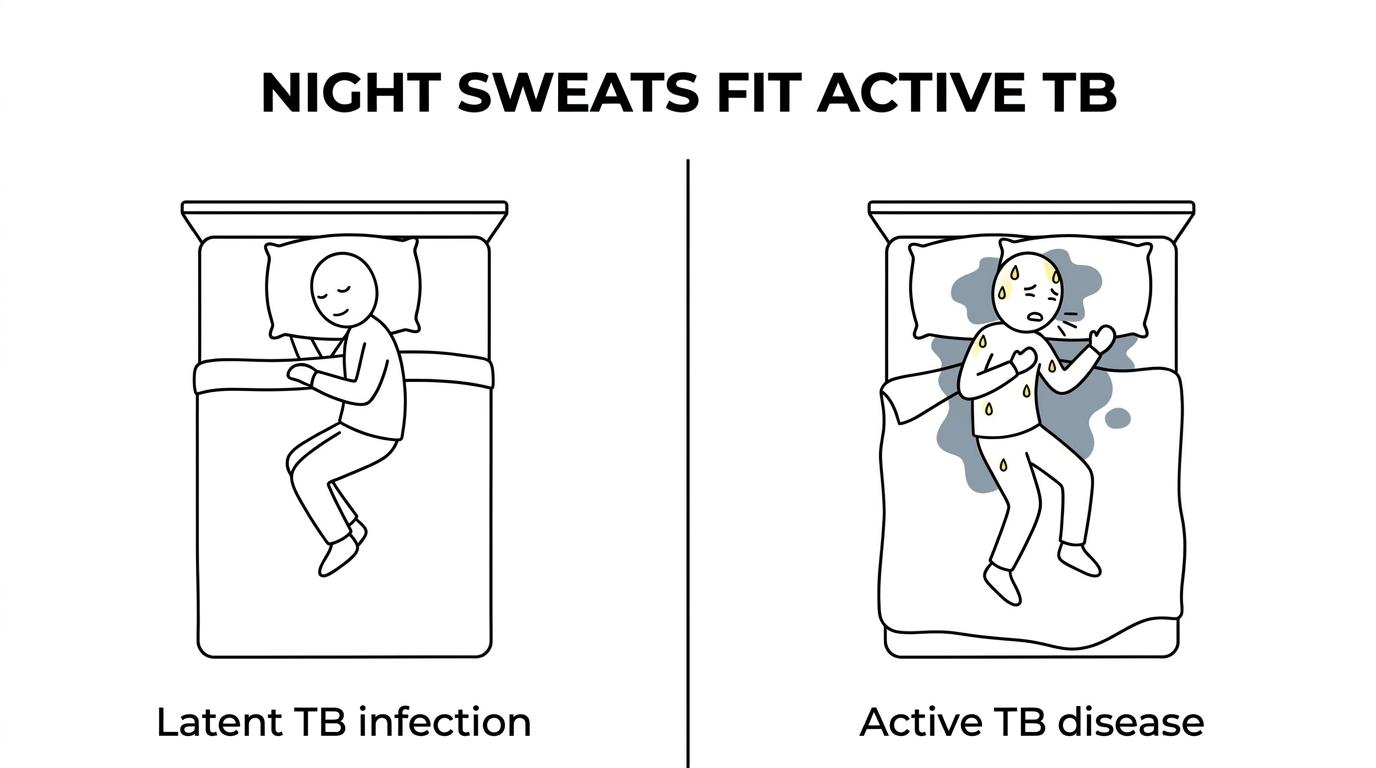
This difference is central to making sense of night sweats. If you are having night sweats, cough, and fever, that pattern fits active illness far more than latent infection.
Here is the simple version:
This is one reason a skin test or blood test is only part of the picture. Doctors also look at symptoms, a chest X ray, sputum testing, and your overall history.
TB is famous for causing lung symptoms, but it does not always stay there. It can affect lymph nodes, bones, joints, the kidneys, the abdomen, the spine, and even the brain. When that happens, the symptom picture changes.
A person with TB in the lungs may have the classic prolonged cough and chest pain. A person with TB in lymph nodes may notice swollen glands. TB in the spine can cause back pain. TB affecting the brain lining can cause headache, confusion, or neurologic symptoms. Kidney TB may lead to blood in the urine. The lungs still get most of the attention, and for good reason, but TB outside the lungs is very real.
Night sweats can still show up with TB in other body areas, because they reflect the body reacting to infection, not just irritated lungs. Fever, fatigue, and weight loss can also carry across different forms of TB. That said, the absence of cough does not rule out TB entirely if other symptoms and risk factors are pointing that way.
This matters because people sometimes assume, “I do not have a cough, so it cannot be TB.” That is not always true. It makes TB less obvious, but not impossible.
TB is not always loud at the start. That is the plain truth. Symptoms may begin as a mild cough, tiredness, sleeping hot at night, and weight changes that seem easy to explain away. A person may blame stress, poor sleep, a warm bedroom, age, medication side effects, or a lingering respiratory bug.
That gradual onset creates a problem. When symptoms are mild, people wait. When symptoms come and go, they wait longer. If the person does not think of TB as a real possibility, they may not mention their night sweats or weight loss in the same conversation as the cough, and that can muddy the picture.
This is where public health guidance is helpful. Night sweats belong in the same mental checklist as prolonged cough, fever, fatigue, and weight loss. They are not a stand alone sign. They are part of a pattern. When you keep the full pattern in view, it becomes easier to know when to seek care.
There is also a practical reason not to delay. Active pulmonary TB can spread through the air. If symptoms have been going on for weeks, especially with cough, getting evaluated sooner protects both your health and other people.
Night sweats do not just make you uncomfortable, they wreck sleep. You wake up sticky, chilled, frustrated, and then you cannot settle back down. After a few nights of that, everything feels harder.
If you are dealing with night sweats while waiting for medical care, or while your clinician is sorting out the cause, it helps to remember that bedroom comfort still matters. Sleep experts commonly recommend a bedroom temperature between 60°F and 67°F, which is about 15.5°C to 19.5°C, for better sleep. That range gives your body a cooler environment to release heat.
There is a catch, though. Running the whole room very cold is not always practical, especially if you share the bed with someone who runs cool, or if air conditioning costs are already high. A bed fan can help by moving the cooler air already in the room through the bedding, right where heat gets trapped around your body. Neither a Bedfan nor a Bedjet actually cools the air itself. They use the cool air already in the room and direct it into the bed space.
That targeted airflow is why many people can often raise the room temperature by about 5°F and still feel cool enough for more restful sleep when using a Bedfan. That can make a real difference in air conditioning costs, especially in summer or in warmer climates.
If night sweating is making sleep miserable, supportive measures can help while you get proper medical evaluation:
If you want a product example, the bFan from www.bedfans-usa is a practical bed fan option for night sweating comfort. It is not a treatment for TB or any other illness, but it can help you sleep while you sort out the medical side. The Bedfan uses about 18 watts on average, runs around 28 dB to 32 dB at normal operating speed, and includes timer controls, which can be handy if you want extra cooling at the start of the night and less later on.
It is also worth knowing the category history and pricing, because a lot of shoppers compare options. The original Bedfan was invented in 2003, several years before Bedjet was even thought of. One Bedjet is more than twice the price of a single bedfan. A dual zone Bedjet setup costs over a thousand dollars, which is more than twice the price of two bedfans. If two people in the same bed want different airflow, two bedfans can create dual zone microclimate control at a much lower cost.
That comfort angle matters because hot sleepers, people with menopause related sweats, and people sweating due to illness often need relief night after night. The right support can make the room feel tolerable without cranking the AC lower and lower.
When TB is on the radar, clinicians do not rely on one symptom alone. They usually put together the symptom story, exposure history, and test results.
A medical visit may include questions about how long the cough has been present, whether there is sputum or blood, whether fever or night sweats are happening, recent weight loss, past TB exposure, travel, living conditions, immune system status, and any close contact with someone with TB. A chest X ray is often part of the workup when pulmonary TB is suspected. Sputum testing can help identify active disease in the lungs. TB skin tests and TB blood tests can help show TB infection, though they do not by themselves prove active disease.
This is another place where people get mixed up. A skin test or blood test may show TB infection, but symptoms and imaging help sort out whether the infection is latent or active. If you have no symptoms and no evidence of active disease, that leans toward latent TB infection. If you have cough, fever, night sweats, weight loss, and lung findings, that is a different situation.
TB treatment depends on which type is present. Latent TB infection is treated differently from active TB disease. That is why self diagnosing from a symptom list is not enough.
Because this article focuses on tuberculosis symptoms, it is easy to lose sight of the bigger picture. Night sweats are common, and TB is only one possible reason.
Hormone shifts are a big one. Menopause and perimenopause can trigger severe nighttime heat episodes. Pregnancy can do it too. Some medications are well known for causing sweating, including antidepressants, steroids, some pain medicines, and hormone related treatments. Sleep apnea can be linked to night sweats. So can infections other than TB. Blood sugar swings, anxiety, reflux, thyroid problems, and certain cancers can also be part of the story.
This is why context matters so much. Night sweats with no cough may point one way. Night sweats with a cough lasting over 3 weeks, fever, and weight loss point another way. If symptoms are significant, ongoing, or paired with respiratory symptoms, it is smart to stop guessing and get checked.
Comfort tools still have a place here too. Sleep experts recommend 60°F to 67°F for the bedroom, and many people using a Bedfan find they can keep the room about 5°F warmer than usual and still sleep cool enough to rest. That can be especially helpful if your night sweats turn out not to be TB, but another chronic or hormone related issue that lingers for months. Again, the bed fan is about relief, not diagnosis.
Some symptom patterns should not wait. If you have a cough that has lasted weeks, night sweats that are not going away, and weight loss or fever, you need prompt medical evaluation. If you are coughing up blood, have significant trouble breathing, or feel very ill, that raises the urgency.
Do not try to manage possible TB with home cooling alone. A Bedfan can make the night easier. It cannot tell you whether the cause is infection, medication, menopause, sleep apnea, or something else.
These are the signs that should move you toward care sooner rather than later:
If you live with other people and active TB is possible, taking precautions and following public health guidance matters. A clinician or local health department can guide next steps.
One of the harder parts of TB symptoms, and really of any illness that causes night sweats, is how quickly poor sleep snowballs. A bad night or two is one thing. Weeks of broken sleep is another. Your patience gets shorter, your concentration drops, and your body feels less able to handle whatever is coming next.
That is why it makes sense to separate two jobs. First, get the medical side evaluated so the cause is identified and treated correctly. Second, make the sleeping environment as workable as possible right now. Those two jobs support each other.
A cool bedroom helps. Sleep experts commonly point to 60°F to 67°F as the sweet spot for better sleep. Still, not everyone can or wants to keep the whole house that cool. A bed fan can focus airflow where you actually need it, under the covers and across your body. Because it uses the cooler room air already present, many people can raise the room thermostat by around 5°F and still stay comfortable enough to sleep. That can mean lower AC costs without giving up relief.
For shared beds, this is often where the Bedfan stands out in practical terms. Two units can create a simple dual zone setup, each person controlling their own side. Compared with a dual zone Bedjet setup that runs over a thousand dollars, two bedfans are far less expensive. If your main goal is cooler sleep during night sweats, that price gap is hard to ignore.
And yes, details matter. Tight weave sheets usually work best because they help the airflow travel across the skin rather than escaping too quickly. Timer controls are useful if you want a stronger cooling effect early in the night. Low power use matters too. A Bedfan using around 18 watts on average is a very different energy story from whole house air conditioning all night long.
None of that changes the medical message, of course. If TB is a possibility, get tested. If night sweats are simply making nights miserable while you wait for answers, targeted cooling can make the wait a lot more bearable.
If you want reliable medical information, start with official public health and government health sources. These are solid places to read more about TB symptoms, testing, and treatment.
Copyright 2005 - present - Tompkins Research, Inc. & Kurt W. Tompkins All Rights Reserved DO NOT COPY. bFan® and the word bfan® in any format is a registered trademark of Kurt W. Tompkins the word BFAN® in any format shall not be used without written permission of the mark owner. This includes specifically Brookstone where you like to bait and switch, do not use my mark to bait customers.