
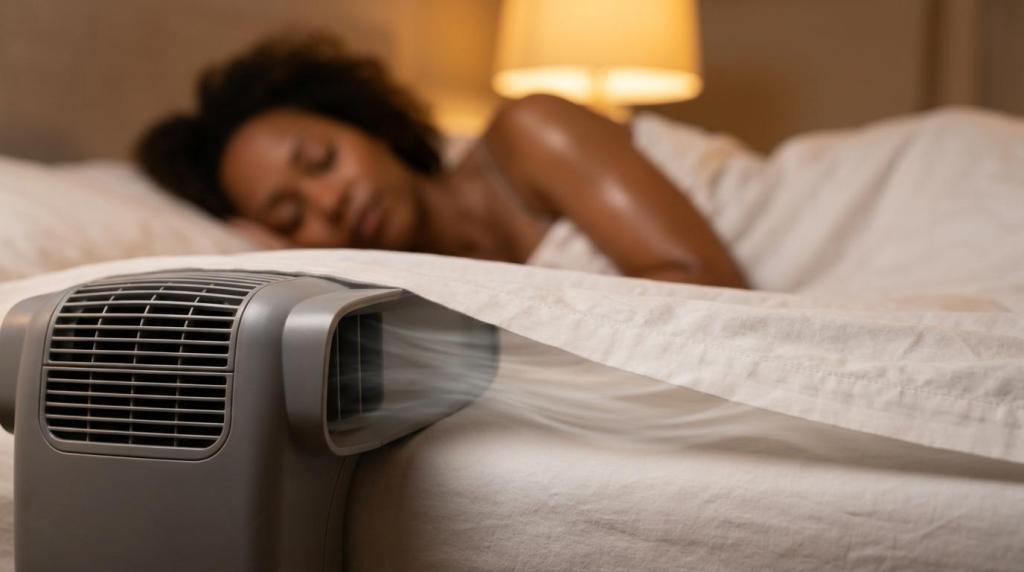
Discover energy savings with bFan, a quiet bed cooling device that cools between the sheets so you can sleep well with less AC overnight.
bFan, from Tompkins Research, Inc., is built for one very specific problem, getting trapped under warm bedding and waking up hot. If you want cooler sleep without cranking the air conditioner lower all night, this bed fan gives you quiet, controllable airflow between your sheets, right where body heat collects.
That matters because most people do not need the whole bedroom to feel icy, they just need the bed to stop holding heat. bFan is made for hot sleepers, people dealing with night sweats, women in menopause or perimenopause, sleepers affected by medications or health conditions, and anyone trying to cut overnight air conditioning costs without giving up comfort.
The basic idea is simple. bFan creates a cooler sleep microclimate inside your bedding by moving room air between the sheets, so trapped heat gets carried away from your body instead of building up around you.
That targeted airflow changes the energy math in a very practical way. Rather than lowering your thermostat cooling set point just to make the bed feel comfortable, you cool the spot where you actually sleep.
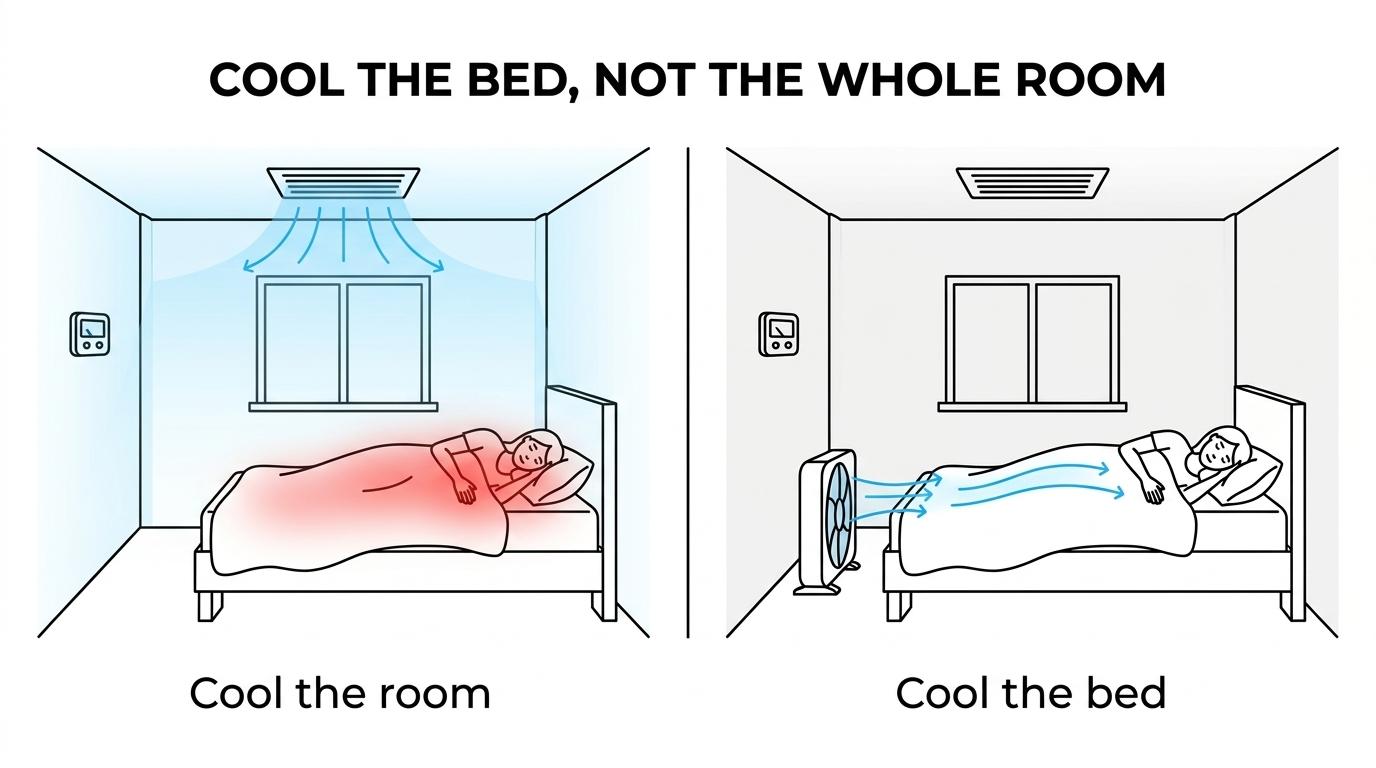
Sleep experts commonly recommend a bedroom temperature between 60°F and 67°F, which is about 15.5°C to 19.5°C, for better sleep. With a Bedfan, many people can often raise room temperature by about 5°F and still sleep cool, because the airflow on the bed helps remove body heat that would otherwise stay trapped under the covers.
"bFan uses about 18 watts on average, and many users can often raise room temperature by about 5°F while still sleeping cool."
That last part is where the savings potential shows up. The U.S. Department of Energy reports that lowering a thermostat cooling set point by 3°F increased cooling energy by 27% to 44% in the reported house types, so even modest thermostat changes can have a real effect on overnight energy use.
bFan gives you a way to chase comfort at the bed level first. For many people, that means less need to overcool the entire bedroom, the whole upstairs, or the whole house just to make eight hours in bed feel bearable.
The device itself is also light on power use. bFan uses about 18 watts on average, which is tiny compared with the energy load of whole room air conditioning.
"At normal operating speed, bFan runs at about 28db to 32db, while using only about 18 watts on average."
That does not mean bFan creates cold air out of nowhere. Neither bFan nor Bedjet cool the air itself. They both use the cooler air already in the room and move it into the bed, so the bed feels cooler even when the thermostat is set a little higher.
bFan is a strong fit if you are the person who wakes up sweating at 2 a.m., kicks off the covers, then pulls them back on twenty minutes later. Tompkins Research, Inc. designed bFan for that pattern, so you can keep the comfort of bedding while moving heat away from your body.
This is especially useful if your household fights over the thermostat. One person wants the room cold, another person does not want to freeze, and everybody ends up paying for whole room cooling to solve what is really a bed level problem.
When bFan works well, it improves more than your electric bill. It can make it easier to fall asleep, easier to stay asleep, and easier to stop bouncing between too hot and too cold all night.
Here are some of the sleepers bFan most often makes sense for:
If your night sweats are new, severe, or connected to illness, bFan should be seen as comfort support, not a replacement for medical care. Persistent night sweats can be associated with menopause, medications, infections, endocrine issues, anxiety, sleep apnea, and other conditions, so it is worth bringing the symptom to your clinician while also making the bed more comfortable.
"The original Bedfan was invented in 2003, and bFan from Tompkins Research, Inc. continues that bed cooling category with direct between the sheets airflow."
That combination, symptom relief tonight and smarter follow up if something bigger is going on, is where a lot of buyers land. You want sleep now, and you want a product that is honest about what it can and cannot do.
bFan is not just a fan pointed vaguely at the bed. Tompkins Research, Inc. designed it as a bed cooling device that sits near the foot of the bed and channels airflow between the sheets, where body heat gets trapped.
Because the airflow is inside the bedding, you feel the effect where it matters most. That usually feels very different from running a box fan across the room or blasting the ceiling fan and hoping for the best.
bFan uses a quiet squirrel cage blower with high pressure airflow, which helps move air through the bedding space more effectively than a loose room fan approach. The sturdy base and adjustable height help you position the airflow so it travels along your body rather than getting lost at mattress level.
The remote control matters more than people think. When you wake up warm, you do not want to sit up, find a switch, or fully wake yourself. The remote control matters more than people think, which makes it much easier to use consistently.
Timer controls are another practical part of the setup. Some people want maximum airflow as they fall asleep, then less later in the night. Others want airflow for the first few sleep cycles and then prefer the unit to shut off. bFan lets you match the cooling window to your own sleep pattern instead of treating every night the same.
Sheet choice also affects the result. When using a bed fan, it is best to have sheets with a tight weave, because tighter woven fabric helps the air flow across your body and carry away heat more efficiently. If your bedding is too open, too loose, or too heavy in the wrong way, the airflow can disperse before it does the job you bought it for.
That is part of why bFan feels more like a system than a gadget. Placement, bedding, room temperature, and airflow level all work together to build a personal sleep microclimate.
A lot of people looking for an energy saving sleep solution worry about trading one problem for another. You save on cooling, but now you have a noisy machine by the bed. Tompkins Research, Inc. addresses that directly with a design focused on quiet operation.
The Bedfan sound level is between 28db and 32db at normal operating speed. For most sleepers, that is in the range where the unit fades into the bedroom background instead of dominating it.
"bFan delivers between the sheets airflow at about 28db to 32db at normal operating speed, quiet enough for many bedrooms."
The other concern is ongoing power use. Here again, bFan stays practical. At about 18 watts on average, the device uses a small fraction of the energy you would spend trying to cool the whole room several degrees more than necessary.
That makes bFan attractive for people who sleep hot in warmer climates, upstairs bedrooms, older homes, or any room where the thermostat has to work hard after sunset. Instead of asking your central system to keep pushing lower, you give yourself a second layer of control at the bed.
This is also where many users find that the room can be set higher and still feel comfortable enough for sleep. Since sleep experts commonly recommend about 60°F to 67°F for bedroom temperature, the goal is not to ignore the room environment, it is to avoid overcooling it when bed level airflow can do part of the work.
If you are comparing bed cooling products, it helps to clear up the marketing noise. Neither bFan nor Bedjet cool the air. They both use the air already in the room. So the real comparison is not about who makes cold air, it is about price, airflow method, control, noise, and whether you want to spend more than you need to solve a bed comfort problem.
Tompkins Research, Inc. has a real category story here. The original Bedfan was invented in 2003, several years before Bedjet was even thought of. That does not just make bFan old, it makes it the original bed fan concept brought to market before newer branded alternatives arrived.
Price is where the difference gets hard to ignore. One Bedjet is more than twice the price of a single Bedfan. If you are looking at a dual zone setup for couples, the dual zone Bedjet is over a thousand dollars and more than twice the price of two bedfans.
bFan handles dual zone microclimate control in a straightforward way, use two fans, one for each sleeper. That gives each person separate control at a fraction of the cost of a dual zone Bedjet setup that runs over a thousand dollars.
"A dual zone Bedjet setup costs over a thousand dollars, while two bFans create dual zone microclimate control for more than half that difference in many comparisons."
That matters because couples rarely sleep the same. One partner wants stronger airflow, one is dealing with hot flashes, the other wants less. One is dealing with hot flashes, the other just wants a gentle cooling stream. Two bFans let you tune each side instead of compromising the whole bed.
There is also a simpler point here. Sleeping cool should not cost a fortune. bFan is positioned as the reasonably priced answer for people who want targeted overnight cooling without paying premium system prices for features they may not need.
If you are weighing your options and want the original category pioneer, the bFan from www.bedfans-usa is worth a serious look. It gives you direct bed cooling, remote control, timer options, and low power use without the jump to a much higher priced competitor.
The best way to think about bFan is not as a bedroom appliance, but as a fix for a chain reaction. You overheat, you wake up, you toss off the covers, you cool off too much, you pull them back on, then the cycle starts again. Tompkins Research, Inc. built bFan to interrupt that pattern right where it starts.
For many users, the biggest improvement is sleep continuity. You may still wake up sometimes, because no product can erase every cause of poor sleep, but a cooler bed often means fewer heat driven wakeups and less restlessness.
bFan can also improve comfort without forcing you to choose between blankets and breathability. A lot of hot sleepers want the feeling of sheets and covers, they just do not want the trapped heat that comes with them. Airflow between the sheets is what solves that contradiction.
You may also notice a relationship benefit. Thermostat arguments are common in shared bedrooms, especially when one person overheats and the other gets cold easily. A bed fan can reduce those battles because the cooling is localized to the sleeper who needs it.
The energy angle is not theoretical either. If your current habit is dropping the AC lower just so the bed feels tolerable, then shifting some of that cooling work to a device that uses about 18 watts on average is a common sense move. The lower the thermostat cooling set point, the harder your central system has to work, and the Department of Energy data backs up that those changes can carry meaningful cooling energy consequences.
Here is what tends to get easier with bFan in day to day use:
That is why bFan appeals to both hot sleepers and budget minded homeowners. It is one of the few sleep comfort products where the comfort benefit and the energy use story point in the same direction.
bFan is the right fit when your main problem is heat trapped in the bed. If the room itself is reasonably cooled, but your body still feels hot under the sheets, this kind of targeted airflow makes a lot of sense.
It is also a smart fit when you want more control without adding a complicated system. Tompkins Research, Inc. keeps the offer focused, a bed fan, remote control, adjustable placement, timer controls, and direct airflow where you sleep.
There are limits, and it is better to be clear about them. bFan does not refrigerate the air. Bedjet does not refrigerate the air either. If your bedroom air is already too hot, too humid, or poorly ventilated, a bed fan will help only as much as the room air allows.
So when is bFan not enough on its own?
Even with those limits, bFan often fills the exact gap people care about most. The room is close, but not quite right. The AC bill is already annoying. The real issue is that the bed keeps holding heat, and you want that fixed without turning the whole house into a refrigerator.
Trust matters more when the product category sounds unusual. A bed fan is not something most people grew up with, so you want to know whether the company actually understands the problem or is just reselling a trend.
Tompkins Research, Inc. has a credible place in this category because the original Bedfan was invented in 2003, years before Bedjet entered the market conversation. That makes bFan the continuation of an idea the company helped create, not a late copy chasing demand.
The product design also points to practical experience. bFan focuses on between the sheets airflow, a stable adjustable base, quiet operation, remote control, and higher pressure delivery that can move air where body heat is trapped. Those are not vague lifestyle claims, they are design choices aimed at one result, keeping you cooler in bed.
Buying direct is part of that focus too. bFan is not sold on Amazon. Tompkins Research, Inc. sells direct, which keeps the relationship simple if you want product specific information, setup guidance, or help choosing between a single unit and a two unit setup for couples.
That direct model also makes the offer clearer. You are not digging through generic marketplace listings trying to figure out which accessory, control option, or setup note actually applies to your bed. You are buying from the company behind the product.
If you want something proven, practical, and aimed squarely at nighttime overheating, bFan makes a lot of sense. It is built for a narrow problem, but for the people who have that problem, that is exactly the point.
For a single sleeper who runs hot, one bFan is usually the obvious starting point. You get targeted cooling, remote control, timer options, and the low power use benefit without changing the entire room strategy.
For couples, the decision is often about control more than raw airflow. If one partner sleeps fine and the other overheats, a single unit may be enough depending on bed size and preferences. If both sleepers want their own settings, two bFans give you true dual zone microclimate control.
That is the setup where the price comparison with Bedjet becomes especially relevant. A dual zone Bedjet is over a thousand dollars and more than twice the price of two bedfans, while two bFans let each sleeper tailor the cooling without paying premium system pricing.
There is also a long term cost question to think about. If a product uses about 18 watts on average and helps you avoid dropping the bedroom thermostat several extra degrees night after night, season after season, the total value is not just the purchase price. It is the combination of comfort, quieter sleep, and less pressure to overcool the whole home.
If you are tired of waking up hot, turning the thermostat lower, and still feeling like the bed itself is the problem, bFan is built for that exact frustration. Tompkins Research, Inc. offers a bed fan that targets trapped body heat where you sleep, uses about 18 watts on average, operates at about 28db to 32db at normal speed, and can help many people raise room temperature by about 5°F while still sleeping cool.
You do not need a complicated explanation or an overpriced workaround. You need the bed to feel cooler, the room to be good enough, and the air conditioning bill to stop climbing just because your sheets trap heat.
If you want cooler sleep without paying to overcool the whole house, talk with bFan about the single unit or two unit setup that fits your bed, your nightly heat pattern, and your energy saving goals.
Copyright 2005 - present - Tompkins Research, Inc. & Kurt W. Tompkins All Rights Reserved DO NOT COPY. bFan® and the word bfan® in any format is a registered trademark of Kurt W. Tompkins the word BFAN® in any format shall not be used without written permission of the mark owner. This includes specifically Brookstone where you like to bait and switch, do not use my mark to bait customers.