
bfan vs bedjet: Compare cooling method, price, power use, and dual-zone value to find the better bed cooling option.
If you’re comparing a bed fan to BedJet, the real question isn’t which brand sounds more high tech, it’s which approach cools your sleep space better for the money you’ll actually spend. bFan, made by Tompkins Research, Inc., sits in the bed fan category that focuses on pushing room air between your sheets, right where heat gets trapped around your body.
TL;DR: Summary
- bFan vs BedJet: For most hot sleepers, bFan is the better value because it cools the sleep microclimate directly, costs far less up front, and uses about 18 watts on average.
- Neither product makes cold air: Both systems use the cool air already in the room, so bedroom temperature, bedding, and airflow path matter more than many shoppers realize.
- Cost is a major separator: A dual zone BedJet setup costs over a thousand dollars, which is more than twice the price of two bed fans for dual zone microclimate control.
- Sleep environment still matters: Sleep experts commonly recommend a bedroom around 60°F to 67°F, and CDC NIOSH places many people near 65°F to 68°F, with quiet and darkness also affecting sleep quality.
- Practical setup matters: Tight weave sheets, correct airflow placement, and timer controls usually make more difference than chasing extreme room cooling.
- Best fit: If you overheat, get night sweats, or want to cut AC use, targeted between the sheets airflow is usually the most efficient first move.
That’s the core of it. Most people sleep better when the bedroom is cool and quiet, and when their body can release heat instead of baking under the covers. A bed fan approach often works well because it attacks the trapped heat layer under your bedding, not just the room around it.
For most hot sleepers, bFan is the better value because it tackles trapped body heat directly at a much lower price. A dual zone BedJet setup runs over a thousand dollars, while two bed fans can create dual zone cooling for far less.
If your goal is simple, better sleep because you’re too warm at night, price matters a lot. One BedJet costs more than twice the price of a single bed fan. If you share a bed and need separate cooling on both sides, that gap gets even bigger, because the dual zone BedJet setup goes past the thousand dollar mark. By contrast, two bed fans can create two separate sleep zones without pushing you into that price range.
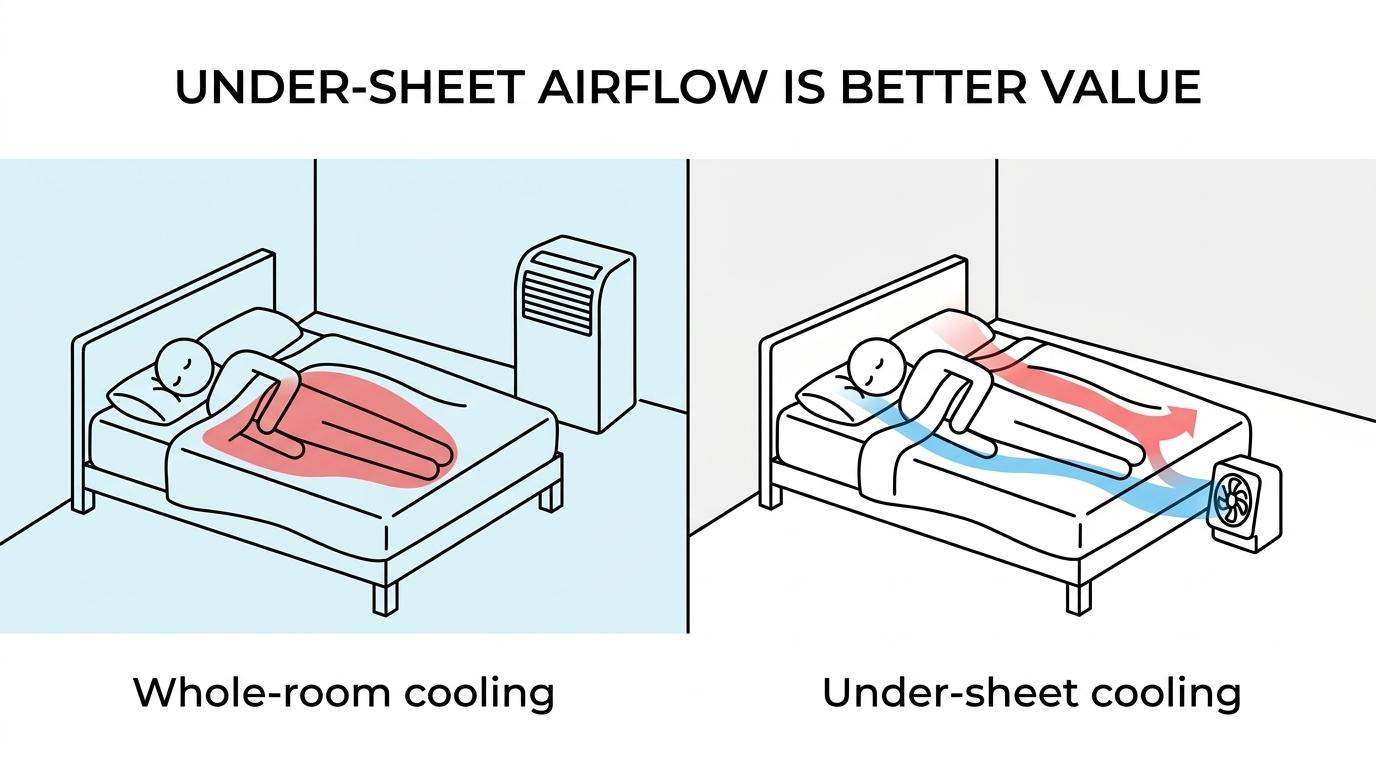
That doesn’t mean higher cost always means bad value. It means you should match the tool to the problem. If your problem is trapped heat under the covers, the most direct fix is usually to move air where that heat is trapped. A bed fan does exactly that, and it does it without requiring you to overcool the whole bedroom just to make the bed feel comfortable.
The common mistake here is assuming that a more expensive sleep cooling system must cool better. In practice, a lower cost system that directly removes heat from your sleep microclimate can be the smarter buy, especially if you’re dealing with menopause, medication related sweating, or just a naturally hot sleep pattern night after night.
Neither system makes cold air. A bed fan and BedJet both use the cooler air already in your bedroom to move heat and moisture away from your skin, which is why room temperature and bedding setup matter so much.
This is where a lot of shoppers get turned around. These products do not function like little air conditioners. They do not refrigerate the air. They use room air, then direct that air into the bed so your body can dump heat more effectively. That matters because sleep is tied closely to thermoregulation, your body’s ability to manage temperature as you settle into sleep and stay asleep.
Sleep experts commonly recommend a bedroom temperature between 60°F and 67°F for better sleep. CDC NIOSH places many people around 65°F to 68°F in a comfortably cool room. Those ranges overlap in a useful way, they both point you toward a cool sleep environment, not a warm one. If your room is already somewhere in that zone, targeted airflow between the sheets can do the rest.
“bFan does not create cold air, it uses room air between the sheets, and many sleepers can often raise the room temperature by about 5°F while still staying comfortable.”
That last point is a big deal for energy use. If a bed fan helps you feel cool enough to turn the thermostat up by about 5°F, you may not need to blast the AC all night. That doesn’t just cut cost for some households, it can also make the room more comfortable for a partner who doesn’t want the whole house kept refrigerator cold.
Another easy misconception is thinking airflow only helps if the air itself is cold. It doesn’t. Moving air strips away the warm, humid layer trapped against your skin and bedding. That’s why even modest airflow, if it’s aimed well and contained by your sheets, can feel dramatically cooler than still air.
The biggest differences are price, airflow delivery, controls, and how you create dual zone cooling. One system asks you to pay premium pricing, while the other keeps the job focused on targeted under sheet airflow.
If you compare these two by the thing that matters most, which is how they affect your body at night, you’ll want to look past flashy wording and focus on what happens in the bed. Heat builds up in your sleep microclimate, the small pocket of air and fabric around your body. The more directly a product can flush that trapped heat out, the better chance you have of falling asleep and staying asleep.
Tompkins Research introduced the original Bedfan back in 2003, years before BedJet was even thought of. That matters less as a bragging point and more as category context. The bed fan idea has been around long enough for hot sleepers to know the basic logic works, move the room’s cooler air into the bed, and let your body release heat.
One more practical point, the shape of the airflow matters. A blower based design with decent static pressure tends to do better pushing air where blankets and fitted sheets create resistance. That’s different from a normal room fan, which can move lots of open air but often struggles to deliver a useful cooling stream under bedding.
You should compare three costs, purchase price, daily electricity use, and how much room cooling you can avoid. A lower priced device that lets you raise the thermostat can beat an expensive system very quickly.
Most people only compare the sticker price. That’s a mistake, because the purchase price is only one part of what you pay for cooler sleep. The other two parts are how much power the device itself uses, and whether it lets you run less air conditioning overnight.
This bed fan is published at about 18 watts on average, which is tiny for a sleep cooling product. A central air system or even a window unit uses much more electricity than a small targeted airflow device. So if your sleep comfort problem is mostly in the bed, not the room, local cooling usually makes more financial sense than dragging the entire bedroom temperature lower than it needs to be.
The quiet, useful truth is that targeted cooling often beats brute force room cooling. You’re not trying to cool every cubic foot of air in the house. You’re trying to keep your body from overheating under blankets for seven or eight hours.
A bFan works best when you place it near the foot or side of the bed, guide the airflow between Tight weave sheets, and use the remote and timer so the bed cools without becoming distracting.
Start with placement. You want the airflow entering the bed, not blasting your face from across the room. Most people do best with the unit positioned at the foot of the bed, where it can feed air up through the sheet space along the body. If the height is adjustable, use that feature. A small placement change can matter more than a speed change.
Next, look at your sheets. Tight weave sheets usually work better because they guide air across your body instead of letting it leak straight out. Loose knits or very open weaves can reduce the cooling effect. This is one of those boring details that ends up making a surprising difference, because good airflow is partly about pressure and direction, not just volume.
“bFan uses about 18 watts on average, so it targets cooling at the bed instead of making you pay to overcool the whole room.”
Then use the controls wisely. Start a little stronger as you get into bed, then set the remote and timer so the bed cools without becoming distracting. That’s where timer controls can be genuinely useful, especially if your overheating is worst during sleep onset or in the first half of the night.
If you want a simple recommendation, the bFan from Bedfans USA is a solid solution when your main problem is trapped heat under the covers and you want direct airflow without paying BedJet level pricing. Just keep expectations realistic, it won’t create cold air, and it works best in a cool bedroom, ideally in that 60°F to 67°F range many sleep experts recommend.
A final pro tip here, don’t pile on a heavy comforter and expect miracles. If the bedding is too insulating, airflow has to fight harder to remove the heat your body keeps producing all night.
The simplest dual zone setup is two separate bed fans, one for each sleeper, because each side gets its own airflow and controls. That gives you real microclimate control without forcing both people into one expensive package.
If one of you runs hot and the other sleeps cool, room temperature alone usually won’t solve it. You can make the room cooler, but then the cool sleeper may feel cold while the hot sleeper still builds up heat under the bedding. That’s where dual zone cooling becomes useful, and it doesn’t need to mean buying the priciest option on the market.
First, treat each side of the bed as a separate sleep environment. Place one unit so it feeds airflow to one sleeper’s side, then adjust the second unit separately. Second, tune the sheet arrangement so the air stays contained on each side as much as possible. Third, let each sleeper set a different timer or airflow level depending on when their overheating tends to happen.
This is also where the price gap becomes hard to ignore. A dual zone BedJet setup costs over a thousand dollars. Two bed fans create dual zone microclimate control at a fraction of that cost. If your only goal is that each person wants their own cooling, two separate airflow sources are often the most direct answer.
People sometimes assume dual zone means you need a single branded system built for couples. You don’t. You just need independent airflow control on each side of the bed. That’s the actual goal.
Most adults sleep best in a cool room, usually 60°F to 67°F, with CDC NIOSH placing many people around 65°F to 68°F. Start there, then use in bed airflow to fine tune comfort instead of driving the thermostat lower and lower.
Your bedroom temperature is the foundation. If the room is too warm, no bed cooling system will feel as effective as it should. If the room is cool enough, targeted airflow can be the final piece that makes the bed feel much better without forcing the rest of the house into an arctic setting.
Here’s the simple way to dial it in. Start around 66°F or 67°F if you’re not sure. Give it a few nights. If you still overheat in the bed, add or adjust the bed fan before you slash the room temperature further. Many people find they can then raise the room temperature by about 5°F and still sleep cool because the airflow is removing heat directly from the body.
That last part matters for sleep quality and energy savings. The goal is not the coldest possible room. The goal is a cool enough room plus enough airflow at the bed to support your body’s normal overnight temperature drop. If your room is already within the cool sleep range, the issue is often trapped bedding heat, not a thermostat that’s wildly off.
A common mistake is changing three things at once, thermostat, bedding, and fan speed. If you do that, you won’t know what actually helped. Change one variable, sleep on it for two or three nights, then adjust again.
Quiet matters almost as much as temperature. CDC NIOSH recommends a dark, comfortably cool room and ways to reduce noise, which is why any sleep cooling device should be judged by sound as well as cooling effect.
This is one area where published details are helpful. The normal operating sound listed for this bed fan is about 28 dB to 32 dB. That’s a useful number because sleep environment advice isn’t just about temperature. It also points to keeping the bedroom quiet, dark, and calm. If a cooling device works but keeps you mentally alert, it’s solving one sleep problem while creating another.
CDC NIOSH also advises people to make the bedroom very dark and to use soft earplugs if the sleep environment is noisy. Put that next to a low thirty decibel operating range and you get the basic picture, lower noise can be a real advantage for a sleep product, not just a nice extra.
“bFan lists a normal operating sound level around 28 dB to 32 dB, which fits the quiet bedroom guidance often recommended for better sleep.”
It’s also worth clearing up a misconception. Louder airflow does not always mean more effective cooling. What matters is whether the air reaches the microclimate under the covers and whether the sound remains easy to live with all night. A well aimed blower can outperform a noisier setup that moves more air in the wrong place.
If your bedroom already has noisy HVAC cycling, street noise, or a loud ceiling fan, improving bed cooling can still help, but you should look at the whole sleep environment. Temperature, sound, light, and bedding all stack together.
Pick a bed fan if you want lower cost, low power body cooling for overheating, night sweats, or energy savings. Consider BedJet if you prefer its delivery style and you’re comfortable spending a lot more for the system.
A bed fan is often the best fit for hot sleepers who want a direct, practical tool. That includes women going through menopause or perimenopause, people dealing with medication related sweating, and anyone who wakes up because the bed feels stuffy and overheated even when the room itself is not that warm.
It also makes sense for energy conscious sleepers. If you hate lowering the whole house temperature just to make your bed feel decent, targeted airflow is the cleaner answer. The 18 watt average use figure matters here. You’re cooling the body zone, not paying to overcool rooms you aren’t using.
BedJet may appeal more to buyers who simply prefer its system style and don’t mind paying much more for the setup. That’s a valid choice if the design works better for your bed or routine. Just make sure you’re buying based on the actual sleep problem you have. If your issue is straightforward overheating under the covers, you may not need the higher spend.
One important health note, night sweats can be caused by hormones, medications, infections, endocrine issues, sleep apnea, or other medical conditions. A bed cooling system can help with comfort, but it doesn’t diagnose the cause. If your night sweats are new, severe, or paired with weight loss, fever, or other symptoms, talk with a clinician.
Most cooling failures come from setup mistakes, not the hardware. Loose bedding, blocked airflow, a room that’s still too warm, and expecting the unit to create cold air can make either system feel less effective.
By the time people say, “I tried a bed cooling product and it didn’t do much,” there’s often a setup problem hiding in plain sight. Heat management during sleep is a systems issue. The room, the bedding, the airflow path, and your body’s own overnight temperature changes all work together.
The small details are where most of the results come from. A properly set up system in a cool, quiet room usually feels much more effective than the exact same hardware dropped into a warm bedroom with bulky bedding and poor airflow.
Copyright 2005 - present - Tompkins Research, Inc. & Kurt W. Tompkins All Rights Reserved DO NOT COPY. bFan® and the word bfan® in any format is a registered trademark of Kurt W. Tompkins the word BFAN® in any format shall not be used without written permission of the mark owner. This includes specifically Brookstone where you like to bait and switch, do not use my mark to bait customers.