
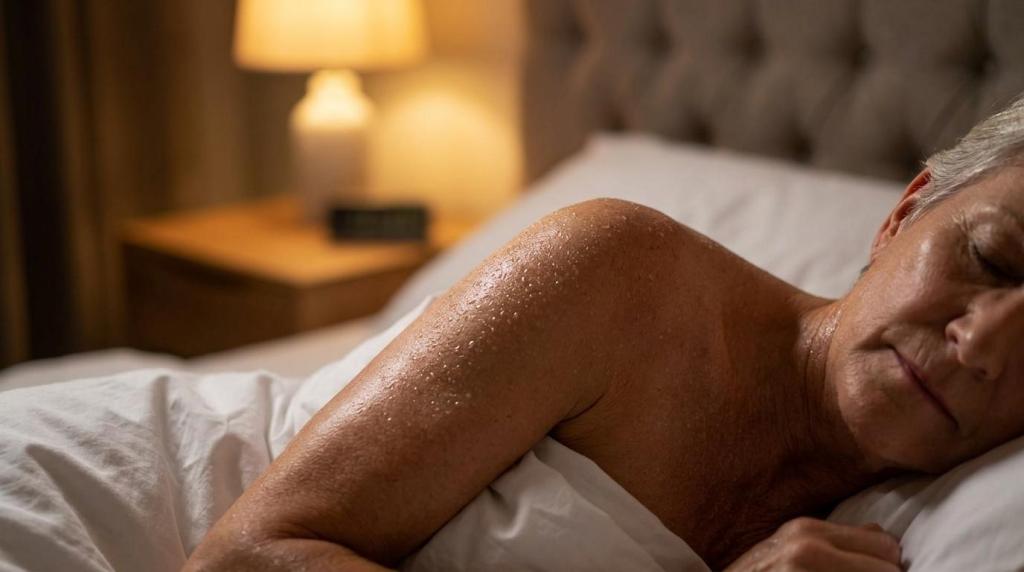
Learn how aging affects body temperature sleep patterns, triggers nighttime overheating, and why cooler bed airflow can improve rest.
If you or someone you care about has started waking up hot, sweaty, or oddly restless in the middle of the night, age may be part of the story. That does not mean something is wrong by itself. It means the body systems that time sleep and manage heat are changing, and those changes can make a warm bedroom feel much more disruptive than it used to.
A lot of people think sleep trouble with aging is only about lighter sleep, bathroom trips, stress, or aches and pains. Those things matter. Still, body temperature deserves a lot more attention than it gets. Your brain and body use temperature as part of the sleep signal, and that signal gets less predictable over time.
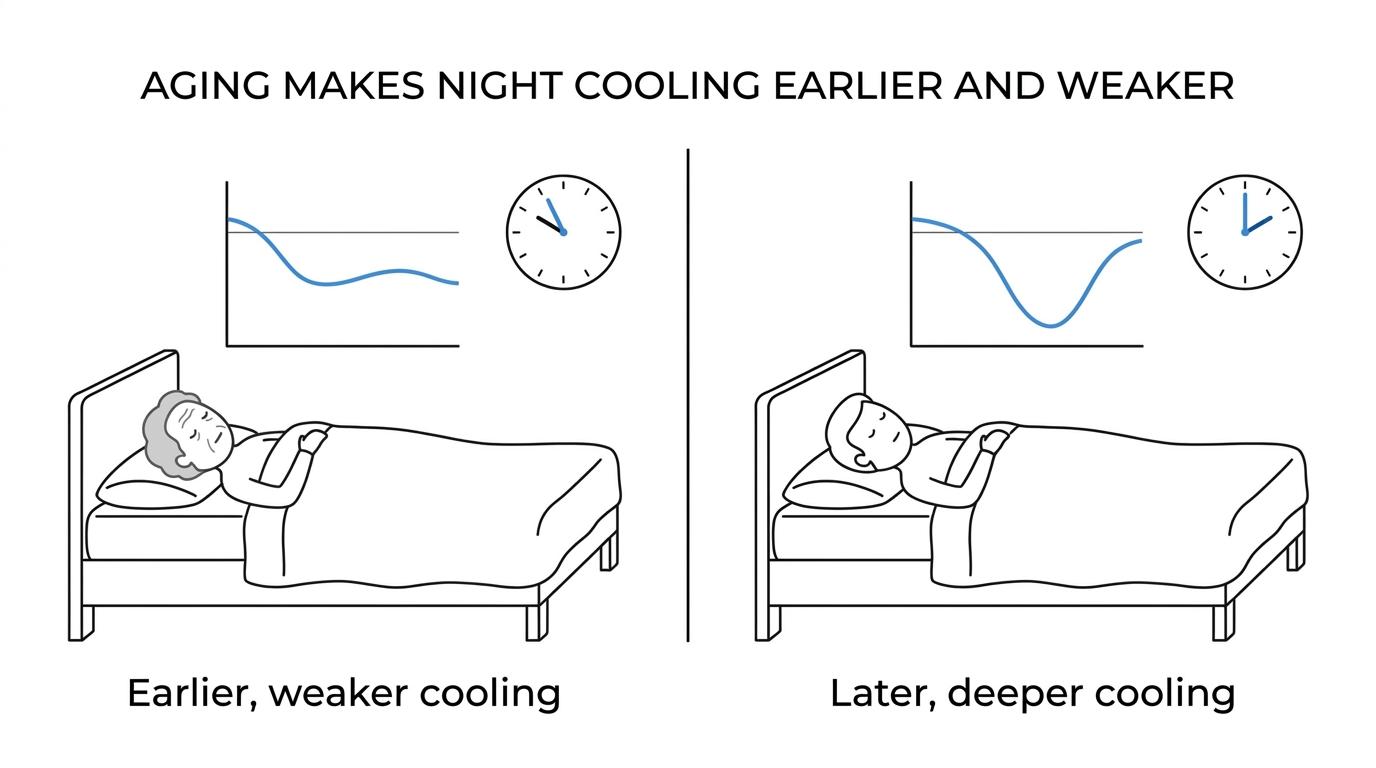
Here is the plain English version. To fall asleep well, your body usually needs to cool down a bit. Research shows core body temperature starts dropping about two hours before sleep under circadian control, and it drops again when you move into NREM sleep. Aging tends to shift that timing earlier, a change often called a phase advance, and it also weakens the daily rise and fall of body temperature, which researchers describe as reduced amplitude. When that cooling pattern becomes less steady, sleep can become easier to break apart.
Your body is never just on or off. Across the day and night, it runs on a circadian rhythm, a built in timing system that influences alertness, hormones, digestion, and the circadian rhythm of body temperature. During the day, core temperature tends to run higher. At night, it usually drops, and that drop helps open the door to sleep.
That cooling is not just a side effect of sleep. It is part of the process. The body sheds heat through the skin, especially through hands, feet, and other areas where blood flow can increase. As heat leaves the body, core temperature trends downward. That helps the brain shift into a sleep ready state.
Once sleep starts, especially in NREM sleep, core temperature tends to fall further. If the room is too warm, the bedding traps too much heat, or the body cannot get rid of heat efficiently, that process gets harder. You may still fall asleep, but staying asleep becomes a different problem. You wake more often, toss the covers off, then pull them back on an hour later.
This is one reason sleep experts commonly recommend a bedroom temperature between 60°F and 67°F, or 15.5°C to 19.5°C, for better sleep. And it is also why a bed fan can matter so much. Many people can raise the room temperature by about 5°F and still cool the body enough for more restful sleep when the airflow is directed under the covers rather than just moving air around the room.
As people get older, the sleep wake cycle often shifts earlier. Older adults may feel sleepy earlier in the evening and wake earlier in the morning, even when they would rather not. NIH material on the sleep wake cycle notes that body clock timing and rhythm decline with age, and older adults usually sleep less and wake up earlier.
Temperature rhythms shift with that clock. Review papers on normal aging report that the body temperature rhythm is often advanced by about an hour in older adults compared with younger adults. In practical terms, the lowest point, sometimes called the nadir core body temperature, can arrive earlier in the night or early morning than it once did.
Aging also tends to reduce the amplitude of that temperature rhythm. That means the difference between the daytime high and nighttime low may be smaller. Think of it as a flatter daily curve. You still have a rhythm, but the signal is not as strong.
There is another wrinkle. Research reviews suggest that the size and timing of these age related changes may differ by sex. That matters because many people notice major temperature related sleep problems during menopause, after hormone treatment changes, or while taking medications that affect sweating or heat tolerance.
When you put all that together, an older sleeper is often dealing with two separate issues at once. The timing of the temperature rhythm is earlier, and the cooling signal itself is weaker. That can make the body more sensitive to a too warm room, heavy bedding, humidity, or trapped heat under the covers.
You do not need a fever or a tropical bedroom to sleep badly from heat. Sometimes just a small mismatch between your body and your bedding is enough. If your body is trying to dump heat, but the mattress, comforter, sleepwear, and room conditions are holding that heat close, you can get stuck in a loop of partial arousals all night long.
With age, thermoregulation can become less flexible. The body may not move heat from the core to the skin as efficiently at night, and the normal pattern of heat loss tied to sleep onset can be less dependable. That does not mean every older adult will overheat. It means the margin for error gets smaller.
You might notice this in ways that do not immediately scream, “temperature problem.”
After years of hearing from hot sleepers, these are the patterns that often point to heat getting in the way:
Those clues do not prove the cause, but they are good reasons to look at temperature, airflow, and bedding before assuming sleep trouble is only about age.
The best bedroom temperature is not identical for everyone, but the standard range is a strong starting point. Sleep experts often recommend keeping the bedroom between 60°F and 67°F. That range gives the body room to cool itself without fighting a hot environment.
Still, many people do not want to chill the entire house that much, especially in summer, especially if one partner sleeps cold and the other sleeps hot. This is where people get frustrated. Lowering the thermostat might help one sleeper but annoy the other, and energy bills can climb fast.
A bed fan changes the equation because it targets the sleep microclimate rather than the whole room. It does not cool the air itself. Neither a Bedfan nor a BedJet cools the air. They both use the cool air already in the room and direct it into the bed area so trapped body heat can move away faster.
That matters because with a Bedfan many people can reduce air conditioning costs by about 5°F and still feel cool enough for better sleep. If your room was set at 66°F, you may be able to sleep comfortably closer to 71°F, while still getting enough direct cooling under the sheets. That can reduce air conditioning costs while keeping your body in a more sleep friendly range.
Age related temperature rhythm changes are only part of the picture. Lots of people who struggle with heat at night are also dealing with another trigger, sometimes several.
Common causes worth thinking about include the following:
If night sweats are new, intense, or paired with symptoms like fever, unplanned weight loss, chest pain, or shortness of breath, it is worth talking with a clinician rather than assuming it is just aging.
A ceiling fan or box fan can help some people, but room fans often leave a lot of trapped heat under the bedding. That is the real issue for many hot sleepers. The air in the room may be okay, while the air inside the bed is not.
A bed fan works differently. It sends air where the problem is, inside the bedding microclimate, where body heat tends to pool. When air moves across the skin under the covers, it carries heat away more directly. That makes it easier for the body to continue the nighttime cooling pattern that supports sleep onset and stable sleep.
This is also why sheet choice matters. With a bed fan it is usually best to use sheets with a tight weave. That may sound backward, but tighter weave sheets often help the air travel across your body instead of escaping too quickly. You get a better wash of air between the sheets, which improves heat removal.
If you share a bed, this kind of targeted cooling can also reduce thermostat battles. One sleeper can cool the bed space without freezing the rest of the room.
Let’s talk practically, because cost and setup matter. If you are comparing a Bedfan style system with a BedJet, there are a few points people should know upfront.
First, neither system cools the air. That is worth repeating because marketing language can make it sound like these are tiny air conditioners. They are not. They both rely on the air already in the room. If the bedroom is sweltering, no bed fan can magically create cold air. It can only move room air into the bed to help your body unload heat more effectively.
Second, price is not a small detail. One BedJet is more than twice the price of a single bedfan. And the dual zone BedJet setup costs over a thousand dollars, which is more than twice the price of two bedfans. If you need dual zone microclimate control for two sleepers, two bFan units can do that at a fraction of the dual zone BedJet cost.
Third, the Bedfan category is not new. The original Bedfan came to market years before BedJet was even thought of, and the bedfan was invented in 2003. That history matters because the core idea, moving air between the sheets to remove trapped body heat, has been tested in real bedrooms for a long time.
The bFan has a few practical advantages that matter for older sleepers and light sleepers. It uses only about 18 watts on average, which keeps operating cost low. The sound level is quiet enough for many bedrooms at 28 dB to 32 dB at normal operating speed. It also offers timer controls, which can be useful if you want stronger cooling at sleep onset and less airflow later in the night.
If you want a simple, direct recommendation, the bFan from www.bedfans-usa is a strong option for people who sleep hot, deal with night sweats, or want to cool the bed without dropping the entire house thermostat. It is one of those products that makes more sense the moment you realize the problem is not just the room temperature, it is the heat trapped under the covers.
The best setup is not complicated, but small changes can make a big difference. You want the room reasonably cool, the airflow aimed well, and the bedding working with the fan instead of against it.
A good starting point looks like this:
This approach is especially useful if your sleep gets worse around the early morning hours. Since aging often brings an earlier phase advance and weaker amplitude in temperature rhythms, a stable bed microclimate can help reduce those heat related wakeups.
A lot of people buy cooling products because they want relief right now. Fair enough. But there is also a bigger picture here. If your sleep is breaking apart from heat, the fix is not only about comfort. It is about giving the body a better chance to stay asleep through the night.
Cooling the whole home to satisfy one hot sleeper is expensive and sometimes unnecessary. If the bedroom is within a reasonable range, again, 60°F to 67°F is the standard guideline, direct under sheet airflow can often do the rest. Since a Bedfan lets many people raise room temperature by about 5°F while still cooling the body enough for more restful sleep, it can lower the strain on the air conditioner and lower energy use.
That targeted approach is part of why a Bedfan can make sense for older adults. Sleep tends to get lighter with age. When sleep is lighter, little disturbances feel bigger. A warm patch under the covers that a younger sleeper might ignore can wake an older sleeper fully. Fixing the bed microclimate may remove just enough friction to make the whole night go better.
This is also why wattage matters. A bed cooling fan using roughly 18 watts on average is doing a very different job, at a very different energy cost, than lowering central air for the whole home all night.
People rarely arrive at nighttime overheating from one single cause. That is especially true later in life. The circadian rhythm of body temperature may be weaker, medication side effects may increase sweating, and hormone shifts may make the body more reactive to small temperature changes.
Menopause is the clearest example, but it is not the only one. Some men notice more nighttime warmth with age related hormone changes. People on SSRIs, SNRIs, steroids, thyroid medicine, blood pressure drugs, diabetes treatment, or some cancer therapies may also find their nights run hotter. Add thick bedding or a warm mattress, and sleep starts to break apart.
This is why it helps to think in layers. First, ask what your body is doing. Second, ask what your bedroom is doing. Third, ask what your bed is trapping.
A simple checklist can help you sort that out:
If you identify heat at the bed level, a Bedfan is often one of the simplest ways to address it without turning the entire bedroom into a refrigerator.
It is easy to blame every bad night on temperature once you learn how tied it is to sleep. That would be too simple. Research on aging and sleep points to multiple causes of disrupted sleep, not just changes in the circadian system. Pain, medications, reduced deep sleep, mood, sleep apnea, light exposure, activity level, and health conditions all count too.
Still, body temperature is not a minor side issue. It is part of the homeostatic system that helps regulate sleep timing, and it interacts with circadian timing all night long. If aging has shifted your sleep phase earlier and reduced the strength of your temperature rhythm, warm conditions can hit harder than they used to.
That is why the same bedroom that felt fine ten years ago may now feel stuffy at 3 a.m. Your body is not necessarily “broken.” It may simply be less forgiving when the cooling signal and the sleep environment do not match up.
A lot of sleep improvements come from respecting that shift instead of fighting it. Keep the room in a sleep friendly range, keep airflow moving where the heat actually builds up, and use tools that support thermoregulation instead of hoping thicker blankets and a lower AC bill can somehow coexist on their own.
Some heat related sleep problems really are environmental. Others are a clue that something medical deserves attention. If you are waking drenched night after night, or your temperature symptoms came on suddenly, it is smart to get checked.
Talk with a clinician if you notice persistent or worsening night sweats, especially with any of these issues:
Getting medical advice does not cancel out practical cooling steps. Often you need both. You want to address the cause if there is one, and you also want better sleep tonight.
The sources below are useful if you want to read the research behind body temperature, circadian timing, and sleep in older adults.
Copyright 2005 - present - Tompkins Research, Inc. & Kurt W. Tompkins All Rights Reserved DO NOT COPY. bFan® and the word bfan® in any format is a registered trademark of Kurt W. Tompkins the word BFAN® in any format shall not be used without written permission of the mark owner. This includes specifically Brookstone where you like to bait and switch, do not use my mark to bait customers.