
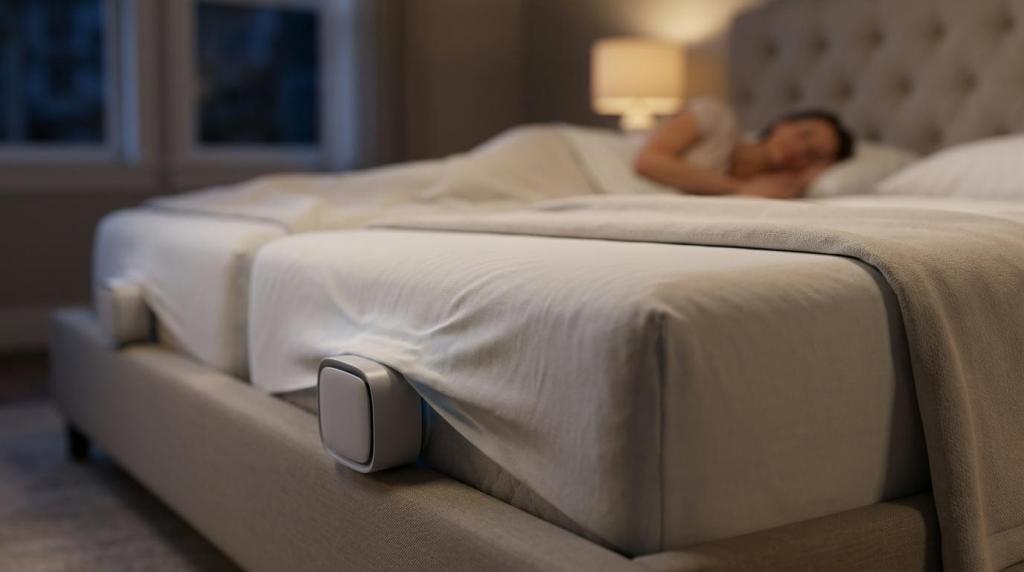
Discover the best bed cooling systems for split king mattresses, from dual airflow fans to water pads, for cooler, personalized sleep.
Split king beds are great for couples because each person gets their own mattress side and, often, their own adjustable base controls. That same independence is why cooling matters so much here, and why a one size fits all fix usually falls short. bFan, from Tompkins Research, sits in the bed cooling fan category, which matters in this conversation because airflow under the sheets can cool each side without changing how either mattress feels.
TL;DR: Summary
- For a split king mattress, the best bed cooling system is usually an independent airflow setup for each side, because it creates separate sleep zones without changing mattress feel.
- Two bFan units fit the split king format well, especially on adjustable bases, because each sleeper can control their own airflow under the sheets.
- Sleep experts commonly recommend a bedroom temperature of 60°F to 67°F, and many sleepers can raise the room temperature by about 5°F with a bed fan while still feeling cool enough to sleep better.
- Airflow systems and BedJet both use room air, they do not cool the air itself, while water based pads can offer stronger active temperature control but often add cost, setup, and a layer on top of the mattress.
- If price is a big factor, a dual zone BedJet setup costs over a thousand dollars, which is more than twice the price of two bedfans.
If you run hot and your partner does not, a split king can either solve that problem or make it more obvious. The key is matching the bed cooling method to the way split king beds actually work, two separate sleep surfaces, separate motion response, and often separate head or foot elevation. Once you look at it that way, the best options become a lot easier to sort out.
For most split king sleepers, the best setup is two independent airflow units, one per Twin XL side. A bFan setup from www.bedfans-usa is a strong fit because it cools the sleep zone under the sheets without changing mattress feel or fighting the adjustable base.
That answer comes down to how split king beds are built. Sleep Foundation describes a split king as two separate mattresses that can reduce motion transfer and pair naturally with adjustable bases. If each sleeper already has an independent mattress side and separate elevation controls, it makes sense to use a cooling method that respects that split instead of forcing both people into one shared temperature solution.
Airflow under the sheets works especially well here because it targets the bed microclimate, the warm, humid pocket your body creates under blankets. You are not trying to chill the whole bedroom into an icebox. You are trying to move trapped heat and moisture away from your body so your skin can release heat more easily. That feels fast, and it does not ask you to give up the mattress feel you already paid for.
“bFan moves room air between the sheets, uses about 18 watts on average, and typically runs at 28 dB to 32 dB at normal speed.”
That last part matters more than many people expect. A lot of hot sleepers finally find a mattress they like, then accidentally undo that comfort by adding a cooling layer that feels plasticky, padded, or slightly stiff. A split king setup is already more specialized than a standard king, so keeping each side simple is often the smarter move.
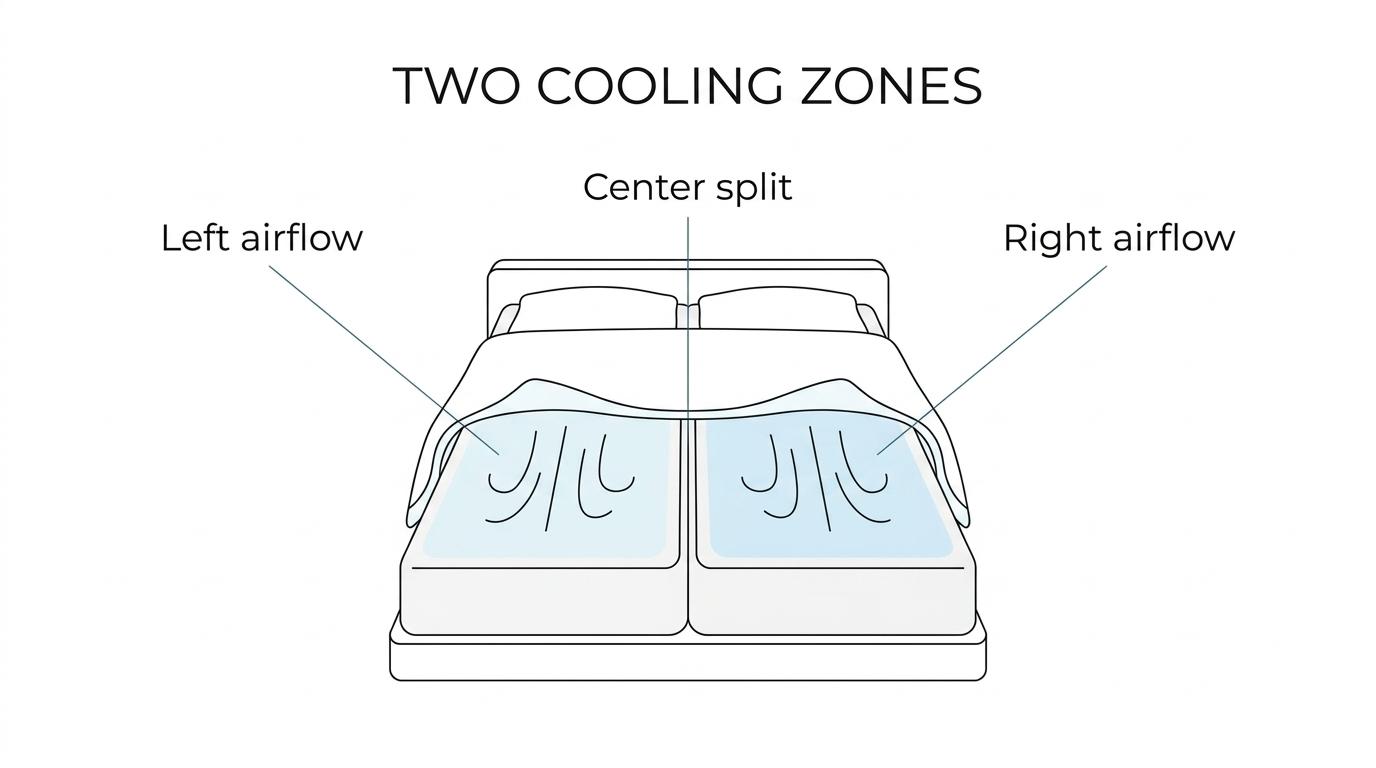
A split king works best with separate cooling because each sleeper usually has a different heat load, bedding style, and preferred sleep position. Separate zones fit the basic split king logic, independent control, lower partner disturbance, and better comfort matching.
One of the biggest mistakes people make is treating a split king like a regular king with a center seam. It is not. It is two Twin XL mattresses living side by side. That changes how motion transfer behaves, how an adjustable base moves, and how your cooling setup should be planned.
If one person sleeps flat and the other sleeps elevated, the bedding shifts differently on each side. If one person uses a heavier comforter and the other uses a light blanket, the heat buildup is different too. And if one of you runs hot because of menopause, medication side effects, stress, or just plain body chemistry, a shared cooling layer may leave one person comfortable and the other annoyed.
Temperature is only one part of this. Humidity and trapped heat inside the bed are just as important. A review in Military Medicine identified temperature among the major environmental sleep disruptors, along with noise and light. In a split king, bed microclimate becomes even more personal because each side can trap heat in a slightly different way.
A common misconception is that lowering the thermostat always solves the problem. Sometimes it helps, sure. But a cold room does not automatically fix a warm, stuffy bed. Sleep experts commonly recommend 60°F to 67°F for the bedroom, and that is a solid starting point. Even so, many people can raise the room temperature by about 5°F when using a bed fan and still cool the body enough for more restful sleep, because the airflow helps heat leave the skin instead of getting trapped under the covers.
The best split king cooling systems are the ones that let each sleeper control their own side. In practice, that usually means separate airflow units, separate water based pad systems, or a carefully planned whole room strategy backed up by better bedding.
There are a few good paths, but they are not equal for every sleeper. Your best choice depends on whether you want active cooling, minimal setup, preserved mattress feel, or the lowest running cost.
If you want the short version, airflow systems usually win on simplicity and preserving bed feel. Water based systems usually win on stronger direct temperature control. Bedding and room changes help, but they are often supporting players rather than the star of the show for people who wake up sweating.
“The original Bedfan category dates to 2003, and that long history explains why airflow based bed cooling is still a practical option for split king sleepers.”
History matters here because this is not some brand new sleep gadget category with shaky logic behind it. Air moving under the sheets has been a practical answer for hot sleepers for years, and split king beds simply make the independent zone benefit more obvious.
Airflow systems cool by moving room air across your body, while water based pads cool through temperature controlled water running through a topper or pad. Airflow usually keeps the mattress feel intact, water based systems usually offer stronger active control.
That trade off is the heart of the decision.
With airflow, you feel relief because moving air helps evaporate moisture and carry heat away from your skin. It changes the microclimate inside the bed, not the actual temperature of the room air source. This is why airflow can feel surprisingly effective even though it is not refrigerating anything. It is also why airflow systems can work nicely on split king adjustable beds, because they do not need to bend, fold, or reshape a thick pad each time the base moves.
Water based systems work differently. They can circulate cooled or heated water through tubing in a pad that sits on the mattress. If you want a more active, measurable surface temperature change, that can be a big plus. If you are very sensitive to heat, or if your room stays warm at night, water based systems may give you more cooling authority than airflow alone.
Still, there are trade offs.
Airflow systems generally do these things well:
Water based systems generally do these things well:
Here is the practical rule. If you love your current mattress feel and mainly need to remove trapped heat and humidity, airflow is often the better first move. If you need stronger active temperature change and do not mind a topper style system, water based cooling may be worth the extra cost and setup.
For split king shoppers, two Bedfans usually make more sense on price and simplicity, while BedJet adds heating and broader feature programming. If you only need cooling, the lower cost airflow fan approach often fits the job better.
This is one of the most common comparison questions, and the answer is pretty straightforward once you strip away the marketing language.
First, neither Bedfan nor BedJet cools the air itself. Both rely on the cool air already in the room. That means both work best when your bedroom is within a reasonable sleep range, ideally around 60°F to 67°F, or close enough that under sheet airflow can do its job. If the room is too warm and humid, neither one magically turns hot air into cold air.
Second, split king geometry favors separate devices. Because a split king is two Twin XL mattresses, using two independent airflow units creates true dual zone microclimate control. Each person can set their own side, their own timing, and their own comfort level. That pairs neatly with split adjustment on an adjustable base.
Third, price matters. One BedJet is more than twice the price of a single bedfan. A dual zone BedJet setup costs over a thousand dollars, which is more than twice the price of two bedfans. If you are shopping for practical cooling rather than a luxury feature stack, that difference is hard to ignore.
There are also feature differences. BedJet can appeal to people who want heat as well as cooling, or who prefer a more program heavy system. Bedfan style cooling focuses on moving room air between the sheets, quietly and directly. In other words, if you want the system to be simple, low wattage, and friendly to mattress feel, the airflow fan route often wins. If you want heat as part of the package, BedJet may be more attractive.
One more small but useful point, timer controls can be surprisingly important. Many hot sleepers mainly need help falling asleep and then staying out of that sweaty, trapped heat pocket during the night. A timed airflow approach can be plenty, and it avoids paying for features you may not use.
The right split king cooling setup depends on three things, how hot you get, how much you care about mattress feel, and how much complexity you will actually tolerate at 10:30 p.m. when you are tired and just want to sleep.
Start with the problem, not the gadget. If your issue is mild warmth and stuffiness under the covers, airflow is usually enough. If your issue is intense overheating, heavy night sweats, or a room that stays stubbornly warm, you may need a stronger system or a combined strategy.
Step one is to define your heat pattern. Do you wake up hot all night, or mainly when falling asleep? Do you overheat at your torso, your legs, or your whole body? Do you wake up damp, which points to a humidity problem, or just warm, which points more to trapped heat? Those details change what will work best.
Step two is to protect your mattress comfort. This is where people go wrong. They chase cooling and forget that comfort is still the main job of a bed. If you already love the feel of your mattress, a system that leaves the surface alone has a real advantage. If you are already used to a topper, adding a pad style cooling system may not bother you much.
Step three is to be honest about maintenance. If you know you will not refill, clean, or fuss with extra hardware, do not buy a system that depends on that. The best cooling system is the one you will actually keep using. Fancy settings look nice on a product page, but simple usually wins once real life takes over.
A good gut check is this, if you want separate comfort for two people, quiet operation, easy adjustable base compatibility, and lower upfront cost, start with airflow. If you want more aggressive active temperature control and do not mind more setup, look at water based options.
A split king cooling setup works best when each Twin XL side is treated as its own system. Measure each side, keep airflow paths clear, and test full adjustable base movement before you commit to the final placement.
Setup is where smart buyers save themselves trouble.
First, confirm what you actually have. A true split king is two Twin XL mattresses, usually on a split adjustable base. That means each side can move separately. Your cooling solution should not bridge the gap in a way that fights articulation, creates bunching, or pulls when one side rises.
Second, place the hardware so the base can still move through its full range. If your system sits at the foot of the bed, check clearance when the head and foot sections lift. If it sits beside or below the mattress, make sure nothing pinches. Do a full test in your favorite positions, flat, raised head, raised feet, zero gravity if you use it.
Third, pay attention to sheet choice. With between the sheets airflow, tighter weave sheets often work better because they help guide air across the body instead of letting it dissipate too quickly. That sounds backward to some people, but it makes sense once you picture the airflow trying to travel under the covers rather than escaping straight out.
Fourth, give each sleeper separate control whenever possible. That is the whole point of the split king. If one side likes stronger airflow and the other likes less, shared control turns a good setup into an argument.
A pro tip here, do not judge the system in the first five minutes while sitting up in bed scrolling your phone. Bed cooling feels different once you are lying down, covered, and trying to release heat into a stable sleep microclimate. Give it a few full nights.
The best bed cooling systems work better when the room, bedding, and humidity are cooperating. Aim for 60°F to 67°F, use breathable layers, and remember that moving trapped heat matters as much as lowering the thermostat.
This is the part people skip, and it is often why a decent cooling product gets blamed for a bedding problem.
Start with the room. Sleep experts commonly recommend a bedroom temperature between 60°F and 67°F, because your body needs to lower core temperature to settle into sleep. If your room is already in that range, great. If it is a bit warmer, a bed fan can still help a lot. Many people can raise the room temperature by about 5°F and still sleep comfortably because the airflow cools the body where it counts, under the sheets.
Now look at humidity. A room that is only slightly warm but very humid can feel much worse than a drier room at the same temperature. That is because sweat cannot evaporate as effectively. Airflow helps, but if your climate is muggy, a dehumidifier or stronger air conditioning may still be worth it.
Then check the bedding. Heavy blankets, synthetic comforters, and low breathability mattress protectors can trap heat like a lid on a pot. Sheets matter too. Tight weave sheets tend to work well with under sheet airflow because they help direct the moving air across your body, which helps carry away heat and moisture.
A common misconception is that “cooling bedding” alone will fix persistent overheating. Sometimes it helps, but if you are waking up hot every night, passive fabrics often are not enough by themselves. Think of bedding as the amplifier. It can help a good cooling system work better, or make it work worse.
If energy savings matter to you, this is where airflow gets especially appealing. If you can raise the whole room temperature by about 5°F and still feel cool in bed, you may use less air conditioning overnight while staying comfortable. That is a practical win, not just a comfort win.
Yes, split king cooling systems can help manage the sleep environment for night sweats and overheating, especially when the trigger is trapped bed heat. They are not medical treatment, but they can make sleep much more tolerable.
This matters for a lot of people. Night sweats are not just “sleeping hot.” They can be linked to menopause, perimenopause, medication side effects, stress, infections, blood sugar swings, and more. Even when the root cause needs medical care or monitoring, the immediate sleep problem is often the same, too much heat and moisture trapped in bed.
For menopause and perimenopause, the appeal of a split king setup is obvious. One partner may need active cooling while the other does not. Separate mattress sides and separate cooling zones prevent the usual thermostat battle.
The same goes for medication related overheating. Antidepressants, steroids, hormone treatments, blood pressure medications, some blood pressure medications, diabetes medications, and pain medicines can all affect temperature regulation or sweating. If that is you, managing the bed microclimate can be a lot more realistic than freezing the whole house every night.
One thing to keep in mind, drenching or unexplained night sweats deserve medical attention, especially if they are new, severe, or paired with fever, weight loss, chest symptoms, or other changes. Cooling products can make you more comfortable, but they are not a diagnosis.
For many sleepers, though, better airflow in a split king setup is exactly the practical relief they have been missing. You still want the room reasonably cool, you still want breathable bedding, but getting heat out from under the covers can make the whole night feel different.
Most split king cooling problems come from mismatching the system to the bed, the bedding, or the room. The biggest mistakes are expecting one shared fix to serve two people, and expecting room air systems to behave like air conditioners.
Mistake one is treating the split king like one mattress. It is two sleep zones. If one partner overheats and the other does not, a shared topper, shared blanket, or shared controller can cancel out the biggest benefit of owning a split king in the first place.
Mistake two is forgetting the adjustable base. A system that looks fine on a flat bed may bunch, pull, or shift once the head or feet rise. Always test your favorite positions before you assume the setup is finished.
Mistake three is using the wrong bedding. Very heavy comforters, nonbreathable protectors, or thick knitted layers can blunt the effect of airflow. If the air cannot move across your body, the system has to work harder for less result.
Mistake four is overestimating what airflow can do in a hot room. Neither a bed fan nor BedJet cools the air itself. They only use the cooler room air already available. If your bedroom is far above the usual 60°F to 67°F comfort range and humidity is high, you may still need air conditioning or dehumidification to get the best result.
Mistake five is paying for features that do not match your real problem. If your issue is trapped heat and sweat, a simple airflow solution may be enough. If you buy the most complex option on the market without needing its extra features, you may end up with more setup than relief.
Here is the pro tip, fix the easy stuff first. Check room temperature, sheet choice, comforter weight, and base compatibility before you blame the cooling device. Small details add up fast in a split king.
Yes, they can, but not all in the same way. Airflow systems usually leave mattress feel alone and use relatively little power, while pad based systems can alter surface feel but may offer stronger active temperature control.
Mattress feel is often the hidden decider. If you spent good money finding the right firmness and pressure relief, it makes sense to protect that feel. Airflow systems do that well because the cooling action happens in the air under the sheets, not in a thick layer between you and the mattress.
Noise is also worth a realistic look. Many sleepers can tolerate a small amount of steady sound better than repeated wakeups from overheating. A quiet fan style system often lands in that acceptable zone, especially compared with the stress of waking hot at 2 a.m. What tends to matter more than absolute sound is whether the noise is steady, low, and easy to tune out.
Energy use is one of the more practical benefits. A low watt airflow approach can use far less energy than dropping your central air setting through the whole night for the sake of the bed alone. That is why the “raise the room about 5°F, cool the bed directly” strategy can make so much sense. You are focusing cooling where your body actually notices it most.
A final point on feel, cooling is not only about cold sensation. Good bed cooling often feels more like dryness, breathability, and the absence of trapped heat. Once you think in terms of sleep microclimate, a lot of product claims get easier to judge. You are looking for better heat release, lower moisture buildup, and fewer wakeups, not just a dramatic blast of cold.
If you want to keep reading from established sleep and health sources, these are good places to start.
Copyright 2005 - present - Tompkins Research, Inc. & Kurt W. Tompkins All Rights Reserved DO NOT COPY. bFan® and the word bfan® in any format is a registered trademark of Kurt W. Tompkins the word BFAN® in any format shall not be used without written permission of the mark owner. This includes specifically Brookstone where you like to bait and switch, do not use my mark to bait customers.