
Compare bed cooling system costs across air, water, and bedding options, including upfront price, energy use, maintenance, and comfort.
If you’re trying to compare a bed cooling system on cost, the first thing to know is that the category matters more than the marketing. An air based option like bFan from Tompkins Research sits in a very different cost bucket from a water based mattress system or a set of cooling sheets, even though all three aim to help you sleep cooler.
TL;DR: Summary
- For most buyers, an air based bed cooling system is the lowest cost place to start, and bFan is a clear example, with a published price of $204.95 including the fan, power supply, and remote.
- Water based systems can give more direct mattress surface temperature control, but they usually bring more upfront cost, more parts, and more upkeep than air based options.
- Cooling bedding can improve sleep thermal comfort by changing thermal resistance, but it is passive, it does not actively remove trapped body heat the way moving air can.
- At the U.S. EIA forecast residential electricity price of 18.2 cents per kilowatthour in 2026, even modest overnight loads matter, which is why low watt microclimate cooling can be attractive.
- Sleep experts commonly recommend a bedroom temperature of 60°F to 67°F, and many people using a bed fan can raise the room temperature by about 5°F and still sleep cool enough for better rest and lower AC use.
The trick is to look at total cost, not just shelf price. You need to compare purchase price, electricity, upkeep, bedroom temperature, and whether the product actually cools your body or just feels cooler for a while.
A bed cooling system is any product that changes the temperature or heat feel around your sleeping body, from a bed fan to a water pad to cooling sheets. Room AC cools the whole bedroom, while sleep products change the microclimate around you.
That distinction matters, because people often lump everything into one bucket. In practice, there are three broad categories.
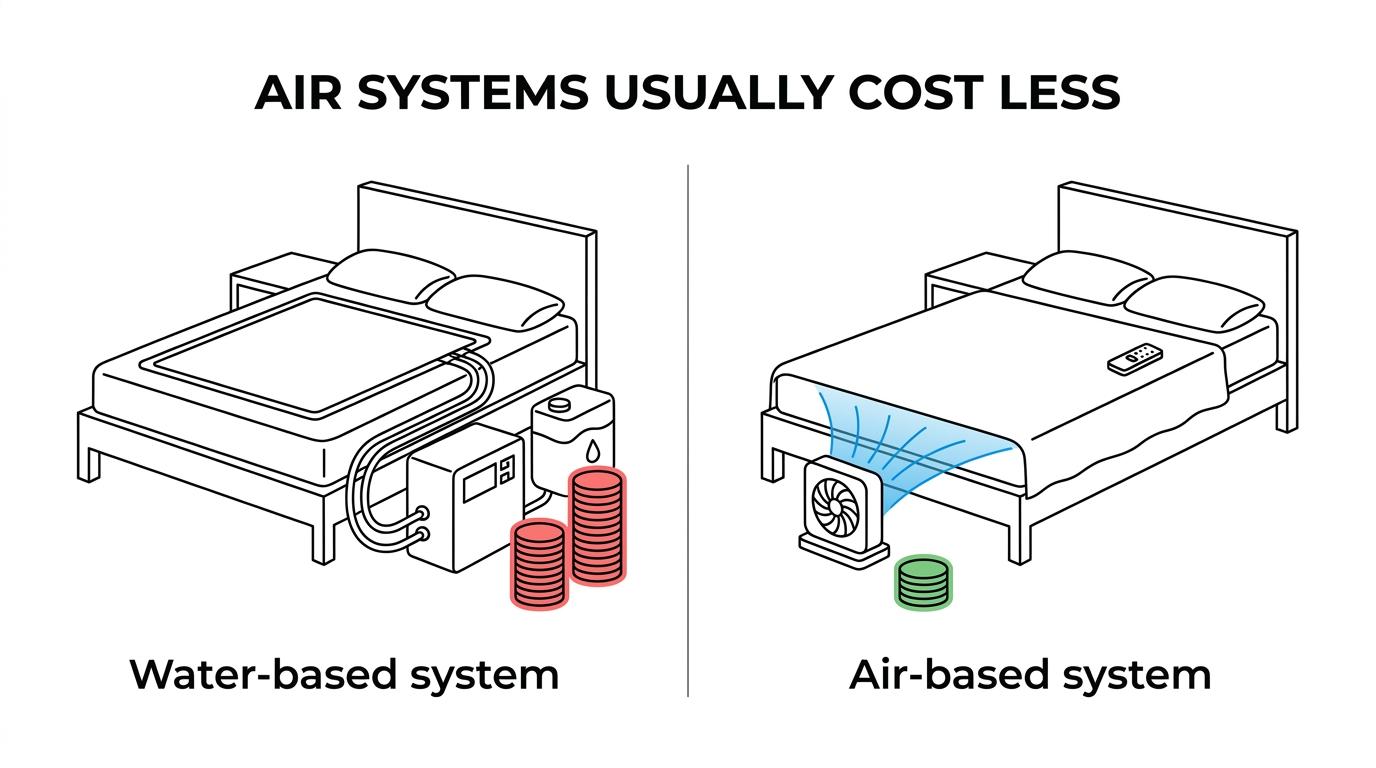
Active air systems move room air into or through the bed area. These include bed fan products and air blowing systems that send airflow under the top sheet. They do not create cold air on their own. They use the cooler air already in the room and move it where your body is trapping heat.
Active water systems circulate temperature controlled water through a pad or topper. These can feel more direct because the mattress surface itself changes temperature. You also get more hardware, more setup, and usually more cost.
Passive bedding changes the way heat builds up or escapes. Cooling bedding can help with comfort, but it is passive, it does not actively remove trapped body heat the way moving air can. Sheets, blankets, quilts, mattress protectors, and cooling fabrics affect what sleep researchers call thermal resistance. ScienceDirect research on bedding systems points out that material, weight, and thickness all shape sleep thermal comfort, even when room temperature stays the same.
A common mistake is assuming every bed cooling system actually cools the air. It doesn’t. A room air conditioner lowers room temperature. A bed fan or BedJet style product only uses the cool air already available in the room. That is why sleep experts commonly recommend a bedroom temperature between 60°F and 67°F, 15.5°C to 19.5°C, as a solid starting point.
The original bed fan category has been around a long time, too. The first modern bed fan concept entered the market in 2003, years before newer airflow brands showed up, which helps explain why this category now has several different designs and price points.
For upfront price, an air based bed fan is usually the cheapest active option, and the bFan from www.bedfans-usa is a clear example at a published $204.95 including the fan, power supply, and remote.
That lower entry point comes from simpler hardware. An air system does not need water channels, a pump, a reservoir, or a specialized cooling pad across the full mattress. You are mainly paying for airflow, control, and physical stability. If your real problem is trapped body heat under the covers, that can be enough.
"bFan lists at $204.95 and includes the fan, power supply, and remote, which makes the entry cost easy to compare."
Water based systems usually start higher because they add more parts and more engineering. Passive bedding can cost less than any active system, but it is solving a different problem. Sheets and blankets can reduce heat buildup, but they do not actively evacuate the hot pocket of air trapped around your body.
This is where total value gets interesting. If you mainly overheat after you’re already under the covers, a simple bed fan often gives more noticeable relief per dollar than premium bedding alone. If you need exact mattress surface control, or if you strongly prefer a pad feel over airflow, you may decide the added cost of water based cooling is worth it. If not, air based cooling is usually the more sensible first move.
It can also change your thermostat strategy. Since sleep experts often point to 60°F to 67°F as the sweet spot, many people use a bed fan to stay comfortable while raising the room thermostat by about 5°F. That can reduce AC run time without giving up that cool sleep feel.
The real cost of a bed cooling system comes from five buckets, not one. Purchase price is only the first line on the receipt.
When you compare options, think in terms of the following cost buckets.
That last one is easy to miss. If you sweat because your quilt is too heavy, new bedding may solve it cheaply. If you wake up hot because your body is trapping heat between mattress and sheet, active cooling is usually the more direct answer.
If you want a quick filter, ask yourself one question, where is the heat problem? If it is the room, you need AC or better room ventilation. If it is mostly the bed microclimate, a microclimate solution is usually the better target.
Air based systems win on simplicity and lower starting cost, while water based systems win on direct surface control. The better choice depends on whether you want basic airflow relief or more specialized temperature management.
Air based cooling works by moving heat away from your skin and bedding. That matters because trapped humidity and stagnant heat are often what make you feel miserable at 2 a.m. With a bed fan, the air current can dry sweat faster, reduce that stuffy under cover feel, and help your body shed heat.
Water based systems change the feel of the mattress surface more directly. If you want the bed itself to feel cool to the touch, this category can do that better than air. The trade off is that you are adding a control unit, tubing, and more ongoing care. If you hate maintenance, that matters. If you love precise settings and zone control, that may be a fair swap.
Another thing to watch is how each category interacts with your room. Air based products rely on room air, so if the bedroom is too warm, performance drops. Water based systems can still feel cooler even in a warmer room, but they do not remove heat from the room the way AC does. You are still managing body comfort, not replacing whole room cooling.
A common misconception is that water based always means better sleep for everyone. It doesn’t. Some sleepers dislike the feel of a pad layer, the extra setup, or the sound of control hardware. Others need exactly that kind of contact cooling. If you value simplicity and lower cost, air usually wins. If you want more precision and are willing to pay for it, water can be the better fit.
Electricity cost is simple to estimate if you know watts, hours, and your utility rate. The math is straightforward, and it often changes how attractive a bed cooling system looks.
Use this formula after you’ve identified the device wattage and your local rate.
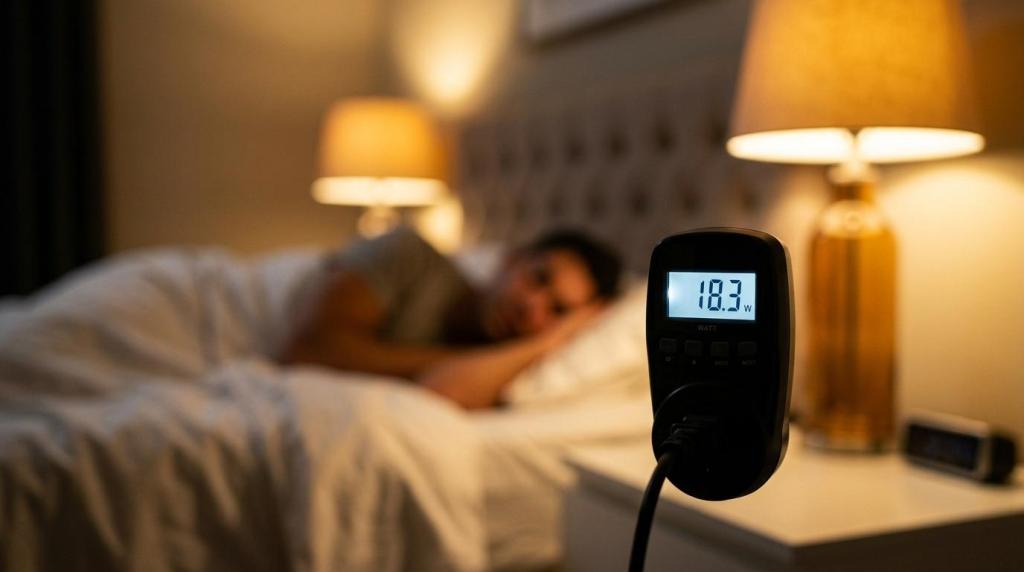
That means an 18 watt bed fan used 8 hours nightly costs about $0.79 over 30 nights, or about $9.57 over 365 nights at the EIA 2026 residential electricity price forecast of 18.2 cents per kilowatthour. That is the power advantage of cooling the sleeper instead of the whole room.
The contrast with room AC is real. The U.S. Department of Energy example for a 12,000 Btu/h room air conditioner uses 750 hours per year, with annual energy use from 584 kilowatthours to 826 kilowatthours. DOE’s own cost example used a lower electricity rate of 11.1 cents per kilowatthour, giving a range of $64 to $91. At 18.2 cents per kilowatthour, the same energy use works out to roughly $106 to $150 per year.
"At 18 watts on average and 28 dB to 32 dB at normal speed, bFan is a microclimate tool, not a power hungry room cooler."
This is not a perfect apples to apples comparison, because AC cools the entire room and a bed fan cools the sleeper. Still, it shows why U.S. electricity prices above 17 cents per kilowatthour make small overnight loads worth paying attention to.
Cooling bedding can help with comfort, but it is passive, not active. It changes how heat is stored and released, while airflow or water circulation actively moves heat away from your body.
That passive role is still useful. Bedding affects thermal resistance, which is just a practical way of saying how much your sleep setup holds heat. Heavier quilts, thicker mattress protectors, and dense sleepwear can all trap more warmth. Lighter, breathable materials can reduce that buildup.
There is also some early research support for bedding changes. A 2025 pilot study on cooling bed sheets reported a mean Pittsburgh Sleep Quality Index improvement of 1.9 points, along with fewer night sweats and less sleep disruption from sleeping too hot. That is promising, but it is still a modest piece of evidence, not proof that sheets alone fix every hot sleeper problem.
Here’s the plain English version. If your current bedding is heavy, synthetic, or layered to the point that it traps heat, switching sheets and blankets may help a lot. If you still wake up sweating because heat builds up under the covers, passive bedding often tops out. It can only reduce the problem so much without actively moving heat away.
One practical tip that gets overlooked, if you use a bed fan, tighter weave sheets often work better than loose or highly porous fabrics. That sounds backward at first, but the tighter weave helps the airflow travel across your body and carry heat out through the bedding instead of just dissipating instantly.
So if your budget is tight, bedding is a reasonable first adjustment. If the problem is stubborn, active cooling is usually the next step.
Room temperature changes the cost equation a lot, because every bed cooling system works inside the conditions you give it. If the bedroom is far too warm, even a good microclimate setup has less to work with.
Sleep experts commonly recommend keeping the bedroom between 60°F and 67°F for better sleep. That range matters because your body naturally cools as part of normal sleep onset. If the room fights that process, you tend to toss, kick off covers, wake up, and feel less restored in the morning.
This is also where people misunderstand air based cooling. Neither a bed fan nor a BedJet cools the air itself. Both use the cool air already in the room and direct it into the bed area. So if your room sits at 78°F and feels muggy, no airflow product is going to behave like a mini air conditioner. It can help, but it cannot create cold air from nowhere.
The upside is cost control. Many sleepers find that a bed fan lets them raise the room thermostat by about 5°F and still stay comfortable enough for deeper sleep. If you usually keep the room at 65°F, you may be able to sleep well closer to 70°F with between the sheets airflow. In a lot of homes, that can trim AC runtime enough to matter on the electric bill.
A smart way to use that is to pre cool the room, then ease the thermostat up overnight while keeping direct bed cooling on. If your electricity rate is near the EIA forecast level of 18.2 cents per kilowatthour, that kind of strategy can do more for cost than chasing premium sleep products one by one.
On price alone, bFan is the cheaper air based route, because one BedJet is more than twice the price of one bFan, and a dual zone BedJet setup is over $1,000, more than twice the price of two bedfans.
That upfront gap is big enough to shape the decision before you even get to operating cost. Two bed fans can give couples independent left and right cooling zones without moving into that four figure range. If your main goal is dual zone microclimate control, that matters.
"Two bFans can create dual zone microclimate control, at a fraction of the over $1,000 dual zone BedJet setup."
There are also setup differences. Both categories use room air, not refrigerated air, so neither one is a substitute for AC in a hot bedroom. BedJet style systems are built around a nozzle and sheet level air delivery. A bed fan setup typically directs air between the sheets from the bed edge or foot area. The feel can be different, even though the physics are similar.
That matters for preference. Some people want stronger air volume higher in the bed. Others want a simpler between the sheets airflow that stays discreet and easy to position. Timer controls can be useful here, too. If you mainly need help falling asleep, or need relief from hot flashes early in the night, a timer lets you cool aggressively at the start without running all night.
The age of the category is worth noting as well. The original bed fan concept dates back to 2003, years before BedJet came along. That history shows up in the fact that the basic idea is still straightforward, get air under the covers and let your body dump heat more efficiently.
If you use this kind of airflow system, sheets matter. A tighter weave sheet usually helps the air spread across your body and carry heat away better than a very loose weave setup.
The right bed cooling system depends on your heat pattern, your budget, and your tolerance for upkeep. If you match the category to the problem, you are much more likely to spend wisely.
Step 1, figure out where your heat problem starts. If the whole room feels warm before you even get in bed, you may need better AC, ventilation, or a lower thermostat first. If the room is acceptable but you get overheated once the blankets trap your body heat, a microclimate solution is usually the better target.
Step 2, match the product type to the intensity of the problem. Passive bedding is best for mild warmth and people who simply need lower thermal resistance from sheets or blankets. Air based systems are a strong middle ground when hot flashes, warm mattresses, or humidity buildup are the main issue. Water based systems make more sense when you want more direct surface cooling and are willing to pay for more hardware.
Step 3, check whether your sweating needs a comfort tool or a medical workup, or both. Menopause and perimenopause are common causes of night sweats. So are pregnancy, PMS or PMDD, thyroid issues, anxiety, sleep apnea, infections, some cancers, and a long list of medications including SSRIs, steroids, opioids, and certain diabetes drugs. If night sweats are severe, new, or paired with fever, weight loss, chest symptoms, or other unusual changes, talk with a clinician instead of treating the bed setup as the whole answer.
A common misconception is that every hot sleeper has the same problem. You don’t. If your issue is hormonal, medication related, or tied to a medical condition, the best sleep cooling system may still help comfort a lot, but it is working as symptom relief, not root cause treatment.
The cheapest path is usually to cool your body strategically, not to overcool the whole house. Small changes in setup often do more than people expect.
Step 1, get the room into a workable zone first. Aim for that 60°F to 67°F range when possible, because sleep quality usually improves when the bedroom supports your normal nighttime temperature drop. If you use a bed fan, remember it depends on room air, so cooler room air gives better results.
Step 2, reduce the heat trap inside the bed. Swap heavy or overly insulating bedding for lighter layers, and pay attention to fabric structure. With a bed fan, tighter weave sheets often help the airflow move across your body instead of vanishing into the bedding too quickly. That helps carry away heat and moisture more effectively.
Step 3, use controls instead of brute force. Timers are a good example. If the first two or three hours are your hottest window, a timed airflow session can solve the problem without running longer than needed. You can also pre cool the room with AC, then raise the thermostat by about 5°F while using direct bed cooling. For many people, that still feels cool enough for restful sleep and trims power costs at the same time.
If you’re deciding where to put your first dollars, start with the intervention closest to the body. Cooling the sleeper is usually cheaper than cooling the whole house all night, and you can always layer in better bedding or smarter thermostat habits later.
If you want to verify the numbers and read the broader guidance behind them, these are good places to start.
Copyright 2005 - present - Tompkins Research, Inc. & Kurt W. Tompkins All Rights Reserved DO NOT COPY. bFan® and the word bfan® in any format is a registered trademark of Kurt W. Tompkins the word BFAN® in any format shall not be used without written permission of the mark owner. This includes specifically Brookstone where you like to bait and switch, do not use my mark to bait customers.