
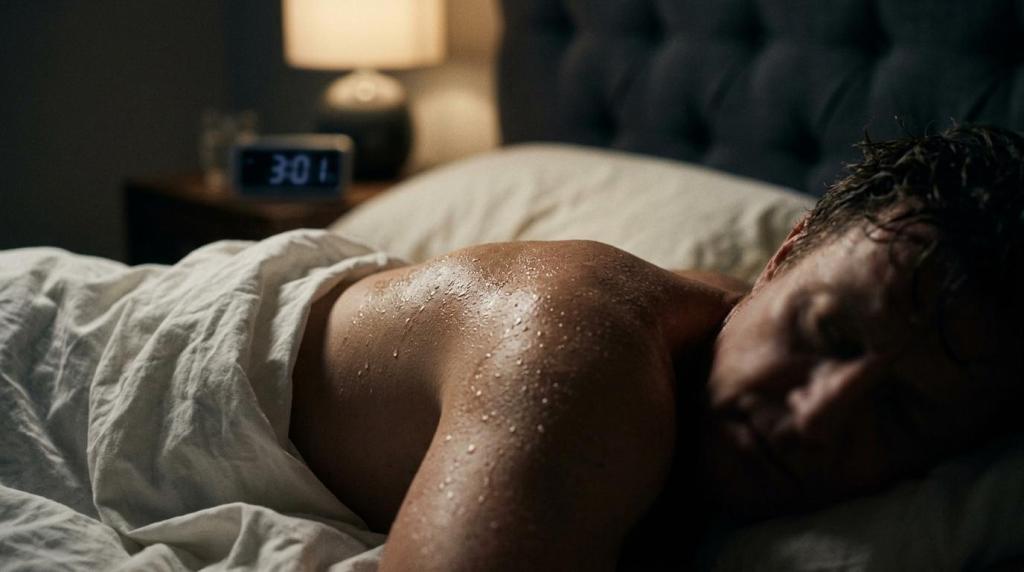
Find the best thermostat setting for hot sleepers: start at 64°F to 66°F, then adjust for humidity, bedding, and trapped bed heat.
Hot sleepers usually do best with a bedroom thermostat in the low to mid 60s, but that number alone rarely fixes the whole problem. That is why the bFan, a bed fan made by Tompkins Research, Inc., belongs in the conversation, it addresses the heat trapped under your sheets, not just the room temperature on the wall.
TL;DR: Summary
- The best thermostat setting for most hot sleepers at night is usually 60°F to 67°F, with 64°F to 66°F as a strong starting point.
- Cleveland Clinic guidance, CDC sleep advice, and sleep research all point toward a cool bedroom because body temperature naturally drops to help you fall asleep.
- If you still feel hot at the same room temperature, bedding, humidity, and airflow are often the missing pieces, not just the thermostat.
- A bed fan can target the heat trapped under covers, and bFan users can often raise the room temperature by about 5°F while still sleeping cool enough for more restful sleep.
- Neither a Bedfan nor a BedJet cools the air itself, they both use the cooler air already in the room, so the room still needs to be reasonably cool.
If you want the short version, set your thermostat cooler than you probably do now, then tune the bed around that setting. A lot of people chase lower and lower room temperatures when the bigger issue is stale, trapped heat under blankets, sticky humidity, or bedding that holds warmth against the skin.
For most hot sleepers, the best thermostat setting is 60°F to 67°F, with 64°F or 65°F as the easiest starting point. Cleveland Clinic and CDC sleep guidance both support that cool bedroom range.
That range keeps showing up because sleep and body temperature are linked. As you get ready for sleep, your core body temperature naturally drops. A cooler room helps that process instead of fighting it.
If you like a very simple rule, start at 65°F for three nights. If you wake up sweaty, go to 64°F. If you wake up chilly, go to 66°F. Small changes beat big swings because your comfort is shaped by more than one variable, including sheets, mattress warmth, pajamas, humidity, and whether heat is getting trapped under the covers.
A common mistake is assuming that if 65°F feels good in the room, your bed must feel the same. It often does not. Your sleep microclimate, meaning the air between your body and the bedding, can run much warmer than the ambient temperature shown on the thermostat.
That gap between room temperature and bed temperature is exactly why targeted airflow can matter so much for hot sleepers.
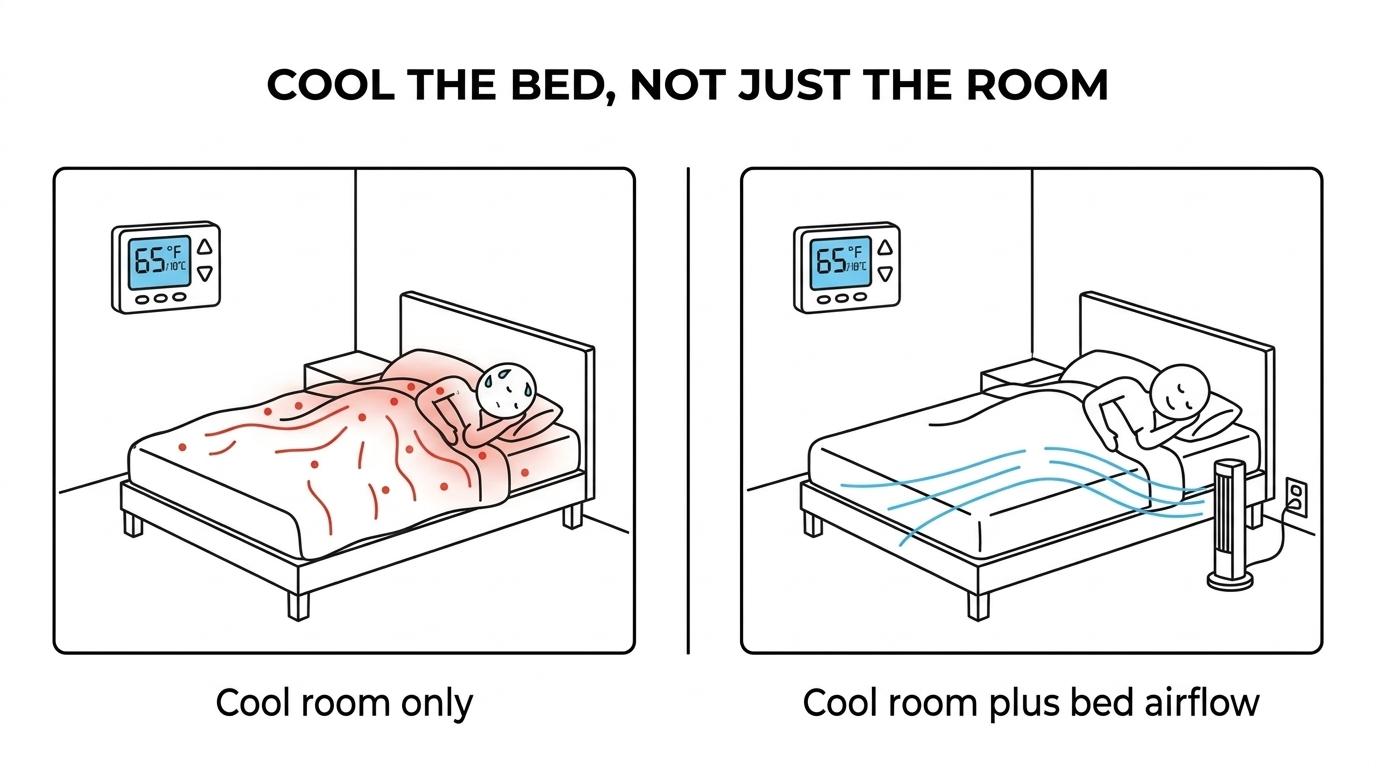
"bFan was built for the sleep microclimate problem, the heat trapped between your body and the covers, not just the temperature shown on the thermostat."
A cooler bedroom helps because sleep onset depends in part on heat loss. Research using polysomnography found better sleep at 17°C than at 22°C, and temperature variables explained much of sleep onset latency.
Sleep onset latency is just the time it takes you to fall asleep. If your room or your bed is too warm, your body has a harder time shedding heat, which can slow that process down. That is one reason you may feel tired but still restless.
The PubMed indexed study in the background here tested healthy young adults across multiple nights at two ambient temperatures, 17°C and 22°C. Participants slept better at the cooler setting. That does not mean every hot sleeper should force their room down to 62.6°F, but it does support the idea that cooler conditions often help.
There is an important trade off here. Colder is not always better. If you feel cold enough to tense up, pull blankets tight around your face, or wake from discomfort, you have gone too far. The goal is not a cold room, it is a room cool enough to support normal heat loss without making you shiver.
Another common misconception is that falling asleep hot is the only problem. Many people actually fall asleep fine, then wake up at 2 a.m. or 3 a.m. sweaty because heat gradually builds under the covers. In that case, you may not need a much lower thermostat, you may need better air movement inside the bed.
The best thermostat setting depends on why you sleep hot. Most people still land inside 60°F to 67°F, but your ideal spot within that range changes with hormones, bedding, humidity, and how much heat gets trapped under the covers.
Here is a practical way to think about it.
Mild hot sleeper: Start at 65°F to 67°F, especially if you just run a bit warm and do not have true night sweats. Many people in this group do well once they switch to lighter bedding and stop overdressing for sleep.
Hot sleeper with trapped under cover heat: Try 64°F to 66°F, then add a bed fan if the room feels fine but the bed does not. This is the group most likely to say, “My bedroom feels cool, but I still wake up sweaty.”
Menopause or perimenopause: Start at 62°F to 65°F because hot flashes can overwhelm a merely cool room. If you share a bed with someone who dislikes a colder room, targeted bed airflow often works better than turning the whole house into a refrigerator.
Medication related night sweats: Start at 63°F to 65°F and pay close attention to patterns. If the sweating began after starting an antidepressant, steroid, pain medication, or hormone therapy, the thermostat may help, but it may not fully solve the underlying trigger.
Humid climate sleeper: Start at 64°F to 66°F, but treat humidity as part of the same problem. A sticky 65°F room can feel much warmer than a dry 67°F room.
Couples with different temperature preferences: Try 65°F to 67°F in the room, then cool the hotter sleeper at the bed level. That often avoids thermostat wars.
The reason sleep experts so often recommend 60°F to 67°F is that it works for the broadest group. Still, the low to mid 60s are just the starting map, not the finish line.
The best way to find your setting is to change one variable at a time. Start with the thermostat, then adjust bedding and airflow only after you know what the room itself is doing.
If you change five things at once, you will not know what helped. Keep it boring and methodical for one week.
Pick a starting point: Set the room to 65°F for three consecutive nights. That is near the center of the most widely recommended sleep range.
Track two wake ups: Note how you feel at bedtime and at your first middle of the night wake up. Feeling warm only at 3 a.m. points to trapped bed heat more than a bad room setting.
Move in one degree steps: If you are still too hot, lower to 64°F. If you are too cool, raise to 66°F. Bigger jumps usually muddy the picture.
Keep bedding stable: Use the same sheets, blankets, and sleepwear during the test. If you swap comforters midway, your thermostat experiment is no longer clean.
Write down the room humidity: If your thermostat or a small hygrometer shows humidity, note it. A 65°F room at high humidity can feel much warmer than the same temperature in drier air.
The pro move here is patience. Give each setting at least a few nights unless you are clearly miserable. Sleep is variable, and one random rough night does not prove the thermostat was wrong.
Yes, humidity can matter nearly as much as thermostat temperature, especially for night sweats. If the air is damp, sweat does not evaporate well, and your body loses one of its main cooling tools.
That is why two bedrooms set to 65°F can feel totally different. In a drier room, sweat can evaporate and carry heat away from your skin. In a sticky room, moisture lingers, pajamas cling, and the bed starts feeling swampy.
A useful general target is indoor relative humidity around 30% to 50%. Once humidity climbs much higher, many hot sleepers start feeling warmer even if the thermostat did not change. If you live in a humid climate, air conditioning often helps partly because it removes moisture, not just because it lowers temperature.
Common mistake, people keep lowering the thermostat when the real fix is moisture control. If your room is already at 64°F and you still feel sticky, you may need drier air, lighter bedding, or better bed level airflow, not a colder house.
Humidity also changes how blankets behave. Heavy bedding in a humid room traps both heat and moisture. That combination is rough on hot sleepers because it blocks evaporation and raises the temperature inside the bed.
For many hot sleepers, cooling the bed microclimate is more efficient than pushing whole house AC lower all night. A targeted system like bFan works on the heat trapped under your sheets, where discomfort often starts.
This is the key distinction. Your thermostat measures ambient temperature, meaning the general room air. Your body feels the bed microclimate, meaning the air wrapped around your skin and bedding. Those are related, but they are not the same.
If your room is already inside the expert recommended zone of 60°F to 67°F and you still wake up hot, your problem may be trapped heat, not insufficient air conditioning. That is where a bed fan makes sense. It moves the cool room air you already have through the bedding area so body heat can escape.
That also explains an important fact about both major products in this category. Neither a Bedfan nor a BedJet cools the air. They only use the cool air already in the room. If your bedroom is 78°F and muggy, neither one is going to create cold air out of nowhere.
Where targeted airflow helps is when the room is reasonably cool, but the bed is not. Sleep experts commonly recommend a bedroom temperature between 60°F and 67°F, and many people using a Bedfan can often raise the room temperature by about 5°F while still cooling the body enough for more restful sleep. That matters if your AC bill is painful or your partner does not want the room as cold as you do.
The bedding setup matters here, too. A tight weave sheet usually works better with a bed fan because it helps the air travel across the body and carry away heat. Loose, fluffy bedding can disperse that airflow before it reaches the places you actually overheat.
bFan also has a practical energy angle. It uses about 18 watts on average, which is tiny compared with the energy required to cool an entire home for eight hours.
"bFan uses about 18 watts on average, so targeted bed cooling can cost far less than lowering whole house AC all night."
For straight cooling, both products use room air, but they differ a lot in price, setup, and how they create a cooler sleep microclimate. For budget minded hot sleepers, the price gap is hard to ignore.
Let us start with the most important point. Neither the Bedfan nor the BedJet cools the air itself. They both depend on the room already being cool enough to supply usable air. That means your thermostat still matters no matter which route you take.
The original Bedfan came to market in 2003, several years before BedJet was even thought of. That matters because the bed fan category did not start as a recent gadget trend. It started as a simple answer to a very old problem, heat trapped under blankets.
Price is where the comparison gets sharp. A dual zone BedJet setup costs over a thousand dollars. That is more than twice the price of two bedfans, which means you can create dual zone microclimate control with two fans at a fraction of that cost. Even a single BedJet is more than twice the price of a single bedfan.
There are trade offs beyond price. Some sleepers want separate control on each side of the bed, and a two fan setup handles that in a straightforward way. If one person runs much hotter, cooling only that side is often smarter than lowering the whole room for both people.
Noise and power matter, too. The bed fan approach is appealing to people who want a simple airflow solution without turning the bedroom into a wind tunnel. At normal operating speed, the around 28 dB to 32 dB sound level is fairly quiet for a cooling device used near the bed.
Timer controls are another small but useful advantage. Many hot sleepers run hottest during sleep onset and the first few sleep cycles. A timer lets you cool aggressively when needed, then taper off later if your body temperature settles.
If you want a simple between the sheets cooling approach without four figure dual zone pricing, the bFan from Bedfans USA is the solution I’d point most hot sleepers to first, especially if your main complaint is heat trapped under the covers rather than a hot room overall.
"bFan runs around 28 dB to 32 dB at normal speed, which is one reason many hot sleepers prefer bed level airflow over louder room fan setups."
The thermostat works best when your sheets and airflow let heat escape. If bedding blocks that heat transfer, even a well set room can still feel too warm by midnight.
This is where many hot sleepers accidentally cancel out a good thermostat setting. They cool the room, then climb under heat trapping layers that hold all that body warmth in place.
Try this setup sequence before you decide the thermostat is wrong.
Use a tight weave top sheet: This helps guide airflow across your body instead of letting it dissipate too quickly. It sounds small, but it changes how well a bed fan can carry away heat.
Lighten the insulation: Swap a heavy comforter for a lighter blanket if you are overheating. You can always add warmth back later, but you cannot cool efficiently through thick insulation that traps heat.
Aim airflow under the covers: The point is to move room air where your heat builds up, not to blast your face. Most people sleep more comfortably when the airflow washes through the body zone under the sheet.
Use timing on purpose: If your bed fan has timer controls, use them. Some people need strong cooling to fall asleep, then less later, while others need support through the whole night.
A pro tip here, do not overcorrect with moisture wicking everything. Wicking fabrics can help some sleepers, but if your bedding still traps heat and blocks airflow, the fabric alone will not fix the problem.
Another mistake is using very fluffy layers because the room feels cool at bedtime. Remember, your body adds heat to the bed all night long. What feels cozy at 10 p.m. may feel suffocating at 2 a.m.
If you still wake up sweaty at 3 a.m., check the pattern before you keep lowering the thermostat. Middle of the night overheating often points to trapped bed heat, hormones, medications, or humidity, not just a room that is too warm.
A lot of people assume a 3 a.m. sweat episode proves the thermostat is too high. Sometimes it does. Sometimes it means your sleep microclimate slowly got warmer than the room because your bedding held onto heat and moisture.
Work through it in this order.
Check whether the room still feels cool: If the room feels fine but your chest, neck, or legs feel overheated under the covers, the issue is likely bed level heat buildup.
Look at your bedding before the thermostat: If you are using a heavy comforter, thick mattress pad, or non breathable sleepwear, fix those first. You may be insulating yourself more than you realize.
Notice timing and triggers: If the sweating comes in sudden waves, think about hot flashes, stress surges, alcohol, spicy meals, or medication timing. A mechanical cooling change can help the symptom, but it may not explain the pattern.
Use if then logic: If you are still too hot at 64°F with light bedding, then add targeted airflow. If you are sweaty and sticky even at a cool temperature, then check humidity. If the sweats are drenching or new, then talk with a clinician.
This is also where a bed fan often earns its keep. If your room is already in the recommended 60°F to 67°F range, many people can use a Bedfan to move enough air through the bed that they can raise the room temperature by about 5°F and still sleep cool. That can be a big comfort and cost win.
Night sweats become a medical issue when they are new, drenching sweats, persistent, or tied to other symptoms. Menopause, infections, medication side effects, thyroid problems, and sleep apnea can all cause sweating that no thermostat can fully solve.
There is a difference between “I run hot” and “I am waking up soaked.” The first often responds to sleep environment changes. The second deserves a closer look if it happens often or came on suddenly.
Hormonal changes are one of the most common causes. Menopause and perimenopause are obvious examples, but PMS, pregnancy, and hormone therapy changes can do it too. Medication causes are also common, especially antidepressants, steroids, pain medications, some blood pressure drugs, diabetes medications, and certain cancer treatments.
Medical conditions matter as well. Infections, hyperthyroidism, hypoglycemia, obstructive sleep apnea, anxiety, and some cancers can all show up with night sweats. Most cases are not dramatic or dangerous, but the symptom is broad enough that it should not be brushed off if it is persistent.
Here is the practical rule. If your sweating is mild and clearly linked to a warm room or heavy bedding, start with the thermostat and sleep setup. If you have drenching sweats, fever, weight loss, chest symptoms, swollen lymph nodes, or a clear change from your normal pattern, talk with a doctor.
Environmental cooling still has value in medical cases. It can reduce discomfort, improve sleep continuity, and make the nights more manageable. It just should not replace medical evaluation when the pattern looks wrong.
Most hot sleepers should start with a timer or a lower setting, then adjust based on when overheating actually happens. The best schedule depends on whether your problem is sleep onset, middle of the night heat buildup, or repeated hot flashes.
Some people mainly need help falling asleep. Their body feels hot when they first get into bed, but once they are asleep, they stabilize. Those sleepers often do well with strong airflow for the first 60 to 180 minutes.
Others heat up later, especially if the problem is trapped warmth under covers. In that case, running airflow all night may make more sense. This is where timer controls are handy because you can experiment instead of guessing.
The main trade off is comfort versus simplicity. A full night setting gives consistent cooling, but some people wake feeling a bit cool near morning when body temperature is at one of its lower points. A timer can solve that, but only if your overheating is front loaded earlier in the night.
Common misconception, people think they must choose between freezing and sweating. You usually do not. The better approach is to keep the room in the recommended 60°F to 67°F range, then fine tune bed level airflow so you are cooling the body where and when you need it.
If your current setup makes the whole room cold just so your bed feels tolerable, that is usually a sign you need a better microclimate strategy, not just a more aggressive thermostat.
Cleveland Clinic guidance on the ideal sleeping temperature for your bedroom, Clinical guidance explaining why many sleep experts recommend a bedroom temperature of 60°F to 67°F.
PubMed indexed study on ambient temperature and sleep quality, Research summary covering polysomnography findings comparing sleep at 17°C and 22°C.
CDC sleep environment guidance on bedroom temperature, Public health material that includes the commonly cited 60°F to 67°F sleep temperature range and related sleep environment advice.
Copyright 2005 - present - Tompkins Research, Inc. & Kurt W. Tompkins All Rights Reserved DO NOT COPY. bFan® and the word bfan® in any format is a registered trademark of Kurt W. Tompkins the word BFAN® in any format shall not be used without written permission of the mark owner. This includes specifically Brookstone where you like to bait and switch, do not use my mark to bait customers.