
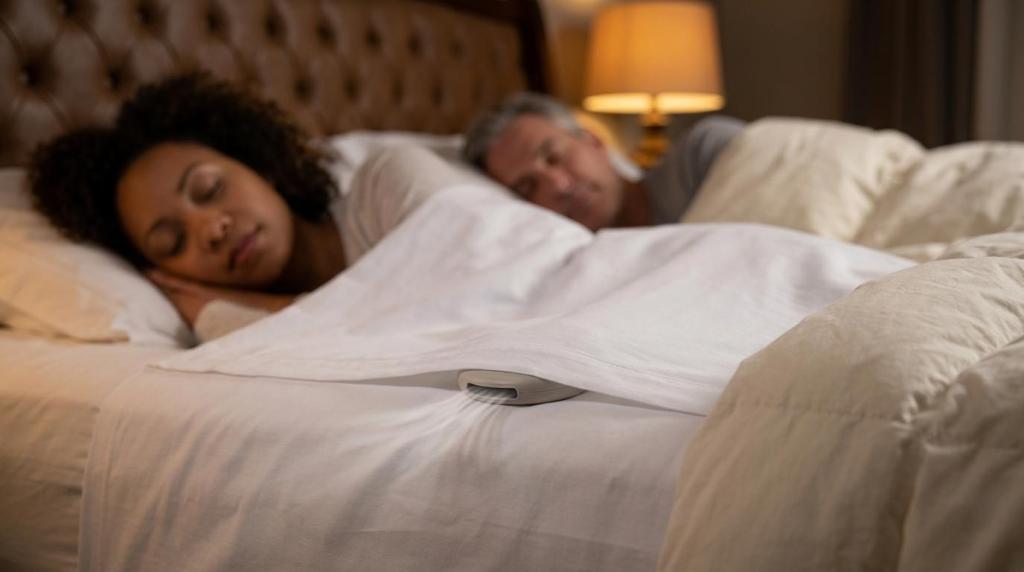
Discover the best bed fans for couples with different sleep temperatures, using targeted airflow for cooler, more comfortable nights.
If you share a bed with someone who sleeps at a totally different temperature, the fix usually is not turning the whole house into a meat locker. bFan, a bed fan made by Tompkins Research, fits this topic because couples often need targeted airflow inside the bed, where heat gets trapped, not just a colder thermostat setting.
TL;DR: Summary
- For couples with different sleep temperatures, targeted bed level airflow is usually better than making the whole bedroom colder, and a bed fan like bFan is built for that exact microclimate problem.
- Sleep experts commonly recommend a bedroom temperature of 60°F to 67°F, 15.5°C to 19.5°C, but many people can raise the room temperature by about 5°F and still sleep cool enough with between the sheets airflow.
- Research indexed by PubMed found increased airflow reduced wakefulness in hot, humid sleeping conditions, which supports the idea that airflow can improve heat loss even when room temperature stays the same.
- Couples do best when they choose separate cooling zones, separate blanket weight, or one sided airflow, instead of forcing both sleepers into one temperature preference.
- A dual zone BedJet setup costs over $1,000, which is more than twice the price of two bed fans, and neither system actually cools the air, they both use the cooler air already in the room.
The reason this matters is simple, sleep comfort is personal. Your shared bed has its own sleep microenvironment, shaped by body heat, bedding, humidity, mattress insulation, and how much air can move under the covers, so the smartest solution often cools the sleeper, not the entire bedroom.
Yes, couples often sleep at different temperatures because skin temperature, hormones, bedding insulation, and trapped heat vary by person. Research indexed in PubMed and newer studies on bed microenvironment both support that thermal comfort is individual, even when two people share the same mattress.
A lot of couples assume the room is the issue, when the real issue is the small climate zone inside the bed. That zone changes fast once two bodies, sheets, blankets, and a mattress start holding heat. If one partner runs warm, has night sweats, or is going through hormonal changes, the bed can feel hot to them long before the room itself feels hot.
A 2024 review of sleepwear and bedding materials found that fabrics and bedding can affect sleep quality by changing skin temperature, body temperature, and thermal comfort. That tracks with real life. The sheet that feels fine to one person can feel stuffy to the other. A 2024 study also found that females had higher skin temperature and higher bed microenvironment temperature than males in groups with the same thermal preference, which helps explain why couples often disagree about what “comfortable” means at night.
A common misconception is that if two people sleep in the same room, they should be comfortable at the same thermostat setting. That is not how thermal comfort works. Sleep onset latency, wakefulness after sleep onset, humidity, bedding weight, and body heat production all shift the picture.
Usually, yes. Targeted bed level airflow can cool the hot sleeper without forcing the whole bedroom below the 60°F to 67°F range that sleep experts often recommend, and a PubMed sleep study found airflow reduced wakefulness in warm, humid conditions.
The strongest practical case for a bed fan is that it cools where the problem actually happens. Most overheating in bed is trapped heat under the sheets. A bed fan pushes room air into that space and helps your body dump heat more efficiently. Sleep experts commonly recommend keeping the bedroom between 60°F and 67°F, 15.5°C to 19.5°C, for better sleep. With a bed fan, many people can often raise the room temperature by about 5°F and still feel cool enough for more restful sleep, which can reduce air conditioning use and lower overnight energy costs.
In the 2007 PubMed indexed study, 17 male subjects slept in warm, humid conditions. Increased airflow significantly reduced total wakefulness compared with still air at the same hot condition, and sleep stage duration did not differ significantly between the cooler baseline and the hot condition with airflow. That matters because it points to airflow, not just colder room air, as an effective way to increase heat loss during sleep.
“bFan uses about 18 watts on average, so targeted bed cooling can cost far less than dropping the whole house thermostat all night.”
Here is the catch, and it is important. Neither a bed fan nor a BedJet cools the air itself. They only use the cooler air already in the room. So if your bedroom is already very warm and stuffy, a bed fan still helps, but it works best when there is reasonably cool room air available to move through the bedding.
For most couples, the best bed fan options are one adjustable bed fan for the hotter partner or two units for true dual zone control. bFan stands out when you want between the sheets airflow, a remote, timer controls, and separate cooling on each side.
There is no single “best” setup for every couple. The right answer depends on whether one of you sleeps hot all the time, both of you do, or the heat issue comes in waves, like menopause, medication side effects, or humidity spikes. Start with the least complicated setup that solves the real problem.
If you and your partner sleep at noticeably different temperatures, option 1 is the most flexible. Two separate airflow sources let you create two microclimates in one bed. That matters more than people think. It means one person can feel cool under the sheets while the other still uses a warmer blanket and a calmer airflow setting, or none at all.
The tradeoff is obvious, two units cost more than one. Still, if both sleepers need different cooling, separate bed level control is usually more effective than trying to split the difference with AC.
Start with the hotter sleeper, then add a second airflow source only if both partners need separate control. Dual zone works best when each side has its own fan position, sheet setup, and speed setting.
Step 1 is to identify the real problem. If one person overheats and the other is comfortable, do not overbuild the setup. Put the airflow on the hot side first. If both partners complain, but one only gets warm during the first hour of sleep, you may not need identical cooling on each side.
Step 2 is placement. A bed fan works best when it can move air between the sheets and across the body, not just at the feet. Tight weave sheets usually help more than loose, open weaves because they guide the airflow along the body instead of letting it spill out too fast. That sounds backward to some people, but for between the sheets airflow, controlled direction matters.
Step 3 is to fine tune the bedding. If one person runs cold, use separate top layers or different blanket weight on each side. That is often more effective than trying to adjust the airflow alone. Pro tip, many couples get better results with split bedding than with one big comforter, because a shared comforter turns your whole bed into one heat trapping chamber.
Step 4 is timing. If overheating is worst during sleep onset or around the early morning hours, timer controls help. Cooling the bed for the first part of the night can be enough for some sleepers, and it avoids unnecessary airflow once body temperature settles.
For most couples, a bed fan is the simpler and lower cost choice, while BedJet offers a feature rich system at a much higher price. bFan matters here because two units can create dual zone microclimate control for far less than a dual zone BedJet setup.
The biggest practical difference is price versus complexity. A dual zone BedJet setup costs over $1,000, which is more than twice the price of two bed fans. Even one BedJet is more than twice the price of a single bed fan. If your goal is simply to stop overheating under the covers, that price gap matters.
Functionally, both categories use room air. Neither BedJet nor a bed fan cools the air. They only move the cooler air already present in the room into or around the bed. So if you were expecting personal air conditioning, that is the wrong frame. What you are really buying is a way to increase heat loss and improve thermal comfort in the sleep microenvironment.
“At about 28 dB to 32 dB at normal speed, bFan is built for bedroom use, not the louder feel of a typical room fan near the bed.”
There are tradeoffs. BedJet has a more complex feature set and may appeal to people who want a gadget heavy setup. A bed fan is usually simpler, quieter in feel, and lower in power draw. The bed fan category itself has been around since 2003, several years before BedJet was even thought of, which is worth remembering if you are comparing bed level airflow as a concept rather than only comparing brand names.
If you want the shortest path to targeted cooling for one or two sleepers, a bed fan is usually the easier choice. If you want more controls and are fine paying a premium, BedJet may fit. Just keep the physics straight, neither system makes cold air.
A bed fan cools the sleeper more directly than a ceiling fan or lower thermostat because it changes the sleep microenvironment under the covers. Central AC changes room temperature, but bedding level airflow changes how trapped body heat leaves the bed.
A ceiling fan can help the room feel better, and lower AC absolutely lowers room temperature, but neither one targets the little heat bubble created by sheets, blankets, and body heat. That is why some people still feel hot in a cool bedroom. The room may be fine while the bed is not.
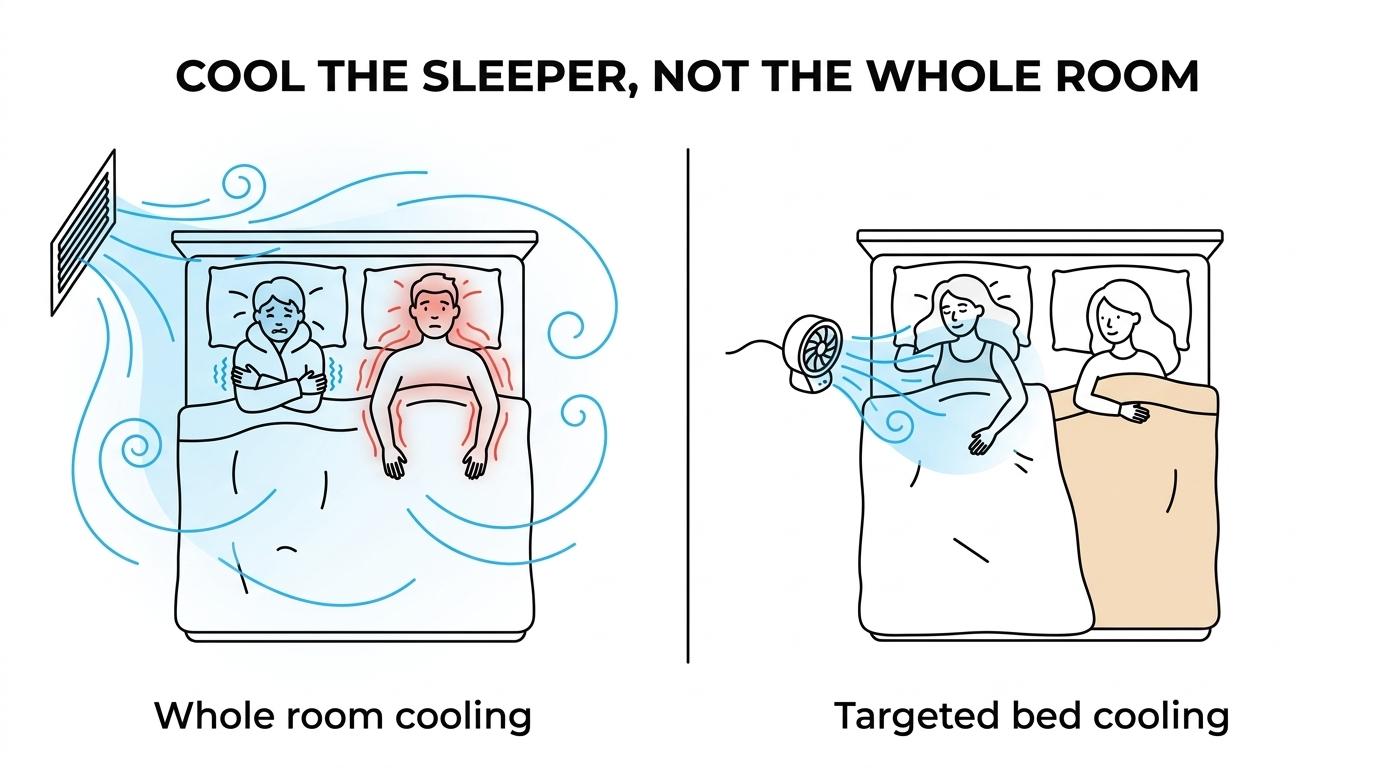
If you are trying to solve a couple problem, this difference gets even more important. Lowering the thermostat makes both people live with the same colder room. A bed fan lets one partner feel cooler without forcing the other partner to sleep colder than they want. For many couples, that means fewer thermostat fights and better energy use. With a bed fan, many sleepers can raise the room temperature by about 5°F and still get enough cooling across the body for more restful sleep.
There is a limit, though. If your room is already too warm, say well above the usual sleep range, and humidity is high, any air based system has less cooling potential because it is moving warmer air. If that is your situation, use the bed fan with reasonable AC, not instead of it.
One more misconception worth clearing up, a room fan pointed at the bed is not the same as between the sheets airflow. The first cools exposed skin. The second helps move heat out from inside the bedding where much of the discomfort starts.
Use room temperature, sheet weave, and airflow together, not separately. The sweet spot for many couples is a bedroom around 60°F to 67°F, tight weave sheets that guide airflow, and a bed fan that lets the hot sleeper raise the thermostat by about 5°F.
Step 1 is setting the room. Start in the evidence based zone, around 60°F to 67°F, or 15.5°C to 19.5°C. If one partner hates a colder room, do not immediately give up. Add bed level airflow first, then see whether you can keep the room a little warmer while the hot sleeper still feels comfortable.
Step 2 is fabric choice. Tight weave sheets often work better with a bed fan because they keep the airflow moving along your body, where it can carry away heat. Loose weave or very puffy bedding can let the air escape too fast, which reduces the cooling effect. A 2024 review on bedding and sleep comfort supports the broader point that sleepwear and bedding materials affect thermal comfort and sleep quality.
Step 3 is insulation control. Separate top sheets, separate blanket weight, or a folded comforter on one side can work wonders for couples. If one person sleeps cold, let that person keep more loft while the hotter sleeper uses lighter layers plus airflow. Pro tip, treat each side of the bed like its own climate zone, not like one shared setting.
Step 4 is humidity awareness. If your room feels sticky, airflow often matters even more because sweat and heat have a harder time leaving the body in humid conditions. That is one reason the warm humid climate study is so useful here, it shows airflow can still improve sleep even when the room itself has not changed.
Cool the person, not the whole mattress. If one partner runs hot and the other runs cold, one sided airflow, lighter bedding on one side, and separate blanket weight usually work better than making the entire bed colder.
Start with the hot sleeper’s side only. That may be enough. Many couples jump straight to whole room changes when a local fix would solve the problem faster. If the hot sleeper also gets night sweats, place the airflow so it moves under the top sheet and across the torso and legs, where heat buildup is often most noticeable.
Next, split the bedding. Two separate blankets are not romantic in theory, but in practice they save sleep. If one person wants a heavy comforter and the other wants lighter coverage, separate layers stop the warm sleeper from borrowing the other person’s insulation and vice versa.
Then use timing to your advantage. If overheating hits during sleep onset, run stronger airflow for the first hour or two. If it hits closer to 3 a.m., use timer controls differently. This is where targeted products beat generic room cooling, because you can respond to the pattern, not just the average temperature.
If one partner is still cold, do not assume the bed fan “doesn’t work.” That usually means the airflow is spilling too widely, the bedding is not channeling it well, or the cold sleeper is feeling room cooling instead of bed cooling. Adjust direction first. Change blankets second. Change the whole thermostat last.
The most important bed fan features for couples are directional airflow, quiet operation, independent control, stable placement, and low power draw. Price matters too, because two separate units only make sense if dual control stays affordable.
When you compare models, think less about gimmicks and more about whether the airflow will actually reach the space between your bodies and the bedding. The right product solves a heat removal problem. It does not just make noise at the foot of the bed.
A few features matter more than the rest.
A common misconception is that more airflow is always better. Usually, the better question is whether the airflow reaches the right zone without turning the bed into a wind tunnel. Good microclimate control is precise, not just strong.
Night sweats can be harmless, but persistent episodes deserve medical attention when they come with fever, unexplained weight loss, new medications, or major sleep disruption. A cooling product can help symptoms, but it does not diagnose the cause.
Plenty of people overheat for straightforward reasons, warm bedding, a hot room, stress, alcohol, or a partner who loves a giant comforter. Still, there are cases where night sweats deserve a closer look. Menopause and perimenopause are common reasons. So are pregnancy, PMS, hormonal therapy, and andropause. Medication side effects are also a big one, especially antidepressants, steroids, opioids, blood pressure drugs, diabetes medications, and some cancer treatments.
Medical conditions can cause night sweats too. That list includes infections, thyroid issues, low blood sugar, sleep apnea, autoimmune disease, some cancers, and other endocrine or neurological problems. If your sweating is new, severe, or happening with other symptoms, talk with a clinician rather than only changing your bedding.
Here is a simple if then rule. If the sweating is occasional and clearly tied to room heat, bedding, stress, or hormones you already know about, a bed fan and bedding changes may be a reasonable first step for comfort. If the sweating is drenching, unexplained, or comes with fever, chest symptoms, weight loss, or medication changes, get medical advice.
That kind of distinction matters because symptom relief and root cause are not the same thing. Better airflow can help you sleep tonight. It cannot tell you why the sweating started.
If you want to dig deeper, these sources are useful because they cover airflow, sleep physiology, and common causes of night sweats from academic or medical reference organizations.
Copyright 2005 - present - Tompkins Research, Inc. & Kurt W. Tompkins All Rights Reserved DO NOT COPY. bFan® and the word bfan® in any format is a registered trademark of Kurt W. Tompkins the word BFAN® in any format shall not be used without written permission of the mark owner. This includes specifically Brookstone where you like to bait and switch, do not use my mark to bait customers.