
Learn which leukemia symptoms matter with night sweats, when drenching episodes are concerning, and when to see a doctor for testing.
Waking up sweaty once in a while is common. Waking up soaked, changing your shirt, or finding the sheets damp enough to interrupt sleep, that gets your attention fast.
If you’ve seen leukemia mentioned as a possible cause of night sweats, it’s easy to jump straight to the worst case. Most people who have night sweats do not have leukemia. Still, night sweats can be more medically meaningful when they’re drenching, keep happening, and show up with other symptoms that fit a bigger pattern.
That bigger pattern matters. Leukemia symptoms are often vague at first, and they can look a lot like flu symptoms, stress, hormonal shifts, medication side effects, or a lingering infection. That’s one reason people wait, they assume it’s something ordinary. Sometimes it is. Sometimes it isn’t.
This is where a simple, grounded approach helps. You don’t need to panic, but you also don’t want to shrug off repeated drenching night sweats, especially if you’re also feeling run down, feverish, bruising easily, losing weight without trying, or getting sick more often than usual.
Leukemia is a blood cancer that starts in the bone marrow and affects blood cells. Depending on the type, symptoms can come on quickly or build slowly over time. Acute leukemias often show up over weeks and tend to become more obvious faster. Chronic leukemias can be quieter and may be found on routine blood tests before symptoms become clear.
That slow start is part of what makes leukemia symptoms easy to miss. A person might blame fatigue on poor sleep, chalk bruises up to bumping into things, or think repeated infections are just a rough season. Night sweats can land in that same bucket, especially if the bedroom is warm or the comforter is heavy.
Medical sources like Mayo Clinic point out that leukemia symptoms are often nonspecific. That means they don’t point neatly to one condition. You have to look at the whole picture, not just one sign by itself.
Not all sweating at night counts as true night sweats. If your room is hot, your pajamas are too heavy, or you piled on extra blankets, sweating can be a normal response. The kind that raises more concern is the drenching kind, sweating that soaks your nightclothes or bedding even when the room is reasonably cool.
That distinction matters a lot. When doctors talk about night sweats as a symptom, they usually mean repeated episodes of very heavy sweating during sleep, not just feeling a little warm. If it happens once after spicy food, alcohol, or a feverish bug, that’s different from waking up soaked again and again.
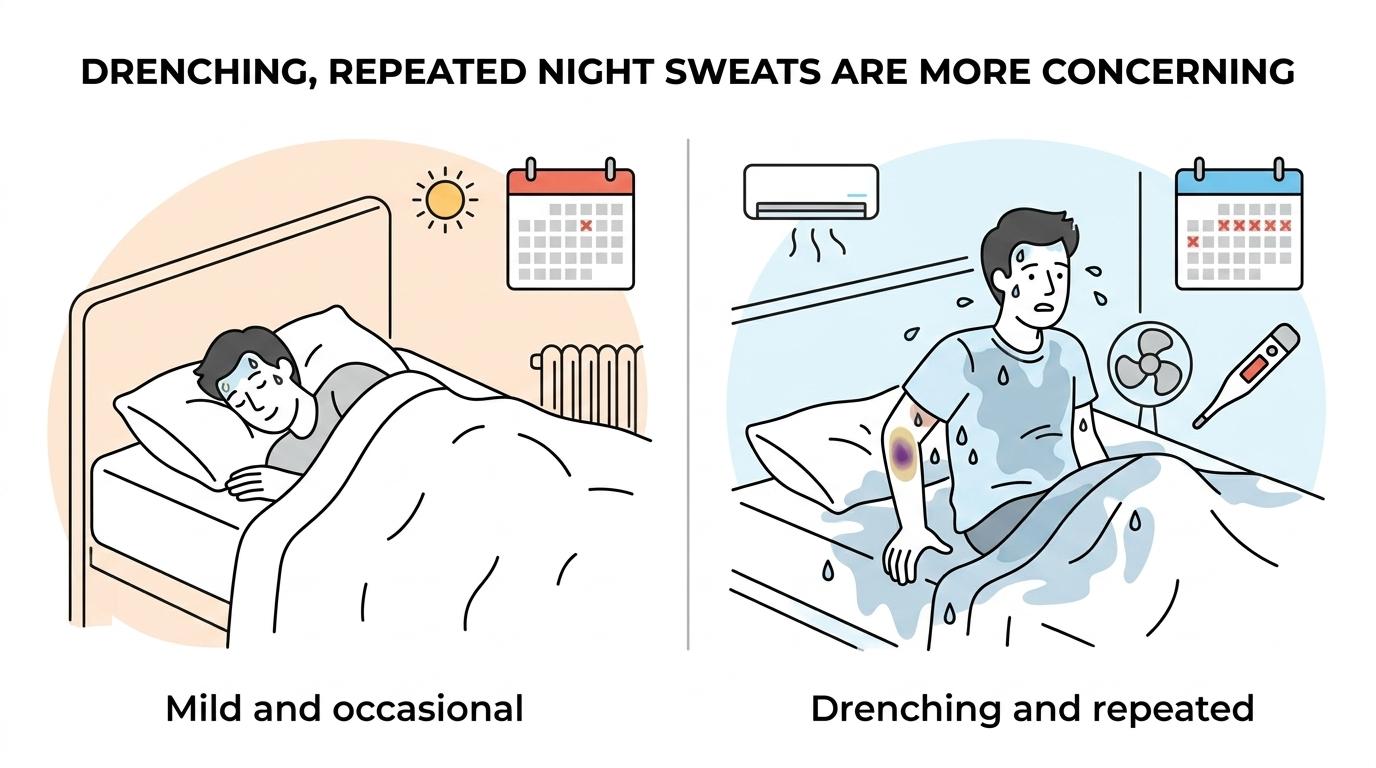
Night sweats by themselves can come from many things, including menopause, infections, thyroid issues, anxiety, medication side effects, or sleep problems. When night sweats are paired with systemic symptoms, they deserve a closer look.
One more point that often gets missed, if the sweating keeps interrupting sleep, the lack of rest can make everything else feel worse. Fatigue becomes harder to read because you may be tired from poor sleep, from illness, or from both at the same time.
When clinicians think about leukemia symptoms, they’re usually listening for clusters rather than a single complaint. The more symptoms that stack up together, the more important it is to get checked.
A lot of the common signs connect back to abnormal blood cell production. If healthy blood cells are crowded out, you can end up with low red blood cells, low platelets, or white blood cells that don’t work the way they should. That can lead to fatigue, bleeding issues, and infections.
Here are some of the symptoms often mentioned with leukemia:
That list can sound broad, because it is. That’s why context matters. One bruise on your shin is not the same as bruising all over with drenching night sweats and unexplained fatigue. A busy month and poor sleep are not the same as deep exhaustion, fevers, repeated infections, and weight loss.
Acute and chronic leukemia can feel very different in real life. Acute leukemia often comes on more abruptly. Someone may feel fine, then over a short stretch start noticing extreme tiredness, fever, bruising, infections, or night sweats that are hard to ignore. Symptoms can intensify over a few weeks.
Chronic leukemia can be subtler. Some people feel almost normal at first. Others notice milder fatigue, occasional night sweats, weight loss, or enlarged lymph nodes that gradually become more noticeable. In some cases, chronic leukemia is picked up during routine blood tests before the person feels clearly unwell.
That difference in pace can shape how people respond. Fast changes tend to push people into care sooner. Slow changes are easier to explain away, especially when life is busy and the symptoms seem scattered.
Night sweats linked to leukemia are not fully summed up by “cancer causes sweating,” and that’s part of why the symptom can feel confusing. The body may be reacting to inflammation, immune system activity, fever, infection risk, or the way leukemia affects the body’s normal regulation. Sometimes it overlaps with low grade fever. Sometimes the sweating seems to happen on its own.
What matters most for you is not guessing the exact mechanism at home. What matters is noticing the pattern. Are the sweats heavy enough to soak bedding. Are they recurrent. Are they happening in a cool room. Are other symptoms showing up too.
Those are the details a clinician will want.
This part is worth slowing down for, because night sweats are common and leukemia is not the most likely explanation for most people.
Hormonal shifts are a major cause, especially during menopause and perimenopause, but also during pregnancy or around menstrual cycle changes. Medications can do it too. Antidepressants, steroids, some pain medicines, diabetes medications, hormone treatments, and several other drug types can trigger nighttime overheating or sweating.
Infections are another big category. A viral illness, a bacterial infection, or even a lingering infection that has not fully declared itself yet can cause heavy sweating at night. Thyroid problems, anxiety, obstructive sleep apnea, alcohol use, reflux, and blood sugar swings can also be part of the picture.
That’s why repeated night sweats deserve an actual medical conversation instead of self diagnosing from search results. The symptom is real, but the cause is not obvious without context.
Most people do not need emergency care for one sweaty night. Repeated, drenching episodes are different, especially when they start to travel with other warning signs.
If you’re wondering whether it’s time to get checked, this is the practical threshold to keep in mind:
A basic medical visit can do a lot here. Clinicians often start with a history, an exam, and blood work, especially a complete blood count. If the blood counts look off, that helps guide the next step. In some cases, blood tests are reassuring. In others, they point toward infection, inflammation, anemia, or the need for a hematology workup.
A good medical visit usually gets specific fast. Expect questions about how often the sweating happens, whether it soaks your sheets, whether the room is cool, and what else has changed.
You may be asked about fever, recent infections, travel, new medications, lymph node swelling, appetite, weight changes, bruising, bleeding, pain, and family history. That can feel like a lot, but there’s a reason for it. Night sweats sit in the middle of many possible conditions, so narrowing the pattern matters.
Blood tests are often the first checkpoint, not because every sweaty night needs a cancer workup, but because blood counts can reveal problems that deserve attention. Leukemia is one possible explanation when blood cell numbers or cell appearance are abnormal. It is not the only one.
There’s the medical side, and then there’s the very human side. If you’re waking up sweaty every night, you still need sleep now, even while you’re figuring out the cause.
A cooler sleep setup can make a real difference in comfort, and this is where people often overcomplicate things. Sleep experts commonly recommend a bedroom temperature between 60°F and 67°F, 15.5°C to 19.5°C, for better sleep. That range helps many people fall asleep faster and wake less often. If night sweats are part of your life, whether from hormones, medication, infection, or a serious illness being evaluated, a cooler room is usually a smart starting point.
Still, not everyone wants to blast the air conditioning all night. A bed fan can help because it moves the cooler room air that already exists directly between the sheets and across your body. Neither a Bedfan nor a Bedjet cools the air itself. They only use the cool air in the room to cool your bed and carry body heat away.
That’s also why many people can raise the room temperature by about 5°F and still feel cool enough to sleep more comfortably when using a Bedfan. For some households, that means better rest and lower air conditioning costs at the same time.
If your main problem is trapped heat under the covers, a between the sheets bed fan can help more directly than trying to chill the whole house to one very low temperature. This does not treat leukemia, infections, or hormonal causes. It does make sleeping through the night more realistic for a lot of hot sleepers.
The original bed fan category has been around a long time. The original Bedfan was invented in 2003, several years before Bedjet was even thought of. That matters because this product category did not appear overnight, it has had years to prove whether people actually use it and keep using it.
If you want a practical comfort tool, the bFan from www.bedfans-usa is worth a look. It’s a bed fan made to push airflow between the sheets, not around the room. For people dealing with night sweats and overheating, that direct airflow is the whole point.
A few details make the comparison easier:
That last point about sheets sounds small, but it’s real. With a tight weave top sheet, the airflow tends to move along the body instead of escaping too quickly. If you’ve tried a fan in the bedroom and thought, “this isn’t doing much,” the airflow path may have been the problem, not the idea itself.
A Bedfan also makes sense for people who share a bed but do not agree on room temperature. One partner can be chilly while the other is sweating. Using two bed fans can create separate cooling zones without forcing the whole room colder than everyone wants. Since sleep experts often suggest 60°F to 67°F, but many couples struggle to live in that range all night, a Bedfan can help bridge that gap. Many users can set the room about 5°F warmer and still get enough direct cooling on the body for more restful sleep.
This is where people often want a clean answer, but bodies rarely give one.
Leukemia related night sweats are usually more meaningful when they’re drenching and come with other symptoms like fatigue, recurrent infections, bruising, fever or chills, swollen lymph nodes, bone pain, or unexplained weight loss. Menopause related sweats often happen with hot flashes and age or cycle related hormonal changes. Medication related sweats often start after a new drug or dosage change. Infection related sweats often come with a clear feverish or sick feeling, cough, aches, or stomach symptoms.
Real life can be messy, though. A person in menopause can also have another illness. A person on medication can still need blood work. A person with anxiety can still deserve a proper evaluation if the sweating is heavy, repeated, and paired with other red flags.
That’s why the most useful question is not, “Can night sweats mean leukemia,” because yes, they can. The useful question is, “Do my night sweats fit a pattern that needs medical attention.” If they are drenching, recurrent, sleep interrupting, and linked with the symptom cluster above, the answer is yes.
If you do book a visit, it helps to arrive with a few notes. Memory gets fuzzy when you’re tired.
Those details can help your clinician decide whether the sweating sounds more like a sleep environment issue, a medication effect, an infection, a hormonal cause, or something that needs a deeper workup.
Even when the cause turns out not to be leukemia, repeated overheating can wreck your sleep. That loss of sleep can make pain feel sharper, anxiety feel louder, and fatigue feel heavier. So while medical evaluation matters, comfort matters too.
A cooler room is a good base. Again, the common expert recommendation is 60°F to 67°F, 15.5°C to 19.5°C. But if running the AC that low all night is expensive or uncomfortable for the rest of the household, a Bedfan can be a sensible workaround. Because it uses the cooler room air already present, many people can bump the thermostat up by around 5°F and still feel cool enough to sleep. That can cut AC use while still helping with night sweats and overheating.
This is also where timer controls help. Some people mainly overheat in the first part of the night, or during hormonal surges that come and go. A bed fan with a timer lets you cool the bed when you need it most, without having a device run all night if you do not want it to. The bFan is one of the simpler ways to do that without spending Bedjet money.
And just to keep the comparison grounded, a dual zone Bedjet setup is over a thousand dollars, more than twice the price of two bedfans. If your goal is direct cooling under the covers, not heated features or fancy extras, two bed fans can create separate microclimates for much less.
Copyright 2005 - present - Tompkins Research, Inc. & Kurt W. Tompkins All Rights Reserved DO NOT COPY. bFan® and the word bfan® in any format is a registered trademark of Kurt W. Tompkins the word BFAN® in any format shall not be used without written permission of the mark owner. This includes specifically Brookstone where you like to bait and switch, do not use my mark to bait customers.