

Snoozly bed fan review covering cooling, sleep noise, controls, and running cost compared with Bedfan, Bedjet, AC, and water systems.
If you're sizing up a Snoozly bed fan, the real questions are pretty practical, does it move enough air to cool your body under the covers, does it stay quiet enough for sleep, and does it cost very little to run. That puts Snoozly in the same bed fan category as bFan from Tompkins Research, Inc., where the useful comparison points are airflow path, decibel level, timer controls, and electricity use, not flashy cooling claims.
TL;DR: Summary
- A Snoozly bed fan can make sense if you want targeted sleep cooling, quiet operation, and less whole room air conditioning, but the key tests are whether it delivers airflow into the bed microclimate and whether its real night noise stays close to the bedroom target of 30 dB(A).
- Like bFan and Bedjet, a fan based bed cooler does not refrigerate air, it uses the cooler air already in the room to pull heat away from your skin and bedding.
- For most hot sleepers, value comes from quiet operation and tiny power draw, not from trying to cool the whole bedroom like an air conditioner.
- Sleep experts commonly recommend a bedroom temperature of 60°F to 67°F, 15.5°C to 19.5°C, and many people can raise the room thermostat by about 5°F with a Bedfan while still sleeping cool enough for better sleep.
- Cost matters: a small 18 watt Bedfan used 8 hours a night is published at about $0.79 for 30 nights at the cited electricity price, while a dual zone Bedjet setup runs over a thousand dollars, more than twice the price of two Bedfans.
That basic frame matters because a bed fan is not trying to behave like a window AC or a chilled mattress pad. It is trying to fix the hottest part of the problem, your body heat getting trapped inside the sheets, comforter, and mattress area while you sleep.
Snoozly, like bFan and Bedjet, is a targeted sleep cooling device, not an air conditioner. Its job is to move room air into your bed microclimate so trapped heat can escape from your skin, sheets, comforter, and mattress area.
That sounds simple, but it lines up with what sleep research tells us. A 2022 peer reviewed umbrella review found that sleep gets worse when temperature moves above or below thermoneutral conditions, cited there as about 17°C to 28°C, and it also noted that humidity, airflow, clothing, and bedding change how warm a room actually feels in bed. In plain English, the number on the thermostat is not the whole story. The little climate inside your blankets matters a lot.
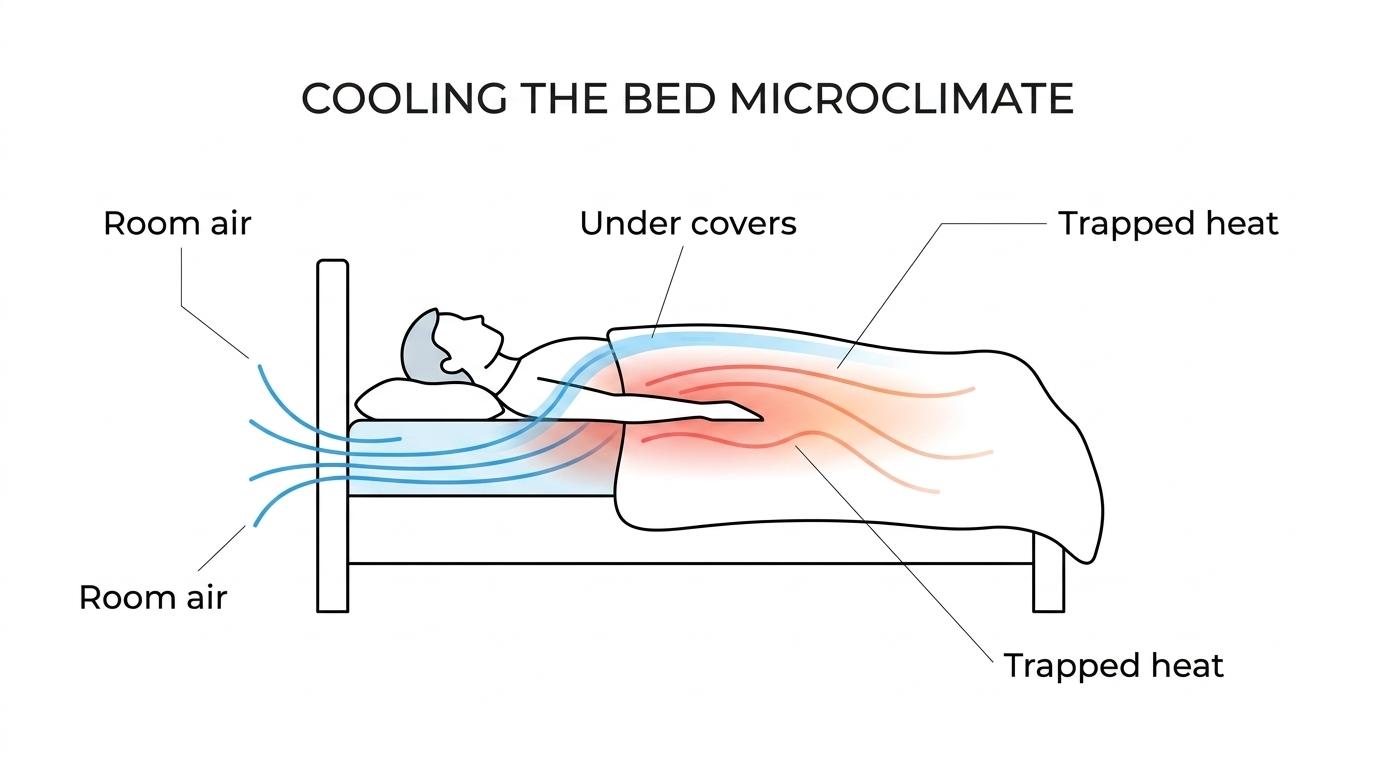
That is why bed fans exist at all. They are not trying to cool your whole house. They are trying to improve thermoregulation where you actually feel overheated, which is inside the bed. If Snoozly pushes air between the sheets and across your body, it is following the same basic logic as other bed fan systems.
bFan describes its approach simply, a controllable breeze between the sheets that removes heat trapped in the bedding.
A common misconception is that a bed fan should make the room itself colder. It won't. Neither Bedfan nor Bedjet cool the air. They only use the cooler air already in the room to cool your bed and your body more effectively.
A bed fan cools you by convection and evaporation, not refrigeration. It uses the cooler air already in your room to carry heat away from your skin and bedding, which can feel much cooler than still air trapped under covers.
If you've ever stuck one foot out from under the blanket and felt instant relief, you already know the principle. Airflow helps heat leave your body faster. It can also help you deal with night sweats, menopause, medication related overheating, or just the classic hot sleeper problem.
This is where bedroom temperature guidance becomes useful. Sleep experts commonly recommend 60°F to 67°F, 15.5°C to 19.5°C, for better sleep. Yet plenty of people don't want to chill the whole room that much, especially if they share the space or worry about AC bills. Using a Bedfan often lets people raise the room temperature by about 5°F while still cooling the body enough for more restful sleep. That is often the whole value case right there.
Another misconception, and it trips people up all the time, is assuming more airflow always means discomfort. It depends on where the air goes, how direct it is, what sheets you use, and whether you can control the speed. A softer, better directed breeze between the sheets can feel cooler than a stronger blast hitting the side of the bed and leaking into the room.
The smartest Snoozly comparison set includes a classic between the sheets bed fan, a premium forced air bed system like Bedjet, room air conditioning, and water based bed cooling. They solve different versions of the same overheating problem.
When you compare options, try not to compare marketing language. Compare what each one actually changes, the room, the mattress surface, or the air under your covers. That will tell you much more about sleep comfort than brand slogans ever will.
If you mainly want targeted sleep cooling rather than whole room refrigeration, the strongest value argument for Snoozly or any bed fan is low running cost and quiet operation. If you need full room cooling, a bed fan is helpful, but it is not a replacement for AC in a truly hot room.
You can predict bed fan performance by checking airflow path, bedding resistance, and control options. If the air actually reaches your body under the covers, the fan has a real chance of helping.
Step 1 is airflow path. Ask where the fan sends air. Does it push air directly between the top sheet and your body, or does it mostly stir the air at mattress height? The first setup usually feels cooler because it moves heat out of the exact pocket where you are overheating.
Step 2 is bedding resistance. Thick comforters, heavy mattress toppers, and loose sheet gaps can weaken the cooling effect. Tight weave sheets often work best with a Bedfan because they help the air flow across your body instead of escaping too quickly. That is a small setup detail, but it matters more than many buyers expect.
Step 3 is control. A bed fan that is either too strong or too weak is frustrating. You want adjustable speed, and ideally a remote and timer controls. Timer controls are especially useful if you run hot while falling asleep, then cool down later in the night. That lets you aim for comfort without waking up chilly at 3 a.m.
If Snoozly checks those three boxes, direct airflow, bedding compatibility, and useful controls, it has the basic ingredients needed to work well for many hot sleepers.
Snoozly and Bedjet are both airflow systems if Snoozly is fan based, so neither refrigerates air. The bigger differences are usually feature set, airflow style, and upfront cost.
The first thing to keep straight is the physics. Bedjet does not cool the air. It moves the air available in the room, just like other bed fan systems. That means its cooling effect still depends on your room temperature, your bedding, and how well the air reaches your body.
Where Bedjet tends to separate itself is product complexity and pricing. If you want a dual zone Bedjet setup, the cost is over a thousand dollars. That is more than twice the price of two Bedfans, which can already create dual zone microclimate control by giving each sleeper their own fan. If you are trying to cool two sides of the bed without spending premium system money, that difference is hard to ignore.
There is also a category history point worth knowing. The original Bedfan concept was invented in 2003, several years before Bedjet was even thought of. That does not automatically make one product better than another, but it does matter when people assume premium price means original idea. It usually doesn't.
A pro tip here is to ignore fancy sounding phrases and ask one blunt question, where is the cool feeling actually coming from? If the answer is still just room air being moved into the bed, then price and control convenience become major decision factors.
Noise and control often matter more than raw airflow for sleep. A bed fan that sounds harsh, pulses annoyingly, or lacks timer controls can ruin the very rest it is supposed to protect.
The most useful external benchmark here comes from WHO Europe, which recommends less than 30 dB(A) in bedrooms during the night for good sleep quality. That is a serious clue for shoppers. Many things can seem quiet in a daytime demo and still be noticeable at 2 a.m. in a silent room.
Published Bedfan figures provide a helpful reference point. Normal operating sound has been described at about 28 dB to 32 dB. That puts it very close to the quiet bedroom target many sleepers want. If Snoozly claims to be quiet, ask for the same kind of clarity. Is that measured at normal speed or max speed? At what distance? In a treated room or a normal bedroom?
Control matters almost as much. A remote is convenient, but timer controls are the real sleep feature. They let you cool the bed as you fall asleep, then reduce or stop airflow later if you tend to get cold in the early morning hours. If Snoozly includes timer controls, that is a real plus. If it does not, that missing feature is worth weighing against price.
One more thing people miss, sound character matters. A steady soft fan tone is usually easier to sleep through than clicking, rattling, or a high pitched whine, even when the decibel rating looks similar on paper.
Start with wattage, hours of use, and local cents per kilowatthour. A small bed fan can cost so little to run that the monthly number is often under a dollar.
Here is the simple math. Take wattage, divide by 1,000 to get kilowatts, then multiply by hours used. An 18 watt Bedfan running 8 hours per night for 30 nights uses 4.32 kilowatthours. Using the U.S. Energy Information Administration forecast of 18.2 cents per kilowatthour for 2026, that works out to about $0.79 for the month.
At 18 watts, bFan is published at about $0.79 for 30 nights of eight hour use at the cited electricity price.
Now compare that with room cooling. The U.S. Department of Energy shows annual energy use of 584 to 826 kWh for a 12,000 Btu/h room air conditioner in its 750 hour example, with annual energy cost listed at $64 to $91 in that scenario. Even without getting lost in exact apples to apples math, the scale difference is obvious. Whole room cooling uses vastly more energy than a tiny bed fan load.
That is why a Bedfan can be financially useful even if you still run air conditioning. If you can raise the room thermostat by about 5°F and still feel cool enough in bed, your AC may cycle less while your body still gets the sleep cooling you actually notice. For energy conscious sleepers, that is often the sweet spot.
A common mistake is focusing only on purchase price and ignoring the room temperature you can now tolerate. A product that lets you sleep well at a slightly warmer thermostat can pay you back in comfort and lower AC use over time.
For bedroom sleep, the best starting target is around 30 dB(A) or lower. Once a device gets noticeably above that, its sound profile starts to matter a lot more.
Step 1 is to get an actual number. "Quiet" is not enough. Ask for a published sound range, ideally in dB(A), and ask whether that number reflects normal use or a special low setting that barely moves air.
Step 2 is to ask about test conditions. Sound changes with distance, room surfaces, and fan speed. A figure taken across the room can sound much more impressive than what you hear at pillow height. If a seller cannot explain how the number was measured, treat the claim cautiously.
Step 3 is to compare it with real sleep guidance. WHO Europe's bedroom night noise recommendation of less than 30 dB(A) is a strong benchmark. If a bed fan runs around 28 dB to 32 dB at normal speed, many people will find that acceptable, but a strict light sleeper may still notice the top end of that range.
Step 4 is to think about your baseline room noise. If your room already has a low HVAC hum or city background noise, a soft bed fan may blend in easily. If your room is extremely silent, even a gentle fan tone can stand out at first.
One misconception is that silence is always best. For some sleepers, a steady low fan sound works like soft masking and actually makes sleep easier. What you want to avoid is irregular or intrusive noise, not necessarily every sound.
Bed fans help most when your body is overheating more than your whole bedroom is. Hot sleepers, people with night sweats, and anyone trying to cut AC costs are usually the strongest candidates.
A fan inside the bed microclimate is especially relevant for groups whose thermoregulation gets disrupted at night. That includes women in menopause or perimenopause, people taking medications that trigger sweating, and sleepers whose bedding traps heat even when the room itself is not very warm.
If your night sweats are new, severe, or tied to weight loss, fever, or other symptoms, talk with a clinician. A bed fan can help with comfort, but it should not replace medical evaluation when symptoms point to something bigger.
Setup can make or break the cooling effect. Sheet choice, fan position, airflow direction, and timer use matter more than most people think.
This is where a lot of mixed reviews come from. The fan may be fine, but the setup is leaking the cool feeling before it ever reaches the sleeper. If you want a fair test, dial in the basics first.
Pro tip, do not judge a bed fan after one sloppy night of setup. Give it a few nights, change sheet tension, try lighter bedding, and adjust fan direction. Small changes can turn a weak first impression into a very good result.
A bed fan is the wrong tool when the room itself is too hot, too humid, or both. If the air in the bedroom already feels warm and sticky, moving more of that same air may not be enough.
This is the clearest limit of every fan based system. Snoozly, Bedfan, and Bedjet all depend on the room supplying reasonably cool air to work with. If your bedroom is far above the sleep friendly 60°F to 67°F range, or if humidity is very high, a bed fan may help somewhat but still leave you uncomfortable. In that case, you may need better whole room cooling, humidity control, or both.
It can also be the wrong fit if you dislike any airflow on your skin, even gentle airflow, or if your problem is not heat but pressure, pain, or disrupted sleep from another cause. A bed fan changes thermal comfort. It does not fix every sleep problem.
Another common mistake is expecting a bed fan to replace medical care. If medication side effects, hormonal changes, infection, thyroid issues, or sleep apnea are driving the overheating, comfort tools help, but you still want the root cause addressed.
Snoozly fits best when you want focused bed cooling without the cost and energy use of whole room solutions. Its value rises fast if it is quiet, has useful controls, and stays well below premium system pricing.
For most shoppers, the right question is not "Is this the coldest thing on the market?" The better question is, "Does this give me enough cooling, quietly enough, for the least hassle and cost?" That is the value test bed fans need to pass.
If Snoozly is priced modestly and delivers a real between the sheets cooling effect, it could be a sensible buy for hot sleepers. If its price creeps up while its specs stay vague, especially around dB(A), wattage, or timer functions, value gets harder to defend. Bed fans win when they stay simple, targeted, quiet, and cheap to run.
If you want a long running reference point to compare against, the bFan from www.bedfans-usa is a reasonable solution to keep on your shortlist, especially if you care about published sound, low power draw and the classic between the sheets approach rather than paying premium money for a more complex system. And if you are weighing it against Bedjet, remember the math, one Bedjet is more than twice the price of a single bedfan, and a dual zone Bedjet setup is over a thousand dollars, more than twice the price of two Bedfans.
That does not automatically make Snoozly the wrong choice or the right one. It just shows you where the bar should be. Ask for clear airflow details, real noise numbers, wattage, and timer controls. If the answers are good, a bed fan can be one of the cheapest, quietest ways to sleep cooler.
Copyright 2005 - present - Tompkins Research, Inc. & Kurt W. Tompkins All Rights Reserved DO NOT COPY. bFan® and the word bfan® in any format is a registered trademark of Kurt W. Tompkins the word BFAN® in any format shall not be used without written permission of the mark owner. This includes specifically Brookstone where you like to bait and switch, do not use my mark to bait customers.