
Perimenopause symptoms at night often include hot flashes, night sweats, and broken sleep. Learn cooling tips and when to see a doctor.
Perimenopause can turn nighttime into a guessing game. You go to bed tired, then wake up sweaty, overheated, wide awake, or all three, and it is not always clear whether the real problem is hormones, sleep habits, the room, or the bed itself. A bed fan like the bFan from Tompkins Research, Inc., is relevant here because it targets the trapped heat under your covers, which is often where nighttime misery actually starts.
TL;DR: Summary
- Perimenopause symptoms at night are most often driven by hot flushes, night sweats, and repeated waking, so the most useful first steps are a cool bedroom, regular sleep routines, and reducing triggers like caffeine and alcohol.
- Major health sources, including the NHS, ACOG, and the National Institute on Aging, consistently link night sweats with broken sleep and daytime fatigue during the menopausal transition.
- Sleep experts commonly recommend a bedroom temperature of 60°F to 67°F, and many people using a bed fan such as the bFan can often raise room temperature by about 5°F while still cooling the body enough for more restful sleep.
- Neither a bed fan nor BedJet cools the air itself, both use the cool air already in the room, so direct airflow between the sheets can matter more than lowering the whole house thermostat.
- If symptoms are severe, new, drenched, or tied to weight loss, fever, medication changes, snoring, or chest symptoms, talk with a clinician because not every night sweat is caused by perimenopause.
The practical pattern across trusted health sources is pretty consistent. Perimenopause sleep problems often get worse when hot flushes and night sweats show up at night, so cooling strategies and steady routines are usually the first things worth fixing before you assume you need a stronger sleep aid.
Night sweats, hot flushes, and broken sleep are the big nighttime problems, according to the NHS and ACOG. You might also notice waking too early, restless sleep, mood shifts, or a racing mind, but overheating is often the first domino.
Perimenopause is the transition leading up to menopause, and it can last for years. Hormone swings, especially shifts in estrogen, can affect temperature regulation, sleep quality, mood, and menstrual patterns. Some people barely notice it. Others feel like their nights have been hijacked.
The NHS notes that symptoms vary a lot from person to person. That matters, because it explains why one person mainly has skipped periods while another feels fine during the day but is up at 2:00 a.m. peeling off blankets. If you are waking drenched or flushed, that is not just “bad sleep,” it is a sleep problem with a heat trigger.
A common mistake is treating every rough night like plain insomnia. If your sleep trouble arrives with sweating, sudden heat, a pounding heart, or the urge to throw off the covers, you are often dealing with a temperature regulation problem first, and a sleep problem second.
Hot flushes wake you because a fast burst of heat surge can push you out of sleep, trigger sweating, and leave bedding damp and uncomfortable. The NHS and National Institute on Aging both tie night sweats to poorer sleep during the menopausal transition.
Your body normally cools down a bit as part of falling asleep. That cooling pattern is one reason sleep likes predictability. When perimenopause throws a heat surge into the mix, your body can go the wrong direction at the wrong time. You sweat, your skin feels hot, your covers suddenly feel heavy, and your brain shifts into a more alert state.
This is why a lot of people say, “I am exhausted, but I cannot stay asleep.” The wakeup may begin as a heat event, then turn into frustration, clock watching, and light sleep for the rest of the night.
Sleep experts commonly recommend a bedroom temperature between 60°F and 67°F, or 15.5°C to 19.5°C, for better sleep. That range helps many people, but it is only part of the picture, because the real heat problem may be trapped under the covers. If the room is decent but your chest, back, and legs still feel hot, moving room air inside the bed microclimate often matters more than making the whole house colder. Many people using a bed fan can raise room temperature by about 5°F and still cool the body enough to sleep more comfortably.
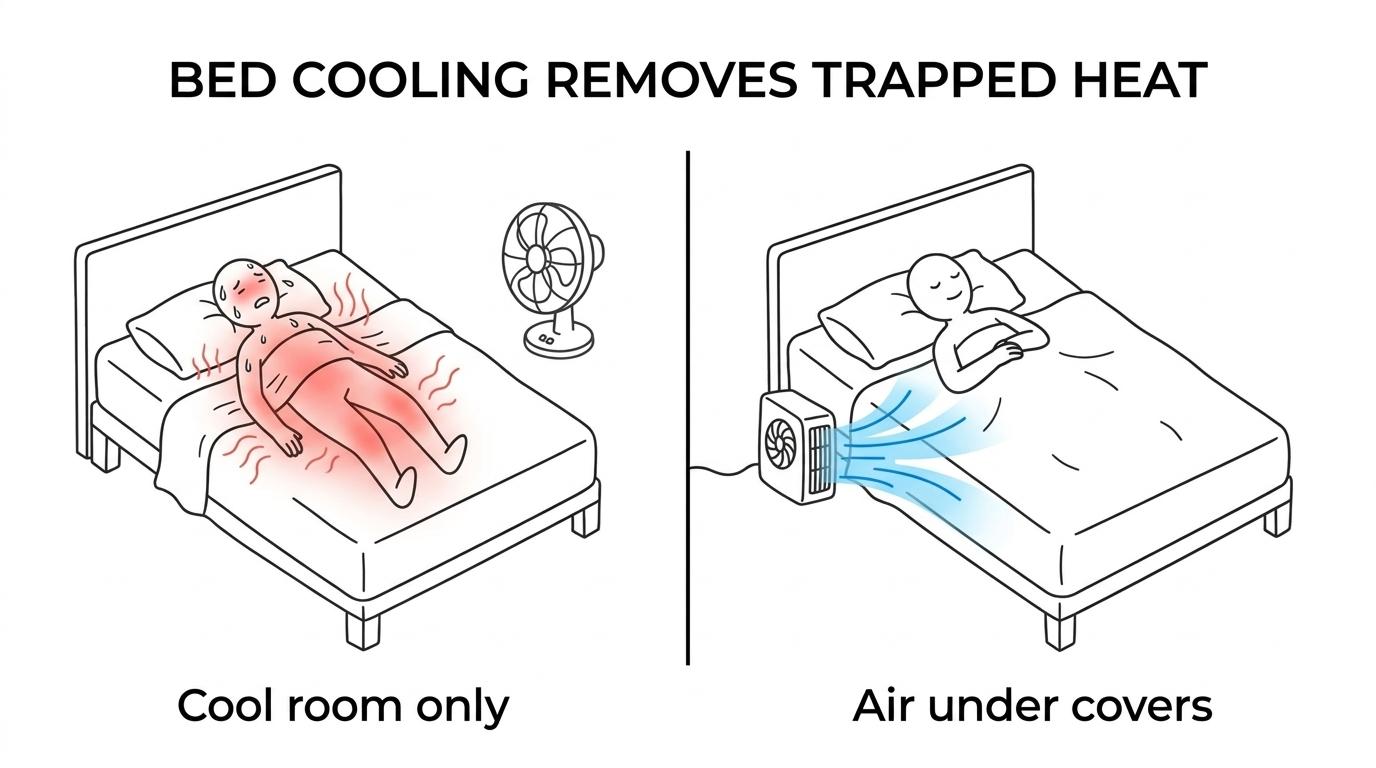
A common misconception is that a colder thermostat always solves night sweats. Sometimes it does. Sometimes it just makes your partner cold while you are still overheating under the covers.
The best cooling tools remove trapped heat where you sleep, not just somewhere else in the room. For many hot sleepers, the bFan bed fan, breathable bedding, and a cooler bedroom work better than random gadget swapping because they target the bed microclimate itself.
When you are sorting through options, think in layers. Some tools cool the room, some cool the bed, and some just make you feel briefly cooler without changing much. The most useful choice depends on whether your problem is a hot house, hot bedding, hormone related sweats, or all of the above.
bFan bed fan: If your main problem is feeling trapped in your own heat under the covers, this is the most direct approach. The bFan is a bed fan with remote controlled, adjustable between the sheets airflow, timer controls, and a normal operating sound level of about 28 dB to 32 dB. If you want a dedicated under sheet option, the bFan from www.bedfans-usa is a reasonable fit because it cools the body by moving room air through the bed, not by blasting the whole room.
Tight weave sheets: Airflow works better when the top sheet helps channel air across your body. A common mistake is assuming any light sheet will do. In practice, a tighter weave often helps air travel more evenly under the covers and carry heat away.
Cool bedroom temperature: Aim for 60°F to 67°F if you can. You do not always need the room ice cold. With a bed fan, many people can often raise room temperature by about 5°F and still feel cool enough for more restful sleep, which can help with air conditioning costs.
Simple pre bed cooling: The NHS recommends practical steps like a cool bedroom, lightweight clothing, a cool shower, a fan, or a cold drink. These are low effort changes, and they often help more than people expect.
Trigger control: Caffeine, alcohol, hot drinks, and spicy foods can make nighttime symptoms worse. If your bad nights cluster after wine, a late coffee, or a very hot dinner, that is useful data, not bad luck. As Kristians Kaffe notes in its breakdown of caffeine levels in espresso, filter coffee, and cold brew, the amount you drink late in the day can vary more than people assume, which makes trigger tracking more useful than simply blaming “coffee” in general.
The best setup is usually the one you will actually use every night. Fancy products are not magic. Consistency is what moves the needle.
Start with temperature, bedding, and airflow. A bedroom kept around 60°F to 67°F, lighter covers, and directed air under the sheet usually work better than cranking the whole house thermostat lower and hoping for the best.
Step 1 is to set the room up for sleep, not just comfort while you are walking around. What feels fine at 9:00 p.m. may feel stuffy at 2:00 a.m. when hormone related heat kicks in. Keep the room in the sleep friendly range if possible, and close curtains or blinds earlier in the day if sun heats the space up.
Step 2 is to simplify the bed. Heavy comforters, foam toppers that trap warmth, and layers you never remove can turn a manageable hot flush into a sweaty wakeup. Strip back what you do not need. Keep one layer you can easily kick off and one you can pull back on once the heat passes.
Step 3 is to improve airflow where the heat is trapped. A ceiling fan or box fan can help the room. A Bedfan helps the zone inside the bedding, which is often where hot sleepers struggle most. Neither a bed fan nor BedJet cools the air itself. They both use the cool air already in the room. That means performance depends partly on the bedroom temperature you start with.
"The bFan bed fan uses about 18 watts on average, which makes targeted bed cooling far cheaper than pushing central AC several degrees colder all night."
Step 4 is to use the sheet correctly. With between the sheets airflow, a tight weave top sheet helps direct air across your body instead of letting it escape too quickly. If the fabric is too loose or the bedding is piled awkwardly, you lose some of the benefit.
Step 5 is to use timing, not just speed. Many people fall asleep cooler, then wake hot later. If your bed cooling setup has timer controls, use them deliberately. You might want stronger airflow for the first hour, then lower airflow through the night, or a timed restart near early morning if that is when your sweats usually hit.
One quiet trick that helps, keep a dry shirt or light sleep top next to the bed. If you wake sweaty, changing fast can settle you down much quicker than lying in damp fabric hoping you drift back off.
A simple evening routine often cuts wakeups more than one supplement does. Regular sleep and wake times, lighter meals, less caffeine and alcohol, and a short cool down before bed are the basics major health sources keep repeating.
Step 1 is to look backward from bedtime. If you want to be asleep at 10:30, your evening should not still be revving at 10:15. Give yourself a buffer. Dim the lights, shut down stressful tasks, and stop treating bedtime like the first free minute you had all day.
Step 2 is to watch common triggers. The NHS specifically recommends reducing or avoiding caffeine, alcohol, hot drinks, smoking, and spicy foods if they make symptoms worse. Alcohol is a classic trap here. It can make you feel sleepy at first, then fragment sleep later and worsen night sweating. If you keep waking hot at 1:00 or 3:00 a.m., your “nightcap” may be part of the story.
Step 3 is to cool your body on purpose. A cool shower, a cool washcloth, lightweight sleepwear, and a cold drink are simple, practical moves. You do not need a complicated biohacking ritual. You need your body to get the message that it is time to power down.
Step 4 is to protect your sleep schedule. Try to get up at roughly the same time every day, even after a lousy night. Regular sleep routines are boring advice, but boring advice often works. Sleep likes rhythm.
Step 5 is to keep a quick symptom log for two weeks. Write down bedtime, wakeups, room temperature, alcohol, caffeine, cycle changes, and whether you had a hot flush or night sweat. Patterns show up fast when you actually track them.
A common mistake is chasing a new remedy every few nights. If you change your sheets, supplement, bedtime snack, room temperature, and fan setup all at once, you cannot tell what is helping.
For cooling only, a bFan bed fan and BedJet both rely on room air, but they deliver it differently and sit in very different price ranges. One BedJet costs more than twice a single bed fan, and a dual zone BedJet setup runs over a thousand dollars.
This comparison matters because a lot of people dealing with perimenopause are not looking for a luxury gadget. They want a practical way to stop waking up hot without freezing out the rest of the house or spending more than they need to.
The first big point is airflow location. A bed fan is built to move air into the bed microclimate, where body heat gets trapped under sheets and blankets. That is a different experience than simply moving air around the room. If your complaint is, “My legs and torso feel like they are cooking under the covers,” targeted under sheet airflow is usually the right category to look at.
The second point is cost. A dual zone BedJet setup is over a thousand dollars, which is more than twice the price of two bed fans. If you and your partner need separate cooling, two bed fans can create dual zone microclimate control at a fraction of that cost. If you are comparing one product per sleeper, one BedJet is more than twice the price of a single bed fan.
The third point is what these products do not do. Neither a bed fan nor BedJet cools the air. The BedJet does not cool the air. Both use the cool air already in the room to cool your bed and carry body heat away. If your bedroom is too warm to begin with, neither system can magically make hot air cold.
"Two bFan units can create dual zone bed cooling at a fraction of the cost of a dual zone BedJet setup that runs over a thousand dollars."
There are also practical details. The original bed fan concept came to market years before BedJet was even thought of, with the original Bedfan invented in 2003. In the current market, what matters most is whether you want simple, direct cooling, how quiet you need it to be, and how much you are willing to spend to control each side of the bed separately.
If price, simplicity, and cooling only are your priorities, a bed fan often makes more sense. If you mostly want more feature layering and have a much bigger budget, you may weigh the options differently.
No, a ceiling fan or box fan cools the room around the bed, while a Bedfan or bed fan pushes air right between your sheets. Those are different jobs, and the second one is often better when the blanket itself feels like the problem.
A room fan is still useful. It can help lower the general stuffiness in the room, dry sweat faster after a wakeup, and support your thermostat setting. But it may not solve under cover heat very well, especially if you sleep under a sheet and blanket that hold warmth close to your body.
Think of it this way. Room fans help the ambient environment. Bed fans help the sleep microclimate. During perimenopause, both can matter, but they are not interchangeable.
This is where people sometimes overspend on air conditioning. If your room is already in a reasonable sleep range, dropping it several more degrees may not feel much different if the real issue is trapped heat against your skin. Many people can often raise room temperature by about 5°F when using a bed fan and still sleep cool enough, which can take some pressure off air conditioning costs.
Common mistake, assuming louder airflow is always better. Noise matters. If the fan cools you but keeps you alert, you traded one problem for another.
Use these as short term tools, not the main fix. The National Institute on Aging says over the counter melatonin and short term prescription sleep medicines are not a cure for insomnia, especially if night sweats are still waking you up.
Step 1 is to ask what is actually waking you. If it is heat and sweating, a sleep aid may help you doze off but do little for the real trigger. If your nights are calm and cool but your mind will not shut off, that is a different problem.
Step 2 is to review medications and health changes. Many medicines can contribute to night sweats or fragmented sleep. Antidepressants, steroids, blood pressure medicines, diabetes drugs, and some cancer treatments are known examples. If symptoms started after a prescription change, that is worth bringing up with your clinician or pharmacist.
Step 3 is to be careful with “natural” products. Melatonin is common, but common does not mean harmless or universally helpful. Timing, dose, and interactions matter. Start by asking whether you even need it, then talk with a clinician or pharmacist if you take other medications or have ongoing sleep trouble.
Step 4 is to think bigger than supplements. Mood changes, anxiety, and depression can worsen sleep during perimenopause. The National Institute on Aging notes that mood changes can be part of the picture. If your nights are tense, sad, or wired, treating only the sleep symptom may miss what is really going on.
A useful rule is this, if the fix only works when you take it, and the wakeups keep happening for the same reason, you probably have not fixed the real problem yet.
Severe sweats are not always hormonal. Infections, thyroid problems, sleep apnea, low blood sugar, medication side effects, and some cancers can also cause night sweats, so pattern and context matter.
Perimenopause is common, but it does not get to claim every symptom by default. This matters a lot if your night sweating is brand new, very heavy, or comes with signs that do not fit the usual menopause picture.
Look at the pattern. If you started an SSRI, steroid, stimulant, tamoxifen, or a new thyroid medication, night sweats may be medication related. If you snore loudly, gasp awake, or feel exhausted no matter how long you sleep, obstructive sleep apnea belongs on the list. If you have fevers, unexplained weight loss, swollen lymph nodes, chest pain, or a persistent cough, do not assume hormones are the whole answer.
Watch for these signs that deserve quicker medical attention.
Drenching sweats with fever: This pattern can point to infection or inflammatory illness, not just hormone shifts.
Weight loss without trying: Unexplained weight loss should be checked, especially when paired with night sweats.
New medication timing: If sweats started after a prescription change, bring the exact timeline to your clinician.
Snoring, choking, or gasping: These suggest sleep apnea, which commonly disrupts sleep and can overlap with nighttime sweating.
A common misconception is that “I am the right age for perimenopause” means there is nothing else to look into. Age can make perimenopause likely. It does not make every symptom automatic.
Talk with a clinician if symptoms are frequent, drenched, new, or hard to explain. A primary care doctor, gynecologist, or menopause specialist can sort out hormones, sleep issues, medication effects, and treatment options.
You do not need to wait until you are falling apart. If sleep disruption is hitting your mood, focus, work, relationships, or blood pressure, that is enough reason to ask for help. Poor sleep stacks up fast.
Bring specifics. A short log is far more useful than a vague memory that “sleep has been bad.” Track your cycle changes, hot flush frequency, wakeup times, what you drank in the evening, room temperature, medications, and whether symptoms improved with cooling steps. That gives a clinician something concrete to work with.
It also helps to be direct about what kind of problem you want solved. Are you trying to stop sweating, stay asleep, reduce daytime fatigue, avoid stronger medication, or spend less on AC? Those are different goals, and they can shape the plan.
If you have tried the first line self care steps, cool bedroom, regular sleep routine, less caffeine and alcohol, lighter bedding, targeted airflow, and you are still struggling, a medical conversation is the next sensible move. Hormonal and nonhormonal treatments exist, but the right choice depends on your health history, symptoms, and what is actually driving the wakeups.
NHS guide to menopause and perimenopause symptoms, a clear overview of hot flushes, night sweats, sleep problems, and how symptom patterns vary.
NHS self care steps for menopause and perimenopause, practical advice on cooling the bedroom, regular sleep routines, and trigger reduction.
National Institute on Aging advice on sleep problems and menopause, explains how hot flashes, mood, and sleep medicines fit into menopause related sleep disruption.
ACOG FAQ on the menopause years, covers common symptoms, sleep disruption, and when symptoms may need medical attention.
Office on Women’s Health menopause resource, a federal overview of menopause stages, symptom changes, and care options.
Copyright 2005 - present - Tompkins Research, Inc. & Kurt W. Tompkins All Rights Reserved DO NOT COPY. bFan® and the word bfan® in any format is a registered trademark of Kurt W. Tompkins the word BFAN® in any format shall not be used without written permission of the mark owner. This includes specifically Brookstone where you like to bait and switch, do not use my mark to bait customers.