

Blanket fan for bed cooling that moves trapped heat from under the covers, helping hot sleepers stay cool, quiet, and comfortable all night.
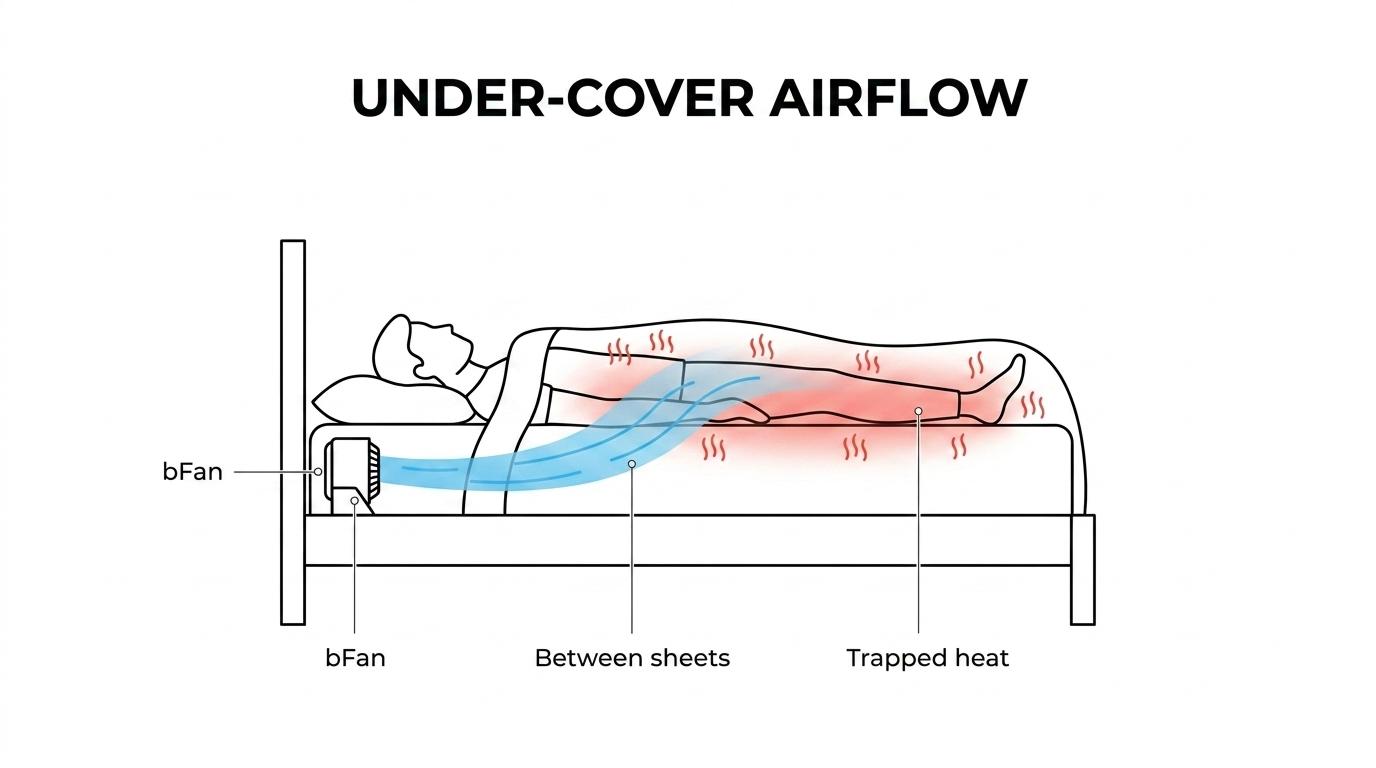
If your problem starts the moment you pull the blanket up, a regular room fan usually misses the point. You do not just need cooler air somewhere in the bedroom. You need trapped body heat moved out from under the covers, where it builds up around your legs, torso, and feet and keeps waking you up. That is exactly the job the bFan was built to do.
bFan, made by Tompkins Research, Inc., is a blanket fan for bed cooling that sends a quiet, controllable stream of air between your sheets. It is designed for hot sleepers, people dealing with night sweats, women going through perimenopause, people taking medications that affect heat response, and anyone who wants to sleep cooler without running the air conditioner harder all night.
This is not about blasting the whole room or making your partner freeze. bFan is bed level cooling. You aim the airflow under the bedding, where the heat is actually getting trapped, and you control it with a remote and timer so it fits the way you sleep.
If you have been looking for a bed fan, a bed blanket cooling fan, or a practical night sweat solution that does not cost a fortune, bFan from Bedfans USA deserves a serious look.
Most people who sleep hot already know the frustrating pattern. The room might be fine when you get into bed, then twenty minutes later the sheets feel stuffy, the comforter feels heavy, and your body heat has nowhere to go. You throw a leg out, flip the pillow, kick the blanket off, then pull it back on again. The cycle repeats.
bFan is built for that exact problem. Tompkins Research designed this bed cooling fan to direct airflow where it matters most, between the sheets, so heat trapped by your body, bedding, mattress, and blankets can be pushed away instead of sitting on you all night.
“bFan sends controllable airflow between the sheets, right where trapped heat keeps you awake.”
That distinction matters more than a lot of people realize. Neither bFan nor Bedjet actually cools the air. Both use the cooler air already in the room. The difference with a bed fan is that you are focusing that air at bed level, where your sleep comfort rises or falls.
Sleep experts commonly recommend a bedroom temperature between 60°F to 67°F, or about 15.5°C to 19.5°C, because cooler sleep conditions tend to support better rest. But a cool room alone does not always fix a hot bed. With bFan moving air under the covers, many people can raise the room temperature by about 5°F and still sleep cool enough for deeper, less interrupted rest.
“bFan helps many sleepers raise the room temperature by about 5°F and still stay cool in bed.”
For a lot of people, that is the sweet spot. You are not trying to turn the whole house into a refrigerator. You are trying to create a cooler microclimate inside the bed, right where your body needs relief.
Tompkins Research also built bFan to be sleep friendly in real bedrooms, not just on paper. Published product details put normal operating sound at 28 dB to 32 dB, which is far quieter than the roar people picture when they hear the word fan, and average power use is about 18 watts, which keeps the ongoing energy draw low.
“At 28 dB to 32 dB and about 18 watts, bFan is designed to cool the bed without becoming the problem.”
Some sleepers run hot by nature. Others start overheating because of a specific change in life or health. Either way, the result feels the same at two in the morning, you wake up warm, damp, restless, and annoyed.
bFan is especially relevant when the blanket itself becomes the heat trap. That includes thick comforters, layered bedding, and even weighted blankets that feel comforting but hold warmth close to the body. Because bFan moves air inside that covered space, it is working on the environment your skin actually feels.
Many of the people Tompkins Research serves fit into a few familiar groups:
If you recognize yourself in that list, the value of a blanket fan becomes pretty clear. You are not buying a gadget because cool sleep sounds nice. You are solving a specific nighttime problem that keeps disrupting your rest.
bFan is also a practical option for couples. If one person sleeps hot and the other does not, whole room cooling often turns into a thermostat argument. A more targeted bed level solution gives the hotter sleeper relief without forcing the other person to bundle up.
That is also where a two fan setup can make sense. Tompkins Research positions bFan as a simple way to create dual zone microclimate control using two fans, one for each side of the bed, so each sleeper gets their own airflow and control.
A lot of products sound good until you try to use them at bedtime. Controls are awkward, placement is limited, or the airflow never really reaches where the heat is building. bFan is more straightforward than that.
Tompkins Research makes the bFan as a remote controlled, adjustable height bed cooling fan with airflow meant to travel between the sheets. You can place it around the bed, preferably near the foot of the bed, and adjust the base direction to guide the air where you want it.
Here is what that means for you in day to day use:
The result is pretty practical. You get relief where the heat is trapped, control without fuss, and a setup that fits into a normal bedroom.
Tompkins Research also sells bFan direct rather than through Amazon. For you, that means you are buying from the company that designs and manufactures the product, not through a marketplace that treats every sleep product like it is interchangeable.
Another useful detail is how the fan works with your bedding. For best performance, use sheets with a tighter weave. That helps the airflow travel across your body and carry heat away rather than spilling upward and disappearing. A blanket fan works best when the sheet and blanket system gives the air a path to move through.
If you have ever set the thermostat lower just so you could sleep through the night, you already know the downside. The bedroom may finally feel bearable, but the rest of the house gets colder than it needs to be, energy use goes up, and the cost shows up later.
bFan gives you another way to think about cooling. Instead of paying to chill a large volume of air just to deal with a smaller pocket of trapped heat in bed, you target the heat at the source. Tompkins Research built bFan to help reduce overheating in bed and potentially lower air conditioning costs by making bed level cooling more effective.
That matters because the cooling need at bedtime is often local, not whole house. Your legs, feet, torso, and lower body can hold a surprising amount of heat once they are insulated by a mattress, fitted sheet, top sheet, comforter, or blanket. A room can be within the recommended sleep range and still leave you feeling overheated under the bedding.
With bFan, many sleepers find they can raise the room temperature by about 5°F and still stay comfortable enough to sleep well. Pair that with average power use of about 18 watts, and the math starts to look pretty attractive if your current answer is to push the air conditioner harder every night.
This is also why it is useful to be honest about what these products do and do not do. bFan does not cool the air. Bedjet does not cool the air either. They both rely on the cooler air already present in the room. If your bedroom is hot and stale to begin with, the room still needs to be within a sensible sleep range. The fan then makes that cooler room air do a better job inside the bed.
Sleep experts commonly recommend 60°F to 67°F for better sleep, and some official sleep guidance lands in a very similar cool bedroom range. A blanket fan fits naturally with that advice because it helps you keep the bed environment cooler without forcing extreme room settings.
If you are comparing products, the biggest thing to keep in mind is that higher price does not mean colder air. Bedjet does not cool the air. bFan does not cool the air. What matters is how effectively the product moves the room’s cooler air into your bed, how easy it is to live with, and how much you are paying for that result.
Tompkins Research has a meaningful claim to this category because the original bed fan was invented in 2003, several years before Bedjet was even thought of. That history matters if you want a product from the original bed fan category pioneer rather than a later entrant.
“Tompkins Research introduced the original bed fan in 2003, years before Bedjet entered the category.”
Price is where a lot of shoppers stop and take a second look. A single Bedjet is more than twice the price of a single bFan. If you are shopping for a couple, the dual zone Bedjet setup costs over a thousand dollars and is more than twice the price of two bFans. That makes the bFan route a very different value story if your goal is cooler sleep without spending luxury appliance money on the bed.
Tompkins Research also makes a strong case for couples because two bFans create dual zone microclimate control in a simple way. Each sleeper can have their own fan, their own placement, and their own settings. If one of you sleeps hot and the other does not, that kind of side specific control can be more useful than trying to force one shared solution on two different bodies.
There is another practical point here. The bFan approach is direct. You are moving air under the blanket to remove trapped heat. That is the core job. If that is the actual problem you need solved, a bed fan often feels refreshingly simple.
For shoppers who want the clearest summary, it comes down to this. If you want targeted bed cooling, quiet operation in the 28 dB to 32 dB range, average power use around 18 watts, remote and timer controls, and a price point far below a dual zone Bedjet setup, bFan is the more grounded choice.
The best product in this category is not just the one with a cooling claim. It is the one you will actually use every night because the setup is manageable, the controls make sense, and the airflow feels helpful instead of distracting.
Tompkins Research designed bFan to sit around the bed, usually at the foot, and send airflow under the top layers of bedding. That placement matters because feet and lower legs are common heat buildup areas, and airflow introduced there can travel naturally up through the bed space.
If you sleep under a comforter, thick blanket, or weighted blanket, that trapped heat has even fewer ways to escape on its own. A blanket fan changes the equation by keeping the air under the covers moving. Instead of warm air pooling next to your body, it gets displaced and carried away.
The adjustable base helps because not every bedroom gives you the same clearance or angle. You may need the fan lower, higher, or aimed a little off center. The bFan setup is meant to give you those options without making placement feel fussy.
The timer controls are another small feature that matters more in real life than it does on a spec sheet. A lot of people overheat most during the first sleep cycle, when the bed is warming up fast, or again in the early morning hours. Having timer control lets you match cooling to when you need it most rather than running the same setting from bedtime to sunrise.
If you want the airflow to feel its best, keep the sleep setup itself working with the fan. A cool room, ideally around that commonly recommended 60°F to 67°F range, gives the fan better source air to work with. Sheets with a tighter weave help the air travel across your body and pull heat away more effectively. Even simple habits like a consistent wind down and a less cluttered bed surface can make the cooling feel more noticeable.
bFan is not trying to be every kind of sleep product for every kind of sleeper. That is part of why it makes sense. Tompkins Research built it for a specific problem, trapped heat in bed.
It is a strong fit when your sleep sounds like this:
You wake up hot even when the room is not terribly warm. Your night sweats are made worse by blankets or a comforter. You need directed airflow under the covers, not just more noise from a box fan across the room. You want something quieter than a typical room fan, easy to control from bed, and far less expensive than premium alternatives.
It is also a strong fit if you care about energy use. Average power draw of about 18 watts is modest, especially compared with running whole home cooling harder just to get relief in one part of one room, your bed.
Couples often find bFan to be the right fit when their comfort preferences clash. One sleeper can get bed level airflow without dragging the thermostat down for the entire room. If both of you sleep hot, two bFans can create dual zone control at a fraction of the cost of a dual zone Bedjet system.
And if you are specifically shopping for a blanket fan for bed use, rather than a generic bedroom fan, bFan is far more on target than something designed to stir the whole room. The product was built around the reality that the blanket can be the problem.
A bed fan can be a very practical comfort tool. It can help you sleep cooler, wake less often, and ease the misery of trapped heat. But it is still a comfort solution, not a diagnosis.
That is worth saying clearly because causes of night sweats can be temporary and obvious, while others deserve medical attention. Menopause and perimenopause are common reasons. Certain medications can also affect thermoregulation or heat tolerance. Pregnancy, thyroid issues, anxiety, sleep apnea, infections, blood sugar swings, and other conditions can be part of the picture too.
If your night sweats are new, severe, or come with symptoms like fever, unexplained weight loss, chest pain, trouble breathing, or a major change in how you feel overall, it makes sense to talk with a clinician. The bFan can help with the nighttime comfort side while you sort out the cause, but it should not be your only next step if something feels off.
That honesty is part of why Tompkins Research comes across as credible here. The company is very clearly focused on improving the sleep environment by moving trapped heat out of the bed. It is not pretending a bed fan is medical care.
Trust usually comes from specifics, not slogans. In this case, the specifics are pretty solid.
Tompkins Research, Inc. designs and manufactures the bFan. The company is tied directly to the product instead of acting like a generic reseller. It positions itself as the original inventor of the bed fan category, and the background provided here states the original bed fan was invented in 2003, several years before Bedjet was even conceived.
The product details also line up with the use case in a believable way. Quiet operation in the 28 dB to 32 dB range makes sense for sleep. Average power use of about 18 watts makes sense for long nightly use. A remote, timer controls, adjustable placement, and a stable base all address normal bedside frustrations rather than adding flashy features that do not help you sleep.
Tompkins Research also keeps the promise focused. bFan is for between the sheets airflow. It is for removing trapped body heat from bedding. It is for people who overheat at night and want a simpler, more affordable answer than turning the entire house colder or stepping up to a much more expensive alternative.
That kind of clarity is useful when you are buying a product for a real problem, not just browsing. You want to know what it does, who it helps, and why it is worth choosing. On those points, bFan is unusually easy to understand.
If you are tired of waking up hot under the blanket, there is a good chance your problem is not a lack of fans in the room. It is trapped heat in bed. And that is where bFan is most relevant.
Tompkins Research offers a bed cooling fan built specifically for between the sheets airflow, with remote control, timer settings, adjustable placement, quiet operation, and average power use around 18 watts. For hot sleepers, night sweats, menopause related sleep disruption, medication related overheating, and couples trying to avoid thermostat battles, that is a practical package.
It is also the more grounded financial choice for a lot of shoppers. A single Bedjet is more than twice the price of a single bFan. A dual zone Bedjet setup is over a thousand dollars and more than twice the price of two bFans. If you want dual zone bed cooling without that level of spend, bFan gives you a direct path.
If that sounds like your situation, the next step is simple. Look at the bFan as a targeted blanket fan for bed cooling, decide where you want the airflow to enter your bedding, and choose the setup that matches how you sleep, whether that is one fan for your side or two for dual zone control.
MedlinePlus guide to menopause, A reliable overview of hot flashes, night sweats, and other menopause symptoms that can affect sleep.
MedlinePlus guide to sleep disorders, Helpful background on sleep problems, sleep habits, and when to seek medical advice.
MedlinePlus page on hot flashes, A useful medical reference for understanding heat episodes that can spill into bedtime and overnight comfort.
MedlinePlus drug information directory, A good place to review medication side effects and discuss heat related concerns with your clinician or pharmacist.
Copyright 2005 - present - Tompkins Research, Inc. & Kurt W. Tompkins All Rights Reserved DO NOT COPY. bFan® and the word bfan® in any format is a registered trademark of Kurt W. Tompkins the word BFAN® in any format shall not be used without written permission of the mark owner. This includes specifically Brookstone where you like to bait and switch, do not use my mark to bait customers.